Eleven thousand five hundred gallons, natural white, rated 1.9
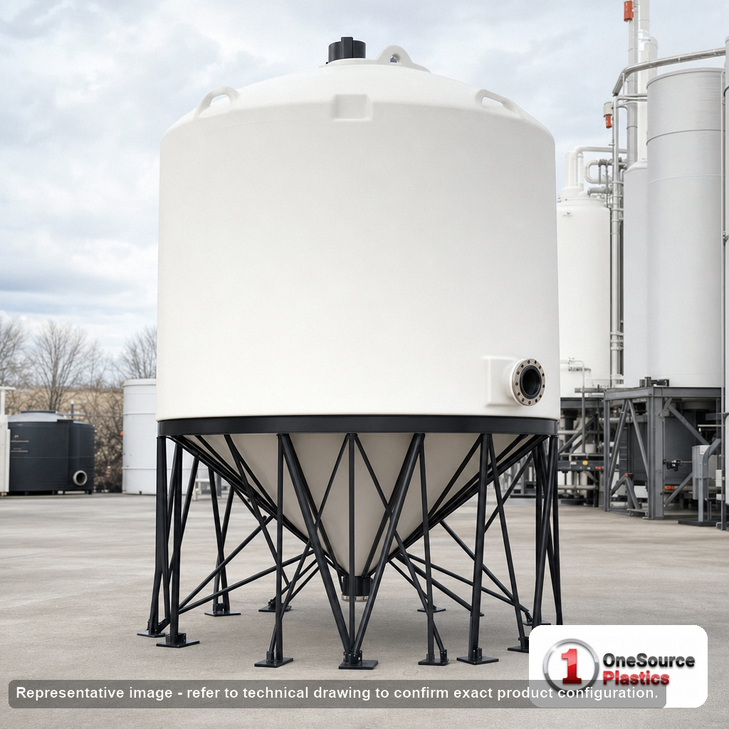
The Snyder 5340100N42 is an 11,500 gallon cone bottom tank in natural white, listed 142 inches long, 142 inches wide and 215 inches tall, with the diameter given as 142 inches, at 3,600 pounds empty and 3,600 pounds shipping. The material field reads Crosslinked Linear Polyethylene. Heavy duty is Snyder's own name word for this listing, and the sheet backs it with figures rather than adjectives: the wall is rated at a specific gravity of 1.9, and the max contents figure is 182,229 pounds against 95,910 pounds of water at 8.34 pounds per gallon. The opening on top is an 18 inch threaded vented manway. The cone is published at 30 degrees. The outlet field reads a bare 13, which is the field value and not a pipe size, so no bore, thread, bulkhead or valve is published and none is claimed here. The sheet notes ladder lugs and 2 flange lines. The service limit is 100 F / 37 C and the freight class is 300 with LTL as the ship mode. It publishes no inlet, no warranty term, no NMFC number and no stand, and none of those is asserted on this page.
Is this the right 11500 gallon tank? Call 866-418-1777 with the liquid, the site and the ceiling height, or get freight to your ZIP and add it to your cart above.
Lincoln to your gate with seventeen and a half feet of shell on the trailer
Begin with the haul, because on a tank this size getting it to the pad is a project rather than a line on an order. It is moulded at Lincoln, Nebraska, and Nebraska is the origin state on the sheet, which puts the plains and the Midwest on the short lane and both coasts on a long one. The shell is 215 inches tall, a shade under eighteen feet, on a circle of 142 inches, getting on for twelve feet across. It travels lying down at 3,600 pounds in a shipment listed at its own 142 by 142 by 215 inches. Read those three figures together and the practical questions write themselves. Can the truck reach the spot. Is there a gate, an overhead line, a canopy or a tree on the last hundred yards. Is there a clear circle of firm ground big enough to stand a twelve foot diameter vessel up in, rather than a corner it has to be turned in. Who is doing the standing, with what machine, and on what day. This sheet publishes no crane, no rigging, no permit and no escort detail, so none is stated here, and that is exactly why the arrangements are agreed with us in advance rather than discovered on the morning. Then the ground it lands on, which is the part that gets under-built on every cone bottom purchase. This vessel has no flat floor. It cannot stand on its own bottom and it never could, and this sheet publishes no stand, no legs, no skirt, no support ring and no bolt pattern. The stand is a separate item with its own drawing, its own lead time and its own price, and it is set, levelled and anchored before the tank arrives, not after. We will not print a height, a rated load or a material for a structure the record does not carry. What the record does give you is the loads that structure has to take: 3,600 pounds of empty tank, 95,910 pounds of water and 182,229 pounds at the rating, arriving through a handful of stand feet inside a 142 inch circle rather than spreading across a slab. Ninety-one tons at the rating is engineered ground with a designed bearing area at each foot, and nothing less. Headroom is the other constraint and it is brutal at this height: the stand, plus 215 inches of shell, plus the clearance a person needs above an 18 inch manway, plus the room the cone needs to discharge into below. Almost nothing indoors takes that, which is why tanks this size usually live outside. Work the support out with the cone bottom tank stand compatibility matrix, settle the volume with the tank sizing calculator, and take the freeboard discipline from the tank sizing guide.
A hundred and forty-two inch circle, three weights, two ratings
| Part | Gallons | Length x width x height | Empty weight |
|---|---|---|---|
| 5340100N42 (this tank, heavy duty, rated 1.9, natural white) | 11500 | 142 x 142 x 215 in | 3600 lb |
| 5340100N48 (heavy duty listing, same weight) | 11500 | 142 x 142 x 215 in | 3600 lb |
| 5340100N40 (lighter listing on the same shell) | 11500 | 142 x 142 x 215 in | 2850 lb |
| 5340100N46 (lighter listing on the same shell) | 11500 | 142 x 142 x 215 in | 2850 lb |
| SII-5320100N43 (same circle, far shorter shell) | 7400 | 142 x 142 x 160 in | 1600 lb |
| 7490100N49 (same circle, taller again) | 13000 | 142 x 142 x 238 in | 3250 lb |
One circle runs through the entire table, which makes this an unusually clean comparison: 142 inches across on every row, so nothing here changes your footprint, your pad outline or your aisle. Four rows are the same 11,500 gallon shell at 215 inches, separated by empty weight and by the name the sheet prints on each: 3,600 pounds on the two heavy duty listings and 2,850 pounds on the two lighter ones. What you can act on is the rating. This listing is rated at a specific gravity of 1.9 with 182,229 pounds of max contents, and that is what covers a product denser than water. The lighter listings carry their own ratings on their own pages. Nothing on any of these sheets describes a wall thickness, a layer count or a construction difference, so this page describes none, and a catalogue that tells you otherwise is guessing. If your product is no heavier than water, a lighter listing is the more honest buy and the saving is real. The two outer rows are the volume question rather than the rating question, and because the circle never changes they are purely a height decision. SII-5320100N43 holds 7,400 gallons at 160 inches, giving back nearly five feet of height for a batch a third smaller. 7490100N49 holds 13,000 gallons at 238 inches, almost twenty feet, for the site with room to go up. That ladder of heights on one footprint is the most useful thing about this family, because you can move up and down it without redrawing the pad, the bund or the access road. Where the material question is the real one behind the choice, the article on when crosslinking matters for a chemistry duty settles it better than any table can.
Comparing across brands too? Call 866-418-1777; we carry Norwesco, Snyder, Chem-Tainer, Enduraplas and Bushman and will say which one fits, or price the freight first.
The fill opening first: an eighteen inch threaded vented manway
- The fill opening: an 18 inch threaded vented manway, sitting at 215 inches plus the height of the stand. That is roughly eighteen feet of shell before the structure is added, so a platform, a fixed ladder and a fall protection plan belong in the same drawing as the foundation. Bring the fill to a coupling at working level rather than asking anybody to carry a line up there.
- The vent: it arrives with the manway on this sheet rather than as a separately specified item. On a tank being drawn down by pump the air path is what protects the wall, so keep it clear, inspect it whenever the tank is opened, and never blank, tape, paint or wrap it to control a smell.
- The outlet field: it reads a bare 13 on this sheet. That is the field value and it is not a pipe size, so we print it as it reads and assert nothing further: no bore, no thread, no bulkhead and no valve is published or claimed. Tell us the line size you need to land, the valve type and the product, and we will confirm what this part number carries before anything is ordered.
- The cone: published at 30 degrees, the middle of the common angles. That keeps a free-flowing liquid moving toward one point and will hold onto material that packs or consolidates. If your product settles hard, say so when you enquire and let us talk about geometry rather than capacity.
- Below the cone: the valve, any reducer and the first run of pipe belong on their own steelwork off the stand and never on the tank, with a flexible connector at the first joint so pump vibration stays out of the wall. With 182,229 pounds of rated contents above it, the low point of a full column is the wrong place for dead weight.
- Ratings and blanks: a specific gravity rating of 1.9, 95,910 pounds of water at 11,500 gallons, 182,229 pounds of max contents and a service limit of 100 F / 37 C. The sheet notes ladder lugs and 2 flange lines, and publishes no inlet, no warranty term and no NMFC number.
On a column this deep the level instrument is the only honest picture of what is in the top of it, and retrofitting the wrong one costs more than choosing well did: the level gauge selection guide for chemical service compares radar, ultrasonic, hydrostatic and magnetostrictive on their failure modes rather than their brochures.
Heavy product at bulk volume, drained to a point
A 1.9 rated cone at 11,500 gallons is bulk storage bought by operations that hold something heavier than water and still need the vessel emptied properly rather than merely emptied. Concentrated mineral and salt solutions at a process plant. Heavy liquid fertiliser and crop input blends at an agricultural retailer or a terminal. Thickened sludge and dewatering feed at a treatment works. Spent liquor and pickling solution in a metals plant. Mineral and wash plant slurry. Bulk intermediates that carry solids in suspension and cannot afford to leave a heel behind at the changeover. The cone is what makes every one of those work, because nothing settles into a corner the vessel cannot reach, and at this volume a residual layer stops being a nuisance and becomes a disposal cost and a contamination risk in the next batch. One caution belongs with the shape rather than the tank: a column just under eighteen feet tall stratifies more readily than a wide shallow vessel, so if your product separates, the draw point and the mixing arrangement matter more here than the capacity does. Plan them together rather than one after the other. A second caution belongs with the rating: 1.9 is a wall rating on this sheet and nothing more. It says nothing about how a particular liquid behaves against polyethylene, and we will not pretend otherwise from a product page. Name the liquid, the concentration and the temperature it genuinely sits at through the year, check it in our chemical compatibility reference first, and let the chemistry decide the gasket and the valve rather than the tank. What sits under the vessel after a release is its own question, and the Captor containment comparison is the honest place to start it.
Liquids this resin is rated to store
These entries are the manufacturer's ratings for this resin, each with the concentration limit and the fitting and gasket to specify. Your concentration and temperature are confirmed on the chemical page or in the chemical compatibility database before ordering.
- Acetic Acid (60%, PP/PVC fittings, EPDM gaskets)
- Aluminum Sulfate (50%, PVC, EPDM)
- Calcium Chloride (40%, PVC, EPDM)
- DEF (32.5%, 316SS fittings, EPDM)
- Ethylene Glycol (100%, PVC, EPDM)
- Ferric Chloride (50%, PVC, EPDM)
- Ferric Sulfate (60%, PVC, EPDM)
- Ferrous Sulfate (20%, PVC, EPDM)
- Hydrofluosilicic Acid (26%, PP/PVC fittings, Viton gaskets)
- Magnesium Chloride (30%, PVC, EPDM)
- Polyaluminum Chloride (PVC, EPDM)
- Potassium Carbonate (50%, PVC, EPDM)
- Potassium Hydroxide (saturated, PVC, EPDM)
- Propylene Glycol (PP/316SS fittings, EPDM)
- Sodium Carbonate (30%, PVC, EPDM)
- Sodium Thiosulfate (40%, PVC, EPDM)
- Urea Solution (50%, PP/PVC fittings, EPDM), and Ozonated Water (up to 10 PPM, PVC, EPDM). Note the material exceptions: most services pair with PVC fitti
Three thousand six hundred pounds and nothing published about the lift
Lincoln, Nebraska is the plant and Nebraska is the origin state on the sheet. The freight class reads 300, a numeric class rather than a mode, the ship mode reads LTL, and no NMFC number is published. The shipping size is listed at 142 inches by 142 inches by 215 inches at 3,600 pounds, which is the tank's own listed size: an oversize load by volume long before it is heavy, and that is the shape that surprises people when the quote arrives. Price the lane to your ZIP with the freight cost estimator; the listed price is before freight. It travels lying down and somebody stands it up at your end, and on a shell nearly eighteen feet tall that is a planned operation with a nominated machine and a nominated person, not something worked out on the morning. This sheet publishes no crane, no rigging, no permit and no escort detail and none is stated here; agree the offload arrangement and the delivery window with us before the truck is booked. Have the stand set, levelled and anchored first, because there is nowhere sensible to park a cone bottom tank this size while a foundation is finished. Sling under the body, never by the manway, and keep the vessel restrained from the moment it is upright, because twelve feet of empty shell takes wind at a speed that catches experienced crews out. Then prove the whole installation with clean water rather than product: hold the 95,910 pound load, walk the manway seal, the cone joint, the stand feet and the pad edge with a torch, and leave it standing full overnight before anything is connected. Chalk the full-water line on the outside after that first fill; it is the level every later reading gets checked against. Write the fill date on the manway with a paint marker; it answers the first question anyone asks about a tank.
Freight and documents
Ships from: Lincoln, NE. LTL freight is quoted to your ZIP with the freight cost estimator or by phone at 866-418-1777. The listed price is before freight.
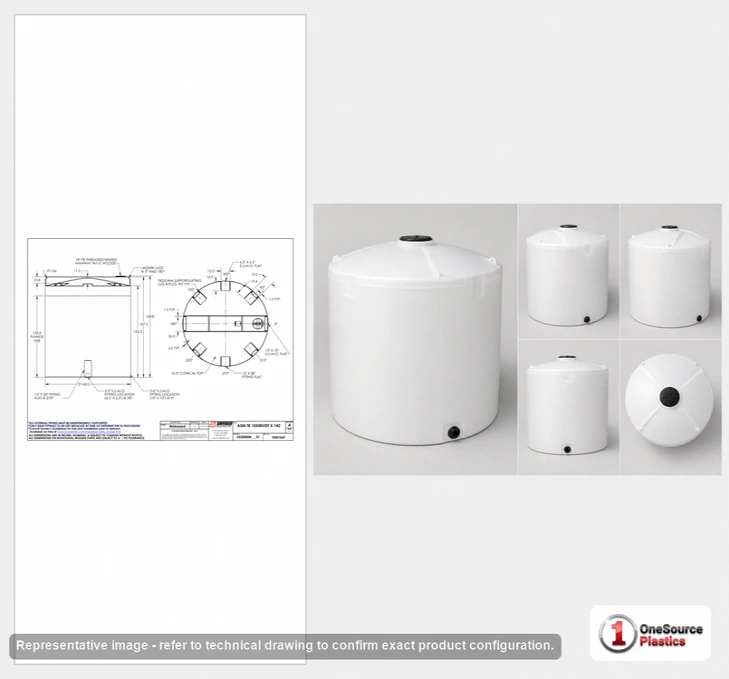
Technical drawing (PDF) for Snyder Industries 5340100N42.
See this tank
Interactive 3D model with live fill. This tank has an interactive 3D model built to its manufacturer dimensions. Rotate it, and set a fill level to see how much liquid it holds at any height. Open the 3D view on the product photo above. Download the 3D model (GLB).
Ready to order?
Add it to your cart at the top of this page, get LTL freight to your ZIP, request a written quote, or call 866-418-1777. The listed price is before freight.