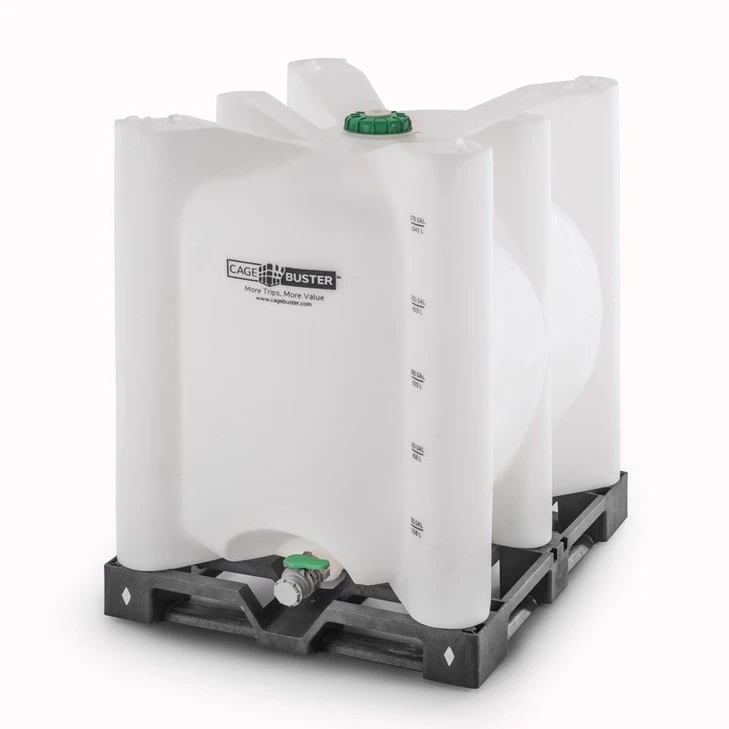
A hundred and twenty over eighty over eighty, stacked to seven and a half feet
The Snyder SII-1035400N95401 is a cubetainer gravity feed system with brass inserts, named on the sheet as 120/80/80 Gallon, moulded in white polyethylene and listed at 36 inches long, 36 inches wide and 91.5 inches tall, at 274 pounds. Three figures for capacity appear on this sheet and we print all three rather than choosing one: the name gives 120/80/80, the capacity field reads 80 gallons, and the capacity text reads 280 Gallons. The tanks share one 36 inch square plan and stack to 91.5 inches, which is a little over seven and a half feet in a footprint a yard square. The only opening figure on the sheet is 8 inches, and the inlet field is the bare number 2, which we print as the sheet lists it and not as a pipe size. Brass inserts are part of the maker's own name for the system; the sheet describes no pump, no valve, no manifold and no pipework, so none is described here. There is no specific gravity rating, no maximum temperature, no warranty and no outlet on this sheet. Freight is LTL under NMFC 156600-03, out of St. Bonifacius, Minnesota.
Want a second opinion on the size? Call 866-418-1777 with the daily draw and the delivery interval, or price freight to your ZIP and add it to your cart above.
St. Bonifacius to your dock, and what comes off the truck
This system is moulded at St. Bonifacius, Minnesota, which is an upper Midwest lane: short into the northern plains and the Great Lakes, longer and planned to the South and either coast. That matters more than usual on this item because of what it is. This is not one tank, it is a stacked arrangement listed at 274 pounds and 91.5 inches tall, and the difference between a tank you roll off a tailgate and an assembly that stands over seven feet is the whole receiving plan. Book a forklift or a pallet truck, take it under the base, and keep it upright; 36 inches of plan carrying seven and a half feet of height is a tall, narrow object on a smooth warehouse floor and it does not want to be walked across a rutted yard. Where it lands is the second question and the more permanent one. Gravity feed means height is the working principle, so this stack goes somewhere it can stay: against a wall, in a corner, beside the bench it serves, with the outlet at the level the receiving vessel needs. Set it on a flat, continuous, level surface bearing the whole 36 inch square base, and think about the load properly. The sheet gives 667 pounds for 80 gallons of water at 8.34 pounds per gallon, which is the figure for the capacity field, and the filled system as a whole is heavier again across the tanks the name describes. All of that is carried on a small square of floor at a height that puts the centre of gravity well above it, so level really does matter here and a slab that slopes for drainage is not level. On a new pour or an outdoor pad rather than an existing plant floor, the concrete pad sizing guide for above-ground polyethylene tanks gives the framework and says where it stops. Then check the ceiling. Ninety-one and a half inches is under a standard commercial ceiling with room to work above it, and it is not under every garage door, mezzanine or basement header, so measure to the lowest obstruction on the route as well as at the destination. Size the volume against what you actually draw in a week with the tank sizing calculator and take the freeboard discipline from the tank sizing guide. Where the duty is standing water held against an emergency, the fire-water reservoir design guide covers the sizing discipline and the freeze protection engineering that comes with cold climate service, and where it is captured or recycled water feeding a process, the industrial water reuse tank topology guide sets out how banded storage trains are put together.
The stack, and the two tanks it is built from
| Part | Capacity as the sheet gives it | Length x width x height | Weight |
|---|---|---|---|
| SII-1035400N95401 (this system, named 120/80/80) | 80 in the capacity field, 280 in the capacity text | 36 x 36 x 91.5 in | 274 lb |
| SII-1032200N95401 (single tank, brass dispense fitting) | 120 gallons | 36 x 36 x 30.5 in | 63 lb |
| SII-1032100N95401 (single tank, brass dispense fitting) | 80 gallons | 36 x 36 x 21.75 in | 50 lb |
The table explains the name. All three share one 36 inch square plan, and the two single tanks are the pieces the system's name counts off: a 120 gallon cubetainer 30.5 inches tall at 63 pounds, and an 80 gallon cubetainer 21.75 inches tall at 50 pounds. Stack them the way the name reads and you get the 91.5 inch assembly on this sheet. That is the useful thing to take away, because it tells you exactly how to think about buying. If you need one vessel at working height with a dispense fitting, buy the single tank in the size that fits your bench and your consumption. If you need more volume on the same square of floor, the answer is height, and that is what this system is. The single tanks are also how a stack gets extended or repaired later, which is a real advantage of a modular product over a single large moulding: a damaged unit is replaced rather than the whole installation. What the sheet will not tell you is how the tanks interconnect, because it publishes no manifold, no pipework and no valve arrangement. Ask us before you plan the plumbing rather than after, and tell us the liquid at the same time. One more practical note on the difference between these rows: the single tanks are 63 and 50 pounds, which one person handles; the assembly is 274 pounds, which one person does not. Plan the handling for the item you are actually buying.
Not sure which one? Tell us the liquid, the site and the ceiling height at 866-418-1777, or request a written quote with freight to your ZIP.
An eight inch opening on top and an inlet field that gives a bare number
- The fill opening: 8 inches is the only opening figure on this sheet, given as both the lid and the manway. Eight inches takes a fill hose, a jug, a funnel and a lance for rinsing; it does not take a person, so decide how the tanks get inspected and cleaned before you decide what goes in them. On a stacked system the top opening is also the highest point of the installation, so plan how somebody reaches it safely at a shade over seven and a half feet.
- The inlet field: the sheet lists the inlet as 2, with no unit attached. We print that exactly as given and claim no pipe size, no thread and no fitting from it. Confirm it against the part before any pipework is cut.
- The brass inserts: the maker's name for this system includes brass inserts and the two single tanks are named with a brass dispense fitting. Those are the words on the sheet and they are all we will assert. Tell us the liquid before you order, because a metal insert in contact with the contents is a compatibility question and not a detail.
- Outlet and valve: no outlet size, no valve and no bulkhead is published, so none is claimed. On a gravity system the discharge height and the line size are what set the flow you actually get, so settle both at order time against the vessel you are filling.
- Air path and level: no vent, no gauge, no sight arrangement and no graduation appears on this sheet. A tank being drawn down needs air in, and a stacked tank nobody can see into needs a way to read the level; both belong in the installation plan.
- Limits: this sheet publishes no specific gravity rating, no maximum operating temperature and no warranty term, so this page states none. The published figures are the dimensions, the weight, the openings and the freight data.
Name the liquid when you order. On a system with metal in the flow path and a modest opening at the top, the contents decide the fittings, the seal material and whether this is the right shape at all.
Gravity feed where there is no pump and no power
A stacked cubetainer arrangement is bought where head, not pressure, is the supply: dispensing a liquid into jugs, pails and sprayers at a service counter, feeding a mixing bench or a wash station by hand, holding process and rinse water beside equipment, supplying a drip or trickle feed to a bench in a nursery or greenhouse, and stocking a shop, a yard, a workshop or a remote building that has floor space but no compressed air, no pump and sometimes no power. The virtue of gravity is that it has nothing to fail: no motor, no seal, no priming, no starting current, and nothing that stops working when the site does. The cost is that flow depends on how full the tank is and how far it falls, so the last few gallons come out slower than the first few, and the height you gave up at installation is the flow you gave up for the life of the system. That is the trade worth thinking about before the stack is positioned. Set the outlet higher than you think you need and the arrangement will still be working the way you expected a year later.
Minnesota, two hundred and seventy-four pounds, one shipment
This system is moulded at St. Bonifacius, Minnesota. The freight class is LTL under NMFC 156600-03, and the ship dimensions on the sheet are given as 92 by 36 by 36 inches, which is the shipped envelope laid down rather than the 91.5 inch standing height. Price the lane to your ZIP with the freight cost estimator; the listed price is before freight. At 274 pounds this is a machine handled item: forklift or pallet truck, under the base, and never a sling round the body of a tank. Check the shipment against the packing list before the driver leaves, because a system assembled from several pieces plus inserts is exactly the delivery where a small item goes missing and is not noticed for a fortnight. Stand it in its final position on level support before anything else is done, and confirm it is stable and restrained at its full height before a drop of liquid goes in. Then fill it with clean water, hold that load, and look at every joint between the tanks as well as at the tanks themselves; on a stacked arrangement it is the interfaces that talk first. Draw the water off through the working outlet at the end of the test and watch the flow fall away as the level drops, because that is the behaviour you have bought and it is better learned with clean water than with product. Keep the packing list with the site file; on a modular system it is the only record of what was actually delivered. Chalk the full-water line on the outside after the first fill; it is the level every later reading gets checked against.
Freight and documents
Ships from: St. Bonifacius, MN. LTL freight is quoted to your ZIP with the freight cost estimator or by phone at 866-418-1777. The listed price is before freight.
Technical drawing (PDF) for Snyder Industries 1035400N95401.
See this tank
Product video. Watch the Snyder Industries 120/80/80 Gallon Cubetainer Gravity Feed System Tanks with Brass Inserts video (60 seconds) with dimensions, fittings and shipping notes.
Ready to order?
Add it to your cart at the top of this page, get LTL freight to your ZIP, request a written quote, or call 866-418-1777. The listed price is before freight.