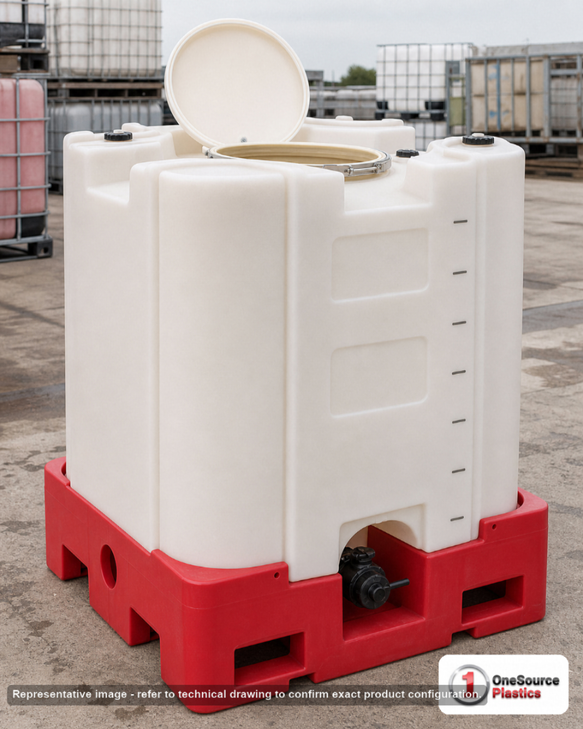
330 gallons in a stackable tote 47 inches square and just over 52 inches tall
The Snyder SII-6510101B96002 is the Excalibur stackable IBC tote: 330 gallons of high density polyethylene in a white body 47 inches by 47 inches on the base and 52.125 inches tall, listed at 194 pounds empty and 194 pounds to ship, molded at Lincoln, Nebraska. It is the lightest and the lowest tote on this sheet. Snyder rates it at a specific gravity of 1.35, which is where the 3,853 pound maximum contents figure comes from against 2,752 pounds for 330 gallons of water at 8.34 pounds per gallon. Access is a 6 inch threaded vented lid. The service limit is 105 F / 41 C. Freight is class LTL on NMFC 156600-03. The sheet publishes no warranty term for this tote, so this page states none; ask us and we will get Snyder's current terms in writing.
Ordering for a plant or a bid? Request a written quote with freight to your ZIP for the file; a single 330 gallon tank goes straight to the cart above.
The lightest 330 on this sheet, and the only one rated at 1.35
The family is the argument here, so take the family first. Five totes sit on this sheet and three of them hold 330 gallons. This one does it in the shortest body of the three, 52.125 inches tall, and at 194 pounds empty it is lighter than the 267 pound and 268.4 pound stackable totes beside it and far lighter than the 335 pound Ultratainer. Two of those numbers matter every working day. The height is what decides whether a tote fits under a fill point, through a roller door, inside a box truck with the door still closing, onto the lower deck of a rack, or under the header of a mix station; on a tote, four inches of height is the difference between a spot that works and a spot that does not. The weight is what the forklift, the pallet jack and the freight bill all see, and 194 pounds empty is the lowest tare on the sheet, which means more of every pound you pay to move is product. What you give up for it is on the same sheet and stated plainly: this tote is rated at a specific gravity of 1.35, and the red stackable tote beside it carries a higher rating that its own sheet publishes rather than this one, so we do not print that figure here. If your liquid is heavier than this rating covers, that is the tote to ask about, not this one. Everything else about placement is about the floor. A tote full of water is 2,752 pounds sitting on a 47 inch square footprint, so the surface under it is flat, level and continuous, whether that is a warehouse slab, a mezzanine deck rated for it, or a truck bed. Before you settle on 330 gallons at all, run your real turnover against the alternatives: the packaging decision between a drum, a tote and a bulk tank is worked through in the container versus tank guide and costed out properly in the drum versus tote versus bulk tank break-even analysis. Check the volume against your draw in the tank sizing calculator, and take the working reserve and headspace from the tank sizing guide.
Five totes on one sheet, and two of them are not plastic
| Part | Gallons | Length x width x height | Empty weight |
|---|---|---|---|
| SII-6510101B96002 (this tote, lowest and lightest) | 330 | 47 x 47 x 52.125 in | 194 lb |
| SII-6610056B97204 (stackable, red in the name) | 330 | 45 x 45 x 63.5 in | 267 lb |
| SII-6610056B97206 (stackable, lower of that pair) | 330 | 46 x 45 x 61 in | 268.4 lb |
| 6840000B97202 (Ultratainer, tallest here) | 330 | 46 x 46 x 70 in | 335 lb |
| 6984000B51303 (Supertainer, 304 stainless steel) | 300 | 42 x 48 x 41.25 in | 424 lb |
| 6984300B32224 (Supertainer, carbon steel) | 350 | 42 x 48 x 47.25 in | 469 lb |
Two rows in that table are a different kind of product and it would be dishonest to blur them. The 300 gallon 6984000B51303 is a 304 stainless steel Supertainer and the 350 gallon 6984300B32224 is a carbon steel Supertainer. They are steel, not polyethylene, they carry no resin and no specific gravity rating on this sheet, and they are bought for reasons this tote cannot answer: a liquid a polymer wall is wrong for, a cleaning regime a plastic body will not survive, a service life measured in decades of return trips. They are also the heaviest tares here at 424 and 469 pounds, on the widest and lowest footprints, 42 by 48 inches. Among the four polyethylene totes the decision is height against tare. This one is the lowest and lightest. The two stackable totes at 45 by 45 by 63.5 inches and 46 by 45 by 61 inches are within a pound and a half of each other in tare and two and a half inches of each other in height, which is a distinction that only matters if your rack or your doorway sits between them. The Ultratainer is the tallest at 70 inches and the heaviest polyethylene body at 335 pounds. Measure the space, weigh what you are willing to haul empty, and check the rating against the liquid, in that order. Where the liquid is one that has to be held over secondary containment as a matter of rule rather than preference, the inspection and leak detection obligations are set out in the RCRA secondary containment guide, and the difference between a contained tank and a tote in a tray is laid out in the Captor Plus containment comparison.
Need the taller or the wider one? Every row links to its page with freight to your ZIP on each; 866-418-1777 will check the ceiling and the pad.
A vented six inch lid on top, and two fitting numbers the sheet gives bare
- The vent is the fitting to understand first, because on a tote it is the one that gets ignored. The sheet gives a 6 inch threaded vented lid, and that vent is the breathing path: a tote being drawn down through a valve has to pull air in at the same rate, and a tote being filled has to push it out. A blocked vent collapses a plastic body inward faster than anyone expects, and a tote is thinner-walled than a bulk tank. Keep it clear and check it every time the lid is opened.
- The lid itself: 6 inches is enough for a fill hose, a light and a look, and it is the opening every clean-out and every level check goes through. Keep it closed between fills, keep the gasket clean, and keep a spare gasket, because on a tote that is opened weekly the gasket is the part that wears out first.
- The outlet as the sheet lists it: the sheet gives the outlet as 2 and gives no unit for it. That figure is printed here and nothing is built on it. It is not a pipe size and we will not present it as one. Tell us what you intend to connect and we will confirm the thread, the valve and the gasket against Snyder's current documentation before you buy pipe or a coupler.
- The inlet as the sheet lists it: the sheet gives the inlet as 2, again with no unit. Same discipline. In practice a tote at this scale is filled through the lid or through a dedicated fill line that we will specify with you, and the honest answer at the counter is a confirmed fitting rather than an assumed one.
- Service limit: 105 F / 41 C as the sheet gives it, which is the lowest limit on any product in this batch and a real constraint, not a formality. It covers the liquid and the tote standing in the sun on a dock in summer.
Everything else about this tote in service is handling. It is described as stackable, so plan the stack deliberately: even bearing, square alignment, the heaviest unit on the bottom, and nothing stacked that is not sitting flat. Fill it where it is going to be drawn from, because 2,752 pounds of water or up to 3,853 pounds of contents at the rating is a forklift job and not a pallet-jack-across-a-rough-floor job. Strap it at the base rather than around the body when it travels. Label the tote with the one product it holds and keep it to that product; a tote that has held three things is a tote nobody trusts. And read the level through the lid rather than inferring it from weight, because on a 47 inch square footprint an inch of depth is a lot of gallons.
Process fluid at tote scale, stacked in a bay
This is the container for a working supply that turns over faster than a drum can keep up with and slower than a bulk tank can justify. The duties it suits: a process fluid feeding a metering pump or a dosing skid on a production line; a food, beverage or personal care plant holding a single ingredient at a station; a plating, cleaning or water treatment chemical drawn down through a valve into pails and hand equipment; a distribution operation breaking bulk into totes for delivery; a laboratory or pilot plant that needs a measured supply rather than a tanker; a maintenance or wash bay keeping detergent, coolant or lubricant at the point of use. The pattern is always the same: the tote sits on a floor or a rack, gets opened at the lid and drawn at the valve, and is moved empty far more often than it is moved full. That is why the two figures that decide this part number are its 52.125 inch height and its 194 pound tare rather than anything about the wall. Two limits, said plainly. The rating on this sheet is a specific gravity of 1.35, and a liquid heavier than that rating covers wants a different tote from the table above. And 105 F / 41 C is the published service limit, which a dark dock in July will reach; keep the tote shaded, fill it cool, or work it down before the afternoon.
Rated chemistries for this tank
The manufacturer lists these liquids for this resin at the concentrations noted, with the fitting and gasket material to specify. Check the concentration and temperature you actually run on the linked page or in the chemical compatibility database before ordering.
- DEF compatibility page and
- urea solution compatibility page and always verify against the OEM chemical-resistance chart at your exact concentration and temperature.
- sulfuric acid
- sodium hypochlorite and
- hydrochloric acid - to confirm fitting and gasket selection at your concentration.For these acid and oxidizer services, the
Nebraska, class LTL, and 194 pounds on a pallet
The tote is molded at Lincoln, Nebraska and the sheet gives its freight class as LTL on NMFC 156600-03, shipping at 47 inches square and 53 inches high at 194 pounds. The freight cost estimator prices the lane to your ZIP, and the listed price is before freight. At this tare and footprint it is a straightforward one-pallet shipment, and that is worth something: the lowest tare on the sheet is also the cheapest thing on the sheet to ship empty, both inbound and on any return trip. Tell us at order whether the delivery address has a dock or a forklift, because a 47 inch pallet at a site with neither is a curbside drop and a tote that then has to be walked inside on a pallet jack over whatever floor is there. Check the body, the lid, the vent and the valve area before the driver leaves, and keep the pallet: it is the handling equipment for the rest of the tote's working life. Then commission it properly before the first product goes in. Fill it with clean water, let it stand where it will live, and look at the base, the lid seating and every fitting face. The one step people skip on a tote rather than on a tank is writing down what it is for on the day it arrives, in paint marker, on the body and on the lid, because a tote outlives the memory of whoever ordered it. A strap that is checked once a season is a strap that holds; put it on the same calendar as the gutters.
Freight and documents
Ships from: Lincoln, NE. LTL freight is quoted to your ZIP with the freight cost estimator or by phone at 866-418-1777. The listed price is before freight.
Technical drawing (PDF) for Snyder Industries 6510101B96002.
See this tank
Product video. Watch the Snyder Industries 330 Gallon HDPE Excalibur Stackable IBC Tote Tank video (71 seconds) with dimensions, fittings and shipping notes.
Ready to order?
Add it to your cart at the top of this page, get LTL freight to your ZIP, request a written quote, or call 866-418-1777. The listed price is before freight.