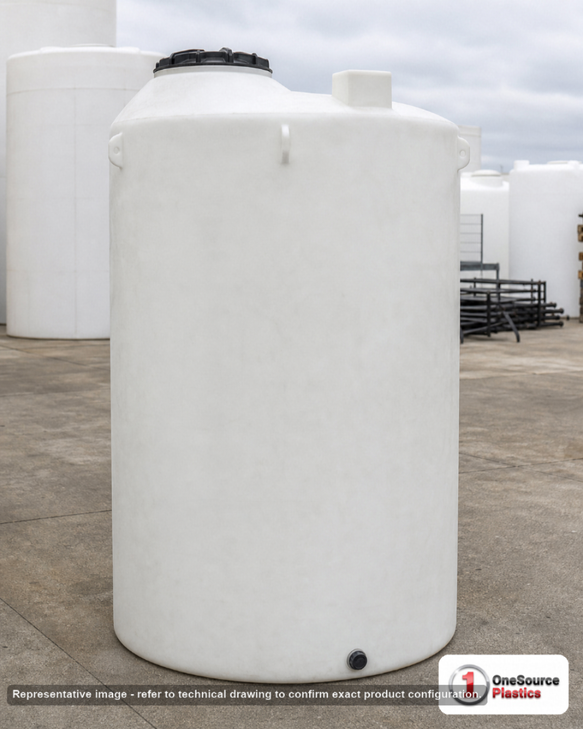
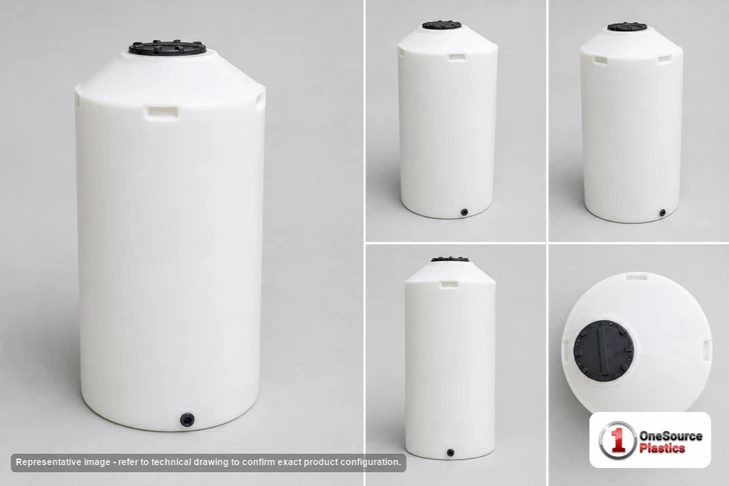
The 1,500 gallon chemical tank that fits where a tall one will not
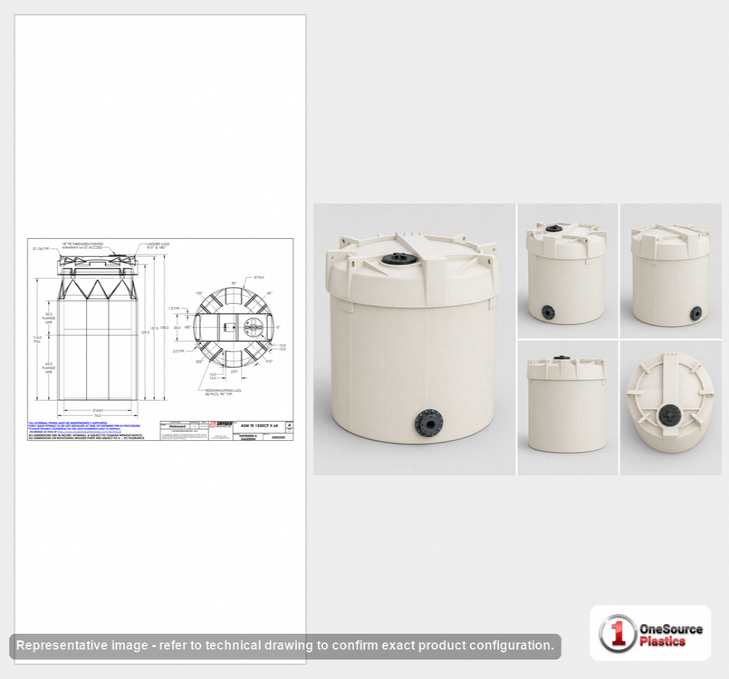
The Snyder 1770000N45 holds 1,500 gallons in a white polyethylene shell 86 inches in diameter and 72 inches tall, weighing 260 pounds, with Snyder's 1.9 specific gravity wall: 23,769 pounds of contents at the rating, against 12,510 pounds for the same volume of water. Six feet of height and seven feet of diameter is the low profile answer to 1,500 gallons of treatment chemical, and the reason to choose it is always the room the tank has to live in.
Two ways to buy. Add it to your cart above with freight quoted to your ZIP, or request a written quote for a job that needs paperwork.
What the 1.9 rating covers
The rating is a weight rating. Specific gravity is the density of the liquid relative to water, and a 1.9 wall is engineered for the hoop stress of a liquid 1.9 times as dense as water filled to the top. Sodium hydroxide at delivered strength, ferric chloride, ferric sulfate, aluminum sulfate, sulfuric acid at most concentrations: all fall under it. What the rating does not tell you is whether the resin resists the chemical, which is a separate property; the chemical compatibility database answers that for the liquid and concentration you actually buy, and the list below is the resin's rated chemistry. The tank sizing calculator sizes the tank to feed rate and delivery interval, and the tank sizing guide covers the reserve to carry between deliveries.
Choosing among Snyder's 1,500 gallon chemical tanks
Snyder covers 1,300 to 1,550 gallons with five shapes, and the table is really a table of ceilings.
| Part | Gallons | Diameter x height | Empty weight |
|---|---|---|---|
| 1770000N45 (this tank) | 1,500 | 86 x 72 in | 260 lb |
| 1770000N42 (XLPE) | 1,500 | 86 x 72 in | 260 lb |
| 1770000C26 | 1,500 | 86 x 72 in | 260 lb |
| 8120100N45 | 1,500 | 86 x 72 in | 270 lb |
| 1840000C26 | 1,550 | 64 x 124 in | 335 lb |
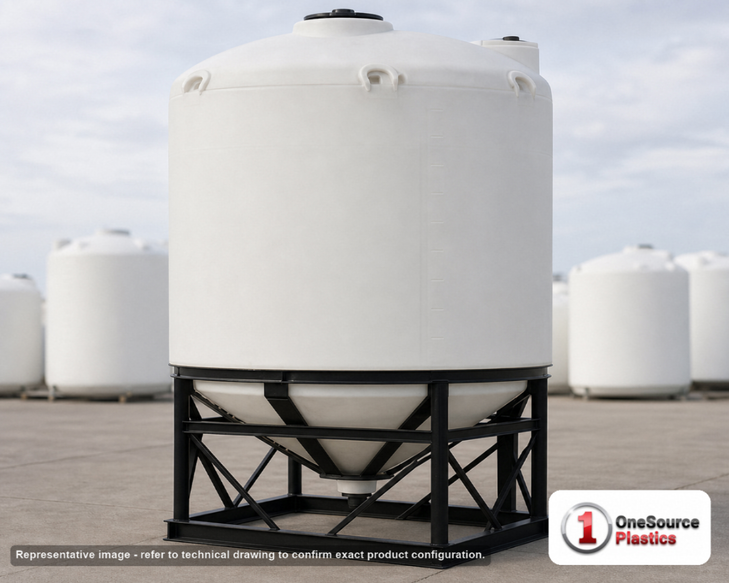
Four of the five rows are the same 86 by 72 inch tank in different resins and molds: the N42 in cross-linked polyethylene for oxidizers and warm liquids, the C26 with a polypropylene bulkhead outlet fitted from the factory, and the 8120100N45 a different mold at 10 pounds more. The 1840000C26 is the tall alternative, 52 inches higher on a base 22 inches narrower, for the room that has height but not floor. The 93 x 60 inch 1,500 gallon buyers guide and the 64 x 116 inch 1,500 gallon buyers guide compare the low and tall shapes across makers.
Not sure which one? Tell us the liquid, the site and the ceiling height at 866-418-1777, or request a written quote with freight to your ZIP.
Openings and what to add
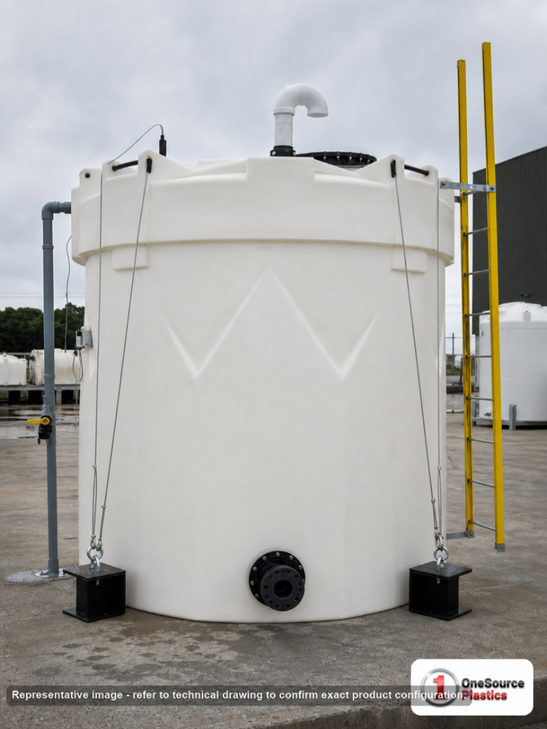
- Outlet: 2 inch, low on the sidewall; pipe it through a flanged transition and an expansion joint, with the valve supported off the tank.
- Access: 18 inch threaded, vented manway; on a 72 inch tank it is reachable from the floor.
- Service limit: 120 F / 48 C.
Pick the level sender for the chemical, not the tank: the level gauge selection guide sorts radar, ultrasonic, hydrostatic and magnetostrictive units by what each one survives, and a 72 inch range is easy for any of them. A wide, low tank keeps the pump suction flooded to the last few inches, which matters for a dosing pump that must not run dry. Bring the fill line in through the manway or a top bulkhead with a dip tube to the floor, so a fast tanker unload does not splash caustic or acid against the lid, and give the vent a line to the outside.
Containment
A 1,500 gallon single wall tank of regulated chemical wants a berm sized to its volume, and a berm around an 86 inch tank is a large one. The Snyder Captor 110 percent containment comparison shows the point at which a double wall tank is the smaller and cheaper footprint once the concrete and the sump are drawn.
Freight for a 1,500 gallon tank
At 86 inches across the 1770000N45 is still LTL freight (NMFC 156600-01), palletized, at a class rate the freight cost estimator shows for your ZIP; the listed price is before freight. Two people and a pallet jack take 260 pounds off a liftgate. Water-fill it to the manway and hold it before the first chemical delivery, and check the outlet fitting after the hold.
Compatibility list
Liquids the maker rates this resin for, with concentration limits and the wetted fitting and gasket to specify. Confirm your own concentration and temperature on the chemical page or in the chemical compatibility database before ordering.
- Acetic Acid (60%) - PP/PVC fittings, EPDM gaskets
- Aluminum Sulfate (50%) - PVC fittings, EPDM gaskets
- Calcium Chloride (40%) - PVC fittings, EPDM gaskets
- DEF (32.5%) - 316SS fittings, EPDM gaskets
- Ethylene Glycol (100%) - PVC fittings, EPDM gaskets
- Ferric Chloride (50%) - PVC fittings, EPDM gaskets
- Ferric Sulfate (60%) - PVC fittings, EPDM gaskets
- Ferrous Sulfate (20%) - PVC fittings, EPDM gaskets
- Hydrochloric Acid (37%) - PVC fittings, Viton gaskets
- Hydrofluoric Acid (48%) - PP/PVC fittings, Viton gaskets
- Hydrofluosilicic Acid (26%) - PP/PVC fittings, Viton gaskets
- Hydrogen Peroxide (50%) - PVC fittings, Viton gaskets
- Magnesium Chloride (30%) - PVC fittings, EPDM gaskets
- Peracetic Acid (30%) - 316SS fittings, Aflas gaskets
- Phosphoric Acid (85%) - PVC fittings, Viton gaskets
- Polyaluminum Chloride - PVC fittings, EPDM gaskets
- Potassium Carbonate (50%) - PVC fittings, EPDM gaskets
- Potassium Hydroxide (saturated) - PVC fittings, EPDM gaskets
- Propylene Glycol - PP/316SS fittings, EPDM gaskets
- Sodium Bisulfate - PVC/PP fittings, EPDM gaskets
- Sodium Bisulfite - PVC/PP fittings, EPDM gaskets
- Sodium Carbonate (30%) - PVC fittings, EPDM gaskets
- Sodium Hypochlorite (under 16.5%) - PVC fittings, Viton gaskets
- Sodium Thiosulfate (40%) - PVC fittings, EPDM gaskets
- Sulfuric Acid (98%) - CPVC fittings, Viton gaskets
- Urea Solution (50%) - PP/PVC fittings, EPDM gaskets
- Zinc Orthophosphate - PP/316SS fittings, EPDM gaskets
Freight and documents
Ships from: Lincoln, NE; Philippi, WV. LTL freight is quoted to your ZIP with the freight cost estimator or by phone at 866-418-1777. The listed price is before freight.
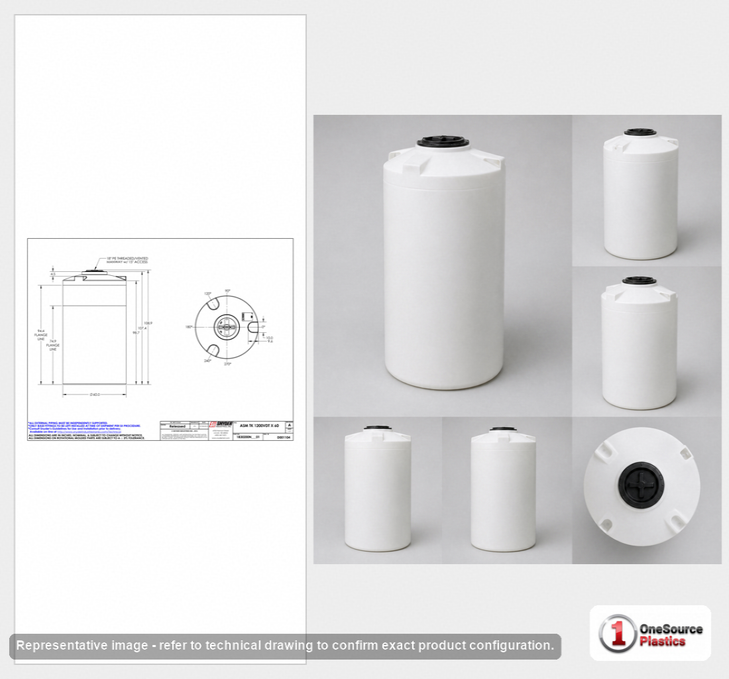
Technical drawing (PDF) for Snyder Industries 1770000N45.
See this tank
Interactive 3D model with live fill. This tank has an interactive 3D model built to its manufacturer dimensions. Rotate it, and set a fill level to see how much liquid it holds at any height. Open the 3D view on the product photo above. Download the 3D model (GLB).
Product video. Watch the Snyder Industries 1500 Gallon HDPE Vertical Chemical Storage Tank in White video (72 seconds) with dimensions, fittings and shipping notes.
Ready to order?
Add it to your cart at the top of this page, get LTL freight to your ZIP, request a written quote, or call 866-418-1777. The listed price is before freight.