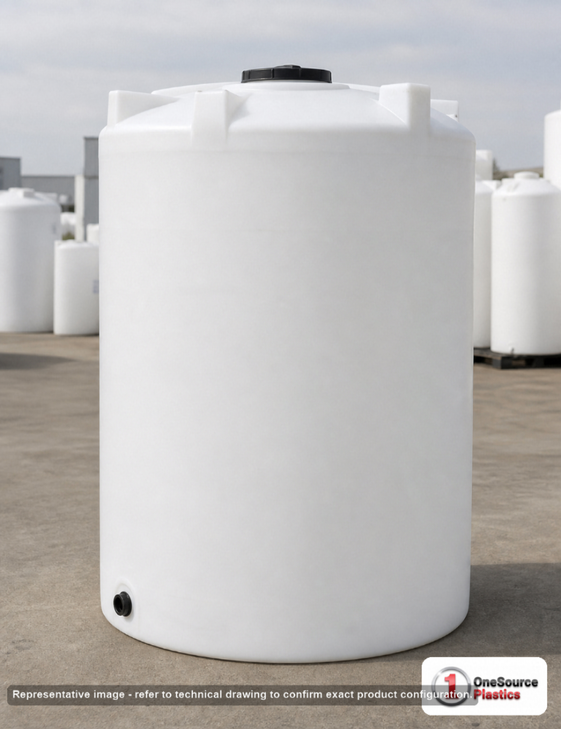
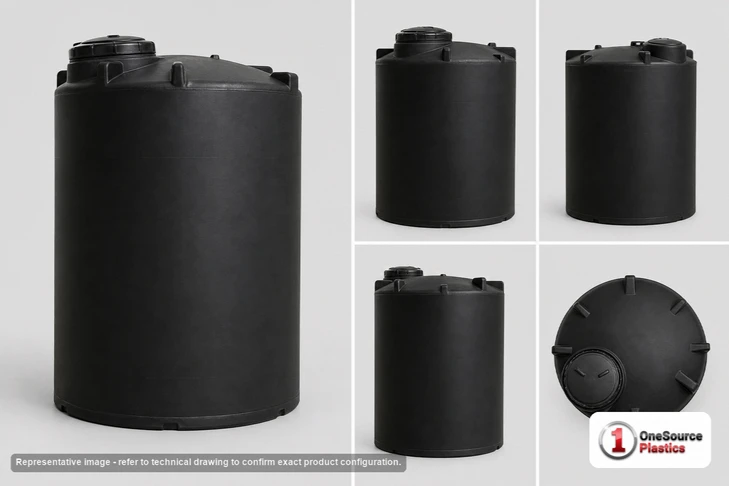
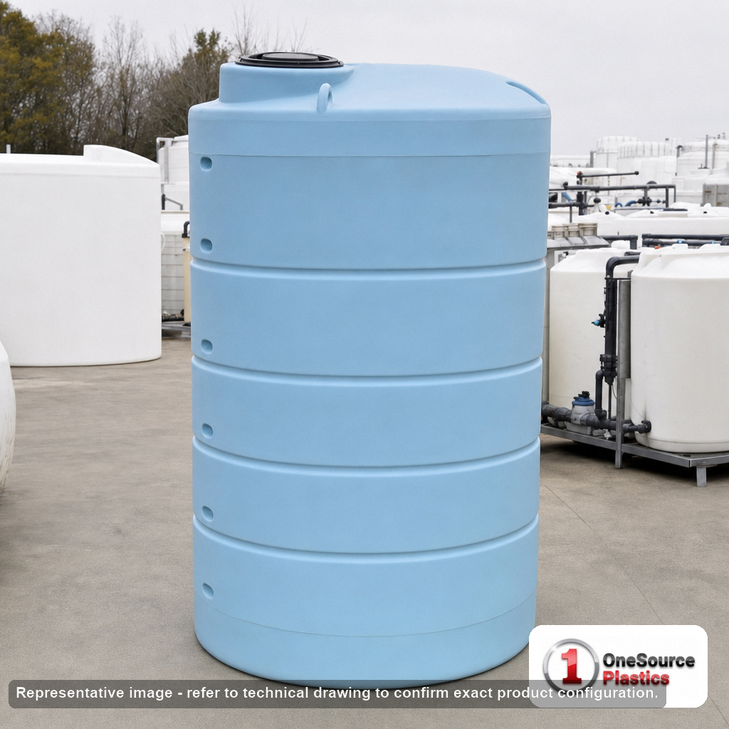
The 305 pound black 1,550 in a shell that also comes at 335
Four tanks share the Snyder 1840000 shell, and the 1840000N49 is the black one rated 1.5 at 305 pounds. It is a polyethylene vertical tank 64 inches across and 124 inches tall, ten feet four inches to the top of its 18 inch threaded, vented manway, holding 1,550 gallons on a circle five feet four inches wide. The sheet rates the wall for a specific gravity of 1.5, which is 19,390 pounds of contents against 12,927 pounds of water. The black resin keeps light off the liquid. A service limit of 120 F / 48 C, a 3 year warranty, and freight at class 300 from Lincoln, Nebraska, Marked Tree, Arkansas or Philippi, West Virginia, whichever plant is nearest the pad.
Ready for the pad? Quote freight to your ZIP, add the 1550 gallon tank to your cart above, and 866-418-1777 will confirm the truck and the unload.
Which of the four 1840000 tanks is this one
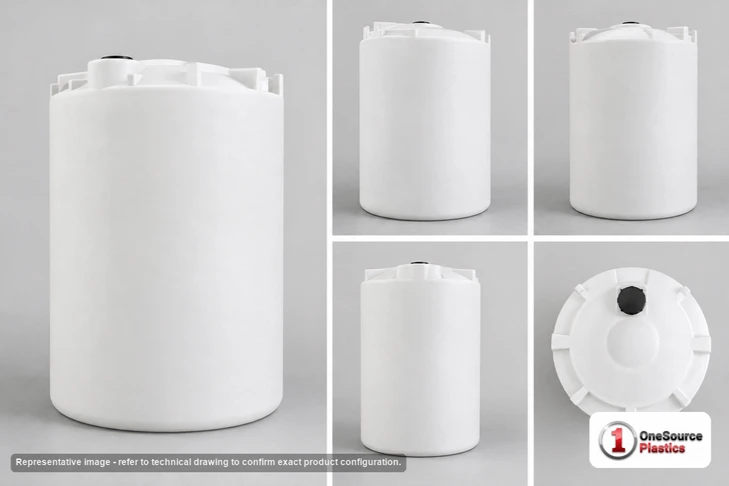
Read the shell by weight and color. The 1840000C26 is the natural white tank at 335 pounds and the 1840000C34 is the black tank at 335; the 1840000N48 is the cross-linked black tank by its name at 305 pounds, rated as its own sheet says; and this N49 is the black tank at 305 pounds rated 1.5. The sheet gives the two weights and does not explain them, so we print what it says. The reason to buy the N49 over the C34 is the rating and the name: a plant that writes the black 1,550 into a specification as the ASTM tank at 1.5 gets this one, and a buyer who wants the heavier black tank without a rating requirement gets the C34. The reason to buy it over the N48 is that the N48 is the cross-linked wall for the heavier duty its own sheet describes; when the liquid is hypochlorite, a fertilizer solution or an everyday process chemical at 1.5 or below, this is the tank. Every one of the four stands ten feet four inches on a five foot four inch circle, so the footprint is the same and the choice is the wall. Full at the rating it puts 19,390 pounds on that circle, and a rotationally molded floor bears on the whole pad, so the slab is engineered per the concrete pad sizing guide, level and in full contact, inside a berm sized to the tank where the liquid is regulated. A tall, narrow tank is a sail when empty, so it is strapped to structure before the first delivery and the straps are checked after the first windy week. Black polyethylene absorbs the ultraviolet that ages a white wall, passes no light to the liquid, runs warmer in the sun than white, and hides the level, so a sender read at the ground is the gauge. Check 1,550 gallons against the draw between deliveries in the tank sizing calculator, and take the reserve and the warm-weather headspace from the tank sizing guide.
Tall 1,550s and the low 1,500 and 1,600 beside them
| Part | Gallons | Diameter x height | Empty weight |
|---|---|---|---|
| 1840000N49 (this tank, black, 1.5 SG) | 1,550 | 64 x 124 in | 305 lb |
| 1840000N48 (black, cross-linked) | 1,550 | 64 x 124 in | 305 lb |
| 1840000C34 (black) | 1,550 | 64 x 124 in | 335 lb |
| 1840000C26 (natural) | 1,550 | 64 x 124 in | 335 lb |
| 1770000C34 (black, low) | 1,500 | 86 x 72 in | 260 lb |
| 32118 (white, low) | 1,600 | 86 x 71 in | 264 lb |
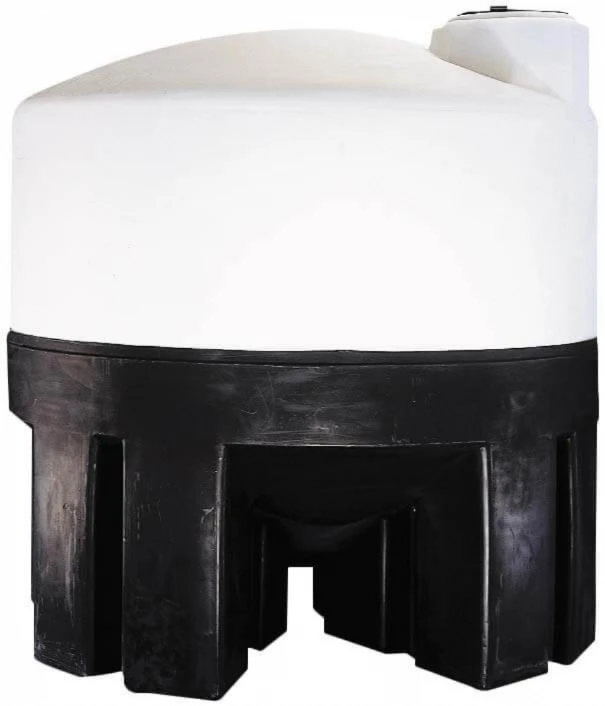
The four tanks in the top rows are one shell in four walls; the weight column is the only visible difference and the rating on each sheet is the real one. The 1770000C34 is the black 1,500 laid down to six feet on a seven foot two inch circle for a roof this tank cannot clear, and the 32118 is the white 1,600 on the same wide base at 71 inches, the tank to compare when the liquid does not mind light and the operator wants to read the level through the wall.
Still deciding between these? Freight to your ZIP often settles it; the wider tanks ship differently. Or call 866-418-1777 and we will walk the table with you.
Ten feet of drop from the fill to the floor
- Vent and fill: the 18 inch manway is threaded and vented, 124 inches up, reached from a platform. Its lid vent breathes a gravity fill and a small transfer pump; a tanker pump pushes liquid in faster than the lid vent lets air out, so on pumped deliveries the vent is sized to the delivery rate before the first load, or the manway is opened for the fill with someone standing at it. Fill down a dip tube to the floor so the liquid does not fall ten feet and beat the headspace wall. Screen the vent and run it outdoors on a liquid that fumes.
- Headspace: stop the fill at the shoulder. The band of wall above the liquid line lives in vapor and is inspected with a light at every opening, because that is where a tank shows trouble first.
- Outlet: the outlet field on the sheet reads 16, and we print it as the sheet gives it. Name the liquid at order and the bulkhead fitting, gasket and bolting are matched to it, with a flexible connector to hard pipe and the first valve supported off the pad, never hung on the wall.
- Service limit: 120 F / 48 C.
Ten feet of liquid above the base is a strong head for a tank this size, so a transfer pump below the outlet runs flooded to the last few inches; mount it there so gravity primes it, and fit a low-level float so it stops before it draws air. A narrow tank on a platform is one people climb and open, so the lid stays on between deliveries, the wall carries the name of the one chemical inside, and the label is renewed when the sun fades it. Where winters freeze, the valve and the first pipe run get trace heat or insulation; the body ices from the top down and takes it.
A tanker's worth of light-sensitive liquid on a small pad
Sodium hypochlorite at a small water or wastewater plant is the classic load for a black 1.5 wall: light degrades it, density does not test the tank, and 1,550 gallons is a delivery a small plant uses before it loses strength. A fertilizer solution at a co-op, a process chemical at a shop that stores in the sun, and the treatment chemical a reuse system doses between its storage stages are the others; the industrial water reuse tank topology article shows where a chemical tank of this size sits in that train. It is a chemical wall, not the tank the fire-water reservoir design guide describes for a fire reserve, though water is well inside its rating.
Nearest of three plants, class 300
The 1840000N49 is molded at Lincoln, Nebraska, Marked Tree, Arkansas and Philippi, West Virginia, and ships from the plant nearest you as freight at class 300 as the sheet lists it; at 64 inches across and 124 inches long on the deck it rides on a flatbed, and the freight cost estimator prices the lane to your ZIP, with the listed price before freight. A forklift with long forks sets 305 pounds on the pad with the forks under the body, never through the manway, and the straps to structure go on the same day, because a tall narrow tank does not stand unstrapped for a week. Fill it with water to the shoulder once and hold it, watching the pad edge and the base fitting for a weep, then drain and dry it before the chemical arrives. Ask the carrier which plant the tank left from and write it on the log; the answer decides which plant a replacement fitting comes from. Write the outlet fitting size and material on the site plan; the replacement is ordered by those two words.
Freight and documents
Ships from: Lincoln, NE; Marked Tree, AR; Philippi, WV. LTL freight is quoted to your ZIP with the freight cost estimator or by phone at 866-418-1777. The listed price is before freight.
Technical drawing (PDF) for Snyder Industries 1840000N49.
See this tank
Interactive 3D model with live fill. This tank has an interactive 3D model built to its manufacturer dimensions. Rotate it, and set a fill level to see how much liquid it holds at any height. Open the 3D view on the product photo above. Download the 3D model (GLB).
Ready to order?
Add it to your cart at the top of this page, get LTL freight to your ZIP, request a written quote, or call 866-418-1777. The listed price is before freight.