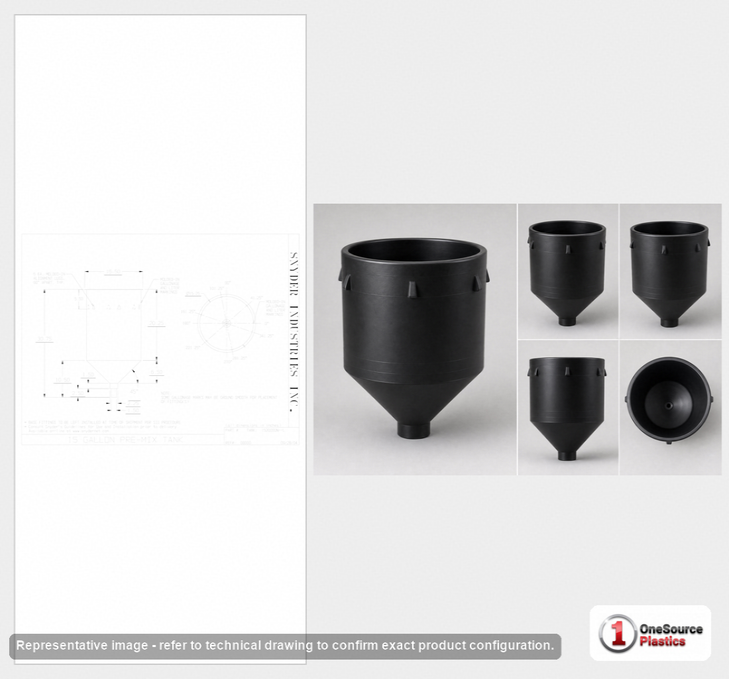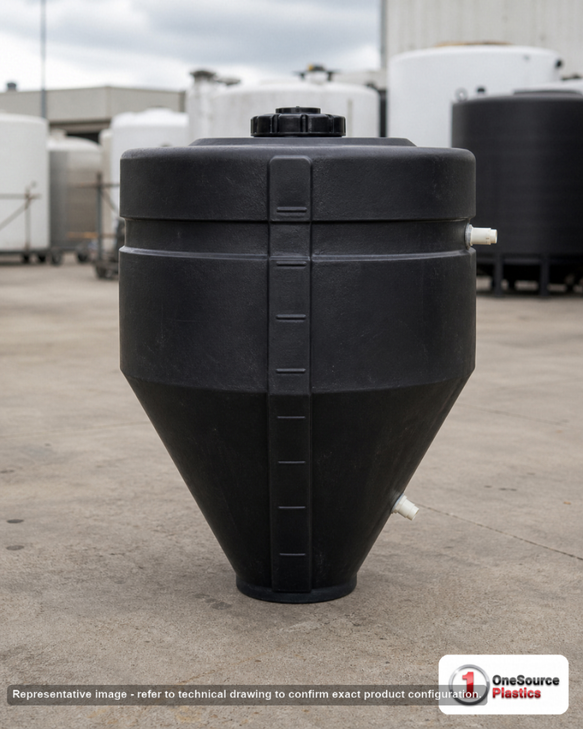
Seventeen gallons in a nineteen inch circle, twenty-four inches tall
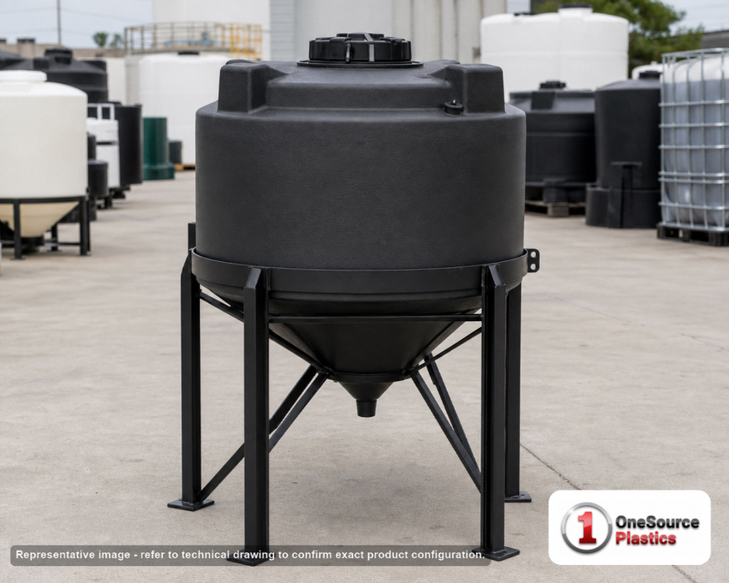
The Snyder 1850000N51 is a 17 gallon heavy duty cone bottom mixing tank in black high density linear polyethylene, listed 19 inches long, 19 inches wide and 24 inches tall at 9 pounds empty and 9 pounds to ship. Heavy duty and mixing are Snyder's own name words and that is as far as this page takes them: the sheet lists no agitator, no motor, no drive and no mount for one, so none is described here. What the sheet does publish is a wall cited at a specific gravity rating of 1.9, 142 pounds for 17 gallons of water at 8.34 pounds per gallon, and 269 pounds of max contents. The outlet field reads 1 Manway / Lid and no lid or manway size is given, so the top opening is the only route in or out on the sheet. The service limit is 100 F / 37 C. There is no cone angle on this sheet and none in the name, so this page states none. There is no warranty term and no stand, leg, frame or cradle of any kind, which matters on a cone and is dealt with below. Freight is class 300 on an LTL mode out of Lincoln, Nebraska.
Ready to price it? The listed price is before freight; quote freight to your ZIP in a few seconds, then add to cart above or call 866-418-1777.
Small batches that have to leave the vessel completely
The duty comes first, because at 17 gallons the duty is the entire specification. Nobody buys a vessel this size to store anything. They buy it to make something up, hold it for hours rather than months, and get all of it out again: a working solution in a plant room, a feed or nutrient batch in a greenhouse, a bath make-up on a finishing line, a sample or pilot batch in a lab or a test cell, a small dosing tank feeding a metering pump. The person doing it is standing next to it, adding by hand or by jug, and the amount is a shift's worth rather than a week's. That is who this tank is for. The cone is the reason to choose this shape over a drum or a flat bottom pail of similar volume, and the reason is simple: 17 gallons in a 19 inch circle is only a few inches deep if the bottom is flat, and the last few inches are where everything you did not want settles, stains, or carries over into the next batch. A cone turns the same volume into a column that keeps moving toward one point, so the batch leaves under its own weight and the vessel is genuinely empty rather than nearly empty. If your process changes product, changes colour, changes concentration or is checked between runs, that difference is the whole game. The price of the cone is that the tank cannot stand on its own bottom. This sheet publishes no stand, no legs, no frame and no cradle, and no height, load or material for one, so the support is a separate item to settle before the tank arrives rather than after. Nothing here invents a part number for it. The general question of how stands and cone tanks get matched is worked through in the cone bottom tank stand compatibility article; ask us and we will confirm what Snyder pairs with this part number. Whatever holds it up also sets the clearance under the discharge, and at this size that clearance is usually the height of a pail or a jug. Measure the container, not the tank. Then check the volume is actually the volume you need with the tank sizing calculator, and take the headspace allowance from the tank sizing guide, because a small vessel filled to the rim is the one that goes over when somebody tips in a bag of solids.
Fifteen, seventeen and thirty gallons across three sheets
| Part | Gallons | Length x width x height | Empty weight |
|---|---|---|---|
| 1850000N51 (this tank, listed black) | 17 | 19 x 19 x 24 in | 9 lb |
| SII-1850000N45 (the white listing, named at sixty degrees) | 17 | 19 x 19 x 24 in | 9 lb |
| 1520000N51 (open top, smaller but taller) | 15 | 17 x 17 x 28 in | 9 lb |
| 32223 (the step up) | 30 | 27 x 27 x 20 in | 20 lb |
Read the height column before the gallon column and the group makes sense immediately. This tank and SII-1850000N45 are the same 17 gallons in the same 19 inch circle at the same 24 inches and the same 9 pounds; the sheets differ in the part number and in the colour, this one being black, and the white listing carries sixty degrees in its own name where this sheet carries no angle at all. We cite each name as its own sheet gives it and read neither onto the other. Where a site already runs one of the two, order the one that matches what is on the floor. 1520000N51 is the interesting neighbour: it holds two gallons less in a narrower 17 inch circle and yet stands 28 inches tall, four inches higher than this tank, at the same 9 pounds, and its own name calls it an open top mixing tank. Less volume, more height, identical weight. The sheet gives all of that and explains none of it, so neither will we; take it as the reminder that volume and height are independent choices in this family. 32223 is the genuine step up at 30 gallons in a 27 inch circle, and note that it is the shortest of the four at 20 inches tall while weighing 20 pounds. The order of decisions that works is height first, footprint second, gallons third. Buy a small cone on volume alone and you end up with a vessel that will not go where you meant it to, or one you cannot reach into, and both faults are permanent once the support is built.
Want us to check the fit? Send the site dimensions to 866-418-1777 or through a written quote request and we will confirm the tank, the pad and the freight.
The top opening is the whole of the published route in and out
- The discharge: this is a cone, so the low point is the point, and everything in the vessel arrives there under gravity. That is the drain path the shape gives you. What the sheet does not give is a fitting for it: the outlet field reads 1 Manway / Lid, and no bulkhead, no valve, no thread and no size is published.
- The top opening: recorded as a manway or lid with no size against it. It is the only published route in or out, so treat it as the fill point, the sampling point and the inspection point at once, and keep it clear of anything that has to be moved to open it.
- Inlet: none published. Fill through the top opening unless we confirm something else with the maker for your part number.
- Service limit: 100 F / 37 C, as the sheet gives it. That is the ceiling on the contents, not a suggestion, and it includes what the sun does to a black tank standing outside on a still afternoon.
- The wall: cited at a specific gravity rating of 1.9, with 142 pounds of water in it at full and 269 pounds of max contents. Weigh your own liquid against those figures rather than assuming, and ask us if the product is near the line.
- Support: no stand, no legs, no frame and no cradle on this sheet, and no load or height for one. A cone cannot stand on its own bottom; settle the support before the tank arrives.
Tell us the liquid and the temperature it actually sits at when you order. The sizing is the easy half of a small cone; the fittings and what holds it up are the half people finish late.
Bench and mix-shed work at working quantities
Seventeen gallons is a shift quantity, and the jobs that suit it share a rhythm: mix it, use it, empty it, rinse it, do it again tomorrow. Greenhouse and nursery feed batches drawn off into a can or a small sprayer. Plating, finishing and parts-washing make-up where the bath is charged from a measured batch. Laboratory and pilot work where a process is being proved at small scale before it goes on the big tank. A dosing or day tank keeping a metering pump flooded with a solution somebody mixes fresh. Agricultural spray make-up at the scale of one implement rather than a nurse tank; where a blend is prone to stratify or salt out, the physics and the field checks that catch it are in the fertilizer blend stratification article. Two practical notes carry across all of them. First, level matters more on a cone than on anything else you own, because a cone that is off true keeps a heel that the operator then finds in the next batch. Second, know the level without opening the lid: on a black tank you cannot see through the wall, and the options are compared in the tank level gauge selection guide. Where the contents need catching if the vessel or a fitting lets go, the containment argument and the way the numbers are worked is set out in the Captor containment comparison. A small tank is not exempt from that question; it is simply easier to answer. Before you commit a product to this shell, check it against our chemical compatibility reference and tell us the concentration and the temperature, because those two numbers move an answer more often than the chemical name does.
Rated chemistries for this tank
The manufacturer lists these liquids for this resin at the concentrations noted, with the fitting and gasket material to specify. Check the concentration and temperature you actually run on the linked page or in the chemical compatibility database before ordering.
- sulfuric acid at 98% (CPVC fittings, Viton gaskets)
- hydrochloric acid at 37% (PVC, Viton)
- phosphoric acid at 85% (PVC, Viton)
- ferric chloride at 50% (PVC, EPDM)
- aluminum sulfate at 50% (PVC, EPDM)
- sodium hypochlorite below 16.5% (PVC, Viton)
- hydrogen peroxide at 50% (PVC, Viton), and concentrated bases like
- potassium hydroxide (saturated, PVC, EPDM) and
- sodium carbonate at 30% (PVC, EPDM). It also handles
- hydrofluoric acid at 48% (PP/PVC fittings, Viton gasket), glycols including
- ethylene glycol and
- propylene glycol ozonated water up to 10 PPM (PVC, EPDM), and a range of metal-salt and sulfate solutions. Aggressive oxidizers and acids like hypochlorite
- DEF at 32.5%
- peracetic acid at 30% (Aflas gasket), and
- zinc orthophosphate call for 316 stainless or PP fittings, not PVC, so step the fitting metallurgy up for those. Full per-chemical detail lives in the
Nine pounds, class 300, Lincoln, Nebraska
This tank is made at Lincoln, Nebraska, and Nebraska is the only shipping state on its sheet, so the midwest is a short lane and the coasts are a planned one. Freight is class 300 on an LTL ship mode, on a tank listed at 9 pounds empty and 9 pounds to ship. Nine pounds is one person and one hand, so nothing at your end needs a machine, but a 24 inch tall moulded vessel is bulky rather than heavy and it travels better in its own carton than loose in a truck bed. Price the lane to your ZIP with the freight cost estimator; the listed price is before freight. Inspect the cone and the top opening before you put anything in it, rinse it out once, and do the first fill with water on the finished support so you can see how it sits before the real contents go in. That first fill is when a stand that is not level tells you so, and it is far better to learn it from water. A photo of the tank on its pad, full, on day one is worth keeping; it is the baseline every later inspection is compared against.
Freight and documents
Ships from: Lincoln, NE. LTL freight is quoted to your ZIP with the freight cost estimator or by phone at 866-418-1777. The listed price is before freight.
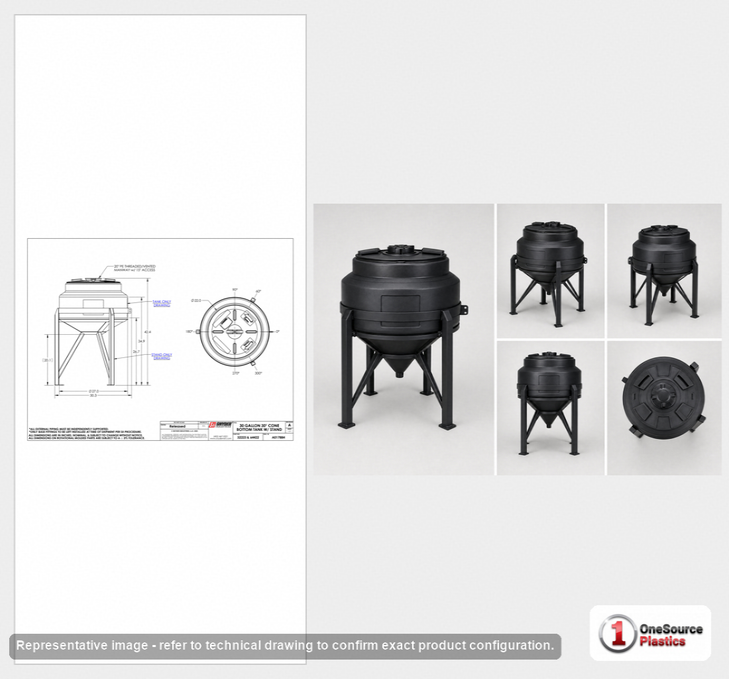
Technical drawing (PDF) for Snyder Industries 1850000N51.
See this tank
Interactive 3D model with live fill. This tank has an interactive 3D model built to its manufacturer dimensions. Rotate it, and set a fill level to see how much liquid it holds at any height. Open the 3D view on the product photo above. Download the 3D model (GLB).
Ready to order?
Add it to your cart at the top of this page, get LTL freight to your ZIP, request a written quote, or call 866-418-1777. The listed price is before freight.