Seventeen gallons of 60 degree cone, 24 inches tall
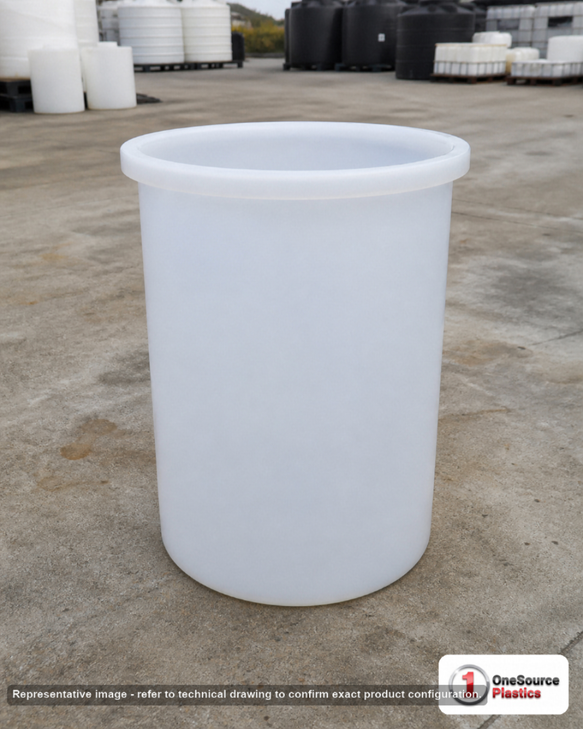
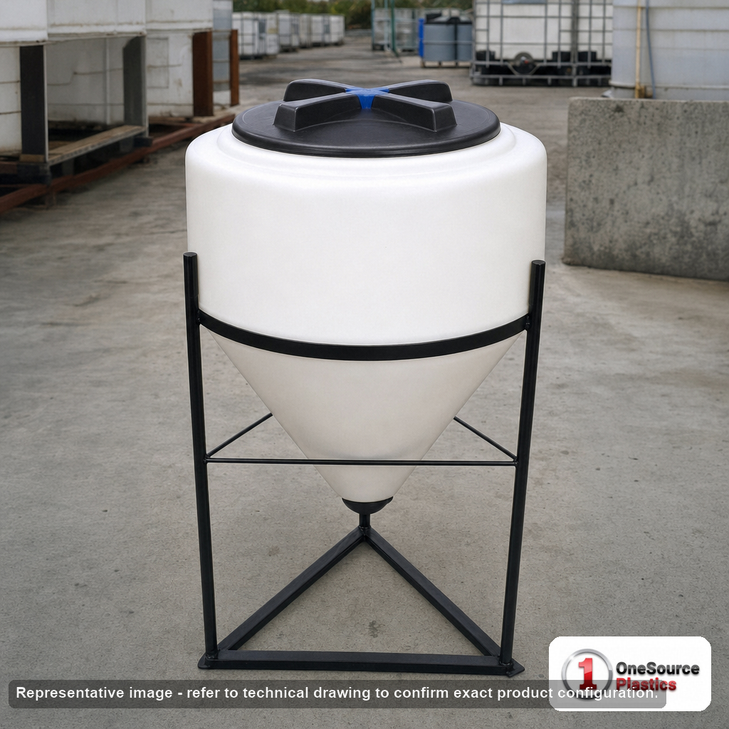
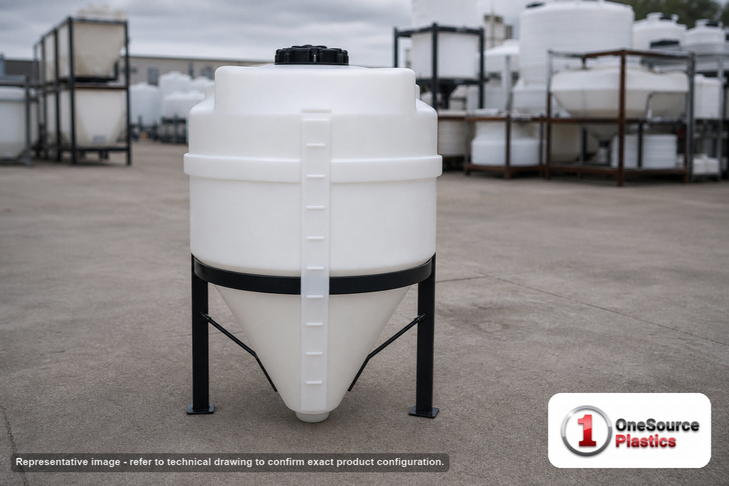
The Snyder SII-1850000N45 is a 17 gallon cone bottom tank in white polyethylene, listed at 19 inches in diameter and 24 inches tall, at 9 pounds empty. The name gives the cone angle as 60 degree and the sheet carries no cone angle field, so the name is the only source for it. Sixty degrees is the steepest angle in this slice and this is by a long way the smallest vessel in it: two feet tall, nineteen inches across, and light enough to carry in one hand. The wall is rated at a specific gravity of 1.9, and the sheet gives 142 pounds for 17 gallons of water at 8.34 pounds per gallon with 269 pounds of max contents. The lid and manway field reads 8 inches. The service limit is 120 F / 48 C. The sheet publishes no outlet, no stand and no warranty term, so none of them is claimed here.
Engineer on the job? Request a written quote with the spec attached, or get freight to your ZIP and add to cart above; 866-418-1777 answers the technical questions.
Bench height, a stand you provide, and nine pounds
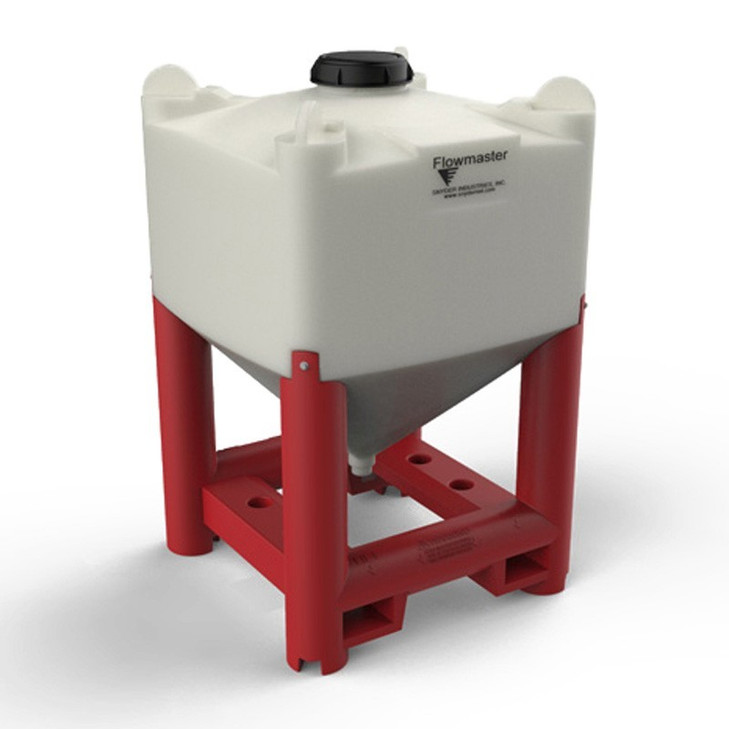
This one is bought for where it sits, and where it sits is almost always a bench, a frame or a small skid rather than a floor. A steep cone cannot stand on its own bottom, and this sheet lists no stand, no legs and no ring, so the support is yours to specify or fabricate. At this scale that is a reasonable thing to do in-house: 24 inches of tank and 9 pounds empty is a vessel that a light frame, a bench cut-out or a purpose-made ring will hold, and the number that governs it is not the empty weight but the full one. The sheet gives 142 pounds of water and 269 pounds at the rating, so the bracket, the bench top or the frame has to carry a couple of hundred pounds arriving on a small circle, plus whatever hangs off the discharge underneath. Get that clearance right at the design stage: the point of a 60 degree cone is that the contents leave through the bottom, and the room under the cone for a valve, a hose and a receiving vessel is what makes the arrangement work at all. Nineteen inches of diameter and 24 inches of height will go under most bench-mounted mixers and inside most fume hoods and small bunds, which is exactly the duty this size is built for. Set it so the cone is plumb and the vessel is level, because a small cone hung slightly off is a cone that keeps a puddle in one side. Check the volume against your batch size in the tank sizing calculator before you order, because a 17 gallon vessel is chosen to match a recipe rather than a storage interval, and take the freeboard from the tank sizing guide so a warming or foaming batch has somewhere to go. Where even a small vessel sits over a floor or a drain that would have to be recovered, the Captor containment comparison is the honest version of the containment argument at any scale.
The 17, the 15 gallon open top and the 30 gallon mixer
| Part | Gallons | Diameter or plan x height | Empty weight |
|---|---|---|---|
| SII-1850000N45 (this tank, 60 degree) | 17 | 19 x 19 x 24 in | 9 lb |
| 1850000N51 (heavy duty mixing tank name, same size) | 17 | 19 x 19 x 24 in | 9 lb |
| 1520000N51 (black open top, narrower and taller) | 15 | 17 x 17 x 28 in | 9 lb |
| 32223 (widest and lowest) | 30 | 27 x 27 x 20 in | 20 lb |
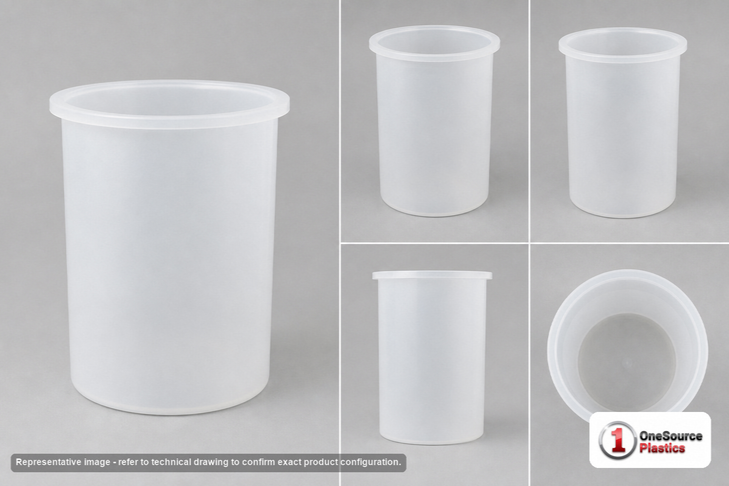
Four small mixing vessels, three genuinely different shapes. 1850000N51 is listed at the same 17 gallons, the same 19 by 24 inches and the same 9 pounds as this tank under a heavy duty mixing tank name, and the sheet gives no other difference, so we print the names and the numbers and leave it there; order the part number your process sheet or your spares list already carries. 1520000N51 is the interesting neighbour. It holds 15 gallons in a 17 inch circle 28 inches tall at 9 pounds, and its own name calls it an open top tank, so it has no lid and this page claims no cover, no seal and no vent for it. That is a real difference in duty, not a variant: an open top is the one you reach into with a paddle or a hand-held mixer and see the batch in, and a closed vessel is the one you keep a lid on. Choose by how the batch is made, not by the gallon figure. 32223 is the step up at 30 gallons, and it goes about it by getting wider rather than taller: 27 inches across and only 20 inches high, at 20 pounds. On a bench with a mixer over it, that extra width may be the thing that will not fit, while the lower height may be the thing that finally does. Take all three numbers to the bench before you choose, because at this scale the cut-out, the mixer clearance and the space under the cone decide it far more often than the volume does.
Height or floor the limit? The table has both shapes; freight to your ZIP is quoted on each row, or call 866-418-1777 with the site.
What leaves the bottom, and the 8 inch opening on top
- The discharge: this sheet publishes no outlet size and no bulkhead. The cone ends in a discharge and the sheet does not dimension it, so no figure appears here. Tell us the line size, the valve and the product, and we will confirm what the part carries before it ships.
- The valve and what is under it: on a small cone the valve, the hose and the receiving container all live in the space between the cone tip and the bench or the floor, and that space is designed in rather than discovered. Support the valve on the frame, not on the cone, and leave room to get a container under it without tilting anything.
- Drain-down: at 60 degrees this is the steepest cone in this group, and a steep cone is bought where the batch must leave completely and where a product that settles or thickens still has to go. That is the argument for this shape over a flat-bottomed pail of the same volume, and the cone bottom buyer's guide on angle selection compares the common angles on the terms that decide it.
- Access: the lid and manway field reads 8 inches, and at 24 inches of tank height that opening is at working level on a bench. Eight inches takes a hand-held mixer shaft, a lance, a funnel and a dip tube; it does not take an arm, so plan the rinse routine before the first batch.
- Venting: the sheet does not describe the opening as vented and lists no breather. If a pump is going to draw this vessel down, the air path is part of your arrangement and not an assumption.
- Limits: 120 F / 48 C, a specific gravity rating of 1.9, 142 pounds of water and 269 pounds of max contents. There is no warranty term and no stand on this sheet.
Name the liquid when you order, because at this size the gasket and the valve are most of the specification, and the chemistry is what chooses them.
Lab batching, plating lines and small make-up work
Seventeen gallons over a steep cone is a make-up and dispensing vessel. It turns up in laboratories and pilot plants, in metal finishing and plating shops holding a small bath or a rinse additive, in print, coating and ink rooms, in breweries and small food producers, in hatcheries, greenhouses and aquaculture systems, and on skids where a measured batch is mixed and then drained into something else. Two things make it worth buying over a drum or a pail. The first is that it empties completely and quickly through the bottom rather than being tipped or pumped out. The second is that at 9 pounds and 24 inches tall it can be taken off its frame, carried to a sink and cleaned properly between products, which is what makes a small vessel safe to reuse. Dedicate one per product where you can, label it, and keep the cleaning routine short enough that the operator actually does it.
Resin compatibility, line by line
Below are the liquids this resin is rated for, the concentration each rating holds to, and the fitting and gasket to specify. Check the exact concentration and temperature you run against the chemical page or the chemical compatibility database before ordering.
- Acetic Acid (60%, PP/PVC fittings, EPDM gasket)
- Aluminum Sulfate (50%, PVC, EPDM)
- Calcium Chloride (40%, PVC, EPDM)
- DEF (32.5%, 316SS fittings, EPDM)
- Ethylene Glycol (100%, PVC, EPDM)
- Ferric Chloride (50%, PVC, EPDM)
- Ferric Sulfate (60%, PVC, EPDM)
- Ferrous Sulfate (20%, PVC, EPDM)
- Hydrochloric Acid (37%, PVC, Viton)
- Hydrofluoric Acid (48%, PP/PVC, Viton)
- Hydrofluosilicic Acid (26%, PP/PVC, Viton)
- Hydrogen Peroxide (50%, PVC, Viton)
- Magnesium Chloride (30%, PVC, EPDM)
- Peracetic Acid (30%, 316SS, Aflas)
- Phosphoric Acid (85%, PVC, Viton)
- Polyaluminum Chloride (PVC, EPDM)
- Potassium Carbonate (50%, PVC, EPDM)
- Potassium Hydroxide (saturated, PVC, EPDM)
- Propylene Glycol (PP/316SS, EPDM)
- Sodium Bisulfate (PVC/PP, EPDM)
- Sodium Bisulfite (PVC/PP, EPDM)
- Sodium Carbonate (30%, PVC, EPDM)
- Sodium Hypochlorite (under 16.5%, PVC, Viton)
- Sodium Thiosulfate (40%, PVC, EPDM)
- Sulfuric Acid (98%, CPVC, Viton)
- Urea Solution (50%, PP/PVC, EPDM)
- Zinc Orthophosphate (PP/316SS, EPDM); and Ozonated Water (up to 10 PPM, PVC, EPDM). Note how the gasket changes with the chemical, EPDM for most salts and base
Parcel mode from Lincoln at nine pounds
This tank is moulded at Lincoln, Nebraska, and the sheet lists Nebraska as the state it ships from. The NMFC is given as 156600 and the shipping weight matches the tank at 9 pounds. Price the lane to your ZIP with the freight cost estimator; the listed price is before freight. Nine pounds is the rare tank that arrives without a machine, a dock or an appointment, and it is also the rare tank that can be knocked off a bench by an elbow, so give it a home before it arrives rather than after. Unpack it, check the cone tip and the 8 inch opening for transit damage while the packaging is still in front of you, and mount it on its frame before anything goes in it. Fill it with clean water first, hold that 142 pound load on the bracket you have built, and watch the frame rather than the tank. Then drain it through the valve you have fitted and time how long it takes, because that number is the one you will plan every batch around afterwards. The vent screen is the cheapest part on the tank and the one that saves it; look at it every time the manway opens.
Freight and documents
Ships from: Lincoln, NE. LTL freight is quoted to your ZIP with the freight cost estimator or by phone at 866-418-1777. The listed price is before freight.
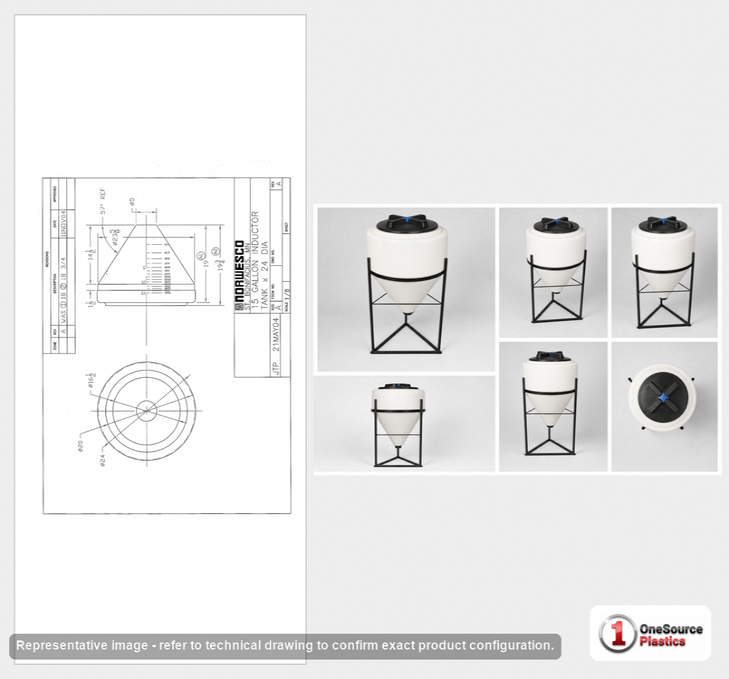
Technical drawing (PDF) for Snyder Industries 1850000N45.
See this tank
Interactive 3D model with live fill. This tank has an interactive 3D model built to its manufacturer dimensions. Rotate it, and set a fill level to see how much liquid it holds at any height. Open the 3D view on the product photo above. Download the 3D model (GLB).
Product video. Watch the Snyder Industries 17 Gallon 60 Degree HDPE Cone Bottom Tank in White video (70 seconds) with dimensions, fittings and shipping notes.
Ready to order?
Add it to your cart at the top of this page, get LTL freight to your ZIP, request a written quote, or call 866-418-1777. The listed price is before freight.