Thirty-five hundred gallons of cross-linked wall at 1.9
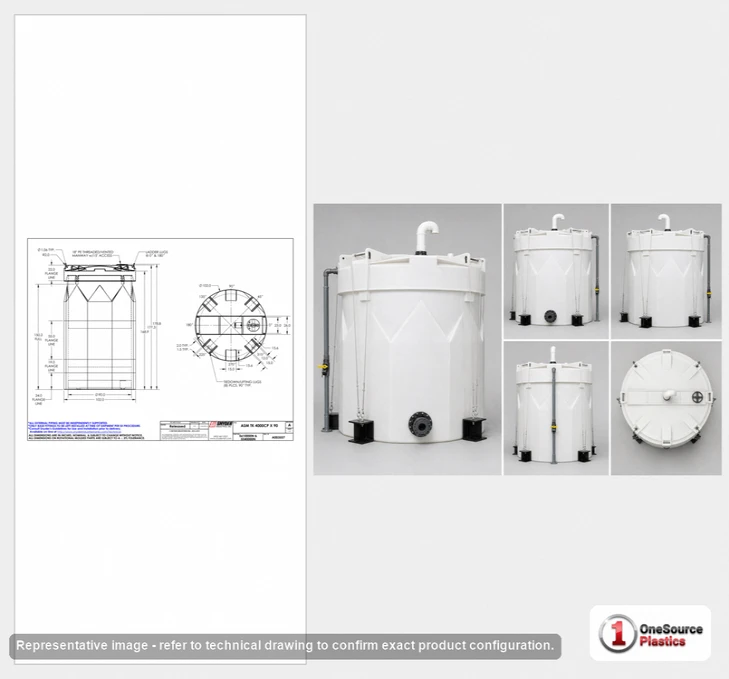
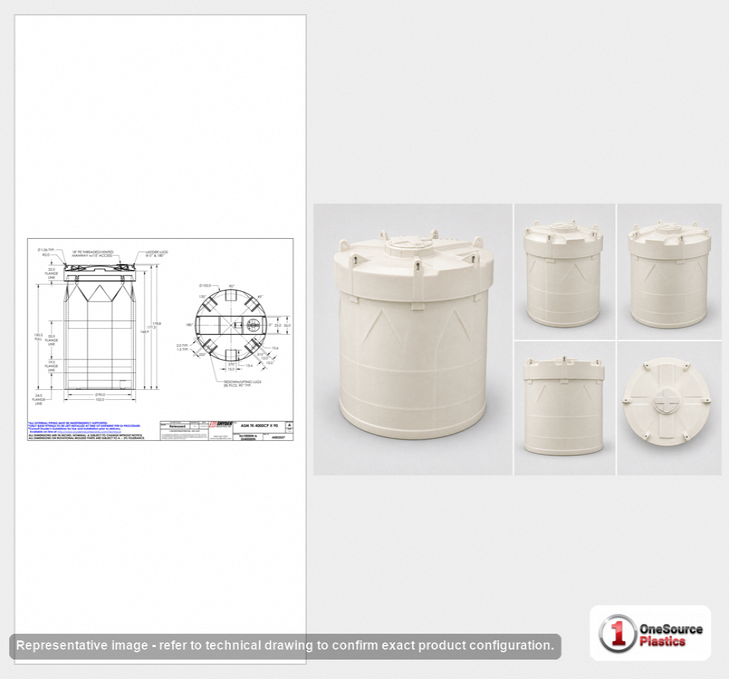
The Snyder 5600000N42 is a 3500 gallon Captor double wall tank, named on its sheet as an ASTM XLPE Captor double wall tank. Captor is Snyder's product name for the containment tank and the other name words are the maker's; no standard, listing or approval is claimed from any of them here. It is listed in natural white crosslinked linear polyethylene at 102 inches long by 102 inches wide by 158 inches tall and 2,500 pounds empty. One capacity, one envelope, one weight and one rating are published for the assembly, and there is no inner tank dimension, no outer containment dimension and no containment percentage on the sheet, so this page states none. The wall is rated at a specific gravity of 1.9, and the sheet gives 29,190 pounds for 3,500 gallons of water at 8.34 pounds per gallon with 55,461 pounds of maximum contents. The only opening is an 18 inch threaded vented manway; the outlet field reads "1 Manway / Lid", an opening rather than a pipe size, and the inlet field is empty. The service limit is 140 F / 60 C, the warranty is a 3 Year Warranty, and freight is LTL at class 250 with no NMFC number out of Lincoln, Nebraska.
Need the certification on file? Add the 3500 gallon tank to your cart above with freight quoted to your ZIP, or call 866-418-1777 and the paperwork ships with the tank.
The 140 F sheet in a shell whose shellmates stop lower
Put this listing beside the tanks that share its 158 inch shell and one figure separates it from most of them: its service limit reads 140 F / 60 C where the high density listings in the same shell stop at a lower figure on their own sheets. That is the reason to order this part number rather than 5600000N52 or 5600000N30, and it is the only reason written down anywhere. Everything else in the group is the same: 3,500 gallons, 102 by 102 by 158 inches, 2,500 pounds empty on the heavier listings, and the same specific gravity rating of 1.9 carrying 55,461 pounds of maximum contents against 29,190 pounds of plain water. So the decision is a temperature decision first and a chemistry decision second. If your product arrives warm, is made up warm, or sits in a bay that runs hot under a steel roof in summer, the higher limit on this sheet is worth having and the lower-limit shellmates are the wrong row. If nothing on your site ever approaches it, the limit is not what should be choosing your tank, and the chemistry and the maker's own naming should. The other honest difference is the material field, which on this sheet reads crosslinked linear polyethylene where two of its shellmates read high density linear polyethylene. We print that as the sheet gives it and offer no interpretation, because the sheet offers none and a resin word is not a compatibility statement. Tell us the product and the strength and we will point at the part number Snyder names for it. Colour is the third field worth a sentence: natural white here against black on two of the shellmates, and a white wall in a lit building is often the only level indication an operator has. The site discipline is the same as every tank in this family. Thirteen feet on an eight and a half foot square plan needs a flat, continuous, level surface under the entire footprint, no rails and no packing at a corner, because 29,190 pounds of water stands on it; the framework and its limits are in the concrete pad sizing guide for above-ground polyethylene tanks. Settle the usable volume with the Captor double wall freeboard sizing guide, since a warm or gassing product does not give you the nameplate figure, then check delivery quantity and turnover in the tank sizing calculator and the tank sizing guide. And because warm service is exactly the condition that works a wall hardest where nobody looks, read the wall thickness at the vapour saturated headspace guide before you set an inspection routine. Where containment is being bought for a regulatory reason, the Captor double wall compliance walkthrough goes through the requirements in order.
Six Captor listings between 3000 and 4000 gallons
| Part | Gallons | Length x width x height | Empty weight |
|---|---|---|---|
| 5600000N42 (this tank, named ASTM XLPE Captor) | 3500 | 102 x 102 x 158 in | 2,500 lb |
| 5600000N30 (same shell, same listed weight) | 3500 | 102 x 102 x 158 in | 2,500 lb |
| 5600000N40 (same shell, lighter listing) | 3500 | 102 x 102 x 158 in | 2,100 lb |
| 5600000N46 (same shell, lighter listing, black) | 3500 | 102 x 102 x 158 in | 2,100 lb |
| 5590000N30 (shorter Captor shell) | 3000 | 102 x 102 x 142 in | 1,900 lb |
| 5610000N30 (taller shell) | 4000 | 102 x 102 x 178 in | 3,200 lb |
The first four rows are one 158 inch Captor shell in four codes, split by the sheet into two listed weights: this tank and 5600000N30 at 2,500 pounds, 5600000N40 and 5600000N46 at 2,100. The sheet sets out the weights and the codes and explains neither, so this page prints them and stops there. What is worth saying is how little separates the whole group physically and how much separates them on paper: identical outside dimensions, identical capacity, different material fields, different colours and different service limits. That is a family designed to be selected by duty, and the fastest way to get it wrong is to select it by price or by suffix. The last two rows are the size step, and in this family a size step is purely a height step. 5590000N30 holds 3,000 gallons at 142 inches and 1,900 pounds on the identical 102 inch square; 5610000N30 holds 4,000 at 178 inches and 3,200 pounds on the same square. Nothing about the pad, the bund line or the bay layout changes as you move between the three. So if you are undecided on capacity, decide it on two numbers you already have: the clear height at the final position after a platform and a fill arrangement are allowed for, and how often you are prepared to take a delivery. Then buy the tallest row that clears the first answer and satisfies the second, because a second truck a month costs more over a decade than sixteen inches of tank ever will.
Pad already poured? Send its size to 866-418-1777 or in a quote request and we will match a row to it, freight to your ZIP included.
Air in and out of an 18 inch threaded opening
- The vent: the manway is listed as threaded and vented, and on a tank rated to 140 F / 60 C the vent has more work to do than on a cold one, because a warm headspace moves more air for the same change in level. Keep the path clear, inspect it whenever the manway is opened, and never restrict or blank it.
- The opening: 18 inches is the only opening the sheet publishes. It is the fill, inspection and cleaning route together, generous enough to look inside properly and to work a lance, but shared by everything anyone wants to do from the top. Plan the drop pipe and the level arrangement before the tank is set.
- Access: the manway is at 158 inches, which is a fixed platform and fall protection designed with the installation. Wherever the delivery permits it, bring the coupling down to working level rather than sending a driver up.
- The outlet: the outlet field reads "1 Manway / Lid", an opening and not a pipe size, and the inlet field is empty, so no outlet dimension or valve is claimed. Give us the duty and the line size and we will confirm what this part number carries before pipe is bought.
- Hot service: if the product runs anywhere near the published limit, say so when you order. Gasket material, valve seats and any flexible connection are chosen against temperature as well as chemistry, and that is the usual cause of a weep on an otherwise sound tank.
- The space between the walls: no monitoring port, gauge or alarm is published, so that arrangement is specified separately and inspected to a written schedule.
- Limits: 140 F / 60 C, a specific gravity rating of 1.9, and a 3 Year Warranty.
Name the product and the working temperature at order time, and every wetted part is specified once against the real duty instead of against a catalogue default.
Process and chemical holding on a contained base
The combination of 3,500 gallons, a higher service limit and a specific gravity rating of 1.9 puts this tank into the warmer and denser end of general plant storage: process chemical holding in manufacturing, clean-in-place and caustic make-up in food, beverage and dairy work, treatment chemical storage at a water or wastewater plant, boiler house and cooling tower dosing, metal finishing and plating lines, and pulp, paper and mineral processing where the product is neither cold nor light. The second wall is bought for the surface underneath rather than for the tank: where a built bund would have been the alternative, this arrives as one item that is its own bund and takes one footprint to do it. Set the receiving procedure up with the tank. Agree where a driver connects, who watches the fill, what the stop level is and what happens if the vent is obstructed. Where private fire water storage is the real question behind the enquiry, that is a different duty sized by different rules and the fire water reservoir design guide for rural and remote sites is where it starts; nothing here is a claim about that use.
What a 158 inch shipment needs at your end
Lincoln, Nebraska is the plant, and the sheet lists Nebraska and West Virginia as ship-from states; both fields are printed as given and nothing is reconciled. Freight is LTL at class 250, no NMFC number is listed, and the load is 102 by 102 by 158 inches at 2,500 pounds. Price the lane to your ZIP with the freight cost estimator; the listed price is before freight. Plan the arrival around the envelope rather than the weight: thirteen feet tall and eight and a half feet square needs a measured route, a gate that takes it, and offloading equipment with reach as well as capacity. Take it under the base with forks or a rated sling arrangement; never lift by the manway and never drag it on the shell. Set it on the cured, level surface in its final position, prove it plumb in two directions while it is empty, then fill with clean water and hold that 29,190 pound load while you read the manway seal, the base all the way round and the pad beneath it. Drain it, let it dry, open the space between the walls, look in good light and write the date on the shell. Finally, log the part number and the first fill date in the maintenance record on the day it lands, because the tank will outlast everyone who signed for it. Tape a copy of the spec sheet inside the control panel door; the next person to touch the tank will not have the box it came in.
Freight and documents
Ships from: Lincoln, NE. LTL freight is quoted to your ZIP with the freight cost estimator or by phone at 866-418-1777. The listed price is before freight.
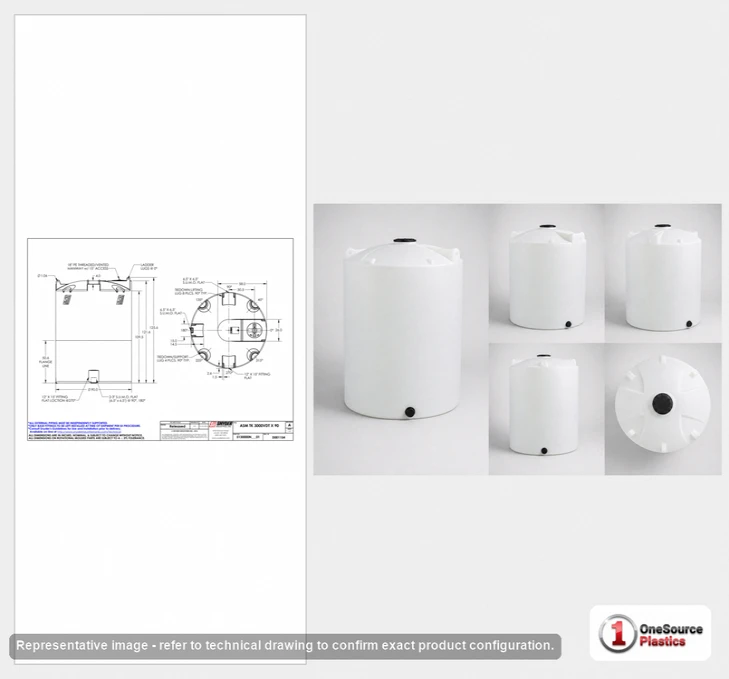
Technical drawing (PDF) for Snyder Industries 5600000N42.
See this tank
Interactive 3D model with live fill. This tank has an interactive 3D model built to its manufacturer dimensions. Rotate it, and set a fill level to see how much liquid it holds at any height. Open the 3D view on the product photo above. Download the 3D model (GLB).
Ready to order?
Add it to your cart at the top of this page, get LTL freight to your ZIP, request a written quote, or call 866-418-1777. The listed price is before freight.