Four hundred and five gallons on a four foot plan
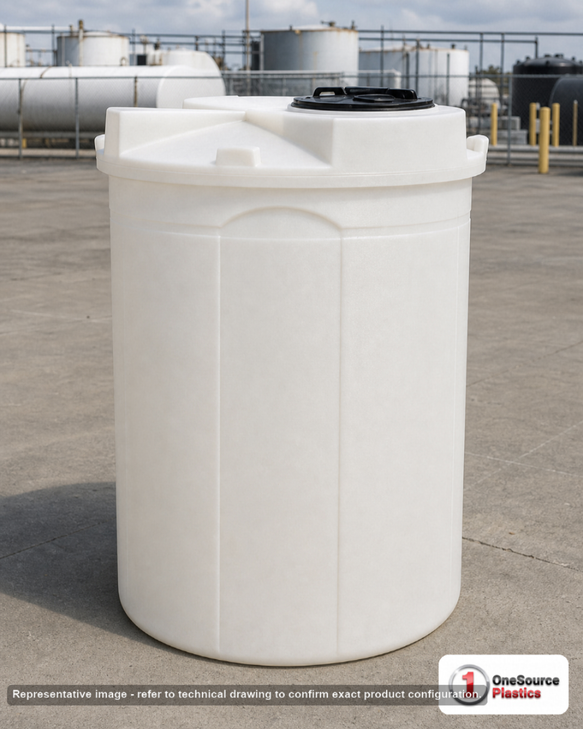
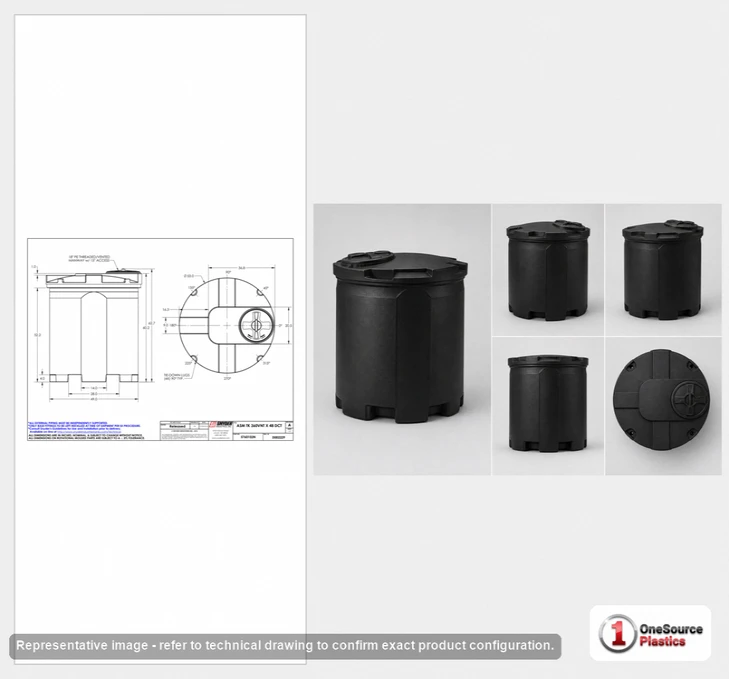
The Snyder 5990702N48 is a 405 gallon double wall tank, listed on its sheet as ASTM XLPE Black, molded in black cross-linked linear polyethylene at 48 inches long by 48 inches wide by 73 inches tall and 250 pounds empty. The name words are the maker's name for the product and nothing is claimed from them here. This sheet publishes one capacity, one set of overall dimensions, one weight and one rating covering the whole assembly; there is no separate inner tank figure, no separate outer figure, no annulus dimension and no containment percentage on it, so none appears below. The wall is rated at a specific gravity of 1.9, and the sheet gives 3,378 pounds for 405 gallons of water at 8.34 pounds per gallon with 6,418 pounds of max contents. The only opening is an 18 inch threaded vented manway, and the outlet field reads 1 Manway / Lid, an opening rather than a pipe size. The service limit is 120 F / 48 C and the warranty is a 3 Year Warranty. Freight is LTL at class 250 with no NMFC number listed, out of Chowchilla, California.
Want it on the pad this month? Check freight to your ZIP, add it to your cart above, and 866-418-1777 will confirm the ship date.
A four foot square and the route to it
The number that decides where this tank can live is 48 inches. A four foot square base is the largest contained vessel in this family that still behaves like a piece of equipment rather than a building project: it sits on a standard pallet footprint, it can be turned in a corridor with a little planning, and it goes into a bay without the wall opening that the six foot shells need. It still will not pass a 36 inch doorway, so the way in is a shutter or a bay door, but at four feet the number of buildings that can take it is a great deal larger than the number that can take the sizes above it. That is the reason to choose this step rather than the 500. The floor comes next and it is the part people underestimate on a mid-size tank. Above a 48 inch base sits 3,378 pounds of water at 8.34 pounds per gallon, and 6,418 pounds at the published 1.9 rating, concentrated on sixteen square feet. The surface has to be flat, continuous and level across the whole footprint, with no rail, no timber and no shim at a corner; if it is going anywhere other than a ground floor slab, the support is a real calculation rather than an assumption. Height is the second constraint and the friendlier one. At 73 inches the shell stands close to six feet, so it clears under a 96 inch ceiling with working room above the manway, and overhead services are usually no obstacle. The manway itself is at about head height, which puts it within reach of a low step rather than a fixed ladder, and that single fact makes this the easiest size in the family to live with day to day. Leave forklift clearance in the final position. The tank is taken under the base with forks, never by the manway, so there has to be room to approach it square, set it down and back out, and there should be a walkway round all four sides afterwards. The side you cannot see is the side that develops a weep, and on a tank this size that is cheap clearance to buy. Before the order, check that 405 gallons is genuinely your number rather than the one that happened to be in stock: run the delivery quantity and the turnover through the tank sizing calculator, and take the freeboard discipline from the tank sizing guide.
Three 405s, a 360 and a 500
| Part | Gallons | Length x width x height | Empty weight |
|---|---|---|---|
| 5990702N48 (this tank, named ASTM XLPE Black) | 405 | 48 x 48 x 73 in | 250 lb |
| 5990702N42 (named ASTM XLPE) | 405 | 48 x 48 x 73 in | 250 lb |
| 5990702N51 (named ASTM Black) | 405 | 48 x 48 x 73 in | 250 lb |
| 5990702N52 (named sodium hypochlorite) | 405 | 48 x 48 x 73 in | 250 lb |
| 5760102N30 (smaller, named sulfuric acid) | 360 | 53 x 53 x 63 in | 250 lb |
| 5780102N42 (larger, named ASTM XLPE) | 500 | 53 x 53 x 81 in | 290 lb |
Four listings share this exact 48 by 48 by 73 inch shell at 250 pounds and differ only in the name and color the maker assigns: two named as cross-linked or black, one named for sodium hypochlorite, and this one. The sheet explains nothing about what those names imply and neither does this page, because a name is not a specification. Describe what you are storing and at what strength, and the part number follows from that conversation rather than from a table. The two size steps either side are worth studying because they move in opposite directions. The 360 gallon 5760102N30 holds less but is wider and shorter, at 53 inches square and 63 inches tall, and the sheet lists it at the same 250 pounds as this tank. That is the row for a low ceiling or a site that wants the manway reachable from the floor, and it costs floor area to get there. The 500 gallon 5780102N42 keeps that same 53 inch plan and goes up to 81 inches for the extra volume, at 290 pounds. So across these three sizes the plan area only takes two values and the gallons are bought with height. This tank is the only one of the three on the narrower 48 inch plan, which makes it the one that fits the tightest opening and the smallest reserved floor space. If the doorway or the aisle is what limits you, this row is the answer, and the volume it gives up against the 500 is modest.
Which wall for your chemical? Call 866-418-1777 with the name and the concentration, or send a quote request and we will pick the row.
The 18 inch manway at 73 inches
- The outlet: the outlet field reads 1 Manway / Lid, which names an opening and not a pipe size. No inlet, thread, flange or valve appears on this sheet, so none is claimed. Before the discharge and the pump are specified, tell us the duty and the line size and we will confirm what this part number carries.
- The opening: an 18 inch threaded vented manway, and it is the only one published. It is the fill route, the inspection route and the cleaning route at once, so plan the delivery connection, the suction and any instrument you want to drop in around a single opening.
- Reaching it: the top sits at 73 inches, which is about head height. A low step is enough to work at the manway, and that is the practical advantage of this size over the taller shells in the family. Design the fill point around a person standing on the floor if you can.
- The vent: the manway is listed as vented. That path protects the wall while a delivery pushes air out and while a pump draws the level down. Keep it clear, inspect it every time the manway is opened, and never restrict it to control an odour.
- The space between the walls: no monitoring port, gauge or alarm is published, and no stand, legs or level device either. How that space is watched and recorded is specified separately, and the whole value of a second barrier is being able to show it is still empty.
- Limits: 120 F / 48 C, a specific gravity rating of 1.9, and a 3 Year Warranty. That is all the sheet publishes about service.
Tell us the product and its strength at order time; the seal, any fitting we add and the pump arrangement follow from the chemistry, and a generic choice there is the one that fails first.
Dosing skids that outgrew a tote
Four hundred and five gallons is roughly the point where a tote programme stops making sense and a delivered volume starts to: a metering station on a treatment skid, a chemical feed point at a small municipal or package water plant, a cooling tower or boiler house dosing room, a food, beverage or dairy line, a plating or finishing shop, and pilot scale work that has moved past drums. The contained shell is what lets that volume stand on a finished floor indoors, and the four foot plan is what lets it stand somewhere useful instead of in the only large space in the building.
Two pieces of reading belong with the decision. The volume you can actually use is not the nameplate number once thermal expansion, chemistry and density are accounted for, and the double wall freeboard sizing guide works that through. Where somebody needs to know how the space between two walls is tested and what those methods cover, the cathodic disbondment testing guide for double wall interstitial spaces covers the methodology and the polyethylene boundary. Then agree the receiving procedure at the same time as the tank: where the driver connects, who watches the fill, what the stop level is, and what happens if the vent is obstructed. Deliveries into a vessel that is fuller than anyone thought are where most of the bad days on a tank like this come from.
Two hundred and fifty pounds and a narrow crate
Chowchilla, California is the only plant on this sheet and California the only ship-from state, so the West Coast and the Southwest are the short lanes and everything further east is a planned move. Freight is LTL at class 250 with no NMFC number, and the crate is listed at 48 by 48 by 73 inches at 250 pounds. Price the lane to your ZIP with the freight cost estimator; the listed price is before freight. This is the easiest crate in the mid range to receive: a four foot square on one pallet position at 250 pounds, a tail lift on most lanes, and a pallet truck at your end rather than a crane. Take it under the base, never by the manway. Set it on the finished, level surface in the final position before anything is connected, then fill it with clean water and hold the 3,378 pound load while you read the manway seal, the base all the way round and the surface beneath it. Drain it, let it dry, open the space between the walls, look at it in good light and write the date on the shell. Put the part number on the maintenance log the day it lands; five years on, nobody remembers which shell is which without it. Walk the base after the first hard rain; a pad that shifts shows it at the edge first.
Freight and documents
Ships from: Chowchilla, CA. LTL freight is quoted to your ZIP with the freight cost estimator or by phone at 866-418-1777. The listed price is before freight.
Technical drawing (PDF) for Snyder Industries 5990702N48.
See this tank
Interactive 3D model with live fill. This tank has an interactive 3D model built to its manufacturer dimensions. Rotate it, and set a fill level to see how much liquid it holds at any height. Open the 3D view on the product photo above. Download the 3D model (GLB).
Ready to order?
Add it to your cart at the top of this page, get LTL freight to your ZIP, request a written quote, or call 866-418-1777. The listed price is before freight.