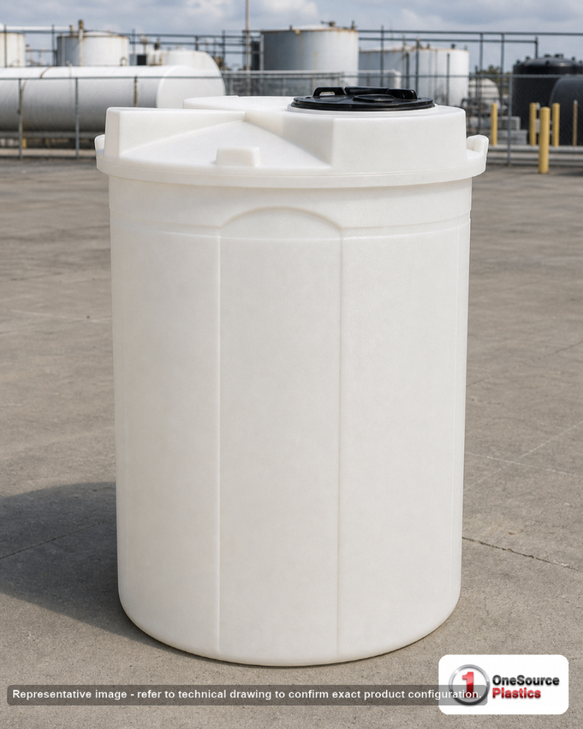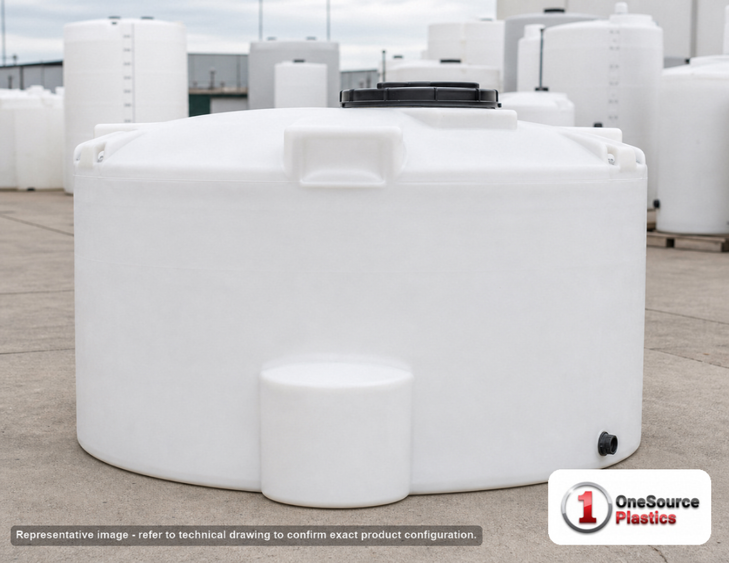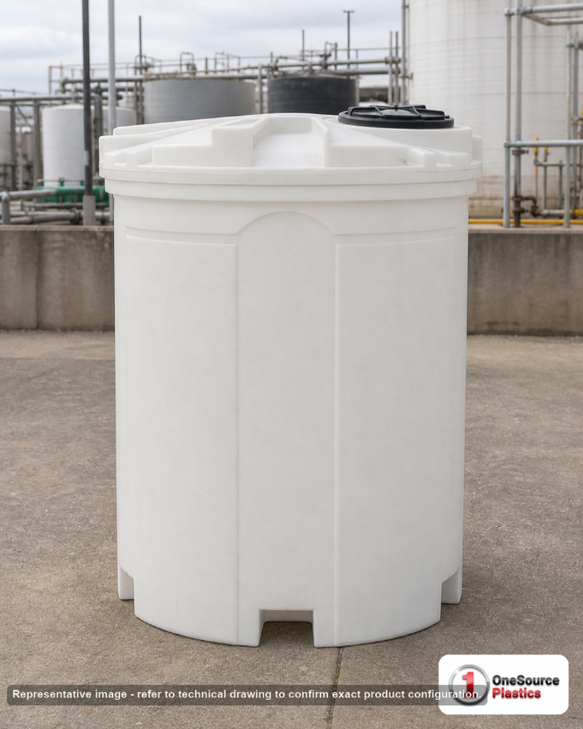
Five hundred gallons on a fifty-three inch square
The Snyder 5780102N42 is a 500 gallon double wall tank, listed on its sheet as ASTM XLPE, molded in natural white cross-linked linear polyethylene at 53 inches long by 53 inches wide by 81 inches tall and 290 pounds empty. Those words in the name are the maker's name for the product and nothing is claimed from them. The sheet publishes one capacity, one set of overall dimensions, one empty weight and one rating for the whole assembly: there is no separate inner tank figure, no separate outer figure, no annulus dimension and no containment percentage on it, so none appears on this page. The wall is rated at a specific gravity of 1.9, and the sheet gives 4,170 pounds for 500 gallons of water at 8.34 pounds per gallon with 7,923 pounds of max contents. The only opening published is an 18 inch threaded vented manway. The outlet field reads "1 Manway / Lid", which names an opening rather than a pipe size, and the inlet field is blank. The service limit on this sheet is 140 F / 60 C and the warranty is listed as a 3 Year Warranty. Freight is LTL at class 250 with no NMFC number, molded at Marked Tree, Arkansas.
Spec sheet in hand? Call 866-418-1777 and read us the liquid and the pad; or get freight to your ZIP and add it to your cart above.
The slab under it, and the door on the way in
Start with the ground, because on a contained tank the floor is the decision everything else follows from. This one occupies a 53 inch square, a little under four and a half feet each way, and stands 81 inches to the top of the manway. That is a great deal of held volume for the floor it takes, and it is the reason a crowded plant room buys this shape rather than a squat one of similar capacity. It is also what puts the demand on the surface. Above that base sits 4,170 pounds of water and 7,923 pounds at the published 1.9 rating, and all of it arrives on under twenty square feet rather than being spread out. The surface has to be flat, continuous and level across the whole footprint: not two rails, not a timber pallet left in place, not a shim under one corner. On a ground bearing slab that is straightforward. On a mezzanine, a suspended floor or a patched bay it is a calculation somebody signs rather than an assumption made on the day. The route in matters as much as the destination. At 53 inches the shipment does not pass a 36 inch doorway, so the way in is a roller shutter or a bay door with a straight run and turning room at the end, and at 81 inches the shell is nearly seven feet before it goes anywhere near a pallet. On a pallet it is taller again, which is what catches people out: the lintel, the shutter guide, the overhead pipe run and the sprinkler line are what to measure, and you measure them at the lowest and narrowest point of the route rather than at the entrance. Move it upright wherever the building allows, because standing a tank of this height back up in a confined space is the awkward part of the job. Then leave working room at the destination. Forks go under the base and never near the manway, so there has to be space to approach square, set it down and back out, and a walkway right round all four sides afterwards. The side nobody can reach is the side that develops a weep and never gets inspected, and on a tank pushed into a corner that is two sides out of four. Two sizing questions belong before the order rather than after it. The volume you can actually use is not the nameplate figure once thermal expansion, chemistry and density are accounted for, which the double wall freeboard sizing guide works through properly. Put your own consumption and delivery quantity through the tank sizing calculator and take the freeboard discipline from the tank sizing guide before you settle on 500 gallons rather than the size either side. Where the reason for the tank is private fire water storage instead of chemical feed, that is a different design problem on a different scale and the fire water reservoir design guide for rural and remote sites is where to take it; nothing on this page is a claim about that use.
Four 500s, a 405 below and a 550 above
| Part | Gallons | Length x width x height | Empty weight |
|---|---|---|---|
| 5780102N42 (this tank, named ASTM XLPE, natural white) | 500 | 53 x 53 x 81 in | 290 lb |
| 5780102N48 (named ASTM XLPE Black) | 500 | 53 x 53 x 81 in | 290 lb |
| 5780102N51 (named ASTM Black) | 500 | 53 x 53 x 81 in | 290 lb |
| SII-5780102N30 (named for sulfuric acid) | 500 | 53 x 53 x 81 in | 290 lb |
| 5990702N42 (smaller, narrower plan, named ASTM XLPE) | 405 | 48 x 48 x 73 in | 250 lb |
| 5040000N30 (larger, wide and low, named sulfuric acid Captor) | 550 | 76 x 76 x 65 in | 315 lb |
Four listings share this exact 53 by 53 by 81 inch shell at the same 290 pounds, and what separates them on paper is the name and the color the maker assigns. One of the four is spelled with the SII- prefix on the sheet and three are not; we print every part number exactly as it is given rather than tidying the list into a pattern, because the number you order against a drawing or a spares list has to match character for character. We interpret none of those names either. A product name is not a specification, and reading one as though it were is how a plant ends up with a vessel that was never meant for its duty. Tell us what you are storing and at what strength, and we will tell you which of the four to order. Two differences on this page are real and observable. This listing is natural white, and a white wall lets an operator read the level through the shell in a lit room, which on a tank whose only opening is at 81 inches is often the only level indication anybody has. And this sheet carries a service limit of 140 F / 60 C, where the black listing on the identical shell carries a lower figure on its own sheet; each page cites the number printed against its own part number and never borrows the twin's. The last two rows are the genuine size decision. 5990702N42 holds 405 gallons on a narrower 48 inch plan at 73 inches and 250 pounds, so stepping down saves a few inches in every direction and gives back about a fifth of the volume, which is the right trade when the aisle or the lintel is the constraint. 5040000N30 is a different tank entirely for barely more capacity: 550 gallons on a 76 inch plan at only 65 inches tall and 315 pounds. That row swaps height for floor, and it is the answer under a low ceiling and the wrong answer in a room where the floor is already spoken for. Measure the ceiling and measure the floor you can give up, then let the row pick itself.
Two rows look the same? The difference is the wall; call 866-418-1777 with the liquid and we will say which, or ask for a quote on both.
The outlet field, and the eighteen inch manway above it
- The outlet: the field reads "1 Manway / Lid" and nothing else. That names an opening, not a pipe size, and the inlet field is blank, so no outlet dimension, no thread, no bulkhead, no flange and no valve is claimed on this page. Give us the duty and the line size you need and we will confirm what this part number actually carries before a pump is specified.
- The opening: an 18 inch threaded vented manway is the only one this sheet publishes, which makes it the fill route, the inspection route and the cleaning route at the same time. Eighteen inches takes a fill coupling, a drop pipe and a rinse lance, and it is wide enough to get a proper look at the inside wall.
- Reaching it: the top of the shell is at 81 inches, above head height for most people. A step, a short platform or a fill line brought down to working level belongs in the installation drawing rather than being improvised on the first delivery.
- The vent: the manway is listed as vented, and that path is what protects the wall while a fill pushes air out and while a pump draws the level down. On a tall, narrow shell the level moves quickly for a given flow, so keep it clear and look at it every time the manway comes off.
- The space between the walls: no monitoring port, gauge or alarm is published on this sheet. How that space is watched and recorded is specified separately, and it is worth specifying, because the whole value of a second barrier is being able to show it is still empty.
- Structure: the sheet publishes no lifting lugs, no ladder lugs, no flange lines, no stand and no legs on this part number. Nothing is claimed beyond the molding.
- Limits: 140 F / 60 C, a specific gravity rating of 1.9, and a 3 Year Warranty. That is the whole of what this sheet publishes about service.
Name the product and its strength at order time. Every wetted part on a contained vessel is chosen against the chemistry, and the fitting is the one part of the system a second wall does nothing for.
White wall, lit plant room, one delivery at a time
Five hundred contained gallons on four and a half feet square is the volume at which a site stops moving totes with a forklift and starts taking a hose fill instead, and the second wall is what makes doing that indoors possible without building a bund. The duties follow from that: a dosing or disinfection room at a small water or wastewater works, coagulant and polymer make-up, a treatment skid in a food, beverage or dairy plant, a boiler house or cooling tower chemical station, a pool and aquatics plant room, a laundry or vehicle wash, a plating and finishing line, and pilot or small batch production standing on a finished floor. Natural white is part of the argument on this part number, because on a vessel whose only opening is at 81 inches, being able to read the level through the wall from across the bay saves an operator a climb every shift. Size it against the truck rather than against the room: at this capacity the bulk chemical cost per gallon usually turns on how often a delivery comes, and that is the arithmetic worth doing before the tank is bought. One habit pays for itself from the first week. Look into the space between the walls on a fixed schedule, write down the date and what you saw, and keep that record with the tank.
Class 250 out of Marked Tree, Arkansas
Marked Tree, Arkansas is the only plant on this sheet and Arkansas the only ship-from state, which puts the mid-South and the lower Mississippi valley on a short lane and makes either coast a planned move. Freight is LTL at class 250 with no NMFC number listed, and the shipping size is given at 53 by 53 by 81 inches at 290 pounds. Price the lane to your own ZIP with the freight cost estimator; the listed price is before freight. One pallet position at 290 pounds means a tail lift on most lanes and a pallet truck at your end rather than a crane, so the equipment is rarely the problem; the height is. Take it under the base, never by the manway, and keep it upright through the building where the route allows. Set it on the finished, cured, level surface in its final position, check it is plumb in two directions and secure it against being knocked before anything is plumbed in, because a tall vessel on a small plan is the one a pallet truck catches. Then fill it with clean water, hold that 4,170 pound load, and read the manway seal, the whole base and the surface under it in that order. Drain it, let it dry, open the space between the walls and record the date and what you saw on the shell in paint marker along with the part number. Everything you check in later years gets compared against that first reading. Last, walk back to the doorway and look at it with the water still in: a tall tank a degree off plumb is obvious from across the room and invisible from beside it. Mark the vent and the outlet on the outside of the shell so nobody caps the wrong one in the dark.
Freight and documents
Ships from: Marked Tree, AR. LTL freight is quoted to your ZIP with the freight cost estimator or by phone at 866-418-1777. The listed price is before freight.
Technical drawing (PDF) for Snyder Industries 5780102N42.
See this tank
Interactive 3D model with live fill. This tank has an interactive 3D model built to its manufacturer dimensions. Rotate it, and set a fill level to see how much liquid it holds at any height. Open the 3D view on the product photo above. Download the 3D model (GLB).
Ready to order?
Add it to your cart at the top of this page, get LTL freight to your ZIP, request a written quote, or call 866-418-1777. The listed price is before freight.