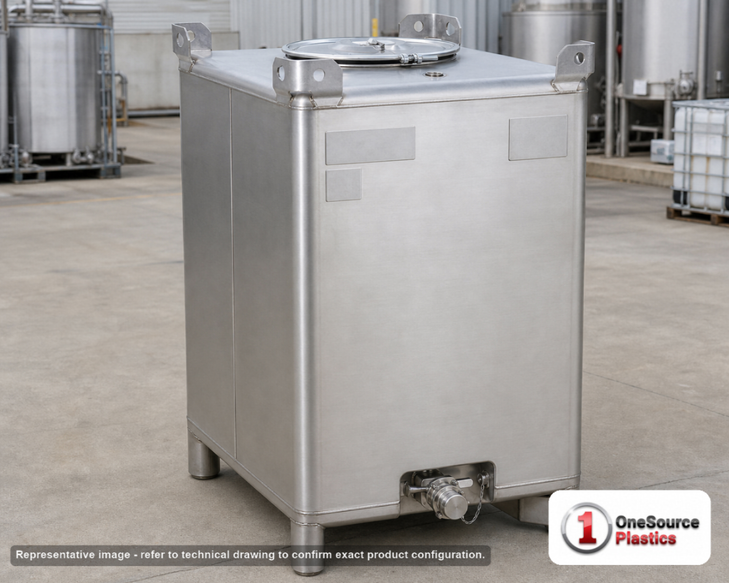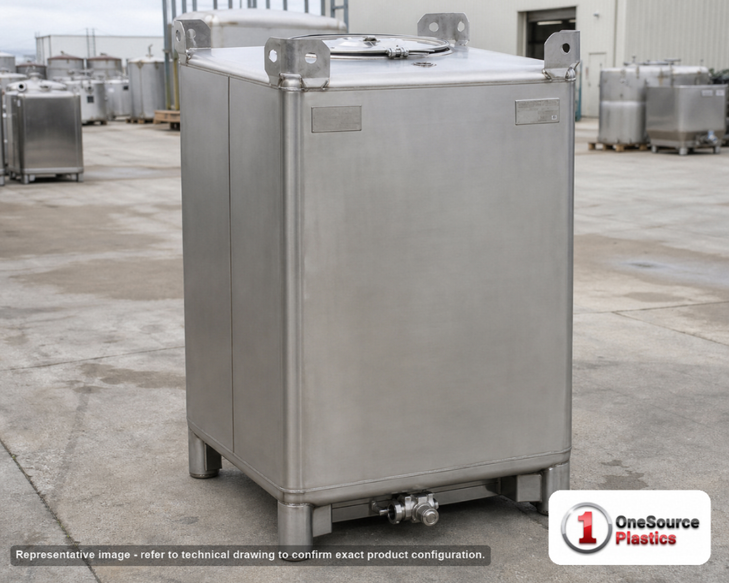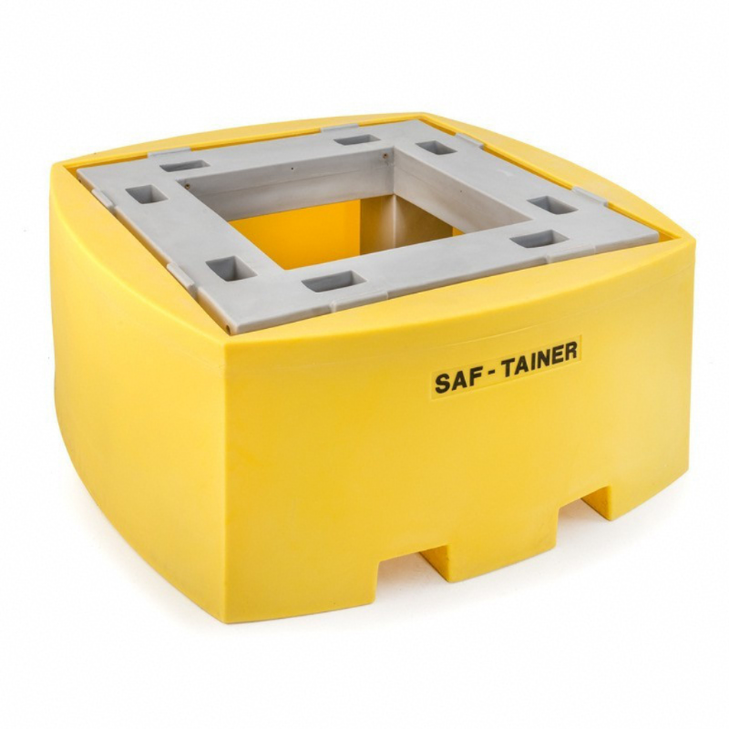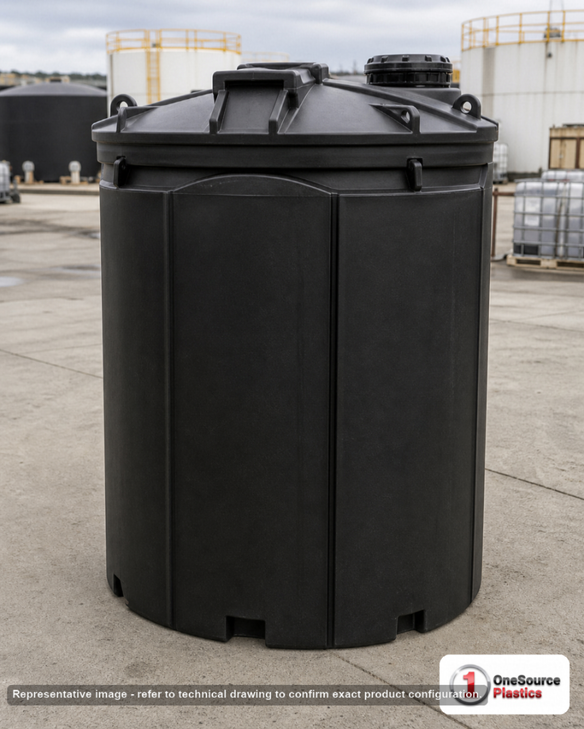
The black 500, rated to 120 F / 48 C
Two things set this part number apart from the natural white listing beside it on the identical shell, and the sheet states both plainly. The Snyder 5780102N51 is a 500 gallon double wall tank, listed as ASTM Black, molded in black high density linear polyethylene at 53 inches long by 53 inches wide by 81 inches tall and 290 pounds empty, with a service limit on this sheet of 120 F / 48 C. Those words in the name are the maker's name for the product and nothing further is claimed from them. The sheet gives one capacity, one set of overall dimensions, one empty weight and one rating for the whole assembly, with no separate inner tank figure, no separate outer figure, no annulus dimension and no containment percentage, so this page states none. The wall is rated at a specific gravity of 1.9, and the sheet gives 4,170 pounds for 500 gallons of water at 8.34 pounds per gallon with 7,923 pounds of max contents. The published opening is an 18 inch threaded vented manway; the outlet field reads "1 Manway / Lid", an opening rather than a pipe size, and the inlet field is blank. The warranty is a 3 Year Warranty. Freight is LTL at class 250 with no NMFC number, molded at Marked Tree, Arkansas.
Ordering for a plant or a bid? Request a written quote with freight to your ZIP for the file; a single 500 gallon tank goes straight to the cart above.
Daylight, a level floor and eighty-one inches of shell
Where this tank goes is decided by light first and by the floor second. The shell is black, which keeps daylight out of the contents, and that is the reason a site picks this part number over the natural white listing on the same 53 by 53 by 81 inch shell at the same 290 pounds. If the vessel stands under a skylight, beside a roller shutter that spends the day open, in a lit bay or outdoors under a canopy, the black wall is doing work that a white one is not. What it costs you is the level reading: on a white tank an operator sees the liquid through the shell from across the room, and on this one the only published opening is a manway at 81 inches, so decide how the level gets read before the tank is set rather than after. Then the floor. A 53 inch base carrying a shell nearly seven feet tall concentrates its load on under twenty square feet: 4,170 pounds of water and 7,923 pounds at the published 1.9 rating. The surface has to be flat, continuous and level under the entire footprint, with no rocking and nothing packed under one corner, and the tank wants securing against being knocked if it stands anywhere near a walkway. On a ground bearing slab that is routine. On anything raised, suspended or previously patched it is a question for whoever owns the structure, and it is cheaper to ask it before the order than after the vessel is plumbed. The way in is the third thing to settle on the site walk. Four and a half feet square will not pass a 36 inch doorway, so the entry is a shutter or a bay door, and the shipment is taller than the shell once it is on a pallet. Walk the route, measure the lowest lintel and the narrowest gap rather than the entrance, and plan for forks under the base with room to approach square, set down and reverse out. Leave a walking route round all four sides of the final position while you are at it; on a black tank you cannot see anything through the wall, so the outside of the shell and the base line are the only things there are to look at. Two engineering notes belong before the order. A polyethylene wall's hardest service is at the vapor line rather than under the liquid, and the wall thickness at the vapor saturated headspace guide sets out why an inspection from the liquid side misses it. The usable volume and the real headspace on a contained vessel are not the nameplate figure either, which is the subject of the double wall freeboard sizing guide. Put your own turnover through the tank sizing calculator and take the freeboard discipline from the tank sizing guide.
One shell, four names, two sizes either side
| Part | Name on the sheet | Gallons | Size and weight |
|---|---|---|---|
| 5780102N51 | this tank, ASTM Black | 500 | 53 x 53 x 81 in, 290 lb |
| 5780102N42 | ASTM XLPE, natural white | 500 | 53 x 53 x 81 in, 290 lb |
| 5780102N48 | ASTM XLPE Black | 500 | 53 x 53 x 81 in, 290 lb |
| SII-5780102N30 | named for sulfuric acid | 500 | 53 x 53 x 81 in, 290 lb |
| 5990702N42 | ASTM XLPE, smaller plan | 405 | 48 x 48 x 73 in, 250 lb |
| 5040000N30 | sulfuric acid Captor, wide and low | 550 | 76 x 76 x 65 in, 315 lb |
Four part numbers, one shell, four names. We print the name each sheet gives and interpret none of them, and where a drawing, a spares list or an existing installation already names one of these parts, order that one and we will confirm the published figures against it before anything ships. One of the four carries the SII- prefix on the sheet; that is how it is spelled and that is how we spell it. What you can act on from this table is color and proportion. Two of the four are black and two are not, and that is a decision about daylight rather than about chemistry. The service limits differ across the group as well, and each page prints its own: this sheet says 120 F / 48 C and the natural white listing on the identical shell says something else on its own sheet. Order against the figure printed on the part number you actually buy. The two other rows move in opposite directions. 5990702N42 holds 405 gallons on a 48 inch plan at 73 inches and 250 pounds, which is the same idea one step down: a little less of everything, and the row to take when the aisle is tight or the ceiling is low. 5040000N30 holds 550 gallons but does it on a 76 inch plan at only 65 inches, weighing 315 pounds, which is a completely different tank for barely more volume. It trades height for floor. If your hard constraint is the roof, that row wins outright. If it is the slab, this tank is the one that holds 500 gallons in the corner of a room that is already full, and that is the case it makes.
Need the taller or the wider one? Every row links to its page with freight to your ZIP on each; 866-418-1777 will check the ceiling and the pad.
What the eighteen inch opening carries
- The outlet: the field reads "1 Manway / Lid", which is the name of an opening and not a pipe size, and the inlet field is blank. No outlet dimension, thread, bulkhead, flange or valve is published on this sheet, so none is claimed here. Tell us the duty, the line size and the pump and we will confirm what this part number carries before anything is ordered.
- The opening: an 18 inch threaded vented manway, and the only one on the sheet. It is the fill point, the inspection point and the cleaning access all at once, so everything you want on top shares it and the arrangement is worth drawing before the tank is set.
- Reaching it: the manway sits at 81 inches. On a black shell you cannot read the level from the floor either, so the access arrangement and the level indication should be designed together rather than separately.
- Pump arrangement: with the published route in and out at the top, the usual layout at this size is a suction line and strainer dropped through the manway to a pump alongside. Keep the suction short, set the strainer clear of the bottom so the settled last inch is not the first thing it lifts, and carry the hose on its own bracket rather than on the manway rim.
- The vent: the manway is listed as vented, and that path is the wall's protection on a fast fill and a hard pump down. Keep it clear, inspect it whenever the manway is open, and never restrict it to hold an odour.
- The space between the walls: no monitoring port, gauge or alarm is published, and no stand, legs or level device either. That arrangement is specified separately; a scheduled look with the date written down is the minimum worth having.
- Limits: 120 F / 48 C, a specific gravity rating of 1.9, and a 3 Year Warranty, as this sheet gives them.
Tell us the product at order time. On a contained vessel the wetted parts are the only route a release can take, and they are chosen against the chemistry rather than against a catalogue default.
Feed points where the light gets in
A black contained tank of this capacity goes where a white one would be working against the light: a dosing point under an open canopy, a wash bay or vehicle wash with the shutter up all day, an agricultural or horticultural chemical store, a plant room with a skylight over it, a quarry or wash plant reagent station, a metal finishing line beside a window, and any yard-side feed point where the vessel stands outdoors but a release still has to be contained. Five hundred gallons on a corner-sized footprint is the practical part: it takes a hose fill, it needs no bund constructed round it, and it occupies a corner rather than a bay. Where it is outside, walk round it after weather and after any traffic near it, and keep the schedule for looking into the space between the walls the same in winter as in summer. The one thing to arrange deliberately is level indication, because a black wall gives you none; agree at the same time who watches the fill, where the connection is made and what the stop level is.
Two hundred and ninety pounds, one pallet position
Marked Tree, Arkansas is the plant on this sheet and Arkansas the only ship-from state, so the mid-South is the short lane and the coasts are a planned move. Freight is LTL at class 250 with no NMFC number, and the shipping size is listed at 53 by 53 by 81 inches at 290 pounds. Price your own lane with the freight cost estimator; the listed price is before freight. The weight is modest for the bulk, so plan around the dimensions: measure the lintels, the shutter and any overhead pipework on the route, and remember that a shell of nearly seven feet is taller again sitting on a pallet. Take it under the base, never by the manway, and keep it upright through the building where the route allows. Set it on the finished, level surface in its final position, check it is plumb from two directions and secure it before anything is connected. Fill it with clean water, hold the 4,170 pound load, and read the manway seal and the base all the way round. Drain it, let it dry, open the space between the walls and record the date on the shell. Then do one extra thing while the water is still in it: mark the outside of the shell at your working full level and at your stop level in paint, because from that day on nobody is going to see it through the wall. A strap that is checked once a season is a strap that holds; put it on the same calendar as the gutters.
Freight and documents
Ships from: Marked Tree, AR. LTL freight is quoted to your ZIP with the freight cost estimator or by phone at 866-418-1777. The listed price is before freight.
Technical drawing (PDF) for Snyder Industries 5780102N51.
See this tank
Interactive 3D model with live fill. This tank has an interactive 3D model built to its manufacturer dimensions. Rotate it, and set a fill level to see how much liquid it holds at any height. Open the 3D view on the product photo above. Download the 3D model (GLB).
Ready to order?
Add it to your cart at the top of this page, get LTL freight to your ZIP, request a written quote, or call 866-418-1777. The listed price is before freight.