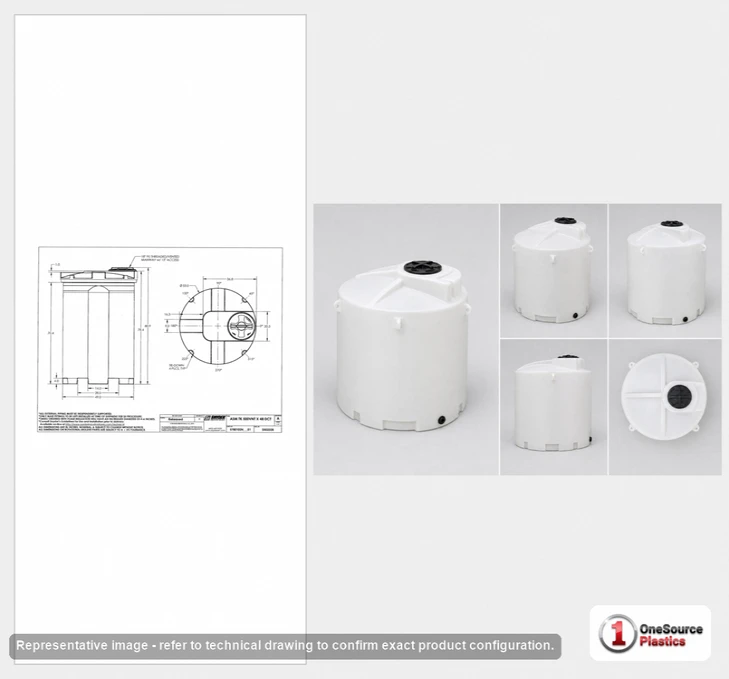
Five hundred and fifty gallons with eight lifting lugs
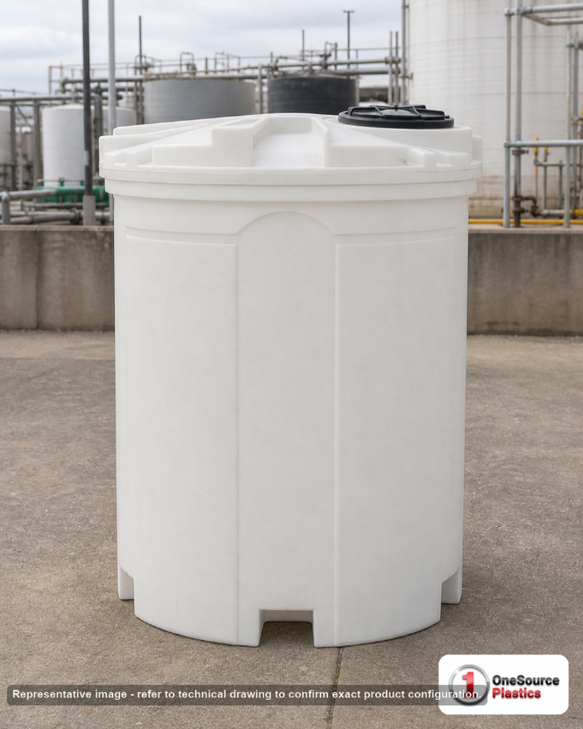
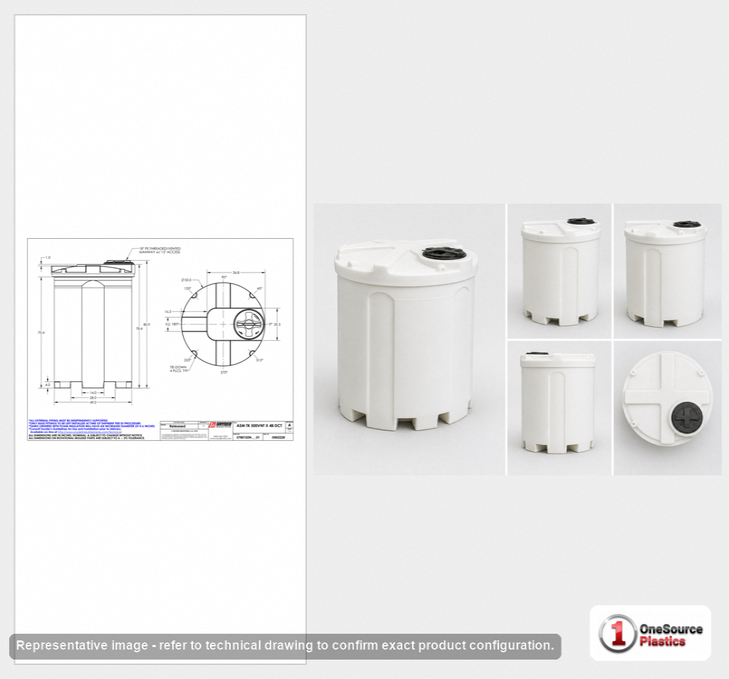
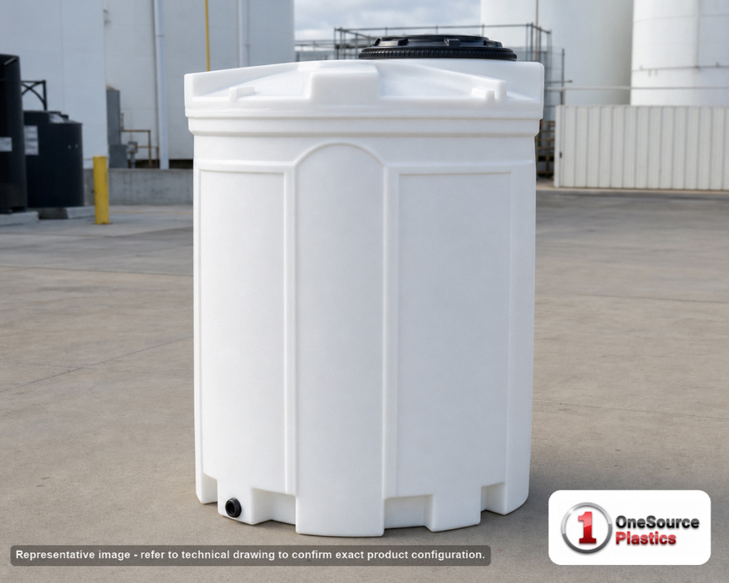
The Snyder 5040000N30 is a 550 gallon double wall tank, listed on its sheet as a Sulfuric Acid Captor. Captor is Snyder's product name for this containment range and the chemical named in the listing is the maker's name for it; this page carries no strength, no concentration and no compatibility claim, because the sheet carries none. It is moulded in opaque white high density linear polyethylene at 76 inches long by 76 inches wide by 65 inches tall and 315 pounds empty. One capacity, one envelope, one weight and one rating are published for the whole assembly, with no separate inner tank figure, no separate outer containment figure, no annulus dimension and no containment percentage, so none is stated here. The wall is rated at a specific gravity of 1.9, and the sheet gives 4,587 pounds for 550 gallons of water at 8.34 pounds per gallon with 8,715 pounds of max contents. The published opening is an 18 inch threaded vented manway; the outlet field reads "1 Manway / Lid", which names an opening and not a pipe size, and the inlet field is blank. Unusually for this range the sheet does publish a structural record: 8 lifting lugs, ladder lugs and one flange line. The service limit is 120 F / 48 C and the warranty is a 3 Year Warranty. Freight is LTL at class 300 with no NMFC number, moulded at Philippi, West Virginia.
Need it before the next delivery? Call 866-418-1777 for the ship date, or get freight to your ZIP and add it to your cart above now.
Point of dosing duty where a bulk tank is too much tank
Think about the duty before the dimensions, because 550 gallons is a deliberate answer to a specific problem. It is the quantity a site holds at the point the chemical is used, rather than at the point it is received: a metering skid on a package water treatment plant, a dosing room at a small municipal works or a lift station, a clean-in-place chemical store in a food, beverage or dairy plant, a plating or metal finishing line, a wash rack or vehicle wash feed point, and pilot or batch production that changes product between campaigns. Those sites draw steadily but slowly. A bulk vessel would leave the same liquid sitting for months, and chemistry that sits is chemistry that separates, settles or drifts. Five hundred and fifty gallons turns over, takes a part load or a small tanker drop, and still gets the bulk chemical cost per gallon well below what drums cost. The containment case is simpler here than at bulk sizes and it is usually the deciding argument. A dosing room has a finished floor, floor drains that go somewhere expensive, and no space to construct a bund. This vessel brings its own second wall, so nothing is poured, coated or detailed, and the containment goes with the tank if the skid is moved. The sheet publishes one assembly and no containment percentage, and where a written plan needs a held volume we ask the maker rather than derive one. This sheet also does something most of the range does not: it publishes a structural record of 8 lifting lugs, ladder lugs and one flange line. That is worth knowing before the site walk, because lifting lugs change how the tank is set and mean the rigging plan is not limited to forks under the base. The pad still matters. A 76 inch square base carries 4,587 pounds of water and 8,715 pounds at the published 1.9 rating; flat, continuous, level, no rocking, nothing shimmed. The concrete pad sizing guide for above ground polyethylene tanks covers the framework, and at 65 inches tall this is a low, stable vessel that asks less of the slab than the tall ones in this family do. Size it on consumption rather than on the space available: put your own draw and drop size through the tank sizing calculator, take the freeboard rule from the tank sizing guide, and read the Captor double wall freeboard sizing guide before you treat the nameplate figure as usable volume. If the second wall is going into a written spill prevention plan, our Captor double wall spill prevention walkthrough is where to take it; nothing here claims a rule, a listing or an approval.
Four 550s on one shell, a 500 and a 750
| Part | Gallons | Length x width x height | Empty weight |
|---|---|---|---|
| 5040000N30 (this tank, named Sulfuric Acid Captor) | 550 | 76 x 76 x 65 in | 315 lb |
| 5040000N48 (named ASTM XLPE Captor Black) | 550 | 76 x 76 x 65 in | 315 lb |
| 5040000N51 (named ASTM HDPE Black Captor) | 550 | 76 x 76 x 65 in | 315 lb |
| SII-5040000N42 (natural white, listed at a different weight) | 550 | 76 x 76 x 65 in | 670 lb |
| 5780102N42 (smaller, tall and narrow, named ASTM XLPE) | 500 | 53 x 53 x 81 in | 290 lb |
| 5990902N30 (larger, wider and taller, named Sulfuric Acid) | 750 | 73 x 73 x 67 in | 390 lb |
Four listings share this 76 by 76 by 65 inch shell and the names on them cross between sulfuric acid and the maker's ASTM, XLPE and HDPE name words. We print each name as the sheet gives it and interpret none of them. Two details in this table are real and worth acting on. The first is that SII-5040000N42 is spelled on the sheet with a prefix the others do not carry, and it is listed at 670 pounds where the other three 550s are 315. Both the spelling and the weight are printed exactly as published, because a part number ordered against a drawing has to match character for character, and because the sheet gives that figure and explains nothing about it. The second is what the neighbouring sizes actually offer. 5780102N42 holds 500 gallons, only fifty fewer than this tank, but does it on a 53 inch plan by standing 81 inches tall at 290 pounds: far less floor, far more height, and a manway well above head height. 5990902N30 goes the other way, 750 gallons on a 73 inch plan at 67 inches and 390 pounds, which is nearly two hundred more gallons for a slightly smaller footprint and only two inches more height than this one. That last comparison is the one to make properly before you order. If the room can take it, the 750 is a great deal of extra capacity for very little extra anything else. If the draw does not justify the volume sitting there, this 550 is the right vessel and the turnover is the reason.
Need a different size? Every tank in the table is in stock programs; ask for a quote on the one that fits, or call 866-418-1777.
Discharge, strainer and the last inch in the bottom
- The discharge path: the outlet field reads "1 Manway / Lid" and nothing else, with the inlet blank, so no outlet dimension, thread, bulkhead, flange or valve is published on this sheet and none is claimed here. At this size the usual arrangement is a suction line and strainer dropped through the manway to a metering or transfer pump beside the tank. Tell us the duty, the line size and the pump and we will confirm what this part number carries before anything is ordered.
- The strainer and the last inch: set the strainer clear of the bottom so the settled inch is not the first thing the pump lifts, and give yourself a way to check it without draining the tank. On a 65 inch vessel the static lift is short and the pump is easy to keep primed, which is one of the quiet advantages of a low shell.
- Low level and dry running: the sheet publishes no level device or gauge of any kind. Fit a low level cut-out and decide at installation how the level gets read, because on a white shell the eye is the only indication you get for free.
- The opening: an 18 inch threaded vented manway, wide enough for a proper look at the wall, a lance and a drop pipe change-out. At 65 inches it is reachable from a single step rather than a platform, which is a genuine daily difference in a dosing room.
- The vent: the manway is listed as vented and that path protects the wall while a fill pushes air out and while the pump draws the level down. Keep it clear and inspect it whenever the manway is open.
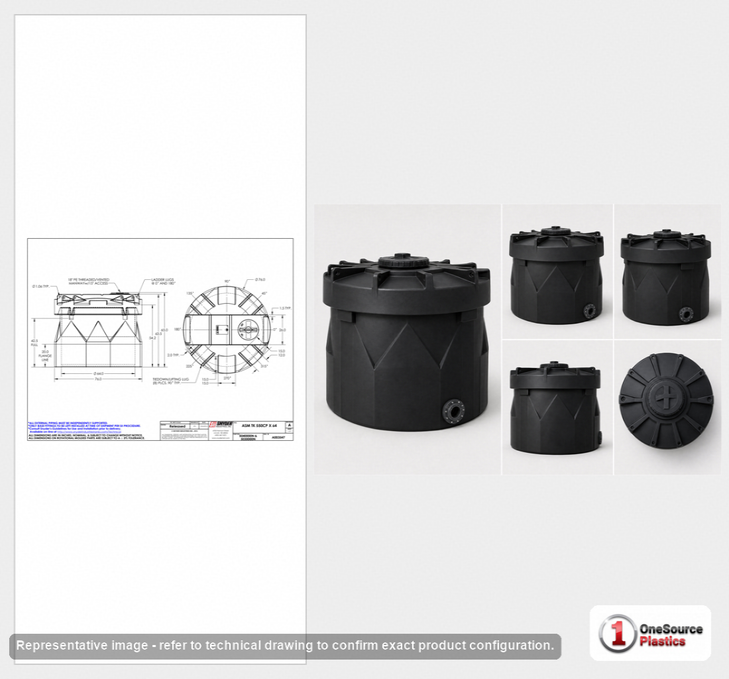
- Structure: this sheet publishes 8 lifting lugs, ladder lugs and one flange line. Use the rigging the lugs are there for and follow the maker's instructions for them; nothing beyond what the sheet lists is claimed.
- The space between the walls: no monitoring port, gauge or alarm is published, so that arrangement is specified separately. A scheduled look with a written date is the minimum worth having.
- Limits: 120 F / 48 C, a specific gravity rating of 1.9, and a 3 Year Warranty.
Name the product and its strength at order time. The manway seal and the suction fitting are effectively the whole wetted system on a tank drawn from the top, and letting either go generic is the mistake that matters.
Package plants, wash racks and small municipal works
Five hundred and fifty contained gallons is the working quantity at the point of dosing: a package or small municipal water plant, a lift station or a wastewater dosing room, a boiler house or cooling tower chemical station, clean-in-place storage in food, beverage and dairy, plating and surface finishing, a truck or rail wash rack, and quarry or wash plant reagent feed. It also turns up as the second tank on a site that already runs bulk storage of something else, sitting at the machine rather than at the yard so the product is not piped across the building. Where it is inside, put it where somebody walks past it daily; a contained tank in the corner behind the pallets is a tank nobody inspects. Where it is outside, keep the schedule for looking into the space between the walls the same in winter as in summer.
Philippi, West Virginia, three hundred and fifteen pounds
Philippi, West Virginia is the plant named on this sheet, and the sheet lists Mississippi and West Virginia as ship-from states against that single plant; both are printed as given and neither is explained. Freight is LTL at class 300 with no NMFC number, and the shipment is the tank at 76 by 76 by 65 inches and 315 pounds. Price the lane to your ZIP with the freight cost estimator; the listed price is before freight. At 315 pounds and a shade over six feet square this is a forklift or a pallet truck with a wide carriage rather than a crane, and the height is the easy part: at 65 inches it clears most roller shutters upright and rides a flatbed without a low bridge problem. Width is what to check on the route in. Take it under the base or with the rigging the published lugs are provided for, never by the manway. Set it on the finished, level pad in its final position before anything is plumbed, because a six foot square tank is not shuffled sideways once it is connected. Fill it with clean water, hold that 4,587 pound load, and read the manway seal, the base all the way round and the surface under it. Drain it, dry it, open the space between the walls and record the date on the shell. Then label it with the contents in paint marker the same day it is set, because an unlabelled chemical tank in a plant room is the one that eventually gets topped up with the wrong thing. Keep the first delivery's paperwork with the tank; strength and date on day one is the baseline for every batch after.
Freight and documents
Ships from: Philippi, WV. LTL freight is quoted to your ZIP with the freight cost estimator or by phone at 866-418-1777. The listed price is before freight.
Technical drawing (PDF) for Snyder Industries 5040000N30.
Ready to order?
Add it to your cart at the top of this page, get LTL freight to your ZIP, request a written quote, or call 866-418-1777. The listed price is before freight.