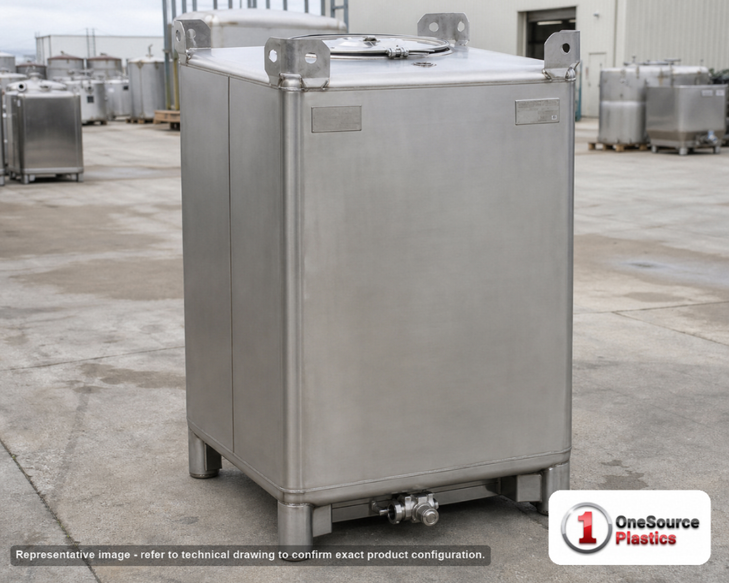
Six hundred and fifty pounds of empty 304 stainless
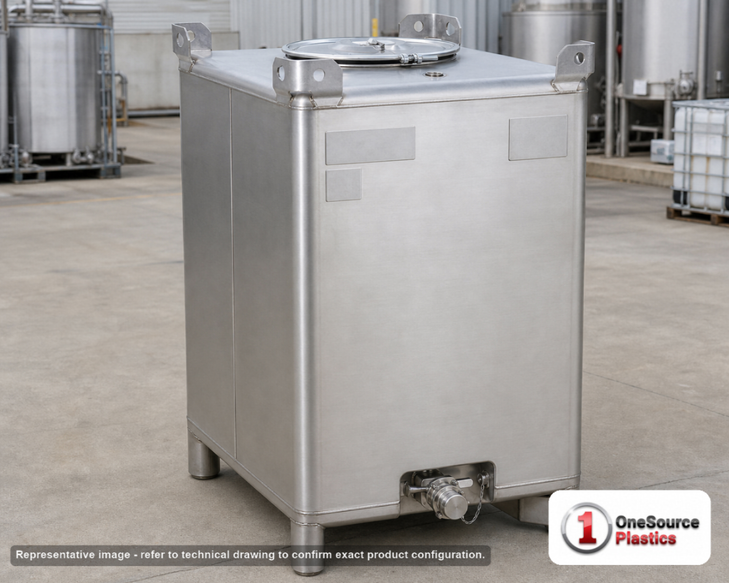
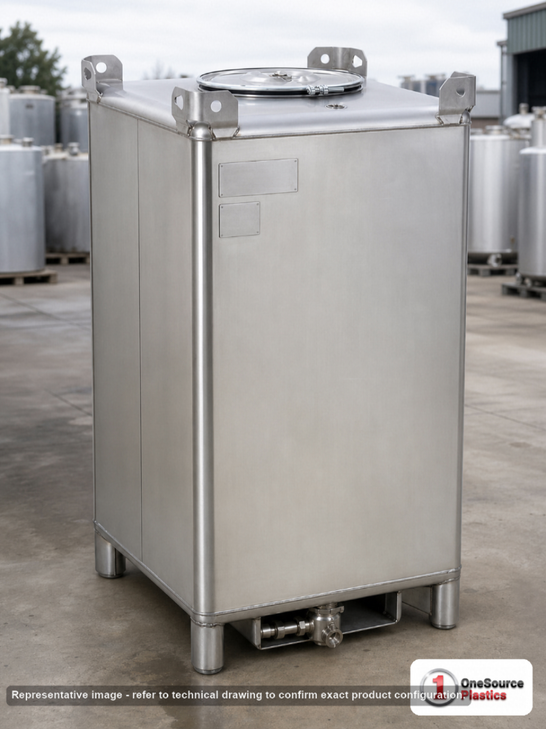
Six hundred and fifty pounds is what this vessel weighs before anything goes in it. The Snyder 6984500B51324 is a 550 gallon 304 stainless steel Supertainer IBC tote tank in silver, listed at 42 inches long, 48 inches wide and 71.25 inches tall. Steel means no resin, no wall grade, no cross-link and no specific gravity rating on this page, because the sheet gives none. Its fittings are the family set: a 2 inch access port as the inlet, a 2 inch 316 stainless ball valve as the outlet, and a 22 inch vented manway. The sheet gives 4,587 pounds for 550 gallons of water at 8.34 pounds per gallon. It publishes no maximum operating temperature, no warranty term, no max contents, no plant and no NMFC number, so this page states none, and it claims no pressure rating, no stacking load, no fork pocket and no transport approval of any kind. Freight class 125.
Ready to price it? The listed price is before freight; quote freight to your ZIP in a few seconds, then add to cart above or call 866-418-1777.
What separates 51324 from the 32213 beside it
Take the family apart before the site, because the sheet puts four 550 gallon records in front of you and only one column tells them apart. This tote, 6984500B51310 and 6984500B51320 are all given at 42 by 48 by 71.25 inches and 650 pounds. 6984500B32213 is the same shell at 612 pounds. Thirty-eight pounds of listed empty weight is the only published difference in the group, the sheet offers no reason for it, and we offer none either. What that means in practice is simple: order the part number your drawing, your spares list or your existing fleet already names, and ask us to confirm the record against the part before it ships. Where the weight does become a real question is in handling, and it is worth doing the arithmetic properly rather than by feel. This vessel is 650 pounds empty and the sheet gives 4,587 pounds for a full charge of water, which is what the forklift, the pallet racking, the mezzanine deck, the trailer floor and the bund grating all have to take together. Any one of those with a rating you have not checked is the weak link, and none of them cares which of the four part numbers you bought. The other genuine decision on this sheet is the step down to the 446 gallon 6984400B32210, which sits on the identical 42 by 48 inch plan at 59.25 inches and 542 pounds. Same floor, a foot shorter, a hundred and eight pounds lighter empty, about a hundred fewer gallons. Where a lift capacity, a deck rating or a clear height is already marginal, that step solves it without costing you any floor. Match the volume to the way your product actually arrives in the tank sizing calculator, leave the headspace the tank sizing guide asks for, and where the real question is drum against tote against fixed tank, the container against tank buying guide settles it on turnover and handling.
Three listings at 650 pounds and one at 612
| Part | Gallons | Length x width x height | Empty weight |
|---|---|---|---|
| 6984500B51324 (this tote, 304 stainless) | 550 | 42 x 48 x 71.25 in | 650 lb |
| 6984500B51310 (same shell, same weight) | 550 | 42 x 48 x 71.25 in | 650 lb |
| 6984500B51320 (same shell, same weight) | 550 | 42 x 48 x 71.25 in | 650 lb |
| 6984500B32213 (same shell, 612 lb on the sheet) | 550 | 42 x 48 x 71.25 in | 612 lb |
| 6984400B32210 (the size below) | 446 | 42 x 48 x 59.25 in | 542 lb |
This table has one interesting column and it is the last one. Everything else about the four 550 gallon records is identical down to the quarter inch: 42 by 48 by 71.25, four times over. The weights read 650, 650, 650 and 612. We print all four as the sheet prints them, and we will not tell you what the 612 means, because the sheet does not and a guess put in print gets quoted back as fact six months later. If your specification is written around a weight, ask us to verify the figure against the actual part before it ships rather than against the listing. The fifth row is where the weight column starts to be useful rather than puzzling. 6984400B32210 is 542 pounds empty against this vessel's 650 and holds 446 gallons on exactly the same 42 by 48 inch plan, twelve inches shorter. That is a real reduction on every lift, every deck and every rack beam in the building, and it costs you about a hundred gallons of working volume. Nobody should buy the shorter tote for the sake of it, but anybody working to a marginal lift capacity, a suspect mezzanine or a low door should price both before assuming the bigger one fits. The right question is not which vessel holds more, it is which one your building and your equipment can handle full without a conversation.
Want us to check the fit? Send the site dimensions to 866-418-1777 or through a written quote request and we will confirm the tank, the pad and the freight.
Headspace first, then the valve at the bottom
- Headspace and the vent: the 22 inch manway is listed as vented, and the air space above the liquid is what absorbs a warm afternoon or a product that gasses. On a 71.25 inch column the vent is also what lets 550 gallons leave through a 2 inch valve without the vessel fighting it. Keep the path clear and inspect it whenever the top is open.
- Filling to a line, not to the rim: the nameplate volume is not the volume to the manway. Decide the working fill before the first delivery and mark it, so nobody has to judge it from the top of a ladder.
- The opening: 22 inches is wide enough for a wash head, a lance, a strainer and an arm with a light, which is what makes this vessel cleanable between products rather than only rinsable.
- The inlet: a 2 inch access port as listed. Tell us what your delivery hose ends in and we will confirm the coupling arrangement against this part number.
- The outlet: a 2 inch 316 stainless ball valve, in the same corrosion-resistant family as the shell it drains. With 4,587 pounds above it when the vessel is full, whatever hangs on the valve gets its own support and a flexible connection at the first joint.
- Limits: no service temperature, no warranty, no pressure rating and no stacking load is published, so none is claimed.
Where the valve feeds a metering pump rather than a hose, the suction geometry, the drip tray and the leak detection belong in the design from the beginning; the pump skid design guide for tank-fed dosing takes them in the order they should be decided.
Process lines that draw 550 gallons down slowly
This size suits a duty that empties over days rather than minutes: a dosing or metering line fed continuously from a bulk vessel, a blending room that draws a measured quantity per batch, a beverage or dairy plant holding an intermediate between steps, a coating, ink or adhesive works feeding a mixer, and laboratory or pilot operations scaling a formulation up. A slow draw is exactly the case where the vent path earns its place, because the vessel spends most of its life partly empty with air moving through the top. It is also the case where reusability pays, since a steel vessel that is washed and put back in service beats a disposable one that leaves the site every few weeks. Look the product up in our chemical compatibility tables before ordering, so the manway seal and the valve seat are picked on the chemistry rather than on the vessel.
Class 125 from a 42 by 48 inch base
Freight class on this sheet is 125, with no NMFC number and no plant listed, so no origin and no lane is named here. Price the move to your ZIP with the freight cost estimator; the listed price is before freight. It travels on its own 42 by 48 inch footprint at 71.25 inches tall, so confirm the door height and the trailer height before booking, and confirm the forklift can raise 650 pounds high enough to place it rather than only lift it. Take it off under the base, never by the 22 inch manway and never with a sling around the body. Set it on flat, level, continuous support in its working position first, then fill with clean water and hold the 4,587 pound load while you read the manway seal, the access port and the 2 inch valve joint. Check the deck, the rack beam or the grating it stands on with the water still in it, because a rating that looks fine on paper shows what it really thinks under a full vessel. Where the contents are a regulated waste, the secondary containment rule for hazardous waste tank systems sets out the leak detection options and the inspection cadence that go with the vessel. Record the empty weight from the sheet alongside the part number in your asset register the day it arrives; when somebody later asks whether the mezzanine takes another one, that is the figure they will need. A photo of the tank on its pad, full, on day one is worth keeping; it is the baseline every later inspection is compared against.
Freight and documents
Ships from: Marked Tree, AR; Merced, CA; Lincoln, NE. LTL freight is quoted to your ZIP with the freight cost estimator or by phone at 866-418-1777. The listed price is before freight.
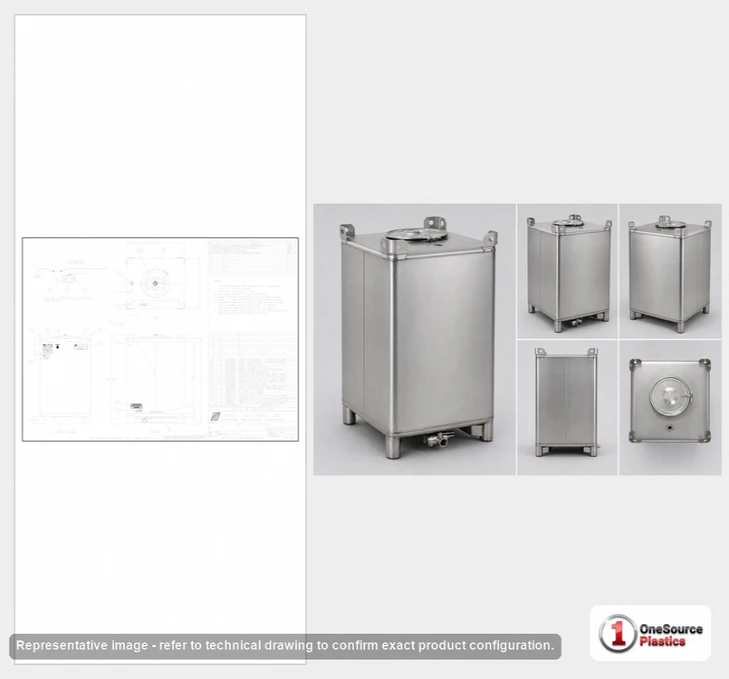
Technical drawing (PDF) for Snyder Industries 6984500B51324.
Ready to order?
Add it to your cart at the top of this page, get LTL freight to your ZIP, request a written quote, or call 866-418-1777. The listed price is before freight.