Five thousand eight hundred gallons, open at the top, ten feet across
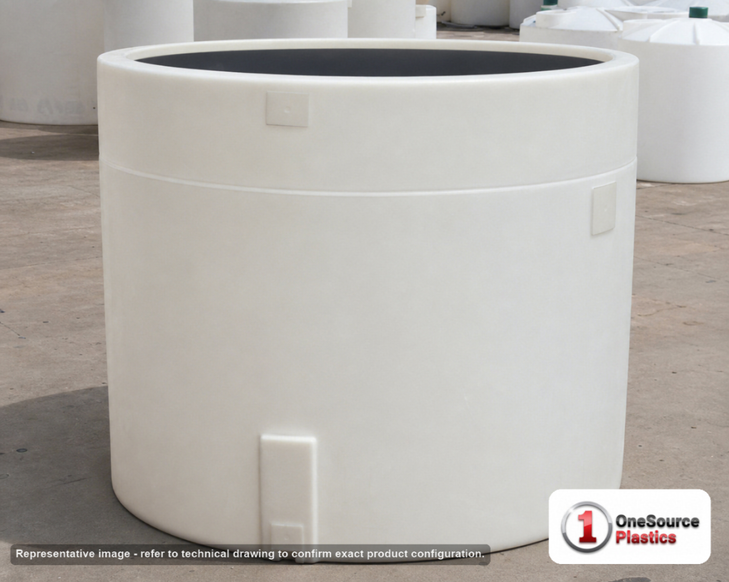
The Snyder SII-5960000N45 is a 5800 gallon open top batch storage tank listed at 120 inches long, 120 inches wide and 125 inches tall, at 1,500 pounds empty. That is a ten foot circle standing a little over ten feet tall, which is a large vessel by any measure and an unusually accessible one, because the top is open. The sheet publishes no lid, no manway, no cover, no outlet and no inlet, so this page claims no seal, no vent and no closure of any kind. The wall is rated at a specific gravity of 1.9, given on the sheet as 1.9 (Max 15.87 lbs/gal), and the sheet gives 48,372 pounds for 5,800 gallons of water at 8.34 pounds per gallon with 91,907 pounds of max contents. The service limit is 120 F / 48 C. There is no warranty term and no NMFC code on this sheet. Freight is given as OVS, an oversize mode rather than a numeric class, out of Lincoln, Nebraska.
Want a second opinion on the size? Call 866-418-1777 with the daily draw and the delivery interval, or price freight to your ZIP and add it to your cart above.
Why an oversize load out of Nebraska is the first thing to plan
Work backwards from the truck on this one, because the freight decides the project. This tank is moulded at Lincoln, Nebraska and moves as an oversize load: ten feet across and ten and a half feet tall, an object that is wider than a lane and taller than most doors before it is even on a trailer. That is a booked movement with a route, a delivery window and agreed unloading equipment, not a delivery that turns up on a Tuesday. It also means the destination has to be reachable by that vehicle, which is a site question people answer far too late. Walk the route from the road to the pad with the dimensions in your hand before the order, not after. Nebraska is a central lane, which helps: the plains and the Midwest are short, and both coasts are planned moves where the freight is a real line on the quotation rather than a rounding. Where it lands is the second half of the problem and it is permanent. The sheet gives 48,372 pounds of water and 91,907 pounds at the rating, spread over a ten foot circle, and a vessel that size is placed once. It wants a flat, continuous, level surface under the whole base with no point loads and no soft edge, and at these weights the foundation is an engineered element rather than a slab poured to look about right. The concrete pad sizing guide for above-ground polyethylene tanks gives the framework and is honest about where it hands over to a structural engineer. Then think about the open top, because it governs where this tank can stand. An open vessel is exposed to rain, snow, dust, sun and anything that falls or is dropped in, and at ten and a half feet the rim is well above head height, so access is a designed arrangement: a platform, a fixed ladder, an edge protection scheme and a way for an operator to look in without leaning over. Decide all of that with the pad, not afterwards. Size the volume against your real turnover in the tank sizing calculator and take the freeboard from the tank sizing guide; an open vessel that is mixed, aerated or filled fast needs the top of the shell kept free. Where the contents give off vapour, the guide to wall thickness at the vapor saturated headspace explains why liquid-side inspection misses what happens above the waterline, and where the duty is captured or recycled water, the industrial water reuse tank topology guide sets out how quality-banded storage trains are sequenced. For standing water held against a fire, the fire-water reservoir design guide is the sizing discipline to read first.
The same ten foot plan at three heights
| Part | Gallons | Length x width x height | Empty weight |
|---|---|---|---|
| SII-5960000N45 (this tank, rated 1.9) | 5800 | 120 x 120 x 125 in | 1,500 lb |
| SII-5960000N42 (same shell, same weight) | 5800 | 120 x 120 x 125 in | 1,500 lb |
| SII-5220300N45 (same plan, shorter) | 4750 | 120 x 120 x 101 in | 600 lb |
| SII-5970000N45 (same plan, taller, named a containment tank) | 6900 | 120 x 120 x 145.6 in | 1,900 lb |
Every row here stands on the identical 120 inch plan, so the entire family is a height decision on one footprint, and that is genuinely convenient: the pad, the access arrangement and the delivery problem barely change between them. The first two rows are the same shell at the same 125 inches and the same 1,500 pounds under two part numbers, and the sheet explains nothing about what separates them; we print the listing and leave the interpretation alone, so where a drawing or an existing installation already names one, match that number. The row worth studying is SII-5220300N45. It holds 4,750 gallons at 101 inches tall and is listed at 600 pounds, which is dramatically lighter than this tank for a shell only two feet shorter on the same plan. The sheet does not explain that either, and we will not guess at it, but it is the row to ask about if the difference matters to your duty or your budget. Above, SII-5970000N45 reaches 145.6 inches and 6,900 gallons at 1,900 pounds, and its own name calls it a containment tank rather than a batch storage tank. That is a different named purpose and we print it as named. What the family tells you to do is straightforward: settle the pad and the access platform for the 120 inch plan once, then choose the height that matches the volume you actually turn over. Going taller later costs nothing in floor space. Going wider would cost you the whole installation.
Not sure which one? Tell us the liquid, the site and the ceiling height at 866-418-1777, or request a written quote with freight to your ZIP.
An open top: no lid, no manway and no outlet on this sheet
- The top: it is open, and that is the product. The sheet gives no lid size, no manway, no cover and no gasket, so this page claims no seal, no vent and no closure. What that buys you is complete access from above: a mixer can be mounted over it, a level can be read by eye, a hose or a chute can be dropped straight in, and the interior can actually be seen and cleaned. What it costs you is exposure to the weather and an open edge at a height that demands a designed access arrangement.
- Rain and evaporation: an open ten foot circle collects whatever falls on it and gives up vapour from the surface. Both belong in the operating plan, especially outdoors, and both change your effective working volume through the year.
- The outlet: no outlet, no inlet, no bulkhead and no valve is published, so no size or position is claimed. Settle it at order time: tell us the liquid, how the tank is filled, how it is emptied and the line size you need, and we will confirm what this part number carries.
- What hangs on the wall: a mixer, a ladder, a level device or a pipe run is carried on its own structure and never on the tank. With 91,907 pounds of max contents, the shell has one job.
- Access at height: the rim stands at 125 inches. Platform, fixed ladder, edge protection and a safe way to look in are designed alongside the pad rather than added after somebody has already climbed something.
- Limits: 120 F / 48 C, a specific gravity rating of 1.9 given as 1.9 (Max 15.87 lbs/gal), and no warranty term on this sheet.
Tell us the liquid and how it gets in and out when you order. On an open vessel this size, the fill arrangement and the draw-off arrangement are the design, and the tank is the easy part.
Batch storage worked from above rather than pumped blind
Open top vessels at this volume are bought where somebody has to get at the contents: batch make-up and blending on a process line, flocculant and polymer preparation at a water or wastewater works, wash, rinse and process water holding at a food, beverage or produce plant, leachate, washdown and reclaim collection at an industrial site, agricultural and horticultural mixing where the tank is loaded by hand as well as by hose, and mineral or slurry duty where the vessel is agitated and inspected constantly. The reason to accept an open top at ten feet of height is always the same: you can put a mixer over it, look into it, sample it, and clean it out properly, and none of those is comfortable through an eighteen inch hole. The reason to think twice is equally simple: the contents are open to the sky and to the room. If the liquid is volatile, odorous, valuable, temperature sensitive or attractive to birds and vermin, an open vessel puts all of that on your daily routine rather than on the tank. Decide which of those two arguments is the one that matters at your site, and the rest of the specification follows.
Lincoln to site, fifteen hundred pounds, oversize
The sheet lists Lincoln, Nebraska as the plant and gives the freight class as OVS with no NMFC code at all, so this moves as an oversize load and is quoted as one. Price the lane to your ZIP with the freight cost estimator; the listed price is before freight. The weight is the easy part at 1,500 pounds; the geometry is not. Ten feet across and ten and a half feet tall needs a machine with the reach and the clearance to take it off a trailer in one movement and set it down without dragging, which means the yard, the approach and the crane or telehandler are agreed before the tank leaves the plant rather than argued about on the day. Take it by the body. Never lift, drag or lever an open top tank by its rim; the rim is the edge of an open shell and it is not a lifting point. Set it on the finished, cured, level pad in its final position, because nothing about this tank is repositioned casually once it is down. Then commission it properly: fill with clean water, hold the 48,372 pound load, and walk the full circumference at the base twice, once on the day and once the next morning. On a ten foot plan the pad tells you what it thinks at the outside edge first, and a hairline you can see on day two is information you will never get again. Mark the water line on the outside of the shell before you drain it; that line is the reference every future reading is checked against. Chalk the full-water line on the outside after the first fill; it is the level every later reading gets checked against.
Freight and documents
Ships from: Lincoln, NE. LTL freight is quoted to your ZIP with the freight cost estimator or by phone at 866-418-1777. The listed price is before freight.
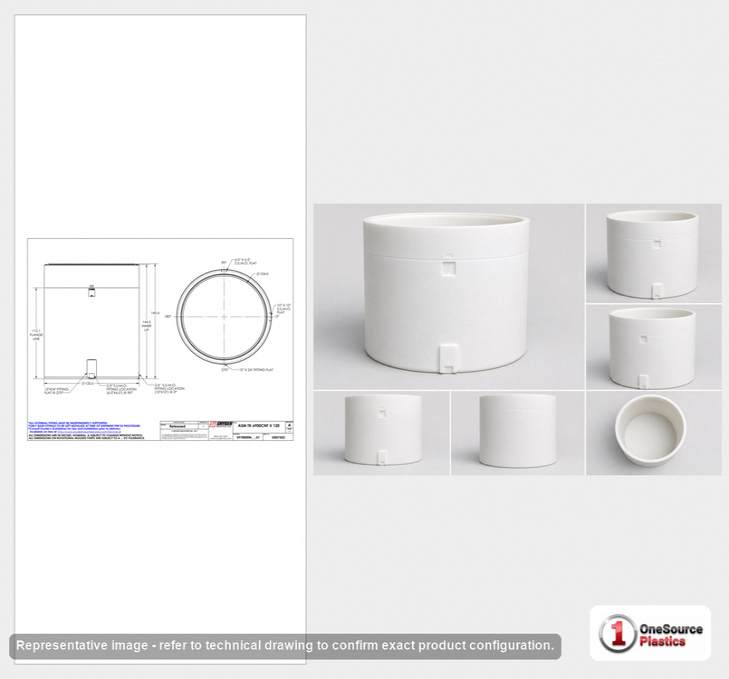
Technical drawing (PDF) for Snyder Industries 5960000N45.
See this tank
Interactive 3D model with live fill. This tank has an interactive 3D model built to its manufacturer dimensions. Rotate it, and set a fill level to see how much liquid it holds at any height. Open the 3D view on the product photo above. Download the 3D model (GLB).
Product video. Watch the Snyder Industries 5800 Gallon HDPE Open Top Batch Storage Tank 1.9 S.G. video (69 seconds) with dimensions, fittings and shipping notes.
Ready to order?
Add it to your cart at the top of this page, get LTL freight to your ZIP, request a written quote, or call 866-418-1777. The listed price is before freight.