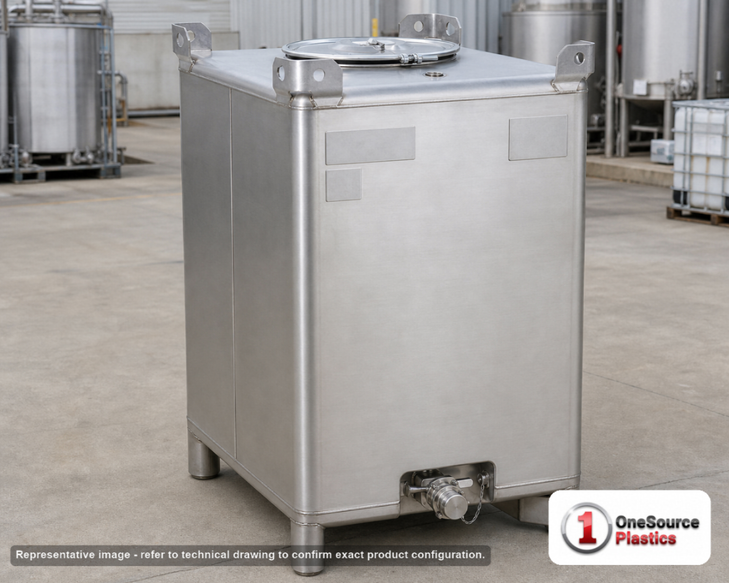
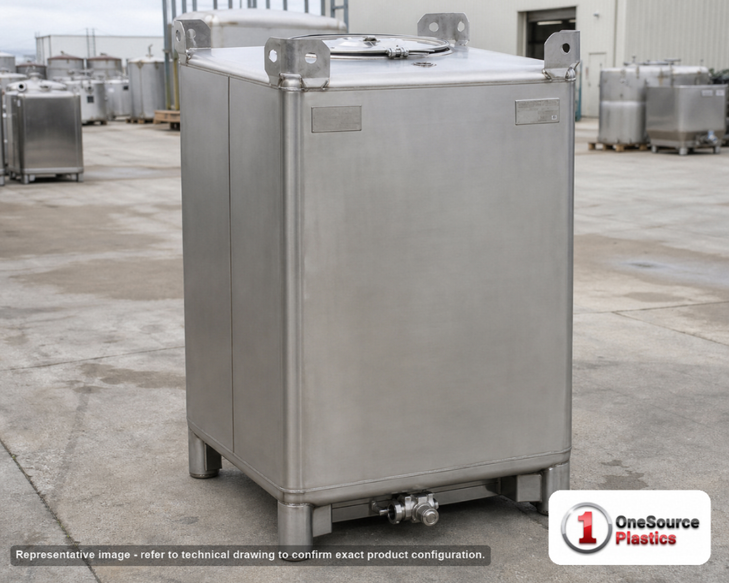
The black 750, five and a half feet tall
The Snyder 5990902N51 is a 750 gallon double wall tank, listed on its sheet as ASTM Black, moulded in black high density linear polyethylene at 73 inches long by 73 inches wide by 67 inches tall and 390 pounds empty. Those words in the name are the maker's name for the product; nothing further is claimed from them. The sheet publishes one capacity, one set of overall dimensions, one empty weight and one rating covering the whole assembly, and carries no separate inner tank figure, no separate outer containment figure, no annulus dimension and no containment percentage, so none of those appears below. The wall is rated at a specific gravity of 1.9, and the sheet gives 6,255 pounds for 750 gallons of water at 8.34 pounds per gallon with 11,884 pounds of max contents. The opening is an 18 inch threaded vented manway; the outlet field reads 3/4, printed as the field stands, and the inlet field is blank. The service limit is 120 F / 48 C and the warranty is a 3 Year Warranty. Freight is LTL at class 300 with no NMFC number, moulded at Chowchilla, California.
Need it before the next delivery? Call 866-418-1777 for the ship date, or get freight to your ZIP and add it to your cart above now.
Daylight, an open shutter, and where black earns its keep
Where this one goes is decided by light before it is decided by anything else. The shell is black, and on a shell identical in every published dimension to the natural white listing beside it, colour is the difference you are buying. If the tank stands under a skylight, beside a roller shutter that is open all day, under an open canopy, or outdoors in a yard, a black wall keeps daylight off the contents where a pale one does not. That is the case for this part number in one sentence. What it costs you is the level reading. On a white shell an operator sees the liquid through the wall from across the bay; on this one the only published opening is an 18 inch manway on top, so how the level gets read has to be designed with the installation rather than discovered after it. The ground comes next. The base is 73 inches square, just over six feet each way, and the shell is 67 inches tall, which is a low, broad object that spreads its load. The surface underneath still has to be flat, continuous and level across the whole footprint, with no rail, no timber left under it and no shim at a corner, because above it sits 6,255 pounds of water at 8.34 pounds per gallon and 11,884 pounds at the published 1.9 rating. On a ground bearing slab that is straightforward; on anything raised, suspended or previously patched, the support is a calculation somebody signs rather than an assumption made on the day. The height works in your favour once it is in place. At 67 inches the manway sits within reach from a low step, which means fills get connected and the inside gets inspected without a fixed ladder or a fall protection arrangement to maintain, and a 96 inch ceiling leaves working room above the opening. Getting it there is the harder half: a 73 inch shipment does not pass a 36 inch doorway, so the route in is a shutter or a bay door, and the narrowest point on that route is the measurement that matters, not the entrance. Leave a walkway round all four sides of the final position; the side nobody can see is the side that develops a weep, and this tank has a lot of side. Before you commit to this capacity rather than the sizes either side of it, settle the volume honestly. The usable capacity and the real headspace on a contained vessel are not the nameplate number, which is what the double wall freeboard sizing guide works through on thermal expansion, chemistry and density. Then put your own truck quantity and turnover through the tank sizing calculator and take the freeboard discipline from the tank sizing guide.
One shell, four listings, two colours
| Part | Gallons | Length x width x height | Empty weight |
|---|---|---|---|
| 5990902N51 (this tank, named ASTM Black) | 750 | 73 x 73 x 67 in | 390 lb |
| 5990902N30 (named Sulfuric Acid) | 750 | 73 x 73 x 67 in | 390 lb |
| 5990902N42 (named ASTM XLPE) | 750 | 73 x 73 x 67 in | 390 lb |
| 5990902N48 (named ASTM XLPE Black) | 750 | 73 x 73 x 67 in | 390 lb |
| 5040000N30 (smaller, named Sulfuric Acid Captor) | 550 | 76 x 76 x 65 in | 315 lb |
| 5990102N30 (larger, named Sulfuric Acid) | 1000 | 81 x 81 x 69 in | 500 lb |
Four listings, one 73 by 73 by 67 inch shell, one weight of 390 pounds, and four different names and material fields. None of those names is explained on the sheet and none is explained here, because guessing a specification out of a name is how the wrong vessel ends up in a plant room. Tell us what goes in it and at what strength and we will name the part number to order. Two of the four are black and two are not, and that is a daylight decision you can make on your own: black keeps the light off the contents, pale lets you read the level through the wall. This listing is black and its sheet publishes a service limit of 120 F / 48 C, where the cross-linked natural white listing on the same shell publishes a higher figure on its own sheet. Each page cites the figure printed against its own part number and borrows nothing from a twin, because the only number that will ever matter to you is the one on the sheet you ordered against. The two size steps are worth studying because this family does not scale the way you would expect. The 550 gallon Captor row is wider at 76 inches square and shorter at 65 inches, so it costs volume without saving floor. The 1000 gallon row is 81 inches square and 69 inches tall at 500 pounds, which buys a third again as much held volume for a few inches in each direction and a taller shipment. Measure the ceiling and measure the floor you can give up. Whichever of the two is the constraint you cannot argue with will pick the row for you, and it is almost never the gallon figure that settles it.
Need a different size? Every tank in the table is in stock programs; ask for a quote on the one that fits, or call 866-418-1777.
What this sheet publishes above the waterline
- The outlet: the outlet field reads 3/4 and we print it exactly as it stands. It is not a claim about a thread form, a connection type, a material or a valve, none of which appear on this sheet. Tell us the duty and the line size and we will confirm what this part number carries before a pump is specified.
- The opening: an 18 inch threaded vented manway, the only one published, doing duty as the fill point, the inspection point and the cleaning access all at once. Eighteen inches is enough to see the inside wall properly and to work a lance, which is the main practical reason to prefer a wide low tank to a tall one at this volume.
- Reaching it: the top is at 67 inches. On a black shell you cannot read the level from the floor either, so design the access arrangement and the level indication together rather than separately.
- The vent: the manway is listed as vented, and that path protects the wall while a fill pushes air out and while a pump draws the level down. Keep it clear and inspect it every time the manway is opened.
- The space between the walls: no monitoring port, gauge or alarm is published, and the inlet field is blank. A scheduled look with the date written down is the minimum worth having.
- Structure: the sheet publishes no lifting lugs, no ladder lugs, no flange lines, no stand and no level device.
- Limits: 120 F / 48 C, a specific gravity rating of 1.9, and a 3 Year Warranty.
Name the product at order time. The manway seal and any fitting we add are selected against the chemistry, and on a contained vessel those parts are the only path a release can take.
Yard-side and canopy dosing points
A black contained tank of this size goes where a pale one would be working against the light: a dosing point under an open canopy, a wash bay or vehicle wash with the shutter up all day, an agricultural or horticultural chemical store, a quarry or wash plant reagent station, a plant room with a skylight over it, a metal finishing line beside a window, and any yard-side feed point where the vessel stands outdoors but a release still has to be contained. Seven hundred and fifty gallons is the practical part of that: it takes a hose fill rather than a forklift, it needs no bund constructed round it, and it occupies a corner of the yard rather than a bay of the building. Where it stands outside, walk round it after weather and after any traffic near it, and keep the schedule for looking into the space between the walls exactly the same in winter as in summer. The one thing to arrange deliberately is level indication, because a black wall gives you none.
A low shipment, a wide pallet, and the lane east
Chowchilla, California is the only plant on this sheet and California the only ship-from state, so the West and the Southwest are short lanes and everything east of the mountains is a move to plan and price properly. Freight is LTL at class 300 with no NMFC number, and the shipping size is listed at 73 by 73 by 67 inches at 390 pounds. Price the lane to your ZIP with the freight cost estimator; the listed price is before freight. This is a wide, low shipment rather than a heavy one, which makes receiving it a question of opening width and floor space instead of lifting equipment: a tail lift covers most lanes, a pallet truck moves it inside, and no crane is needed. Take it under the base, never by the manway. Set it on the finished, cured, level surface in the final position, confirm it sits square with no rock at any corner, and only then connect anything. Fill it with clean water, hold that 6,255 pound load, and read the manway seal and the base all the way round in good light. Drain it, let it dry, open the space between the walls and write the date on the shell. On a black tank do one extra thing while the water is still in it: paint your working full level and your stop level on the outside, because from that day forward nobody is going to see either through the wall. Keep the first delivery's paperwork with the tank; strength and date on day one is the baseline for every batch after.
Freight and documents
Ships from: Chowchilla, CA. LTL freight is quoted to your ZIP with the freight cost estimator or by phone at 866-418-1777. The listed price is before freight.
Technical drawing (PDF) for Snyder Industries 5990902N51.
See this tank
Interactive 3D model with live fill. This tank has an interactive 3D model built to its manufacturer dimensions. Rotate it, and set a fill level to see how much liquid it holds at any height. Open the 3D view on the product photo above. Download the 3D model (GLB).
Ready to order?
Add it to your cart at the top of this page, get LTL freight to your ZIP, request a written quote, or call 866-418-1777. The listed price is before freight.