2,000 gallons, seven feet four inches tall, on a 90 inch circle
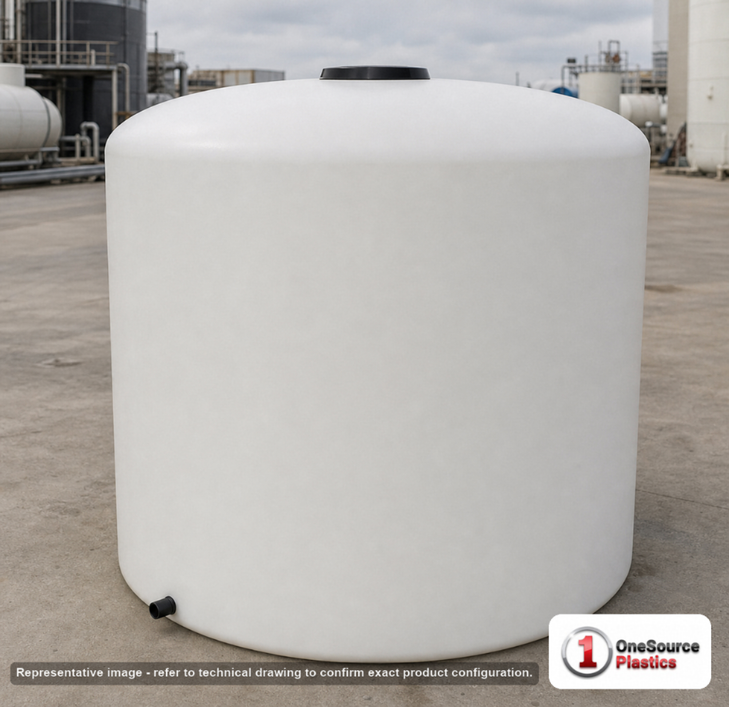
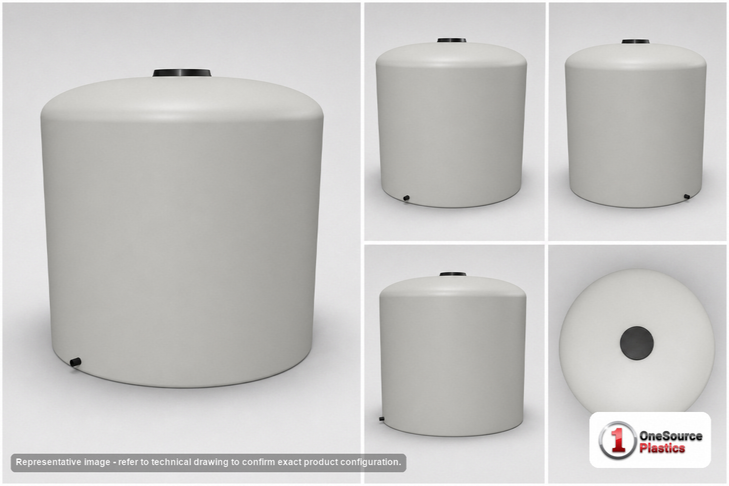
Low and squat by design: the Snyder SII-5050000C37 holds 2,000 gallons in a white polyethylene shell 90 inches across and 88 inches tall, and the sheet lists it at 400 pounds empty. The wall is rated at a specific gravity of 1.5 with the maximum contents given as 25,020 pounds, against 16,680 pounds for the same 2,000 gallons of water at 8.34 pounds per gallon. The sheet publishes a service limit of 120 F / 48 C and a 3 Year Warranty. Fittings are a 2 inch polypropylene female NPT bulkhead outlet at the base and an 18 inch threaded vented manway on top, with no inlet given. Freight is class 500 on an ordinary LTL deck, and the sheet names two plants, Lincoln, Nebraska and Philippi, West Virginia.
One tank or a train of them? A single 2000 gallon tank goes straight to the cart above; for several, request a written quote with freight to your ZIP.
A low tank under a low roof, and the slab beneath 25,020 pounds
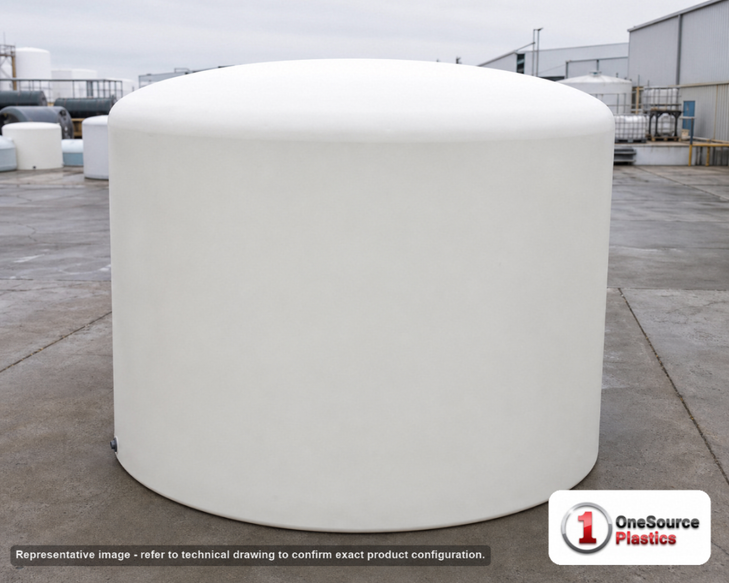
This is a shape chosen by the building. At 88 inches the tank stands seven feet four inches, which fits under a 96 inch ceiling with the manway still reachable from a step, clears a roller door, sits inside a bay without fouling services, and stands below the eaves of a shed without anybody measuring twice. A tall 2,000 gallon shell does none of that. What the low shape asks for is a 90 inch circle of floor, seven feet six inches, that is flat, level and genuinely load bearing, because a rotationally molded base bears on the whole surface it touches and on nothing else, and at the rating on the sheet a full tank puts 25,020 pounds onto that circle. Indoors that is a real point load worth checking against the structure rather than assuming, especially on a suspended floor or a mezzanine; outdoors it is a designed slab, level, continuous, in full contact, extended past the wall, along the lines of the framework in the pad sizing discipline we apply to every vertical. Where the liquid is regulated the bund goes in with the pad, sized to the tank. At 400 pounds empty it is heavy enough to need a machine and light enough for the wind to move it before it is filled, so strap it while it is empty if it stands outside. Then check that 2,000 gallons is the working volume and not just the nominal one: a wall rated 1.5 is bought for a liquid heavier than water, so the density, the headspace it needs as it warms and the reserve you keep in hand all go through the tank sizing calculator and the tank sizing guide before the order rather than after it.
Four 2,000 gallon walls on one 90 inch base, with a 1,900 and a 2,500 beside them
| Part | Gallons | Diameter x height | Empty weight |
|---|---|---|---|
| SII-5050000C37 (this tank, white, rated 1.5) | 2,000 | 90 x 88 in | 400 lb |
| 5050000C26 (heavy duty, same shell) | 2,000 | 90 x 88 in | 340 lb |
| 5050000C34 (black, heavy duty, same shell) | 2,000 | 90 x 88 in | 340 lb |
| 5050000C37-BLACK (black, same grade) | 2,000 | 90 x 88 in | 340 lb |
| 1780200N40 (smaller, narrow, tall, cross-link) | 1,900 | 72 x 119 in | 445 lb |
| 5090000C26 (larger, same base, taller) | 2,500 | 90 x 107 in | 450 lb |
Four tanks share the 90 by 88 inch shell, and the number that separates this one is 400 lb against 340 lb for the other three. That extra wall is the reason to buy it: the sheet rates it 1.5 and puts a 120 F / 48 C ceiling and a 3 Year Warranty in writing, where the other grades carry whatever their own sheets publish and this page asserts none of it. It is also the white wall in the group, so an operator can read a shadow line through it in daylight instead of climbing to the lid; the black walls are the choice where light degrades the liquid and nobody needs to see the level. Step outside the shell and the trade is shape. 1780200N40 holds 1,900 gallons in cross-linked polyethylene on a 72 inch base but takes it up to 119 in, nearly ten feet, which is the buy when floor is short and headroom is not; 5090000C26 keeps this same 90 inch base and adds 2,500 gallons at 107 in and 450 lb, which is the easy upgrade when the ceiling allows another foot and a half. Inside a building, the 88 inch height is usually what decides it.
Other makers in the running? 866-418-1777 will compare them honestly; Norwesco, Snyder, Chem-Tainer, Enduraplas and Bushman are all here, or price freight on this one.
A 2 inch bulkhead outlet, and the vent that has to keep up with the pump
- Outlet: a 2 inch polypropylene female NPT bulkhead fitting at the base, as the sheet lists it. Make the thread up once with a sealant matched to the liquid, then set a union close to the tank so every future valve change happens on the pipe and never on the bulkhead. Leave room to swing a wrench and keep the fitting clear of a pallet jack's path.
- Head and rating at the base: 88 inches of shell gives seven feet four inches of liquid over the fitting, and at a rating of 1.5 the pressure there is half again what the same height of water would give. Rate the valve, the gaskets and the first pipe run for the liquid, and stand the valve on its own support rather than hanging it on the wall.
- Pump: below the outlet with a short falling run, or self-priming if it has to sit level with the tank, because seven feet four inches is modest suction head and a pump lifted above the fitting will lose prime at the end of every draw. Cleanable strainer, and a run-dry cut-out that stops the pump with liquid still over the fitting.
- Vent: the 18 inch manway is threaded and vented, and on a tank this size the vent is the fitting that gets ignored until it matters. Pumping out faster than air can get in pulls the wall inward; filling faster than air can get out pressurises a vessel never designed for it. Sizing that properly is arithmetic, not intuition, and the worked examples for thermal inbreathing, liquid movement outbreathing and the combined case are in the atmospheric vent capacity guide for polyethylene verticals.
- Fill point: the sheet lists no inlet, so specify it. On a tank only seven feet four inches tall a connection at working level is straightforward to arrange, and it beats dropping a delivery hose through the lid every time.
Plumb this one as if it will be moved, because a 2,000 gallon tank inside a building usually is. A flexible first joint, a union near the wall and a valve on an independent support mean it can be drained, disconnected and relocated in a day rather than cut out of a rigid line. Keep the base visible all the way round, leave a hand's width of working space outside the bund wall if there is one, and label the tank with the liquid, the outlet size and the date it went into service in a marker that survives a wash-down. Where the liquid arrives warm, hold the 120 F / 48 C figure on this sheet as the design ceiling rather than a target.
Day storage, batch make-up and dense liquid held indoors
2,000 gallons is a shift or a week rather than a season, which is what makes this the workhorse size indoors: a day tank drawing from bulk and feeding a dosing skid, batch make-up and dilution at a plant or a wash bay, bulk chemical and additive storage at a workshop, brine and solution holding, mix and rinse water where a taller tank would not clear the ceiling, and process liquid held between stages. The rating on this sheet is 1.5, so it is a vessel for liquids heavier than water and the fittings should be chosen for the liquid rather than the volume. Where the 2,000 gallons is instead water standing against a fire risk on a rural property or a remote site, be clear about the difference between stored gallons and a designed reserve, because draw rate, connection and freeze protection are what make one, and the fire-water reservoir design guide works through the whole argument rather than assuming it.
An ordinary LTL deck at class 500, 400 pounds empty
Of the tanks this size, this is the straightforward one to get to site. The sheet lists class 500 and an ordinary LTL movement rather than an oversize load, shipping at 90 inches by 90 inches by 88 inches, from one of the two plants named on the sheet, Lincoln, Nebraska or Philippi, West Virginia; we confirm which lane an order ships from when it is placed. The freight cost estimator prices it to your ZIP, and the listed price is before freight. Seven feet six inches of width still will not go through a standard doorway, so measure the route in before the truck arrives, and remember that 400 pounds is a forklift or four strong people with a plan, not two people and optimism; take it by the body, never by the manway, and keep it upright, because a shell dropped on its shoulder takes a flat spot it will never sit flat on again. Inspect the base and the outlet area while the driver is still on site. Then water test it where it will live, leave it standing overnight, and look underneath in the morning with a light. The last thing to do on delivery day is write the date on the tank itself, because the 3 Year Warranty starts from a day somebody has to be able to name. Put the tank's part number on the maintenance log the day it lands; five years on, nobody remembers which shell it is.
Freight and documents
Ships from: Lincoln, NE; Philippi, WV. LTL freight is quoted to your ZIP with the freight cost estimator or by phone at 866-418-1777. The listed price is before freight.
Technical drawing (PDF) for Snyder Industries 5050000C37.
See this tank
Interactive 3D model with live fill. This tank has an interactive 3D model built to its manufacturer dimensions. Rotate it, and set a fill level to see how much liquid it holds at any height. Open the 3D view on the product photo above. Download the 3D model (GLB).
Product video. Watch the 2000 Gallon Plastic Vertical Liquid Storage Tank video (74 seconds) with dimensions, fittings and shipping notes.
Ready to order?
Add it to your cart at the top of this page, get LTL freight to your ZIP, request a written quote, or call 866-418-1777. The listed price is before freight.