The black seven thousand four hundred: no light through the wall
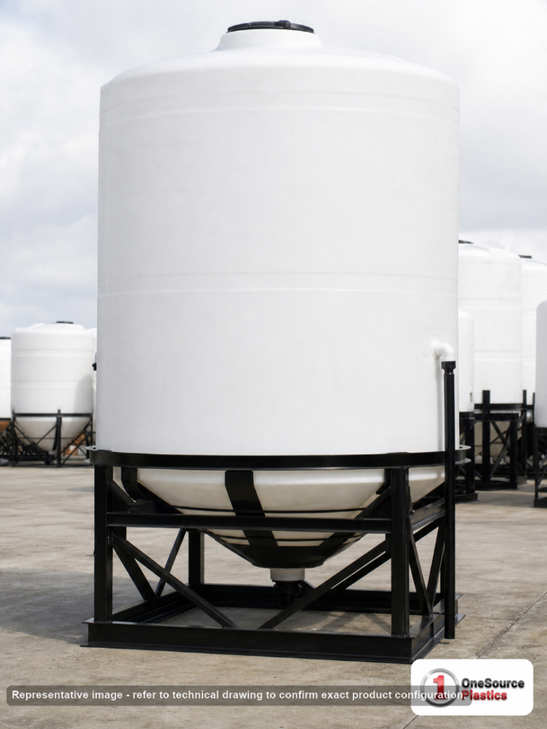
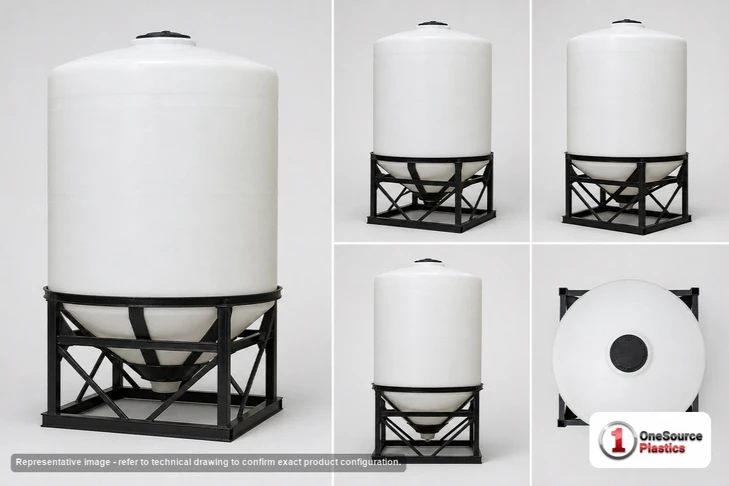
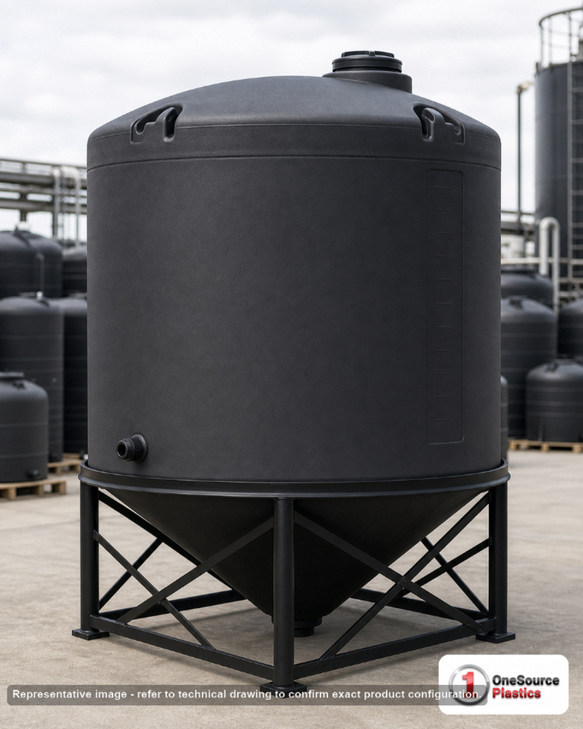
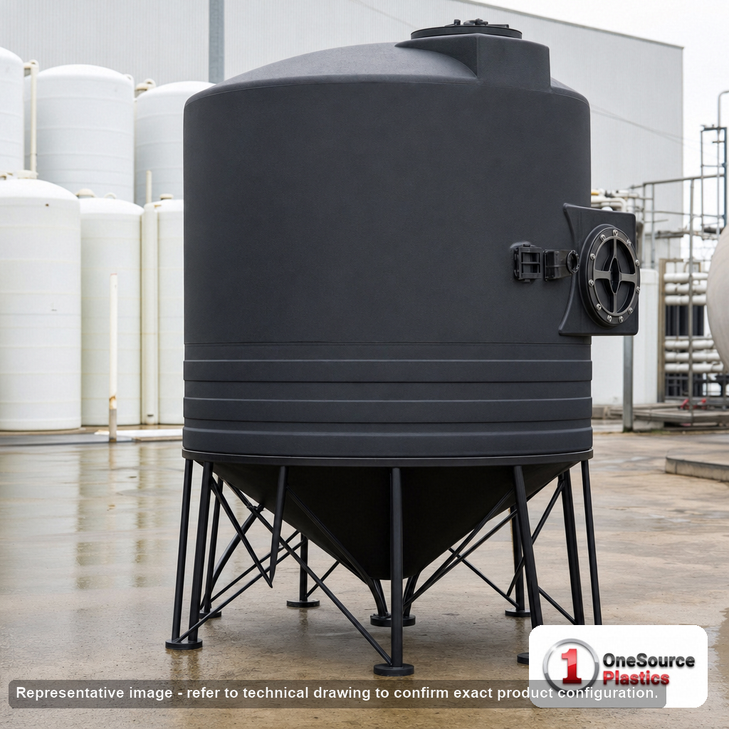
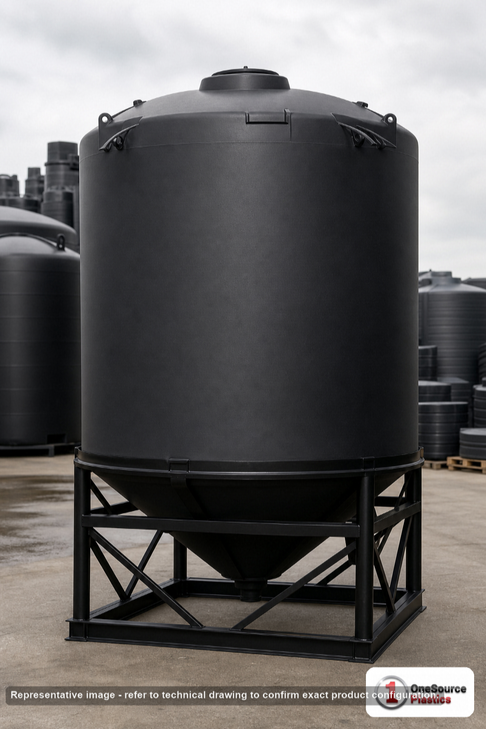
This is a 7400 gallon cone bottom tank, part number SII-5320100N51, listed at 160 inches tall with the diameter given as 142 inches, at 1850 pounds empty and 1850 pounds shipping. The record publishes no separate length and no separate width; the diameter and the height are its only two dimension figures. The material field reads High Density Linear Polyethylene and the colour field reads Black. Heavy Duty is a word in the listing name and the material field is what this page cites. The wall carries a specific gravity rating of 1.9, and the sheet gives 117,260 pounds of max contents against 61,716 pounds of water at 8.34 pounds per gallon. The opening on top is an 18 inch threaded vented manway. Freight class reads 300 beside an LTL ship mode, and the tank is moulded at Lincoln, Nebraska. The outlet and inlet fields are empty and no cone angle field appears. This record publishes no service limit, no certification entry, no lid size, no warranty term, no NMFC number, no structural detail and no stand, and none of that is claimed here.
Need it before the next delivery? Call 866-418-1777 for the ship date, or get freight to your ZIP and add it to your cart above now.
The duty that adds darkness to the specification
The duty first, and on this listing the duty has an extra clause. Everything that makes a 7400 gallon cone worth buying still applies: a bulk volume that arrives by the truckload, is drawn down by a dosing or blending system, has to be emptied completely between campaigns, and has to keep any solids moving toward one point rather than laying them across a floor nobody can reach. At 61,716 pounds of water, what a flat bottom would leave behind is a disposal job rather than a rinse. The extra clause is light. This is the black listing on this shell, and an opaque wall is bought where the vessel sees daylight and the contents should not. In water systems that is the difference between a clean tank and a green one over a season; for plenty of stored products it is a straightforward handling requirement that the material is kept dark. A wall that does the job needs no cover, no shade and nobody to remember to replace one, which is the whole argument. The trade is worth stating as plainly as the benefit: you cannot read a level through the wall of a black tank, so an instrument stops being an optional extra and becomes part of the specification, and it should be chosen before the tank is standing rather than retrofitted afterwards. The jobs are the ordinary bulk ones with the sun added: an outdoor dosing pad at a treatment works, a yard tank at an agricultural retailer feeding a fill point, a skid in a building with roof lights or translucent panels, a greenhouse service area that is glazed from end to end, a wash operation under a clear roof sheet. The envelope decides where it can go. The record gives a diameter of 142 inches, eleven feet ten inches, and a height of 160 inches, thirteen feet four inches, with no length or width published, so none is quoted here. Underneath, the support is a separate purchase and a serious one. A cone bottom tank has no flat floor and cannot stand on its own bottom, and this sheet publishes no stand, no legs, no skirt, no support ring and no bolt pattern, so this page describes none. The structure has to carry 1850 pounds of empty tank, 61,716 pounds of water and 117,260 pounds at the rating, landing on its feet inside a 142 inch circle rather than spread across a slab. That is an engineered foundation, designed and signed off before the tank arrives, and the height above it has to allow for the structure, the 160 inch shell and the clearance above an 18 inch manway. Size the working volume with the tank sizing calculator and take the freeboard discipline from the tank sizing guide before the frame is drawn.
One shell, four part numbers, two of them black
| Part | Gallons | Dimensions as listed | Empty weight |
|---|---|---|---|
| SII-5320100N51 (this tank, black, rated 1.9) | 7400 | 142 in diameter x 160 in | 1850 lb |
| SII-5320100N45 (same shell, no dimensions or weight on this record) | 7400 | 160 in tall, no other figure listed | not listed |
| SII-5320100N49 (same shell, no dimensions or weight on this record) | 7400 | 160 in tall, no other figure listed | not listed |
| SII-5320100N43 (the only row with a full envelope listed) | 7400 | 142 x 142 x 160 in | 1600 lb |
| 7180000N40 (less volume, a narrow column more than twice as tall) | 6500 | 90 x 90 x 273 in | 2100 lb |
| 5340100N40 (much more volume, this circle, taller) | 11500 | 142 x 142 x 215 in | 2850 lb |
The record is uneven about its own family and the table prints it as it reads rather than tidying it up. Four part numbers hold 7400 gallons on this shell. SII-5320100N43 is the only one with a complete envelope listed, at 142 by 142 by 160 inches and 1600 pounds; SII-5320100N45 and SII-5320100N49 carry a height of 160 inches and no other dimension and no weight at all, and those cells have been left honest rather than filled in from a neighbour. This listing publishes its own figures and those are the ones the page stands behind: 1850 pounds, a 142 inch diameter, a 160 inch height, a specific gravity rating of 1.9 and 117,260 pounds of max contents. Two of the four listings are black, which is worth knowing if colour is what you are specifying; send us the part number you are considering and we will confirm what that record carries in writing before an order goes in. The two lower rows change the shape rather than the colour. 7180000N40 holds 6500 gallons on a 90 inch circle at 273 inches, which is a narrow column more than twice this tank's height and a completely different structural problem. 5340100N40 holds 11500 gallons on this same 142 inch circle at 215 inches and 2850 pounds, adding volume upward without taking another inch of ground. Between the three, the decision is made by the site rather than by the tank: the narrow column where the footprint is precious, the 215 inch shell where the ground is fixed and the height is free, and this 160 inch listing where overhead clearance is the binding constraint. Where the product carries solids and the outlet is what really decides whether the cone works, the cone outlet sizing article is the honest treatment of it.
Need a different size? Every tank in the table is in stock programs; ask for a quote on the one that fits, or call 866-418-1777.
Discharge, access and the fields this record does not fill in
- The discharge path: the lowest point of the vessel is a single spot and the whole contents keep running toward it, which is the reason a cone is specified at a volume where a flat floor would leave a tanker load of residue behind.
- The outlet: the field on this record is empty. No outlet dimension, no thread, no bulkhead and no valve is published, so none is claimed here. Send us the line size you need to land, the valve type and the product, and we will confirm what this part number carries before an order is placed.
- The inlet: blank as well, so the fill arrangement is not published and is not described on this page.
- The cone angle: no cone angle field appears on this sheet and the listing name carries none, so this page states none rather than borrowing an angle from a sibling's name.
- Supporting the pipework: the valve, any reducer and the first run of pipe belong on their own steelwork off the structure rather than on the tank, with a flexible connector at the first joint. Thirteen feet four inches of full column puts real static head on that joint before a pump adds vibration to it.
- Access on top: an 18 inch threaded vented manway at 160 inches plus the height of the structure, which is a working-at-height task everywhere. The platform, the fixed ladder and the fall protection plan belong in the same drawing as the frame, and the fill belongs at a coupling at working level.
- The vent: supplied with the manway on this sheet rather than separately specified. On a black tank it is also the component nobody can see from the ground, so put it on the same inspection round as the manway seal and never blank, tape or wrap it.
- Ratings and blanks: a specific gravity rating of 1.9, 61,716 pounds of water at 7400 gallons and 117,260 pounds of max contents. No service limit, no lid size, no warranty term, no certification entry, no NMFC number and no structural detail appears on this record.
The colour has one consequence that belongs in the fittings plan rather than in the sales copy: the level has to be instrumented or measured, never eyeballed. Decide how, and where it sits relative to the fill and the vent, before anything is drilled. The top fitting placement article lays out that geometry, and the level gauge selection guide compares the technologies on how they fail rather than on how they are sold.
Outdoor pads and daylight, and the product that will not take it
The installations that ask for this listing rather than the pale one are the ones where the tank stands in the light. An outdoor dosing pad at a treatment works, exposed from dawn to dusk. A yard tank at an agricultural retailer feeding a loading point through a season. A process skid in a building with roof lights or translucent wall panels, where the sun crosses the tank for part of every day. A greenhouse or nursery service area that is glazed overhead. A wash bay under a clear roof sheet. In water and process systems, light is what turns a clean vessel green over a summer, and an opaque wall removes that problem at the point of purchase rather than at the point of cleaning. Where a product is meant to be kept dark, the same wall does the job permanently and without a cover anybody has to maintain. Beyond the colour the buying case is the bulk case: fill by the truckload, draw down continuously, empty completely between campaigns, and keep whatever settles moving toward one point. Two honest limits. The rating on this record is a specific gravity of 1.9, a wall rating describing how dense a liquid the wall is rated to hold and nothing more; it says nothing about how your particular product behaves against polyethylene, and we will not present it as if it did. Name the liquid, the concentration and the year-round temperature when you enquire, check it in our chemical compatibility reference before a gasket, a seal or a valve is chosen, and let the chemistry decide those. The second limit is that this record publishes no service limit at all, which matters most on exactly the installations this colour is bought for, because an outdoor tank in full sun is a different thermal problem from one in a plant room. Ask us with the site described rather than assuming a figure. One habit is specific to a dark shell and it is not optional at this volume: mark the tank clearly with what is inside it, because nobody can tell from the outside and the person who needs to know is rarely the person who filled it. The tank label and signage article sets out how those markings are meant to reconcile with each other. Beyond that: confirm every support foot is bearing before the first fill and again after it, walk the full circle at every inspection, and keep a written record of what the vessel has held.
Service list by chemical
One line per liquid the maker rates for this resin, with the concentration it is rated to and the fitting and gasket to order. Take your own concentration and temperature to the linked page or the chemical compatibility database before ordering.
- Acetic Acid (60%) - PP/PVC fittings, EPDM gaskets
- Aluminum Sulfate (50%) - PVC fittings, EPDM gaskets
- Calcium Chloride (40%) - PVC fittings, EPDM gaskets
- DEF (32.5%) - 316SS fittings, EPDM gaskets
- Ethylene Glycol (100%) - PVC fittings, EPDM gaskets
- Ferric Chloride (50%) - PVC fittings, EPDM gaskets
- Ferric Sulfate (60%) - PVC fittings, EPDM gaskets
- Ferrous Sulfate (20%) - PVC fittings, EPDM gaskets
- Hydrochloric Acid (37%) - PVC fittings, Viton gaskets
- Hydrofluoric Acid (48%) - PP/PVC fittings, Viton gaskets
- Hydrofluosilicic Acid (26%) - PP/PVC fittings, Viton gaskets
- Hydrogen Peroxide (50%) - PVC fittings, Viton gaskets
- Magnesium Chloride (30%) - PVC fittings, EPDM gaskets
- Peracetic Acid (30%) - 316SS fittings, Aflas gaskets
- Phosphoric Acid (85%) - PVC fittings, Viton gaskets
- Polyaluminum Chloride - PVC fittings, EPDM gaskets
- Potassium Carbonate (50%) - PVC fittings, EPDM gaskets
- Potassium Hydroxide (saturated) - PVC fittings, EPDM gaskets
- Propylene Glycol - PP/316SS fittings, EPDM gaskets
- Sodium Bisulfate - PVC/PP fittings, EPDM gaskets
- Sodium Bisulfite - PVC/PP fittings, EPDM gaskets
- Sodium Carbonate (30%) - PVC fittings, EPDM gaskets
- Sodium Hypochlorite (
- Sodium Thiosulfate (40%) - PVC fittings, EPDM gaskets
- Sulfuric Acid (98%) - CPVC fittings, Viton gaskets
- Urea Solution (50%) - PP/PVC fittings, EPDM gaskets
- Zinc Orthophosphate - PP/316SS fittings, EPDM gaskets
One hundred and sixty inches lying on a trailer
Lincoln, Nebraska is the plant on this record and Nebraska is the shipping state, so the central plains are the short lane and either coast is a planned one. The freight class reads 300, a numeric class rather than a mode, the ship mode reads LTL, and no NMFC number is published. The item ships at 1850 pounds in an envelope 142 inches across and 160 inches tall: thirteen feet four inches of vessel at a weight that is light for its size, which is why the ticket is written around the space rather than the scale. Price your own ZIP with the freight cost estimator; the listed price is before freight. It travels lying down and it is stood up at your end, and standing it is the operation that needs planning before the truck is booked rather than on the day. This sheet publishes no crane, no rigging, no permit and no escort detail, so none is stated here; settle the offload equipment, the access route and the delivery window with us in advance. Have the foundation and the support structure complete, levelled and signed off first. Sling under the body rather than by the manway, keep the tank restrained from the moment it is upright, and treat an empty shell of this height as a sail, because that is exactly how it behaves in an open yard. Fill with clean water before product, hold the 61,716 pound load, and read the manway seal, the cone joint, the structure feet and the ground around them in daylight. Leave it standing full overnight and look again in the morning, because what has moved overnight is almost never the tank. One last thing that matters more on a dark shell than a pale one: chalk or mark the full-water line on the outside after the first fill, because it is the reference every later reading gets checked against and there is no other way to see it. Keep the first delivery's paperwork with the tank; strength and date on day one is the baseline for every batch after.
Freight and documents
Ships from: Lincoln, NE. LTL freight is quoted to your ZIP with the freight cost estimator or by phone at 866-418-1777. The listed price is before freight.
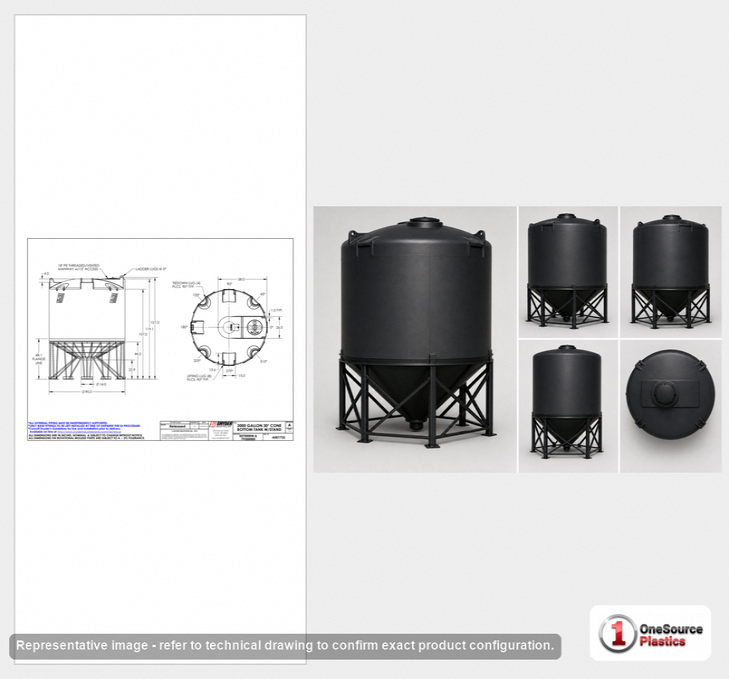
Technical drawing (PDF) for Snyder Industries 5320100N51.
See this tank
Interactive 3D model with live fill. This tank has an interactive 3D model built to its manufacturer dimensions. Rotate it, and set a fill level to see how much liquid it holds at any height. Open the 3D view on the product photo above. Download the 3D model (GLB).
Product video. Watch the 7400 Gallon Heavy Duty Cone Bottom Tank video (74 seconds) with dimensions, fittings and shipping notes.
Ready to order?
Add it to your cart at the top of this page, get LTL freight to your ZIP, request a written quote, or call 866-418-1777. The listed price is before freight.