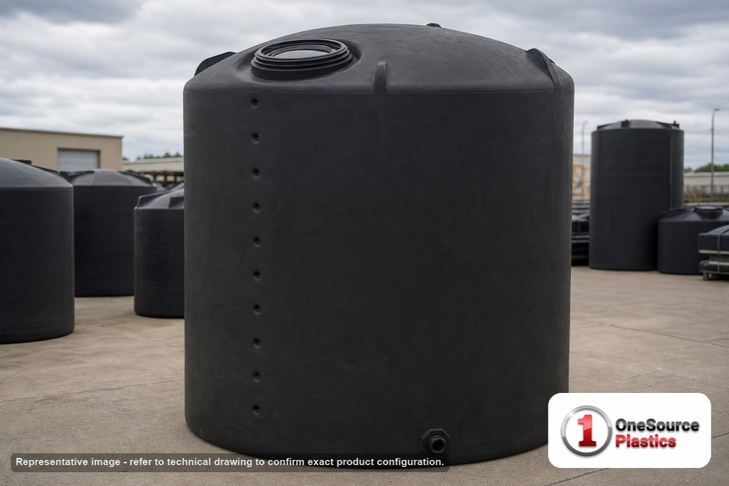
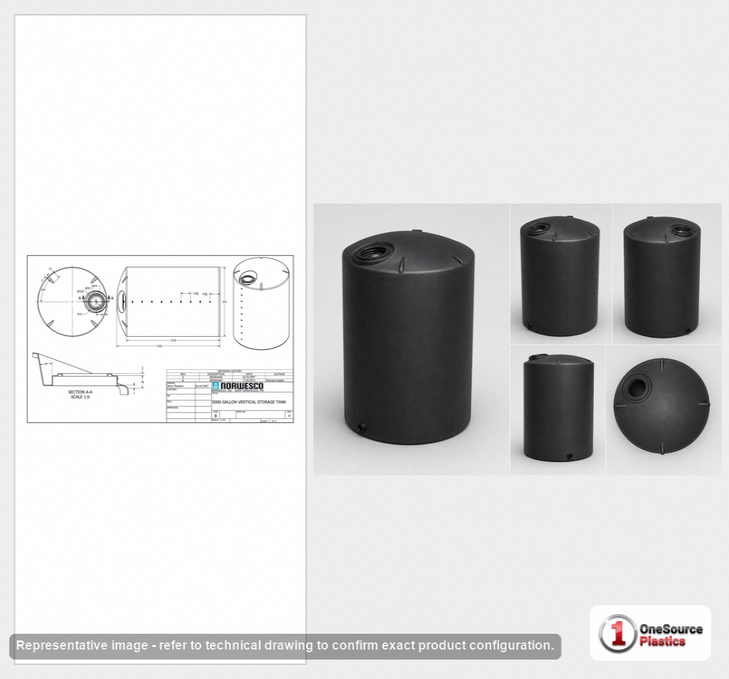
Norwesco 6000 Gallon Black Heavy Duty Vertical Storage Tank (41414)
41414 holds 6000 gallons in a black polyethylene shell that measures 102 inches across and 182 inches tall, which is eight and a half feet of circle standing just over fifteen feet up. The empty weight cell and the shipping weight cell both read 1451 lb. The outlet is a 3 inch PP female NPT bulkhead fitting with a 2 inch reducer; the top opening is a 16 inch threaded vented manway; the inlet row is a dash. The specific gravity cell reads 1.9, against 50040 lb of water at 8.34 pounds per gallon and a maximum contents cell of 95076 lb. The service ceiling is 120 F / 48 C, the warranty cell reads five year, the freight class is 300 and the mode is LTL. Three plants build it: Hanford in California, St. Bonifacius in Minnesota and Fairfield in Texas.
Spec sheet in hand? Call 866-418-1777 and read us the liquid and the pad; or get freight to your ZIP and add it to your cart above.
The grade line is the buying decision
Start with the contents, because that is what this particular record is about. The specific gravity cell reads 1.9 and the maximum contents cell reads 95076 lb. Those two figures together are the sheet's statement about what may go in the tank, and they are the reason a buyer picks this part number out of a shell that also exists under a different number. If the liquid in question weighs more per gallon than water does, the grade line is the number the specification has to clear, and 1.9 is what this sheet publishes.
Water is the easy case and the sheet gives it plainly: 6000 gallons at 8.34 pounds per gallon is 50040 lb sitting on the pad. Anything denser than that walks up toward the contents cell, and the contents cell is the ceiling this record prints. Read them in that order when you are sizing a bund, a slab or a transfer pump, and put our tank sizing calculator and the longer tank sizing guide on the same screen while you do it.
The honest limitation on this page is that the sheet says nothing about what the liquid is. There is no application cell filled in and no structural cell filled in, so this record describes a vessel, a grade line, a temperature ceiling and a set of openings, and it describes nothing about chemistry, mixing, heating or mounting. Everything past the printed fields is your specification to make, and a supplier's data sheet for the liquid is where that work belongs.
Three inches at the wall, two at the reducer
Size the pump route from the outlet backwards, and the outlet on this record is a 3 inch PP female NPT bulkhead fitting supplied with a 2 inch reducer. That is a genuinely useful arrangement on a tank this tall, because it lets you take the full 3 inch port when the transfer rate matters and thread down to 2 inch when what you actually own is a 2 inch pump. What it does not do is decide for you. Pick the size before you pipe it, because taking a 3 inch port down to 2 inch at the wall and then trying to feed a 3 inch suction line downstream is how a pump ends up cavitating on a tank that had plenty of head available.
Head is the one thing this shape gives you for free. A full shell puts liquid 182 inches above the floor, and the outlet sits at the bottom of that column, so a self-priming pump set beside the tank starts flooded rather than dry. The trade is that the same column is what pushes on the bulkhead gasket, so thread the port square, support the first length of pipe on something that is not the tank, and never hang a valve body off the fitting with no external support under it. A bulkhead through a poly wall is a sealed penetration, not a pipe hanger.
Filling is the other half of the route and the sheet keeps that simple: the inlet row is a dash, so the only port this record publishes is the one at the bottom. Liquid goes in through the 16 inch threaded vented manway on top unless you arrange something else, and arranging something else is your work and not this record's. The vented half of that manway description is the half to respect. When a 3 inch outlet pulls hard on a sealed vessel the vent is the only thing standing between the pump and a shell that wants to collapse inward, so nothing goes over it, nothing gets taped across it, and it gets a look every single time the lid comes off. The install specific here: fill with water once, to the top, on the surface the tank will live on, then go back round the bulkhead threads by hand after the shell has taken its working shape. Poly moves as it loads and a fitting snugged on an empty tank has not yet been asked the question.
Five rows around 41414
| Part | Gallons | Shell (in) | Empty weight |
|---|---|---|---|
| 41414 (this record) | 6000 | 102 x 102 x 182 | 1451 lb |
| 40769 | 6000 | 102 x 102 x 182 | 1331 lb |
| N-40226 | 6000 | 182 tall, plan not printed | |
| N-40233 | 6000 | 182 tall, plan not printed | |
| 40164B | 5000 | 102 x 102 x 152 | 986 lb |
| 40764 | 6100 | 119 x 119 x 140 | 1286 lb |
Four rows in that table carry 6000 gallons and two of them print a full shell: this record and 40769, both at 102 by 102 by 182 inches. The N- rows publish a height of 182 inches and leave the plan and the weight cells empty, so those cells are left empty here too rather than filled in from a neighbour. Read the table down the weight column and the shell column, not across the gallon column, because the gallon column is where four of these rows agree and nothing is learned.
The two rows at the bottom are different vessels rather than different versions of this one. 40164B puts 5000 gallons into the same 102 inch circle at 152 inches tall, which is the row to look at when the constraint is overhead clearance rather than volume. 40764 goes the other way: 6100 gallons on a wider 119 inch circle at 140 inches, a shorter and fatter shell for the same broad job. Why this part number, then: because you want the 102 inch footprint, you want 6000 gallons, and the grade cell and contents cell on this particular sheet are the ones your liquid has to clear.
Two rows look the same? The difference is the wall; call 866-418-1777 with the liquid and we will say which, or ask for a quote on both.
Reservoir duty on a hundred-and-two inch circle
Eight and a half feet of diameter carrying 50040 lb of water is a slab question before it is a tank question. The load is a ring around the perimeter rather than a point in the middle, and poly shells are unforgiving about a slab that has settled unevenly under that ring. Our guide to sizing a concrete pad for an above-ground polyethylene tank walks the framework and, more usefully, walks where that framework stops applying.
Two duties come up constantly on a shell this size and both have their own reading. A standing reserve for private fire protection is covered in our write-up on reservoir design for rural and remote sites, including the freeze-protection engineering that a black shell in a cold climate makes people think about. A process reuse loop is the other, and our piece on reuse tank topology and quality-banded storage trains covers how a vessel like this one sits inside a staged train rather than on its own.
Whichever of those it is, the 120 F / 48 C service ceiling belongs in the same conversation. That number is the sheet's limit on the liquid arriving at the tank, not a target, and a stream that is occasionally warmer than the ceiling is a process problem to solve upstream of the manway rather than something the shell absorbs quietly.
One crate, one number, three plants
The crate line reads 102 by 102 by 182 inches at 1451 lb, and the empty weight cell reads the same 1451 lb, so this record publishes no packaging or dunnage allowance at all. The mode is LTL at class 300. Three plants are named on the sheet, in California, Minnesota and Texas, which usually means the origin that prices best for your address is not the one you would have guessed. Run the address through the freight cost estimator before you budget; the listed price is before freight.
Receive it against the paperwork rather than against your eye. Because the two weight cells on this record print the identical figure, the bill of lading has one number to agree with and no allowance to hide in, so a scale ticket that reads meaningfully off 1451 lb is a question worth asking on the spot rather than a rounding difference to wave through. Note the reading, note the plant on the tag, and keep both with the paperwork.
Then look at the manway threads in daylight before the truck pulls away, because a 16 inch threaded closure that has been cross-loaded on a trailer is the defect you want to find while somebody is still standing there. Fifteen feet of tank is easy to inspect from the ground on the way up and almost impossible once it is stood on its pad. Mark the vent and the outlet on the outside of the shell so nobody caps the wrong one in the dark.
Freight and documents
Ships from: Hanford, CA; St. Bonifacius, MN; Fairfield, TX. LTL freight is quoted to your ZIP with the freight cost estimator or by phone at 866-418-1777. The listed price is before freight.
Technical drawing (PDF) for Norwesco 41414.
See this tank
Interactive 3D model with live fill. This tank has an interactive 3D model built to its manufacturer dimensions. Rotate it, and set a fill level to see how much liquid it holds at any height. Open the 3D view on the product photo above. Download the 3D model (GLB).
Ready to order?
Add it to your cart at the top of this page, get LTL freight to your ZIP, request a written quote, or call 866-418-1777. The listed price is before freight.