Norwesco 6000 Gallon Black Vertical Storage Tank (40769)
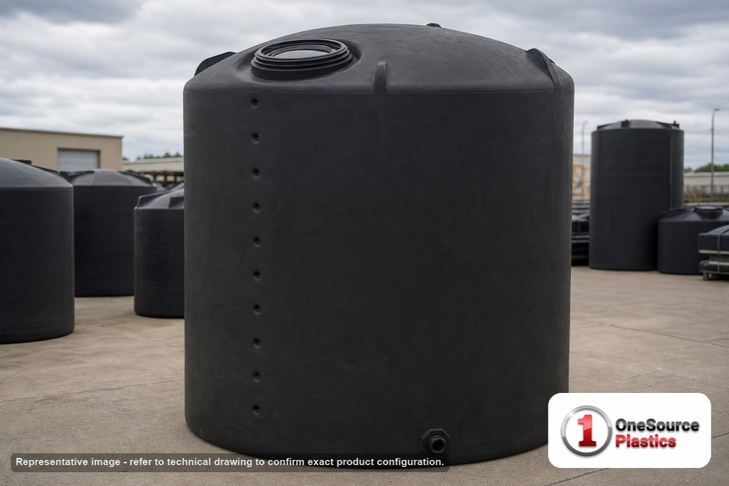
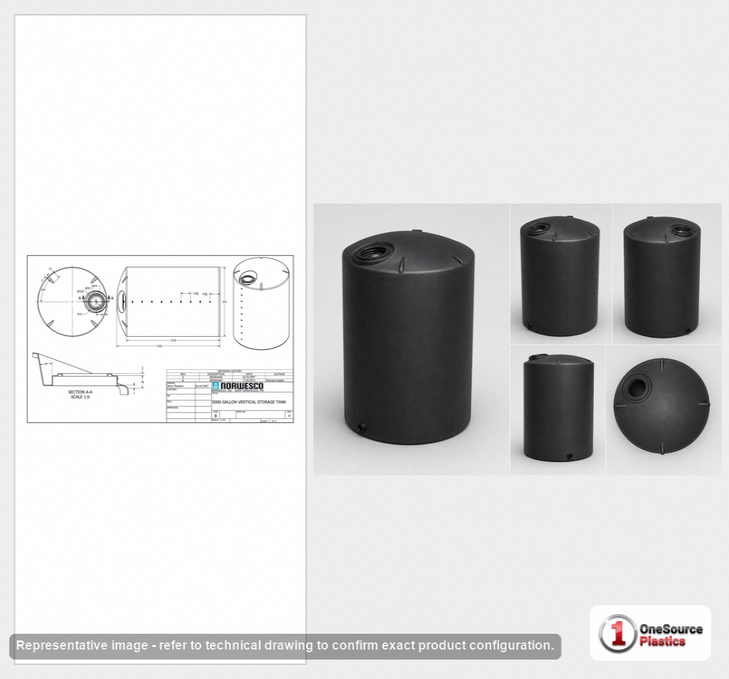
40769 is a 6000 gallon black polyethylene vertical measuring 102 inches across by 182 inches tall, with an empty weight cell of 1331 lb and a shipping weight cell that repeats 1331 lb. Its outlet is a 3 inch PP female NPT bulkhead fitting with a 2 inch reducer, its top opening is a 16 inch threaded vented manway, and nothing is printed against inlet. The specific gravity cell reads 1.5 and the maximum contents cell reads 75060 lb, against 50040 lb of water at 8.34 pounds per gallon. Service ceiling 120 F / 48 C, warranty cell three year, freight class 300, mode LTL. Hanford in California, St. Bonifacius in Minnesota and Fairfield in Texas all build it.
Ordering for a plant or a bid? Request a written quote with freight to your ZIP for the file; a single 6000 gallon tank goes straight to the cart above.
40769 among the six-thousands
| Catalogue number | Capacity | Plan and height | Weight cell |
|---|---|---|---|
| 40769 (this record) | 6000 gal | 102 x 102 x 182 in | 1331 lb |
| 41414 | 6000 gal | 102 x 102 x 182 in | 1451 lb |
| N-40226 | 6000 gal | 182 in tall, plan blank | |
| N-40233 | 6000 gal | 182 in tall, plan blank | |
| 40164B | 5000 gal | 102 x 102 x 152 in | 986 lb |
| 40764 | 6100 gal | 119 x 119 x 140 in | 1286 lb |
The useful column in that table is the third one. Four rows carry the same gallon figure, so capacity tells you nothing about which record you want; the plan and height column tells you everything. This record and 41414 share a shell at 102 by 102 by 182 inches. The two N- rows publish a height of 182 inches and leave their plan and weight cells empty, and empty is how they are left here.
The other two rows change the shape rather than the version. 40164B stands 152 inches on the same 102 inch circle at 5000 gallons; 40764 spreads to a 119 inch circle and comes down to 140 inches at 6100 gallons. If the building you are putting this in has a roof line you have already measured, that column decides the purchase before any of the other cells get a vote.
Need the taller or the wider one? Every row links to its page with freight to your ZIP on each; 866-418-1777 will check the ceiling and the pad.
Who buys the three-year record
This sheet prints a specific gravity cell of 1.5 and a maximum contents cell of 75060 lb, and those two numbers are the plain statement of what the record is for. The buyer is somebody storing a bulk liquid whose weight per gallon sits inside that ceiling: water at 8.34 pounds per gallon fills this shell to 50040 lb and leaves room, and a moderately denser liquid still has headroom before the contents cell becomes the governing number. Nothing on this sheet names a liquid, an application or a process, so the record describes a vessel and a set of limits and stops there.
The warranty cell reads three year on this record, and it is printed here exactly as the sheet prints it, alongside a service ceiling of 120 F / 48 C. Those are the two published commitments on the page and the rest of the specification is a matter for your process engineer and the liquid supplier's data sheet.
The honest limitation is the one that catches people on a shell this shape: 182 inches of tank means the manway is fifteen feet in the air. There is no ladder cell, no platform cell and no structural cell on this record, so access to the top is something you design and buy separately, and it should be designed before the tank is stood up rather than after somebody needs to look inside it.
The draw-off, cell by cell
| Sheet cell | What 40769 prints |
|---|---|
| Outlet | 3 inch PP female NPT bulkhead fitting with a 2 inch reducer |
| Inlet | a dash |
| Lid and manway | 16 inch threaded vented manway |
| Specific gravity | 1.5 |
| Maximum contents | 75060 lb |
| Service ceiling | 120 F / 48 C |
Read that table as the pump route and it reads bottom to top. The suction side starts at a 3 inch bulkhead with a 2 inch reducer in the box, which means the port can serve a 3 inch transfer pump directly or step down cleanly to a 2 inch one; what it should not do is change size twice on its way to the pump. Decide which of the two you are building, build it in one step at the wall, and keep the suction line short and rising to the pump rather than looping down and back.
One dash in the inlet row is all this record says about filling, and it deserves reading as a fact rather than an omission: this listing publishes one port, and the 16 inch threaded vented manway is the opening liquid comes in through unless you add something. The vent in that manway is what lets the shell breathe while the pump is pulling on it, so treat an obstructed vent as a serious fault rather than a nuisance.
The install specific for this one is about the reducer. Fit it, or do not fit it, before the tank is full, and put a union immediately downstream of whichever size you settle on. On a vessel holding 50040 lb of water the difference between an hour's work and a day's work is whether the first joint past the bulkhead can be broken without draining the tank.
Three guides worth reading before the first fill
A 102 inch circle carrying 50040 lb is a foundation job, and ours is the reading we would give anybody pouring for it: pad sizing for above-ground polyethylene tanks, which spends as much time on where the framework stops as on where it applies. Pour it flat, pour it level, and get the finish right, because a poly shell telegraphs a bad slab into the wall rather than bridging it.
If the water arriving is caught off a roof, the front end of the system matters more than the tank does: our first-flush diverter sizing guide covers what to throw away before it reaches the manway. For a standing reserve on a site with no hydrant, the reservoir design guide for rural and remote sites is the one to read, and for a plant recovering process streams our reuse topology piece explains why a tank this size is usually one stage of a train rather than the whole answer.
Sizing the volume itself comes first of all, and the sizing calculator and sizing guide exist so that the gallon figure is a decision rather than a guess. Draw-down rate, refill interval and the height you can live with are the three inputs; this shell answers the third one at 182 inches.
Thirteen hundred pounds and a fifteen-foot ride
Crated, the record reads 102 by 102 by 182 inches at 1331 lb, which is the same figure as the empty weight cell, so no dunnage allowance is published on this listing either way. Class 300, LTL, and three possible origins: California, Minnesota and Texas. Which of the three loads your tank is a lane question rather than a catalogue question, so price the freight estimate against your actual ZIP; the listed price is before freight.
When it arrives, walk the vertical seam line from the base to the manway boss while the tank is still lying on the deck. Fifteen feet of shell that has travelled on its side takes its strapping loads along that line, and a flat spot or a bright polished band across the wall is what a strap that worked loose leaves behind. From the ground with the tank on the trailer you can see the whole 182 inches in one pass; from the pad you can see about the bottom third.
Photograph anything you find before it is unloaded, and get the tank onto its prepared surface the same day rather than parking it on gravel over a weekend. A strap that is checked once a season is a strap that holds; put it on the same calendar as the gutters.
Freight and documents
Ships from: Hanford, CA; St. Bonifacius, MN; Fairfield, TX. LTL freight is quoted to your ZIP with the freight cost estimator or by phone at 866-418-1777. The listed price is before freight.
Technical drawing (PDF) for Norwesco 40769.
See this tank
Interactive 3D model with live fill. This tank has an interactive 3D model built to its manufacturer dimensions. Rotate it, and set a fill level to see how much liquid it holds at any height. Open the 3D view on the product photo above. Download the 3D model (GLB).
Ready to order?
Add it to your cart at the top of this page, get LTL freight to your ZIP, request a written quote, or call 866-418-1777. The listed price is before freight.