


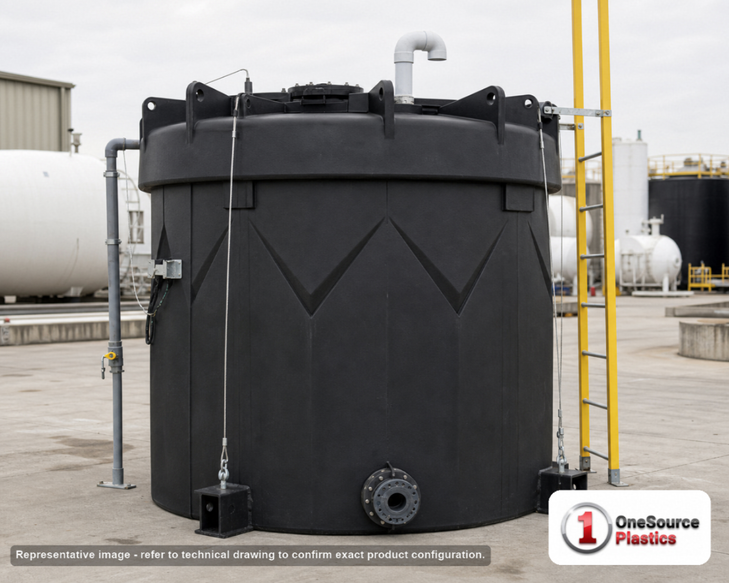
Eleven hundred gallons, eight feet eight to the manway
The Snyder 5470000N51 is a 1,100 gallon double wall tank, listed on its sheet as an ASTM Black Captor. Those name words are the maker's name for the product; Captor is Snyder's product name for this containment range and nothing further is claimed from either. It is moulded in black high density linear polyethylene at 76 inches long by 76 inches wide by 104 inches tall and 650 pounds empty. The sheet publishes one capacity, one set of overall dimensions, one weight and one rating for the whole assembly, and carries no separate inner tank figure, no separate outer containment figure, no annulus dimension and no containment percentage, so none appears here. The wall is rated at a specific gravity of 1.9, and the sheet gives 9,174 pounds for 1,100 gallons of water at 8.34 pounds per gallon with 17,431 pounds of max contents. The published opening is an 18 inch threaded vented manway; the outlet field reads "1 Manway / Lid", an opening rather than a pipe size, and the inlet field is blank. The structural record is 8 lifting lugs, ladder lugs and one flange line. The service limit is 120 F / 48 C and the warranty is a 3 Year Warranty. Freight is LTL at class 300 with no NMFC number, moulded at Philippi, West Virginia.
Buying for a site, a fleet or a district? Request a written quote with freight to your ZIP, or add it to your cart above and call 866-418-1777 with any question on the fit.
Mid size dosing duty between a 1000 and a 1500
Eleven hundred gallons is a duty size with a very clear buyer: the plant whose draw has outgrown a few hundred gallons at the point of use but does not justify the biggest vessel in the yard. That is a mid sized municipal water or wastewater works dosing coagulant, polymer or pH correction; an industrial feed room on a process, power or manufacturing site; a laundry, textile or food and beverage plant holding a cleaning or sanitising chemical; a plating, pickling or surface finishing line; a wash rack or vehicle wash compound; and a quarry or wash plant reagent station. The pattern those share is a monthly or six-weekly drop rather than a weekly one, a pump running most of the day, and a chemical that has to be somewhere it cannot get into a drain. The number that usually settles it is the bulk chemical cost per gallon on the drop size your supplier actually runs. Ask what load sizes they deliver on before you fix the capacity; a tank that never takes a full load is a tank sized for the wrong programme. The containment job is the reason the vessel is doubled rather than plain. An indoor feed room has a finished floor and drains that go somewhere costly, and a yard compound has a surface nobody wants to coat and bund. This tank brings the second wall with it, and takes it away if the plant is rearranged. What is published is one assembly: no containment percentage, no annulus dimension, so where a written plan needs a held volume stated on paper we ask the maker rather than derive one. Shape is where this size is easier to live with than the tall vessels above it. At 104 inches, eight feet eight, on a 76 inch square base, it stands under most industrial ceilings with working room above the manway, and the access arrangement is a short platform rather than a structure. The floor carries 9,174 pounds of water and 17,431 pounds at the published 1.9 rating on roughly forty square feet, so flat, continuous, level, no rocking and nothing shimmed under a corner, with a signed calculation for anything other than a ground bearing slab. The wall is black, which keeps daylight out of the contents and costs you the level reading through the shell; this sheet publishes no gauge, no sight arrangement and no level switch, so design the indication and the pump cut-out with the installation. Two references belong before the order. The hardest service a polyethylene wall sees is at the vapour line rather than under the liquid, which the wall thickness at the vapour saturated headspace guide works through, and it explains why a liquid side inspection misses it. The usable volume on a contained vessel is not the nameplate figure, which is the subject of the Captor double wall freeboard sizing guide. Run your own draw through the tank sizing calculator, take the freeboard discipline from the tank sizing guide, and where the second wall is going into a written spill prevention plan start with our Captor double wall spill prevention walkthrough. Nothing on this page is a claim about any rule, listing or approval.
Four 1100s on the 104 inch shell
| Part | Gallons | Length x width x height | Empty weight |
|---|---|---|---|
| 5470000N51 (this tank, named ASTM Black Captor) | 1100 | 76 x 76 x 104 in | 650 lb |
| 5470000N48 (named ASTM XLPE Black Captor) | 1100 | 76 x 76 x 104 in | 650 lb |
| SII-5470000N30 (white, named for sulfuric acid) | 1100 | 76 x 76 x 104 in | 650 lb |
| SII-5470000N42 (natural white, named XLPE) | 1100 | 76 x 76 x 104 in | 650 lb |
| 5990102N30 (smaller, wide and low, named Sulfuric Acid) | 1000 | 81 x 81 x 69 in | 500 lb |
| 5990302N30 (larger, wider, named Sulfuric Acid) | 1500 | 93 x 93 x 76 in | 950 lb |
Four listings share this 76 by 76 by 104 inch shell at the same 650 pounds, and two of them are spelled with the SII- prefix while two are not. We print every part number exactly as the sheet spells it rather than tidying the list into a pattern, because a number ordered against a drawing or a spares list has to match character for character. The names cross between a chemical name, the maker's ASTM and XLPE name words and a plain descriptive listing, and no sheet explains what any of them implies, so neither do we. Colour is the difference you can act on without asking: this one is black and keeps daylight out of the contents, and the white listings let an operator read the level through the wall in a lit room. The two size rows are a genuinely different proposition rather than a step up and down the same shell. 5990102N30 holds 1,000 gallons, only a hundred fewer than this tank, on an 81 inch plan at 69 inches tall and 500 pounds: five inches wider each way on the floor buys you nearly three feet of clearance overhead and a manway within easy reach. 5990302N30 holds 1,500 gallons on a 93 inch plan at 76 inches and 950 pounds, which is four hundred gallons more, still barely over six feet tall, on a footprint under eight feet square. If your ceiling is low and your floor is not, both of those rows deserve pricing before you settle here. This tank's argument is the narrow plan: it holds eleven hundred gallons on the smallest footprint of the three.
Comparing against another maker? Send the competing spec to 866-418-1777 or a quote request and we will show the differences honestly.
The pump lift from a 104 inch tank, and what the sheet does not give
- The pump path: the outlet field reads "1 Manway / Lid" and the inlet is blank, so no outlet dimension, thread, bulkhead, flange or valve is published on this sheet and none is claimed here. What gets built at this size is a drop pipe and strainer through the manway to a transfer or metering pump beside the tank, which is a suction lift rather than a flooded suction.
- The lift: from the bottom of a 104 inch tank the lift is real but manageable, which is one of the practical advantages of this shell against the taller vessels in the range. Keep the suction line short and rising steadily to the pump, with no high point to trap vapour, and design against a nearly empty tank rather than a full one.
- Prime and dry running: give the pump a foot valve or a self-priming head and fit a low level cut-out at installation. This sheet publishes no level device, gauge, sight arrangement or switch of any kind, and the shell is black, so the instrument is the only warning there is.
- The strainer: set it clear of the bottom so the settled inch is not the first thing the pump lifts, and give yourself a way to check it without emptying the tank.
- The opening: an 18 inch threaded vented manway, the only published opening, doing duty as fill point, drop pipe route, inspection hatch and cleaning access at once.
- Reaching it: at 104 inches the manway is well above head height, so a short fixed platform belongs in the installation drawing and the fill connection should come down to working level.
- The vent: listed as vented. That path protects the wall on a fast fill and a hard pump-down; keep it clear and look at it whenever the manway is open.
- Structure: this sheet publishes 8 lifting lugs, ladder lugs and one flange line. Rig on the lugs to the maker's instructions and claim nothing beyond the published record.
- The space between the walls: no monitoring port, gauge or alarm is published, so that arrangement is specified separately and the dates written down.
- Limits: 120 F / 48 C, a specific gravity rating of 1.9, and a 3 Year Warranty.
Tell us the product and its strength when you order. The manway seal and the suction fitting are the entire wetted system on a tank drawn from the top, and on a contained vessel they are the only route a release can take.
Municipal and industrial feed rooms with a monthly drop
Eleven hundred contained gallons is bought by sites with a steady daily draw and a supplier who runs part loads: coagulant, polymer and pH control feed at a mid sized water or wastewater works, a chemical feed room on a process, power or manufacturing site, cleaning and sanitising storage in food, beverage, dairy, laundry or textile plants, plating, pickling and anodising lines, quarry and wash plant reagent stations, and vehicle wash compounds. It is also a common second vessel where a site already runs a larger tank on another product and wants this one at the machine rather than piped across the building. Because the shell is black, build the level indication into the installation rather than leaving it to the eye, and leave a walking route on all four sides once the tank is set. The side of a contained vessel that nobody walks past is the side a weep starts on, and a tank in a corner is a tank nobody inspects.
Six hundred and fifty pounds, class 300, West Virginia
Philippi, West Virginia is the only plant named on this sheet and West Virginia the only ship-from state, which makes the mid-Atlantic, the Ohio valley and the Northeast short lanes. Freight is LTL at class 300 with no NMFC number, and the crate is the tank at 76 by 76 by 104 inches and 650 pounds. Price the lane to your own ZIP with the freight cost estimator; the listed price is before freight. At 650 pounds on a six foot four base this is a forklift with a wide enough carriage or a crane on the published lugs, working from hard standing with room to approach square. The height is the friendly part of this size: at eight feet eight it goes through most bay doors and roller shutters upright, and it rides a flatbed without finding every bridge on the route. Measure the narrowest and the lowest point anyway before the truck is booked. Take it under the base or on the lugs and never by the manway. Set it on the finished, cured, level pad in its final position, check it is plumb from two directions and secure it before anything is connected. Fill it with clean water, hold that 9,174 pound load, and read the manway seal, the whole base and the pad under it in good light. Drain it, let it dry, open the space between the walls and record the date and what you saw on the shell. Because nothing is visible through a black wall, mark your working full level and your stop level on the outside in paint while the water is still in it; from that day on the marks and the instruments are the only level anybody has. Save the pallet; a tank that ever has to move again is easier to move on it.
Freight and documents
Ships from: Philippi, WV. LTL freight is quoted to your ZIP with the freight cost estimator or by phone at 866-418-1777. The listed price is before freight.
Technical drawing (PDF) for Snyder Industries 5470000N51.
Ready to order?
Add it to your cart at the top of this page, get LTL freight to your ZIP, request a written quote, or call 866-418-1777. The listed price is before freight.


