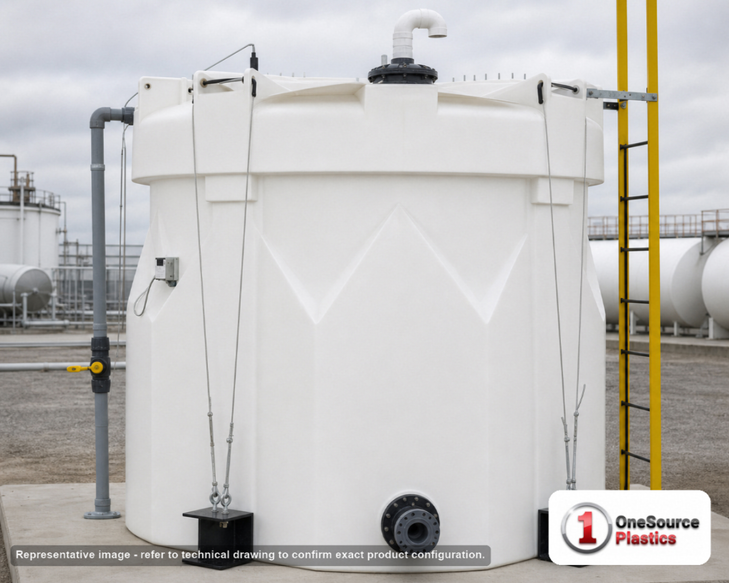
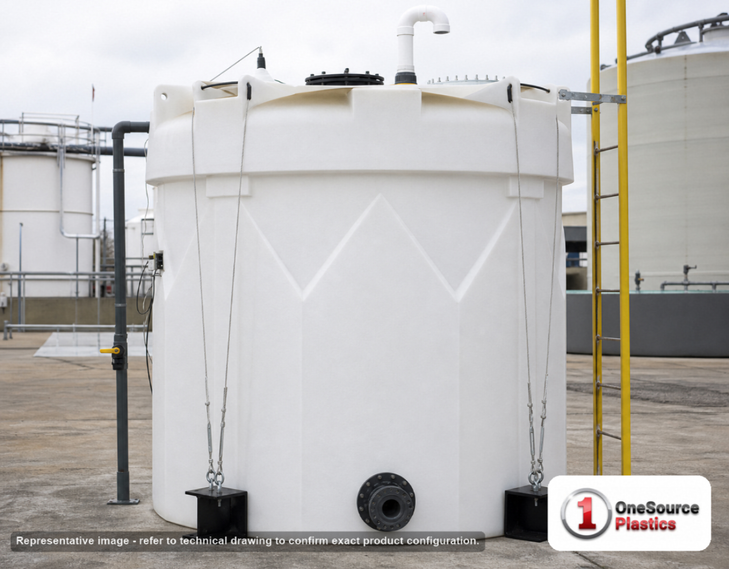
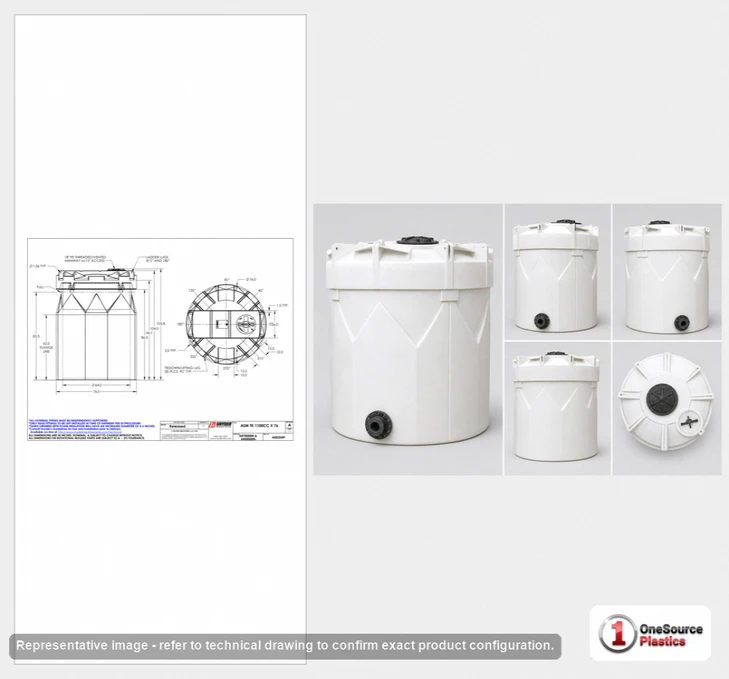
1,100 gallons of double wall containment on a 76 inch base
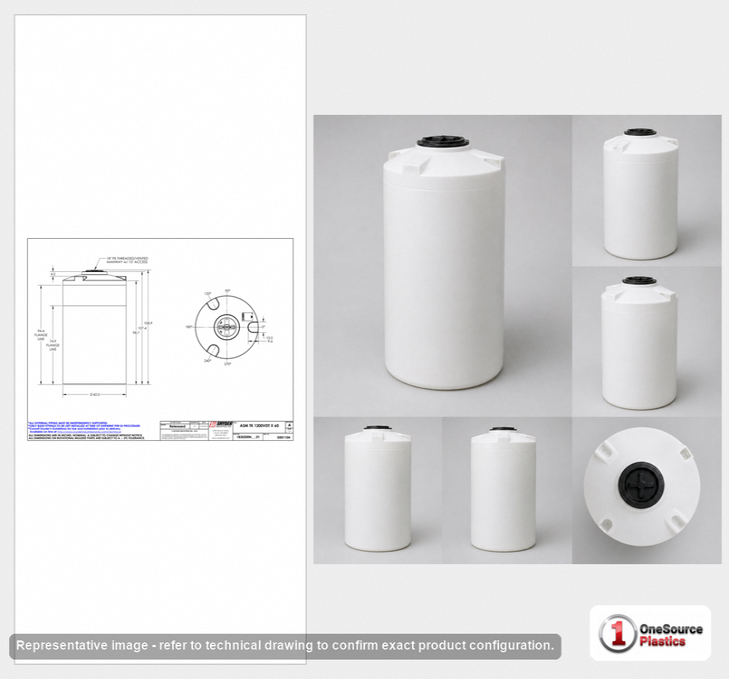
The Snyder SII-5470000N42 holds 1,100 gallons in a double wall storage tank: an inner tank inside an outer containment shell, 76 inches across and 104 inches tall, listed at 650 pounds empty and 650 pounds to ship, in the high density linear polyethylene its material field names, molded at Philippi, West Virginia. The sheet rates it at a specific gravity of 1.9, which is where the 17,431 pound maximum contents figure comes from, against 9,174 pounds for 1,100 gallons of water at 8.34 pounds per gallon. Access is an 18 inch threaded vented manway. The service limit is 120 F / 48 C, with a 3 year warranty. Freight is class LTL. The sheet publishes no outlet and no inlet fitting, so this page asserts neither.
Ready to price it? The listed price is before freight; quote freight to your ZIP in a few seconds, then add to cart above or call 866-418-1777.
Philippi, West Virginia, and the freight lane a double wall this size rides
This is the size of contained tank that still ships like ordinary freight, and that is the practical reason it sells. The sheet gives the class as LTL at 76 by 76 by 104 inches and 650 pounds out of Philippi, West Virginia. Compare that with the 10,000 gallon shells in the same family, which move as permitted oversize loads with a route survey and a crane: this tank is a pallet-scale delivery on a standard trailer, taken off with a forklift or a telehandler, and it can be ordered on an ordinary lead time rather than planned as a project. For a buyer anywhere in the eastern half of the country, Philippi is a short lane, and on a light freight item the lane is a bigger number than the class. What it asks of the site is modest by the standards of the family and absolute in its own terms. Seventy-six inches of base is a little over six feet across, which fits inside a bay, beside a building, in a bunded room or on a small slab, and 104 inches of height keeps the whole tank under a nine foot ceiling with room to open the manway. Under it, level and continuous carries the argument: a rotationally molded floor bears on the whole surface it touches and nothing else, so 9,174 pounds of water, or up to 17,431 pounds of contents at the sheet's rating, wants a flat slab poured wider than the base rather than a pad that stops at the tank's edge. Keep the surround drained so wash-down water runs away from the base, and leave room to walk right round, because the only reason to buy a double wall is that the outer shell can be inspected and the annulus between the two walls can be watched. If the tank is jammed against a wall, that advantage is thrown away on the day it is installed. The usable volume is the other thing to settle before ordering, because a dense liquid that warms through the day does not leave you the nameplate figure to work with, and the double wall freeboard sizing guide works that arithmetic out. What a contained installation has to do to satisfy a site's containment rules is set out in the Captor double wall containment walkthrough, and the shape argument for a tank of this volume is laid out in the complete buyers guide to the vertical tanks at this volume, which is written around a single-wall shell and is worth reading for the comparison. Run the volume against your real draw in the tank sizing calculator and take the reserve and freeboard from the tank sizing guide.
Four 1,100 gallon part numbers at one weight, plus the 1,000 and the 1,500
| Part | Gallons | Diameter x height | Empty weight |
|---|---|---|---|
| SII-5470000N42 (this tank, 1.9 specific gravity) | 1100 | 76 x 104 in | 650 lb |
| 5470000N48 (same shell, same listed weight) | 1100 | 76 x 104 in | 650 lb |
| 5470000N51 (same shell, same listed weight) | 1100 | 76 x 104 in | 650 lb |
| SII-5470000N30 (same shell, same listed weight) | 1100 | 76 x 104 in | 650 lb |
| 5990102N30 (smaller, wider, much lower) | 1000 | 81 x 69 in | 500 lb |
| 5990302N30 (larger, wider, low) | 1500 | 93 x 76 in | 950 lb |
Four part numbers on this sheet hold 1,100 gallons in the same 76 by 104 inch shell at the same 650 pounds, and the sheet publishes nothing that separates them. We will not invent a difference; what we will do is confirm at order which number is being supplied and what wall specification it carries, because that is the honest answer to a question the manufacturer's own paper leaves open. What the sheet does separate clearly is the silhouette either side of this one, and both neighbours go wide rather than tall. The 1,000 gallon 5990102N30 puts a hundred fewer gallons on an 81 inch base at only 69 inches of height and 500 pounds, which is thirty-five inches shorter than this tank: that is the buy for a low ceiling, a room with a beam across it, or a site that wants to open the manway from the floor. The 1,500 gallon 5990302N30 adds four hundred gallons on a 93 inch base at 76 inches tall and 950 pounds, which is still lower than this tank while being a foot and a half wider. So this shell is the tall, narrow member of the group, and the reason to choose it is floor space: 76 inches of base is the smallest circle here, and where a bay is tight and the ceiling is generous it is the only one of the three that fits. Decide the height you have first, then the floor, then the volume, and the row falls out of it.
Want us to check the fit? Send the site dimensions to 866-418-1777 or through a written quote request and we will confirm the tank, the pad and the freight.
An 18 inch threaded vented manway, 104 inches up
- The opening the sheet publishes: an 18 inch threaded vented manway, at the top of a shell 104 inches tall. That is the fill point and the inspection port, and at a little over eight and a half feet it is a step, a platform or a fixed access job rather than something reached from the floor. Decide which before the tank is delivered.
- How the liquid arrives: take the fill to a coupling at working level rather than passing a hose over the top, and run the fill line down inside the body instead of letting the product free-fall onto the surface. On a foaming or gassing product that free fall costs freeboard you had counted on.
- Venting: the manway is vented and the vent path is kept clear. A tank drawn on hard through a blocked vent pulls its own wall in, and a narrow, tall shell loses shape faster than a wide one.
- What the sheet does not publish: no outlet and no inlet fitting. Said plainly rather than guessed. On a double wall every penetration through the inner tank has to be made without compromising the containment shell around it, so the fitting schedule is part of the tank order and nothing is cut in the field.
- The annulus: the space between the inner tank and the outer shell is the product. Keep it monitored, keep whatever watches it readable from where somebody actually walks, and keep the outside of the outer shell visible all the way round.
- Service limit and warranty: 120 F / 48 C, with a 3 year warranty as the sheet gives it. The rating is a specific gravity of 1.9 and the 17,431 pound maximum contents figure is that rating against the capacity; no margin beyond it is claimed.
Downstream, treat the tank as something that moves. A polyethylene shell changes dimension with temperature and with the weight of its own contents, so the first joint on any line gets a flexible connector, the first valve rides on its own support off the slab, and no rigid pipe is bolted between a wall bracket and the tank. Where the bay sees forklift traffic, put a kerb or a bollard between the traffic and the base; on a tank this size the base and the fittings are the only fragile parts, and a pallet corner finds them. In freezing weather protect the valves and the exposed pipe and leave the body alone. Tell us the liquid at order and we will match the fitting, gasket and valve materials against Snyder's current documentation rather than guessing at the counter.
Day tanks, dosing supply and contained outdoor storage
Eleven hundred gallons is the working size of contained storage: too much for a stack of totes, far short of a bulk shell, and exactly right for a tank that gets filled every week or two. The duties: a day tank feeding a dosing or metering skid at a water or wastewater plant; a chemical supply at a laundry, a car wash, a food or beverage plant, a plating line or a print works; a waste or by-product holding tank that has to be inside a barrier while it waits for collection; an outdoor supply in a yard where a concrete berm would fill with rain and have to be pumped and tested before it could be counted as containment; a satellite tank in a bay some distance from a main storage area, where trucking a tote in every few days is the alternative. The reason to spend on a double wall at this size is almost always housekeeping rather than purchase price: a berm is a civil structure that cracks, collects water and gets used as a storage area by whoever is busy, while the containment here arrives with the tank and gets inspected in the same walk-round. Where the duty is stored water held as a reserve against fire, that is a separate design exercise with its own sizing, connection and freeze discipline, and the fire-water reservoir design guide is where that gets argued rather than assumed. The one limit the sheet states is 120 F / 48 C, and it applies to the liquid and to the tank standing in the sun.
Class LTL on 650 pounds, and the machine that takes it off the truck
The sheet gives class LTL at 76 by 76 by 104 inches and 650 pounds, molded at Philippi, West Virginia. The freight cost estimator prices the lane to your ZIP, and the listed price is before freight. Six hundred and fifty pounds in a shipment a little over six feet across and eight and a half feet tall is a forklift or telehandler job, not a two-person lift and not a tailgate delivery, so tell us at order whether the address has a dock and a machine; without them it is a curbside drop and a problem you do not want on the day. Take it off with slings under the body and never a hook through the manway, and put it straight onto the finished slab rather than parking it beside and moving it later. Check the outer shell all the way round in daylight before the driver leaves, including the side that will end up against a wall. Then fill it with clean water, hold it, and read the base, the slab edge and the annulus through the hold before any product goes in. That water fill is the cheapest test this installation will ever get and the only one you can run without a cleanup plan. A photo of the tank on its pad, full, on day one is worth keeping; it is the baseline every later inspection is compared against.
Freight and documents
Ships from: Philippi, WV. LTL freight is quoted to your ZIP with the freight cost estimator or by phone at 866-418-1777. The listed price is before freight.
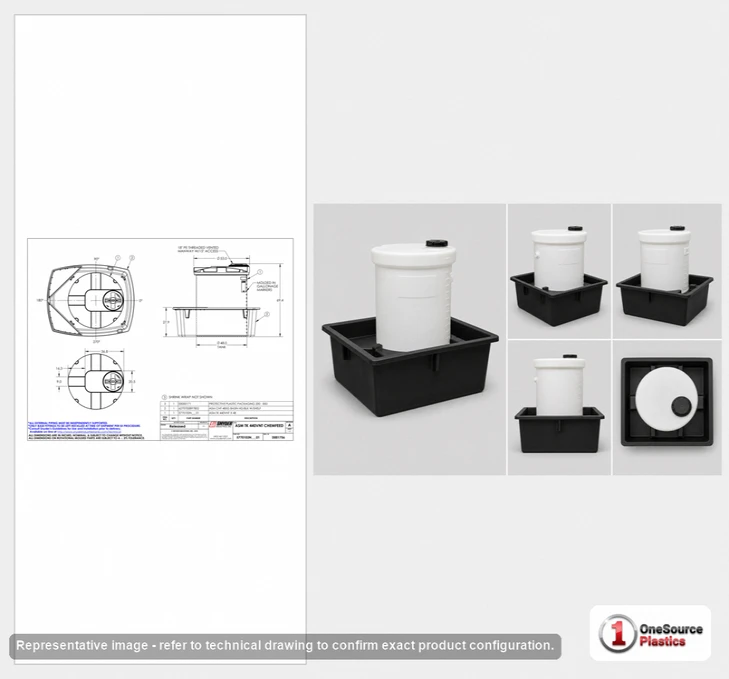
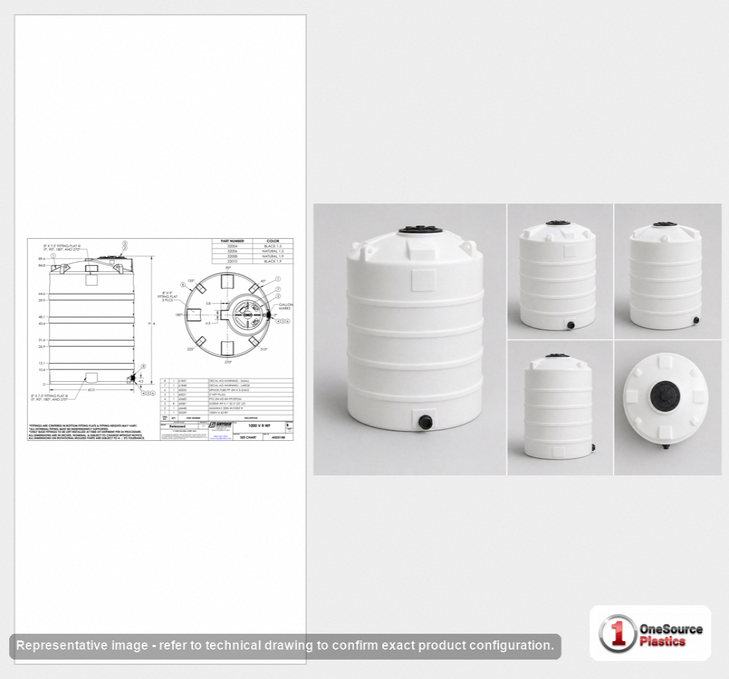
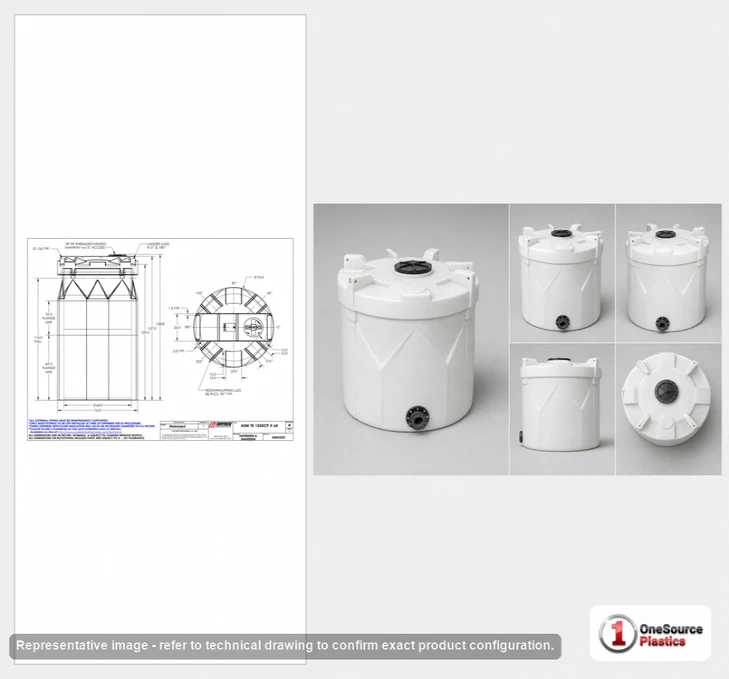
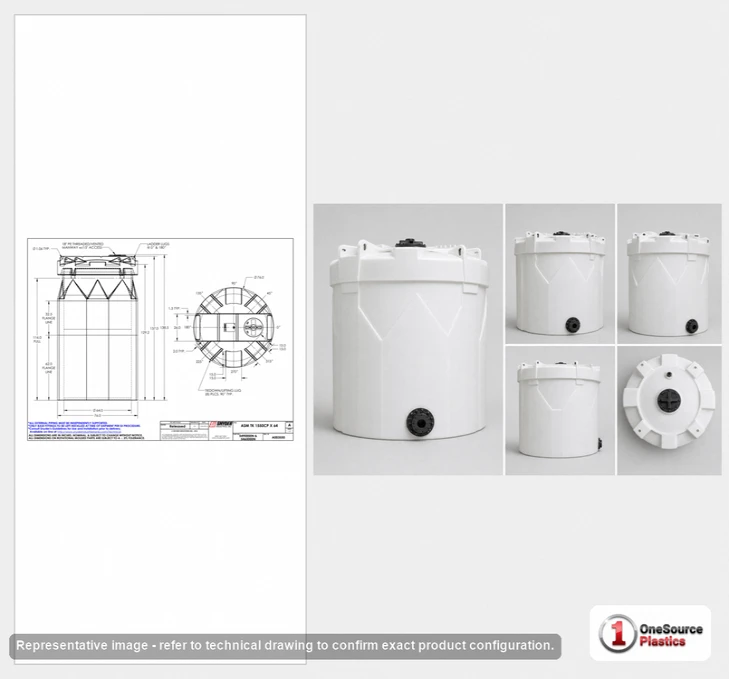
Technical drawing (PDF) for Snyder Industries 5470000N42.
See this tank
Product video. Watch the Snyder Industries 1100 Gallon Double Wall Storage Tank XLPE 1.9 SG Natural White video (71 seconds) with dimensions, fittings and shipping notes.
Ready to order?
Add it to your cart at the top of this page, get LTL freight to your ZIP, request a written quote, or call 866-418-1777. The listed price is before freight.