Fifteen hundred gallons on a seven foot nine base
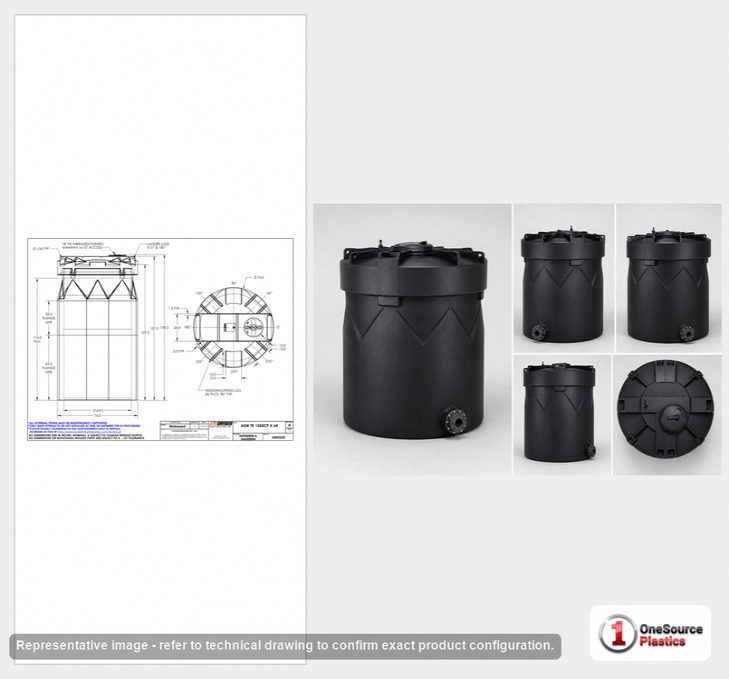
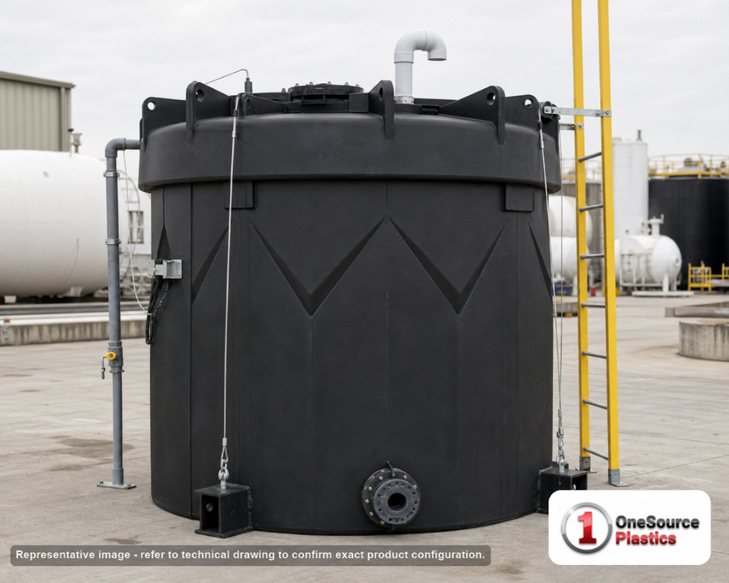
The Snyder 5990302N51 is a 1500 gallon double wall tank, listed on its sheet as ASTM Black, moulded in black high density linear polyethylene at 93 inches long by 93 inches wide by 76 inches tall and 950 pounds empty. Those words in the name are the maker's name for the product and nothing is claimed from them here. The sheet publishes one capacity, one set of overall dimensions, one empty weight and one rating for the whole assembly: there is no separate inner tank figure, no separate outer containment figure, no annulus dimension and no containment percentage on it, so none appears below. The wall is rated at a specific gravity of 1.9, and the sheet gives 12,510 pounds for 1500 gallons of water at 8.34 pounds per gallon with 23,769 pounds of max contents. The opening is an 18 inch threaded vented manway, and the outlet field reads 1 Manway / Lid, which names an opening rather than a pipe size. The service limit is 120 F / 48 C and the warranty is a 3 Year Warranty. Freight is LTL at class 250 with no NMFC number, and the sheet lists two plants, Chowchilla, California and Lincoln, Nebraska.
Want it on your site? Get LTL freight to your ZIP, add it to your cart above, or call 866-418-1777 and a tank specialist will confirm the fit.
The slab under twelve and a half thousand pounds of water
At this capacity the position stops being a siting question and becomes a structural one, so start there and be blunt about it. The base is 93 inches square, seven feet nine each way, and the shell stands 76 inches. Above that footprint sits 12,510 pounds of water at 8.34 pounds per gallon, and 23,769 pounds at the published 1.9 rating. That is not a load you put on a floor because it looks solid. It goes on a ground bearing slab or on a base designed for it, flat and continuous and level across the whole 93 inch footprint, with no rails, no packing and nothing shimmed at a corner, and somebody who owns the structure signs it off before the order goes in. A contained tank at this size is not something anyone moves afterwards to fix a mistake underneath it. Containment is the reason to buy this rather than a single wall vessel of the same volume, and at 1500 gallons the comparison is stark. A constructed bund for this much product means kerbs, a coating specification, a drainage detail, a volume argument and a floor that is committed permanently. This tank brings its second wall with it and takes it away again if the process moves. Where somebody needs to understand how the space between two walls is tested and what those methods actually cover, the cathodic disbondment testing guide for double wall interstitial spaces sets out that methodology and where the polyethylene boundary lies; this vessel is polyethylene and stands above ground, and nothing here claims otherwise. The route in is the other early decision. Seven feet nine of width means a wall opening, a large shutter or an outdoor position: it is not going through a building on a pallet truck and round two corners. Height is the easy part at 76 inches, which is a shade over six feet and leaves the manway reachable from a modest platform rather than a tower. Leave room to approach the final position square with forks and a walkway on all four sides once it is set; the side you cannot reach is the side that never gets inspected, and there is a great deal of side here. Three references belong with a tank this size. A polyethylene wall's hardest service is at the vapour line rather than under the liquid, which the wall thickness at the vapour saturated headspace guide works through. The usable volume is not the nameplate figure, which is the subject of the double wall freeboard sizing guide, and your own turnover belongs in the tank sizing calculator with the discipline from the tank sizing guide. Where the duty is private fire water rather than chemical feed, the fire water reservoir design guide for rural and remote sites is the right starting point; nothing on this page is a claim about that use.
Four 1500s, an 1100 and a 1550
| Part | Gallons | Length x width x height | Empty weight |
|---|---|---|---|
| 5990302N51 (this tank, named ASTM Black) | 1500 | 93 x 93 x 76 in | 950 lb |
| 5990302N30 (named Sulfuric Acid) | 1500 | 93 x 93 x 76 in | 950 lb |
| 5990302N42 (named ASTM XLPE) | 1500 | 93 x 93 x 76 in | 950 lb |
| 5990302N48 (named ASTM XLPE Black) | 1500 | 93 x 93 x 76 in | 950 lb |
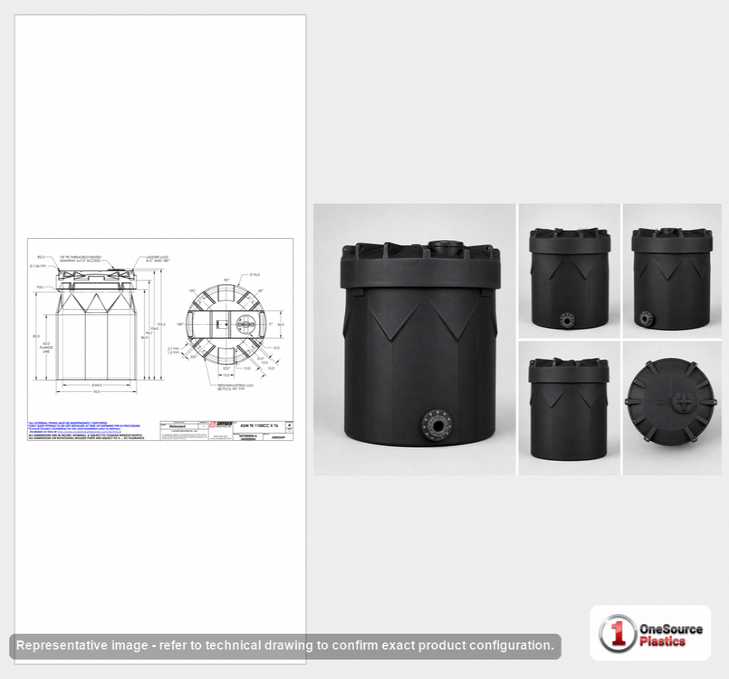
| 5470000N48 (smaller, tall, named ASTM XLPE Black Captor) | 1100 | 76 x 76 x 104 in | 650 lb |
| 5490000N48 (larger, taller, named ASTM XLPE Black Captor) | 1550 | 76 x 76 x 136 in | 780 lb |
Four listings share this exact 93 by 93 by 76 inch shell at the identical 950 pounds, and what separates them on paper is the name, the colour and the material field the maker assigns. We print every name as the sheet gives it and explain none, because a name is not a specification. Tell us the product and the strength and we will tell you which part number to order. The two Captor rows underneath are where the real engineering choice sits, and they are a completely different tank rather than a size step. Both stand on a 76 inch square plan, narrower than this one by well over a foot in each direction, and both buy their volume in height instead: the 1100 gallon 5470000N48 at 104 inches and 650 pounds, and the 1550 gallon 5490000N48 at 136 inches and 780 pounds. That 1550 holds slightly more than this tank on roughly two thirds of the floor area, and it does it by standing more than eleven feet tall. So the question in this part of the family is not gallons at all, it is which dimension your site can spare. If the building is low and the yard is wide, this 93 inch shell is the answer and everything on top stays within reach of a modest platform. If the floor is expensive and there is height to spare, the tall Captor rows put the same product in far less plan area and ask for a serious access arrangement in exchange. Work out which constraint you cannot argue with before you look at a capacity at all.
Picked the 1500 gallon tank? Add it to your cart above; freight is quoted to your ZIP before you pay anything.
One published opening on a ninety-three inch shell
- The outlet: the outlet field reads 1 Manway / Lid. That names an opening and not a pipe size, and the inlet field is blank, so no outlet dimension, thread, bulkhead, flange or valve is published on this sheet and none is claimed here. Tell us the line size, the valve type, the pump and the product, and we will confirm what this part number carries before anything is bought.
- The opening: an 18 inch threaded vented manway, and the only one published. On a vessel of this volume that single opening is the fill route, the inspection route and the cleaning route at once, which makes planning what goes through it a design job rather than an afterthought.
- Reaching it: the top of the shell is at 76 inches. A step will not do here; design the platform and the fill connection with the tank, bring the fill point down to working level, and keep a driver off the shell entirely.
- The vent: the manway is listed as vented, and on a tank holding this much product that path is doing serious work on every fill and every hard pump down. Keep it clear, inspect it whenever the manway is opened, and never blank it.
- The space between the walls: no monitoring port, no gauge and no alarm is published. At 1500 gallons that arrangement is worth a written procedure with a named owner and a schedule, not a habit.
- Structure: the sheet publishes no lifting lugs, no ladder lugs, no flange lines, no stand and no level device on this part number.
- Limits: 120 F / 48 C, a specific gravity rating of 1.9, and a 3 Year Warranty.
Name the product and its strength when you order. The second wall does nothing for a fitting that was specified generically, and on a vessel this size the fitting is where a release starts.
Bulk holding indoors without a berm
Fifteen hundred contained gallons is a bulk holding quantity: coagulant, polymer and disinfection chemical storage at municipal water and wastewater works, clean-in-place and sanitising chemical stores in food, beverage and dairy plants, cooling tower and boiler house treatment at scale, plating and surface finishing lines, pulp and paper additive feed, and industrial process storage that takes a full truck drop rather than a part load. At this volume the money is in the chemistry buying rather than in the tank: a site holding 1500 gallons buys at a bulk chemical cost per gallon that a tote programme never reaches, and the tank pays for itself in truck drops. The black shell keeps daylight off the contents, which is worth having wherever the vessel stands in a lit bay, under a canopy or outdoors. Because it is black, arrange the level indication deliberately at design time; it is not something to work out after the first fill on a tank this size.
Nine hundred and fifty pounds, class 250, two plants
This sheet lists two plants, Chowchilla, California and Lincoln, Nebraska, and two ship-from states, which is the most useful single fact on the page for anybody east of the Rockies: the lane is not automatically a coast-to-coast move the way it is on the smaller shells in this family. Freight is LTL at class 250 with no NMFC number, and the shipping size is given at 93 by 93 by 76 inches at 950 pounds. Price your own ZIP with the freight cost estimator before you fix the capacity; the listed price is before freight. Receiving this one needs planning rather than improvisation. Nine hundred and fifty pounds is within a forklift's comfort, but seven feet nine of width is not a pallet truck job through a building, so agree the offload point, the equipment and the final position before the truck is booked. Take it under the base with forks approaching square, never by the manway, and set it on the finished, cured, level surface in its final position; nothing about this tank is repositionable once it is plumbed. Fill it with clean water, hold that 12,510 pound load, and read the manway seal, the base all the way round and the slab beneath it, then leave the water in overnight where the schedule allows and read the base again in the morning. Drain it, let it dry, open the space between the walls, look in good light and write the date on the shell. Photograph the base line from two sides while it is still empty; a settling slab is far easier to compare against a picture than against anybody's memory. Keep the delivery paperwork with the tank; the serial number on the shell is what a warranty claim starts from.
Freight and documents
Ships from: Chowchilla, CA; Lincoln, NE. LTL freight is quoted to your ZIP with the freight cost estimator or by phone at 866-418-1777. The listed price is before freight.
Technical drawing (PDF) for Snyder Industries 5990302N51.
See this tank
Interactive 3D model with live fill. This tank has an interactive 3D model built to its manufacturer dimensions. Rotate it, and set a fill level to see how much liquid it holds at any height. Open the 3D view on the product photo above. Download the 3D model (GLB).
Ready to order?
Add it to your cart at the top of this page, get LTL freight to your ZIP, request a written quote, or call 866-418-1777. The listed price is before freight.