The black thousand on an eighty-one inch square
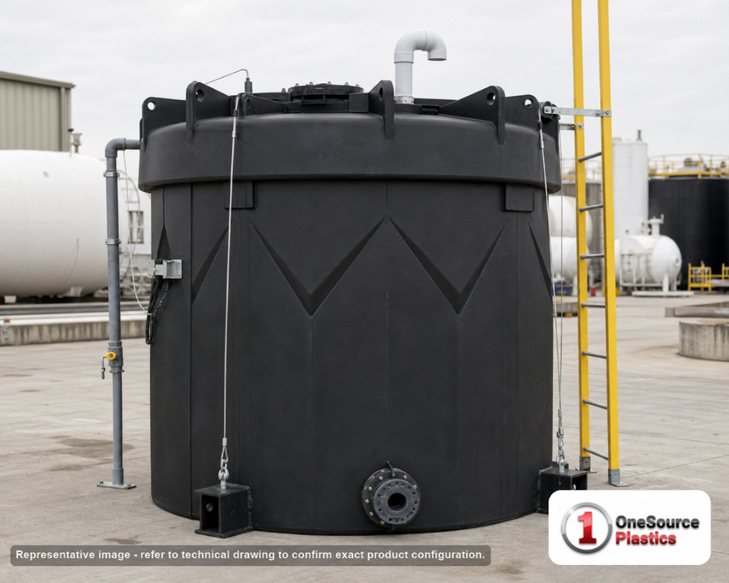
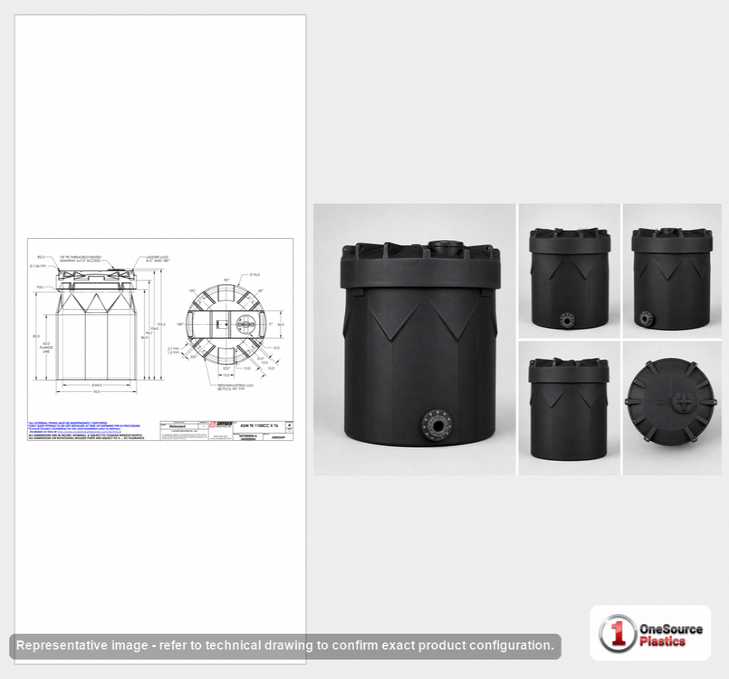
The Snyder 5990102N51 is a 1000 gallon double wall tank, listed on its sheet as ASTM HDPE Black, moulded in black high density linear polyethylene at 81 inches long by 81 inches wide by 69 inches tall and 500 pounds empty. Those words in the name are the maker's name for the product and nothing is claimed from them here. The sheet publishes one capacity, one set of overall dimensions, one empty weight and one rating covering the whole assembly, and carries no separate inner tank figure, no separate outer containment figure, no annulus dimension and no containment percentage, so none of those appears below. The wall is rated at a specific gravity of 1.9, and the sheet gives 8,340 pounds for 1000 gallons of water at 8.34 pounds per gallon with 15,846 pounds of max contents. The opening is an 18 inch threaded vented manway, and the outlet field reads 1 Manway / Lid, which names an opening rather than a pipe size, with the inlet field blank. The service limit is 120 F / 48 C and the warranty is a 3 Year Warranty. Freight is LTL at class 300 with no NMFC number, and the sheet lists two plants, Chowchilla, California and Lincoln, Nebraska.
Talk to a person first? 866-418-1777 reaches a tank specialist, not a call center; or see freight to your ZIP and add the 1000 gallon tank to your cart above.
The lane, the class, and the shipment that carries it
Two plants are listed against this part number, Chowchilla, California and Lincoln, Nebraska, and that is where the buying decision starts on a shipment this size. A vessel 81 inches square and 69 inches tall at 500 pounds is bulky rather than heavy, and LTL at class 300 prices that bulk: the pallet footprint and the class do more to the number than the pounds do. With a plant on each side of the country the lane can be a short one from the plains, the Midwest or the South out of Nebraska, or from the West and Southwest out of California, which is exactly the difference between a tank that makes sense at this capacity and one that does not. Get your own ZIP priced before the capacity is fixed, because at this size the lane is a material share of the installed cost and the part that varies most between two otherwise identical quotes. The proportion of the shipment then decides how the tank behaves at your end. Low and broad means the weight spreads, the centre of gravity stays down, and the manway at 69 inches is reachable from a low platform with no fall protection arrangement to design and maintain. It also means the way in is a large shutter, a wall opening or an outdoor pad rather than a corridor, and the narrowest point on that route is the measurement that matters. The surface under it has to be flat, continuous and level across the whole 81 inch footprint, with no rails, no timber packing and nothing shimmed at a corner, because above it sits 8,340 pounds of water at 8.34 pounds per gallon and 15,846 pounds at the published 1.9 rating. Colour is the reason this row exists rather than the pale listing on the identical shell at the identical 500 pounds: a black wall keeps daylight off the contents, and the price of that is the level reading, which on a tank whose only opening is a manway on top has to be arranged deliberately at design time. Three references belong with the decision. A polyethylene wall's hardest service is at the vapour line rather than under the liquid, which the wall thickness at the vapour saturated headspace guide works through, and it explains why an inspection from the liquid side gives false comfort. Where somebody needs to know how the space between two walls is tested and what those methods cover, the cathodic disbondment testing guide for double wall interstitial spaces sets out that methodology and where the polyethylene boundary lies; this vessel is polyethylene and stands above ground, and nothing here claims otherwise. And the usable volume is not the nameplate number, which is the subject of the double wall freeboard sizing guide; your own turnover belongs in the tank sizing calculator with the freeboard discipline from the tank sizing guide. Where the duty is private fire water rather than chemical feed, the fire water reservoir design guide for rural and remote sites is the place to start; nothing on this page is a claim about that use.
One thousand gallon shell, four names on it
| Part | Name on the sheet | Gallons | Size and weight |
|---|---|---|---|
| 5990102N51 | this tank, ASTM HDPE Black | 1000 | 81 x 81 x 69 in, 500 lb |
| 5990102N30 | Sulfuric Acid | 1000 | 81 x 81 x 69 in, 500 lb |
| 5990102N48 | ASTM XLPE Black | 1000 | 81 x 81 x 69 in, 500 lb |
| 5990102N52 | Sodium Hypochlorite (UV) | 1000 | 81 x 81 x 69 in, 500 lb |
| 5990902N30 | Sulfuric Acid, the size below | 750 | 73 x 73 x 67 in, 390 lb |
| 5470000N48 | ASTM XLPE Black Captor, narrow and tall | 1100 | 76 x 76 x 104 in, 650 lb |
Four part numbers, one shell, four names, and the sheet explains none of them. Neither will this page, because guessing a specification out of a name is how the wrong vessel ends up on a pad. Where a drawing, a spares list or an existing installation already names one of these, order that one and we will confirm the published figures against it before anything ships; otherwise tell us the product and the strength and the part number follows from that conversation. What you can act on is colour and proportion. Two of the four are black, including this one, and two are not; black keeps daylight off the contents where a pale shell lets the level be read through the wall. That is the whole of the honest difference you can see from across a bay. The 750 gallon row is this same wide low tank one step down, at 73 inches square and 67 inches tall and 390 pounds, so it gives back a quarter of the volume and takes almost nothing off the handling or the reach. The 1100 gallon Captor row is a different animal: a 76 inch plan taken up to 104 inches at 650 pounds, which puts a tenth more product on a narrower footprint and asks for a serious access arrangement in return. Decide which dimension your site is short of before you look at a capacity. If it is floor, price the tall row and cost its platform in at the same time. If it is not, this shell is the one that stays easy to fill, inspect and clean for twenty years.
Neighboring size a better fit? Every row links to its own page; freight to your ZIP is quoted on each, or call 866-418-1777.
Loading it through the top, and nothing else published
- The fill opening: an 18 inch threaded vented manway is the only opening on this sheet, which makes it the fill route, the inspection route and the cleaning route at once. Eighteen inches takes a fill coupling, a drop pipe and a rinse lance, and it is wide enough to get a real look at the inside wall.
- Reaching it: the top of the shell is at 69 inches. A low platform serves, and the fill connection should come down to working level so a driver makes the connection standing on the ground rather than on the tank.
- The vent: the manway is listed as vented, and that path is the wall's protection on a fast fill and a hard pump down. Keep it clear, inspect it every time the manway is opened, and never blank it.
- The outlet field: it reads 1 Manway / Lid and nothing else, with the inlet field blank. That names an opening, not a pipe size, so no outlet dimension, thread, bulkhead, flange or valve is claimed here. Tell us the duty, the line size and the pump and we will confirm what this part number carries.
- Level indication: on a black shell nothing can be read through the wall, so how the level is measured and where it is displayed belongs in the same drawing as the platform and the fill point, not in a decision taken after the first fill.
- The space between the walls: no monitoring port, gauge or alarm is published, and the sheet gives no stand, no legs, no lifting lugs, no ladder lugs and no flange lines either. Nothing of the sort is claimed on this page.
- Limits: 120 F / 48 C, a specific gravity rating of 1.9, and a 3 Year Warranty.
Name the product at order time. The manway seal and any fitting we add are selected against the chemistry, and on a contained vessel those parts are the only path a release can take.
Sites where the tank stands in daylight
A black thousand gallon contained tank goes where a pale one would be working against the light: a yard pad beside the plant room, a dosing point under an open canopy, a wash bay or vehicle wash with the shutter up all day, an agricultural or horticultural chemical store, a quarry or wash plant reagent station, a metal finishing line beside a window, and treatment plants where the vessel stands outside the building and only the pipework comes in. A thousand gallons is the practical part of that: it takes a full hose fill rather than a forklift and a pallet of totes, it needs no bund constructed round it, and it moves a site onto a bulk chemical cost per gallon that a tote programme never reaches. Where it stands outside, walk round it after weather and after any traffic near it, and keep the schedule for looking into the space between the walls exactly the same in winter as in summer.
Chowchilla, Lincoln, and which one is closer to you
This sheet lists two plants, Chowchilla, California and Lincoln, Nebraska, with California and Nebraska as the ship-from states, which is worth checking against your own map before anything else: one of them is usually a short lane and the other usually is not. Freight is LTL at class 300 with no NMFC number, and the shipping size is given at 81 by 81 by 69 inches at 500 pounds. Price your ZIP with the freight cost estimator; the listed price is before freight. At 500 pounds this is a forklift item rather than a crane item, and the planning that matters is width and floor rather than lifting: measure the narrowest point on the route, leave turning room at the destination, and keep a walkway on all four sides once it is set, because the side nobody can reach is the side that never gets inspected. Take it under the base, never by the manway. Set it on the finished, cured, level surface in the final position, confirm it sits flat with no rock at any corner, and only then connect anything. Fill it with clean water, hold the 8,340 pound load, and read the manway seal and the whole base in good light. Drain it, let it dry, open the space between the walls and record the date on the shell. On a black tank, paint your working full level and your stop level on the outside while the water is still in it, because nobody is ever going to see either through this wall. Once it is full and holding, leave it alone for a day before the plumbing goes on; a settled tank is a quiet one.
Freight and documents
Ships from: Chowchilla, CA; Lincoln, NE. LTL freight is quoted to your ZIP with the freight cost estimator or by phone at 866-418-1777. The listed price is before freight.
Technical drawing (PDF) for Snyder Industries 5990102N51.
See this tank
Interactive 3D model with live fill. This tank has an interactive 3D model built to its manufacturer dimensions. Rotate it, and set a fill level to see how much liquid it holds at any height. Open the 3D view on the product photo above. Download the 3D model (GLB).
Ready to order?
Add it to your cart at the top of this page, get LTL freight to your ZIP, request a written quote, or call 866-418-1777. The listed price is before freight.