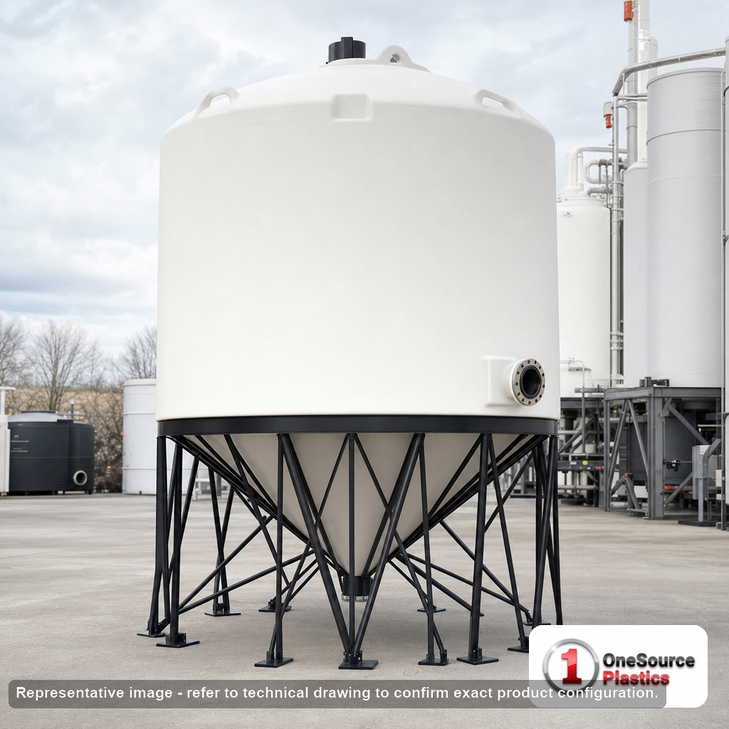
Snyder 11500 gallon black heavy duty XLPE cone bottom tank, rated to 1.9 specific gravity
Part number 5340100N48 is the heaviest wall in Snyder Industries' 11500 gallon cone bottom line: black crosslinked linear polyethylene, rated for liquids up to 1.9 specific gravity, 142 inches in diameter and 215 inches tall. It weighs 3,600 lb empty, more than the standard wall on the same shell, and that extra plastic is what carries the denser liquid. Filled with water it holds 95,910 lb; filled to the 1.9 rating the contents weigh about 182,229 lb. On top is an 18 inch threaded vented manway. The service limit is 100 F. The black wall keeps light out, which slows algae and protects light sensitive chemicals.
Is your liquid heavier than 1.5? That is when this tank is the right one. Call 866-418-1777 with the specific gravity, or get freight to your ZIP and add it to your cart above.
When the heavy duty wall is worth it
Specific gravity is the weight of a liquid against water. Many treatment chemicals, brines and fertilizer concentrates run well above 1.5, and a standard wall tank holding them is overloaded every day it is full. This tank is rated to 1.9, so it handles those liquids at full volume. The cone drains to the low point, which suits batching and settling solids out. Crosslinked polyethylene is the resin Snyder offers for tougher chemical service; our article on when crosslinking matters for chemistry duty covers why. Look up your liquid in the chemical compatibility guide; the heavy liquids buyers of this tank check most are ferric chloride, hydrofluosilicic acid, calcium chloride, magnesium chloride and potassium hydroxide. Keep it at or under 100 F. For containment around a tank this size, see the Snyder Captor containment comparison.
What to settle before you order
- Stand and slab. At up to about 182,229 lb of contents plus the tank, the stand and the concrete under it are an engineered design, not an afterthought. The cone bottom stand compatibility matrix covers the Snyder pairings; ask us about the stand when you order.
- Outlet. No outlet size is stated for this tank. Tell us the pipe size and valve you need at the cone and we confirm the fitting with Snyder.
- Measuring the level. A black wall hides the level, so plan a gauge for the 18 inch manway; the level gauge selection guide for chemical service compares radar, ultrasonic and the rest.
- Clearance. 215 inches tall before the stand; check overhead lines and the lift to set it.
Other walls and sizes
Same black shell, standard 1.5 wall: 11500 gallon XLPE cone bottom tank 5340100N46. Natural colour: the heavy duty 5340100N42 and the standard 5340100N40. Down a size, the 7400 gallon cone bottom tank; up a size, the 13000 gallon cone bottom tank. Use the tank sizing calculator or the tank sizing guide to check the volume.
Shipping and receiving
It ships at freight class 300 out of Snyder's Lincoln, NE plant, 142 by 142 by 215 inches at 3,600 lb. That width is more than a standard trailer, so talk to us about the route and the site before the order is placed. Have a crane or a large forklift ready. Match the part number to 5340100N48 on the bill of lading, inspect the cone before you sign, and fill with water first to check every connection.
Add it to your cart at the top of this page, get LTL freight to your ZIP, or call 866-418-1777. The listed price is before freight.
Freight and documents
Ships from: Lincoln, NE. LTL freight is quoted to your ZIP with the freight cost estimator or by phone at 866-418-1777. The listed price is before freight.
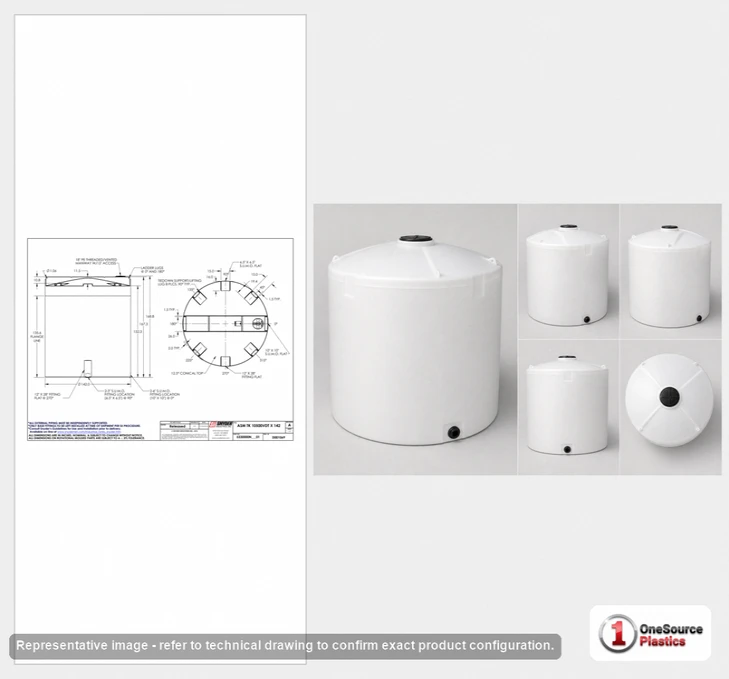
Technical drawing (PDF) for Snyder Industries 5340100N48.
See this tank
Interactive 3D model with live fill. This tank has an interactive 3D model built to its manufacturer dimensions. Rotate it, and set a fill level to see how much liquid it holds at any height. Open the 3D view on the product photo above. Download the 3D model (GLB).
Ready to order?
Add it to your cart at the top of this page, get LTL freight to your ZIP, or call 866-418-1777. The listed price is before freight.