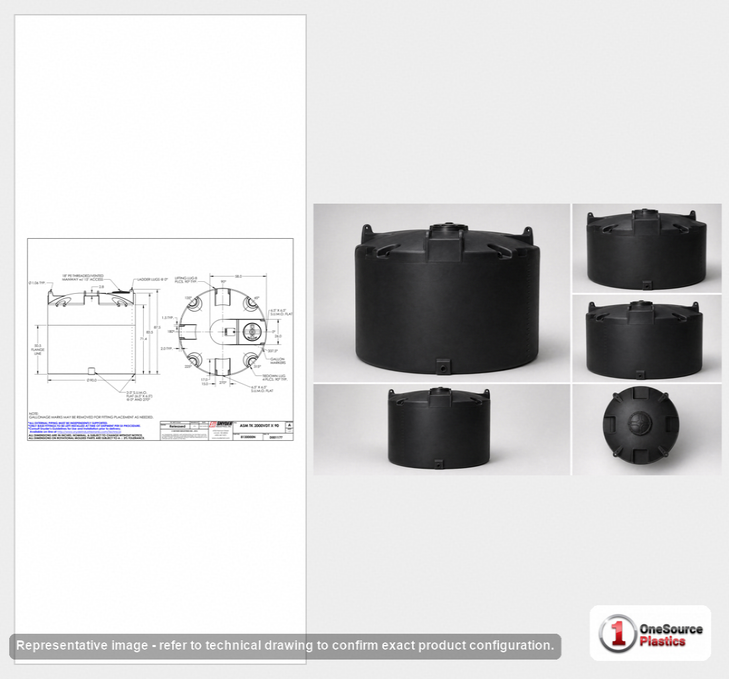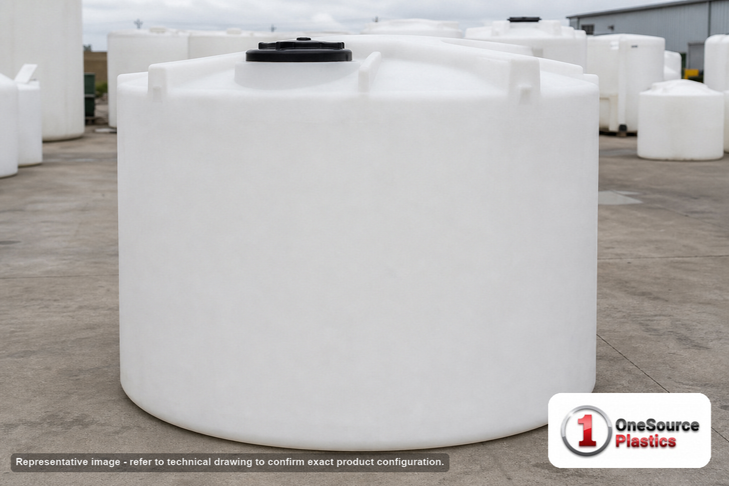
The 2,000 gallon day tank under an eight foot ceiling
Seven feet four inches tall, the Snyder 5050000N40 is the 2,000 gallon tank that stands under an eight foot ceiling with room for the vent: natural white cross-linked polyethylene, 90 inches across and 88 inches high, 340 pounds empty, 16,680 pounds full of water, with a wall rated on the sheet for a specific gravity of 1.5, or 25,020 pounds of contents. It is bought as a day tank beside a bulk tank, as a batch tank at a small plant, and as a water or fertilizer tank on a farm. An 18 inch threaded, vented manway, an outlet the sheet lists as 12, a 3 year warranty, a service limit of 140 F / 60 C, and freight at class 400 from Lincoln, Nebraska or Philippi, West Virginia.
Want a second opinion on the size? Call 866-418-1777 with the daily draw and the delivery interval, or price freight to your ZIP and add it to your cart above.
A shift's worth of chemical, refilled from bulk
Plants that keep a bulk tank outdoors buy this one for indoors: a day tank that holds a shift or a day of chemical next to the metering pumps, refilled from bulk by a transfer pump on a float, so the metering pumps draw from a tank at room temperature with a short suction line and the bulk tank stays outside where the tanker can reach it. There is no truck at a day tank. The delivery is the transfer pump running for a few minutes when the low float calls for it, and stopping on the high float, and the tank is sized so that a full transfer never overfills it and a missed one never starves the pumps before the morning check. The same tank is a batch tank at a small plant, where a recipe is mixed and drawn down, and a water or fertilizer tank on a farm where 2,000 gallons is a nurse-tank load and the roof is low. Full of water it puts 16,680 pounds on a 90 inch circle, and full at the rating 25,020, twelve and a half tons; a rotationally molded floor bears on the whole pad, so the slab is engineered per the concrete pad sizing guide, level and in full contact, inside a berm sized to 110 percent of the tank where the chemical is regulated. Seven feet four inches on a seven and a half foot base is the squattest shape in this batch and needs the least strapping, and it gets a strap anyway, because a day tank lives where the forklift works. Natural white shows the level through the wall, which on a day tank is the check the operator makes at the start of every shift. The tank sizing calculator checks 2,000 gallons against the shift's draw, and the tank sizing guide covers the reserve and the freeboard a warm room adds.
The 5050000 shell and the slim 1,900 beside it
| Part | Gallons | Diameter x height | Empty weight |
|---|---|---|---|
| 5050000N40 (this tank, white, 1.5 SG) | 2,000 | 90 x 88 in | 340 lb |
| 5050000C26 (white, heavy duty) | 2,000 | 90 x 88 in | 340 lb |
| 5050000C34 (black, heavy duty) | 2,000 | 90 x 88 in | 340 lb |
| 5050000C37-BLACK (black) | 2,000 | 90 x 88 in | 340 lb |
| 1780200N40 (slim, tall) | 1,900 | 72 x 119 in | 445 lb |
| 5090000C26 (white, heavy duty, taller) | 2,500 | 90 x 107 in | 450 lb |
Four tanks share this shell at 340 pounds. This is the white cross-linked standard wall, the day-tank buy for a thin chemical the operator needs to see. The C26 is the white heavy-duty wall for a denser chemical, the C34 the black heavy-duty wall for a dense chemical kept dark, and the C37-BLACK the black standard wall for a light-sensitive thin one. The 1780200N40 stands 1,900 gallons on a 72 inch base at 119 inches, listed at 445 pounds, heavier than this tank as the sheet gives it, for a floor too tight even for a seven and a half foot circle; the 5090000C26 is a heavy-duty 2,500 on this base at 107 inches for a room with more height.
Not sure which one? Tell us the liquid, the site and the ceiling height at 866-418-1777, or request a written quote with freight to your ZIP.
A day tank feeds the metering pump, and the floats run the refill
- Outlet: the sheet's outlet field reads 12, and we print it as given; tell us the chemical at order and the fitting size, gasket and bolting are confirmed for it, with a flanged transition, a flexible connector to hard pipe, and the first valve on its own support off the pad.
- Access: 18 inch threaded, vented manway, 88 inches up, opened from the floor; the transfer line from bulk enters through a dip tube, the vent runs outdoors on anything that fumes, and the vent is sized to the transfer pump.
- Service limit: 140 F / 60 C.
Seven feet of head is the least in this batch, so the metering pump goes as low as the room allows, below the outlet, with a short suction line rising toward it and no pocket, and that is still a flooded suction that primes itself on every start; a day tank exists to give the pump a short, warm, flooded suction, and a pump mounted above the outlet throws that advantage away. Three floats run the tank. A low float stops the metering pump before it draws air and, above it, a refill float starts the transfer pump from bulk; a high float stops the transfer and alarms if it runs on, because the transfer pump is the one that overfills a day tank, not the truck. A strainer at the tank end of the suction and a calibration column at the pump let the operator prove the dose at the start of a shift. The flexible connector between the tank fitting and the hard pipe takes the movement a full tank makes on a warm floor. The manway stays closed, the wall carries the chemical's name, and the headspace band gets a look with a light whenever the lid is off. Where the room can freeze, trace the outlet valve and the first pipe run; the body ices from the top down without harm.
Day tanks, farms, and the three-brand 2,000 gallon comparison
A day tank at a water or wastewater plant, a batch tank at a food or beverage plant, a wash-chemical tank at a dairy, and a water or fertilizer tank on a farm with a low shed. At this size there are three makers to weigh, and the Snyder versus Norwesco versus Chem-Tainer 2,000 gallon comparison sets the three walls side by side on rating, shape and fittings before the order goes in. It stores water well inside its rating, though a fire reserve is designed to its own rules, which the fire-water reservoir design guide sets out before anyone buys a chemical wall for it.
Three hundred and forty pounds, class 400, from Lincoln or Philippi
The 5050000N40 ships from Lincoln, Nebraska or Philippi, West Virginia as freight at class 400 as the sheet lists it; at 90 inches across and 88 inches long on the deck it is a permitted load, and the freight cost estimator prices the lane to your ZIP, with the listed price before freight. At 340 pounds a pallet jack moves it on its pallet and a forklift sets it, with straps under the body, never through the manway; measure the door, because a tank 90 inches across goes through a roll-up door and not a man door. Water first: fill it to the manway, hold it, watch the pad edge and the outlet fitting, then drain and dry before the first transfer from bulk, and run the floats through a full cycle with water before the chemical is in. Order the spare gasket for the outlet fitting with the tank. Chalk the full-water line on the outside after the first fill; it is the level every later reading gets checked against.
Freight and documents
Ships from: Lincoln, NE; Philippi, WV. LTL freight is quoted to your ZIP with the freight cost estimator or by phone at 866-418-1777. The listed price is before freight.
Technical drawing (PDF) for Snyder Industries 5050000N40.
See this tank
Interactive 3D model with live fill. This tank has an interactive 3D model built to its manufacturer dimensions. Rotate it, and set a fill level to see how much liquid it holds at any height. Open the 3D view on the product photo above. Download the 3D model (GLB).
Ready to order?
Add it to your cart at the top of this page, get LTL freight to your ZIP, request a written quote, or call 866-418-1777. The listed price is before freight.