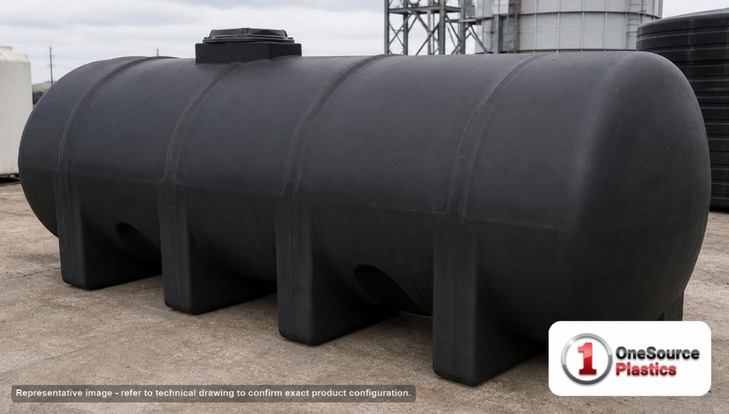
A 2000 gallon black leg tank with securing hoops, rated 1.9 specific gravity, for a nurse trailer or a flatbed
Snyder part number 1002300N51 is a 2000 gallon horizontal leg tank in black polyethylene, 142 inches long, 84 inches wide and 55 inches tall, weighing 700 lb empty, supplied with securing hoops for tying it down. The legs are moulded into the body so it sits flat on a flatbed, a drop deck trailer or a skid with no cradle, and the wide, low shape keeps the load near the deck. It comes with a 2 inch outlet and an 18 inch opening on top. Snyder rates it for liquids up to 1.9 specific gravity, a maximum of 15.87 lb per gallon, which covers water, every common liquid fertilizer and most farm and treatment chemicals; 2000 gallons of water weighs 16,680 lb (2000 x 8.34), and at the full rating the contents can reach about 31,700 lb. The service limit is 120 F. Black keeps light out of the contents, which slows algae in water that sits and protects light sensitive products.
Black or white for your load? Call 866-418-1777 with the product and where the tank will sit, or get freight to your ZIP and add it to your cart above.
Where it goes
Pick black when the tank will sit full in the sun for weeks: a water supply tank parked at a well site, a nurse tank that holds product between applications, anything where algae or light damage is the worry. The trade is that you cannot read the level through the wall, so plan on a sight tube or a gauge. Otherwise it is the same low, wide 2000 gallon nurse tank: 84 inches across a flatbed deck, 55 inches tall for a low centre of gravity. Full of water it is more than eight tons, and at the 1.9 rating it can approach sixteen, so the trailer's axle ratings and the tow vehicle decide whether it belongs there. Run the straps through the securing hoops, never over the top opening, set the weight over the axles, and re-tension after the first few miles. The legs need a flat, continuous deck for the full footprint. Our guide to applicator and leg tanks for fertilizer and the DOT non-roadable trailer rules explains when a nurse trailer counts as a cargo tank.
What goes in it
Water that sits, liquid fertilizer, and the heavier salt solutions and treatment chemicals that a 1.5 rated tank cannot carry. A 1.9 specific gravity rating means liquids up to 1.9 times the weight of water. Check the chemistry as well as the weight in our chemical compatibility guide; urea solution, calcium chloride, sodium hypochlorite and hydrogen peroxide are the common questions on a black tank, the last two because they break down in light. Keep the liquid under 120 F; a black tank in full sun runs warmer than a white one, so check the product temperature on hot days. The tank sizing calculator and tank sizing guide cover the volume.
Openings and fittings
- Outlet. 2 inch. It fits the 2 inch valves, camlocks and transfer pumps most farms already own; the trade is a slower sprayer load than a 3 inch outlet. The thread form and fitting material are not listed on this page, so ask us before you buy the valve.
- Top opening. 18 inches: wide enough to fill from a pump discharge, to drop a float or a suction line in, and to get a head and shoulders in to inspect and clean. Confirm with us whether it ships as a lid or a manway before you buy a replacement cover.
- Hoops. The securing hoops come with the tank. Strap through them, not over the shell.
- Drawing. Snyder's drawing for this tank, linked under Technical Drawing on this page, shows the outlet position, the hoop positions and the leg layout.
Sizes nearby
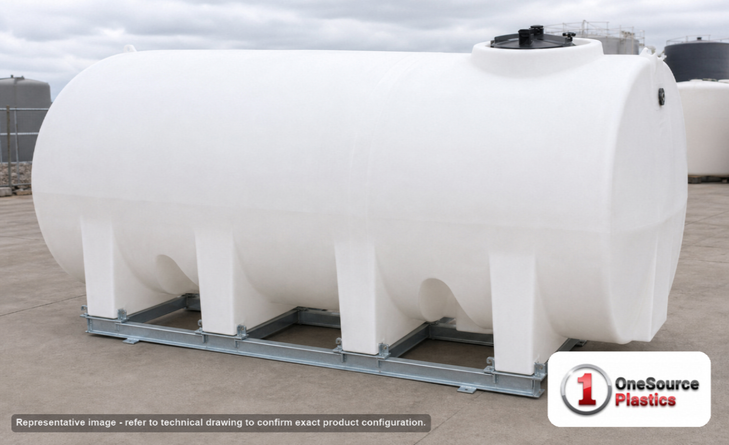
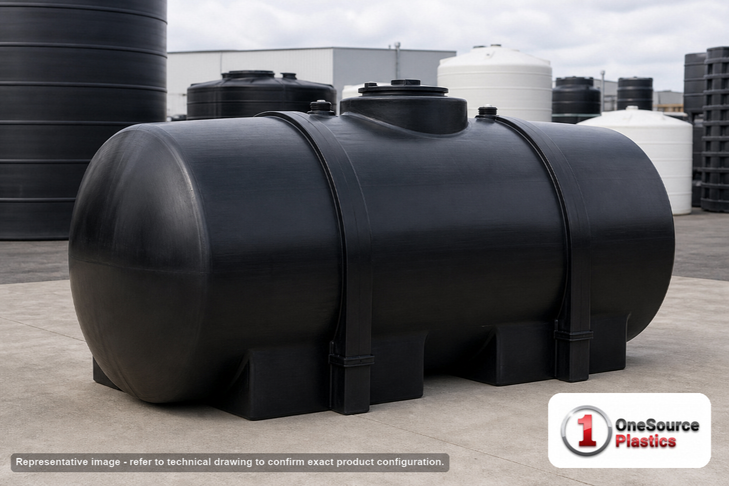
The same tank without the black pigment is part number 1002300N45. Snyder also makes this 2000 gallon tank with securing hoops as part number 1002300C37 and as part number 7510000C26 on a different mould; compare the ratings, outlets and drawings on each page before you choose. One size down is the 1685 gallon leg tank; one size up is the 2600 gallon leg tank.
Shipping and receiving
The tank ships as oversize freight from the nearer of Snyder's plants at Chowchilla, California or Philippi, West Virginia, 142 by 84 by 55 inches at 700 lb, on a truck that needs room to turn and a forklift or a crew to unload. The listed price is before freight; the freight cost estimator gives the lane cost to your ZIP. At the tailgate, check the part number against 1002300N51 on the bill of lading, look at every leg, the hoops and the outlet boss for transit damage, and fill it with water the first time before it carries anything heavier.
Questions before you order? Call 866-418-1777.
Freight and documents
Ships from: Chowchilla, CA; Philippi, WV. LTL freight is quoted to your ZIP with the freight cost estimator or by phone at 866-418-1777. The listed price is before freight.
Technical drawing (PDF) for Snyder Industries 1002300N51.
See this tank
Product video. Watch the Snyder Industries 2000 Gallon Plastic Horizontal Leg Tank with Securing Hoops - Black video (63 seconds) with dimensions, fittings and shipping notes.
Ready to order?
Add it to your cart at the top of this page, get LTL freight to your ZIP, or call 866-418-1777. The listed price is before freight.