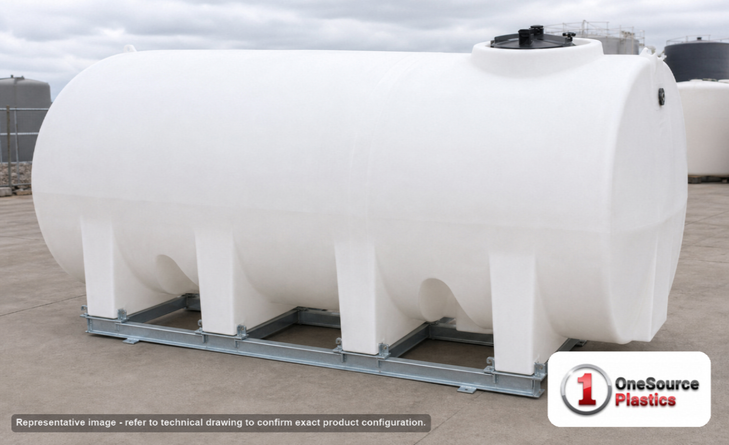
2000 gallons rated 1.9, white, 55 inches tall
Density is what this one is for. The Snyder SII-1002300N45 is a white polyethylene horizontal leg tank, 142 inches long, 84 inches across and 55 inches tall, 700 pounds empty, with molded legs and securing hoops, and the sheet rates its wall at a specific gravity of 1.9. That is 31692 pounds of contents where 2000 gallons of water weigh 16680 pounds at 8.34 pounds per gallon. The fittings on the sheet are one 2 inch outlet and an 18 inch lid, with no inlet listed. The service limit is 120 F / 48 C. The sheet publishes no warranty term. Freight class is OVS, NMFC 156600, molded at Chowchilla, California and Philippi, West Virginia.
Know your ZIP and your ceiling height? Freight to your ZIP takes seconds, and 866-418-1777 will confirm the height; then add it to your cart above.
Density is the reason to take this one
The family question on this sheet is settled by the liquid, not the site. Three tanks share the same 142 by 84 by 55 inch body at the same 700 pounds, and this is one of the two rated to a specific gravity of 1.9 rather than to the lighter figure the third one carries. The gap is not small: the sheet puts 31692 pounds of contents in this tank, where the lighter-rated wall in the identical shell is held to what its own sheet allows. If what you are storing is heavier than water, that rating is the whole purchase, and no amount of strapping or pad work substitutes for it. Against the black tank in the same shell, which carries the same 1.9 rating, this is the white one, which is what a buyer picks when the level wants reading from outside and the tank lives under cover or indoors. The rest is the discipline any wide leg tank needs. Seven feet across and less than five feet tall is a low, broad load: it stays put, it passes under low structure, and it needs support along the whole length of its legs, which means rails running the full 142 inches or a slab in full contact rather than blocks under the ends. The securing hoops are the only place a strap belongs. There is no baffle in the body, so a part-full load rolls, and at this rating a part-full load is heavier per gallon than water. Size the volume to the duty in the tank sizing calculator, and take the working reserve and the expansion allowance from the tank sizing guide.
The 2000 gallon shell read wall by wall
| Part | Gallons | Length x width x height | Empty weight |
|---|---|---|---|
| SII-1002300N45 (this tank, white, 1.9 rating) | 2000 | 142 x 84 x 55 in | 700 lb |
| SII-1002300N51 (black, same rating) | 2000 | 142 x 84 x 55 in | 700 lb |
| SII-1002300C37 (lighter rating, larger outlet) | 2000 | 142 x 84 x 55 in | 700 lb |
| SII-7510000C26 (longer, narrower, taller) | 2000 | 160 x 62 x 70 in | 580 lb |
| SII-1460000C26 (smaller, narrow body) | 1685 | 159 x 48 x 62 in | 480 lb |
| SII-8470000C26 (larger, tall and wide) | 2600 | 155 x 82 x 70 in | 1014 lb |
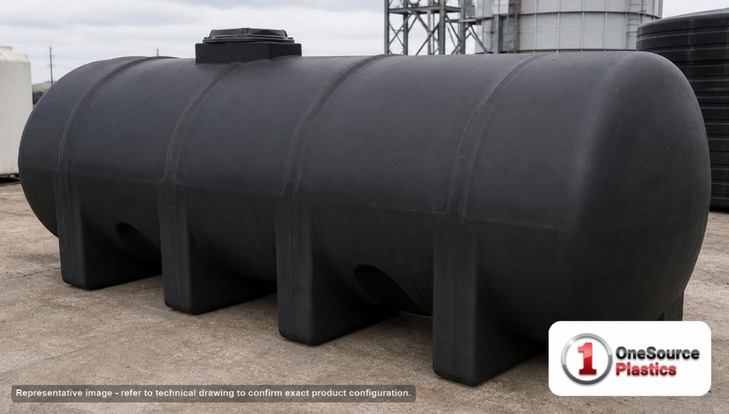
Read the shell first and the wall second. The SII-1002300C37 is the same vessel carrying the lighter rating its own sheet gives it, with a larger outlet than the 2 inches here, so it is the better buy for a light liquid and the wrong buy for a heavy one. The SII-1002300N51 is this tank's rating in a black wall, which is the choice when the tank stands in daylight and the liquid would rather not see any. Off the shell, the SII-7510000C26 holds the same 2000 gallons in a longer, narrower, taller body, 160 by 62 by 70 inches at 580 pounds, for a frame this one will not sit on. The 1685 gallon SII-1460000C26 is the size below at 159 by 48 by 62 inches and 480 pounds, and the 2600 gallon SII-8470000C26 is the size above at 155 by 82 by 70 inches and 1014 pounds. This page is the white, wide, low 2000 rated for a heavy liquid.
Need two of them? Request a written quote for the pair with freight to your ZIP, or call 866-418-1777 and we will price the truck once.
What the lid leaves open and what two inches costs
- Vent: the sheet gives an 18 inch lid and no vent with it, so settle that at order rather than in the field. Air has to enter as liquid leaves, and a dense load leaving a wide, low body is exactly the case where a blocked or absent breather shows up as a dented wall. A vented lid or a breather matched to the pump, with the screen kept clear, is the fix.
- Headspace: 2000 gallons is the rated volume and the sheet publishes no separate fill figure. Under a 1.9 rating the headspace is also the margin that keeps a warming, expanding liquid off the underside of the lid, so leave it and do not fill to the rim of the opening.
- Outlet: one 2 inch outlet as the sheet lists it, and no inlet listed. Two inches is a real constraint on a dense liquid: the heavier the load, the more the pump has to work, so keep the suction short, keep it falling, use full-bore fittings, and pick a sweep over a hard elbow at the tank.
- Fill: the 18 inch lid is the fill point, since the sheet names no inlet. A tube to the floor, a watched level, and a wall that carries the name of the one liquid inside.
- Limits: 120 F / 48 C, and 31692 pounds of contents at a specific gravity of 1.9 as the sheet gives it. No warranty term is published.
Everything hung off that fitting is designed for the weight of the liquid, not the weight of water. Break the first joint with a flexible connector, carry the first valve on its own support off the deck or the pad, and do not bolt a rigid run between a tank and a frame that flexes under load. On a wide body the outlet sits where forklifts and trailer tongues travel, so guard it. Where it freezes, trace or insulate the valve and the exposed pipe; the body itself takes the cold and the valve does not.
Heavy solutions on a skid, a deck or a pad
A 1.9 rating in a low, wide body is bought for the solutions that weigh more than water and are moved in bulk: liquid fertilizer and starter blends at a co-op or a farm, brine and chloride solutions for dust control and winter work, process and wash solutions at a plant, and supply duty feeding a mixer or a blender from a skid. The failure mode on a blend is not the tank, it is the load layering while it stands, and the density-driven mechanism, the mixing protocol and the checks that catch it before the spreader runs off spec are in the fertilizer blend stratification guide. If this tank is going onto a trailer for applicator work, the applicator and leg tank scope article explains where the non-roadable trailer line sits, and the portable utility tank classification article goes through the agricultural exemption at 49 CFR 173.5 for a farm fleet that runs several of these.
Resin compatibility, line by line
Below are the liquids this resin is rated for, the concentration each rating holds to, and the fitting and gasket to specify. Check the exact concentration and temperature you run against the chemical page or the chemical compatibility database before ordering.
- hydrochloric acid at 37% (PVC)
- hydrofluoric acid at 48% (PP/PVC)
- hydrofluosilicic acid at 26% (PP/PVC)
- hydrogen peroxide at 50% (PVC)
- phosphoric acid at 85% (PVC)
- sodium hypochlorite below 16.5% (PVC), and
- sulfuric acid at 98% (CPVC).
- peracetic acid at 30%.
- diesel exhaust fluid (DEF) at 32.5%
- propylene glycol (PP/316SS), and
- zinc orthophosphate (PP/316SS).
- acetic acid at 60% (PP/PVC)
- aluminum sulfate at 50%
- calcium chloride at 40%
- ethylene glycol at 100%
- ferric chloride at 50%
- ferric sulfate at 60%
- ferrous sulfate at 20%
- magnesium chloride at 30%
- polyaluminum chloride
- potassium carbonate at 50%
- potassium hydroxide saturated
- sodium bisulfate (PVC/PP)
- sodium bisulfite (PVC/PP)
- sodium carbonate at 30%
- sodium thiosulfate at 40%
- urea solution at 50%, and ozonated water up to 10 PPM. See the full
Chowchilla or Philippi with 700 pounds on the deck
The sheet lists two plants for this tank, Chowchilla, California and Philippi, West Virginia, and gives the freight class as OVS with NMFC 156600, crated at 142 inches by 84 inches by 55 inches. Seven feet of width is what makes it oversize; 700 pounds is a forklift lift. Book it knowing where a flatbed can stop, how wide the gate is and who is taking it off, because a refused delivery on an oversize load is charged in both directions. The freight cost estimator prices the lane to your ZIP, and the listed price is before freight. Slings under the body between the legs and hoops, no hook through the 18 inch opening, and set it square on rails or slab that carry the full 142 inches. Then take the first fill seriously: water only, on the final mount, held long enough to read every leg, both hoop seats and the outlet fitting, drained and dried before a dense liquid goes in. Mark the water line on the outside while it is full; under a 1.9 load that line is the only cheap reference you will ever have for what full looks like. Photograph the outlet fitting from below before the pipe goes on; a slow weep is easier to compare against than to describe.
Freight and documents
Ships from: Chowchilla, CA; Philippi, WV. LTL freight is quoted to your ZIP with the freight cost estimator or by phone at 866-418-1777. The listed price is before freight.
Technical drawing (PDF) for Snyder Industries 1002300N45.
Ready to order?
Add it to your cart at the top of this page, get LTL freight to your ZIP, request a written quote, or call 866-418-1777. The listed price is before freight.