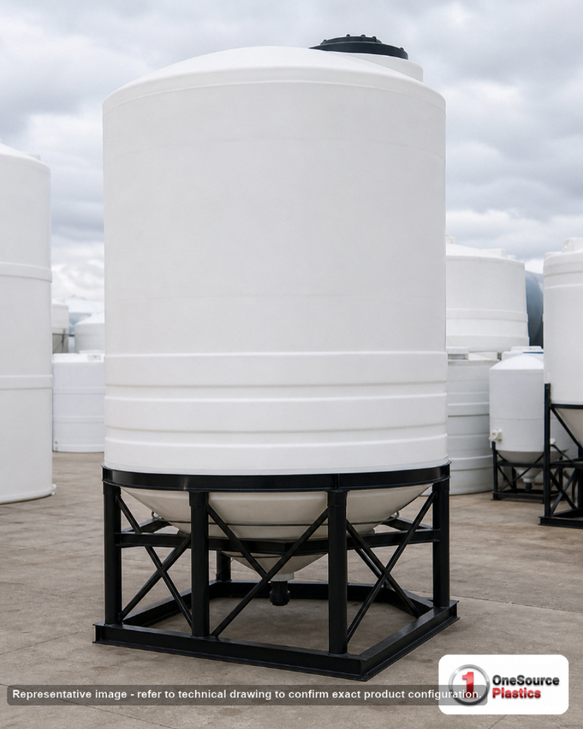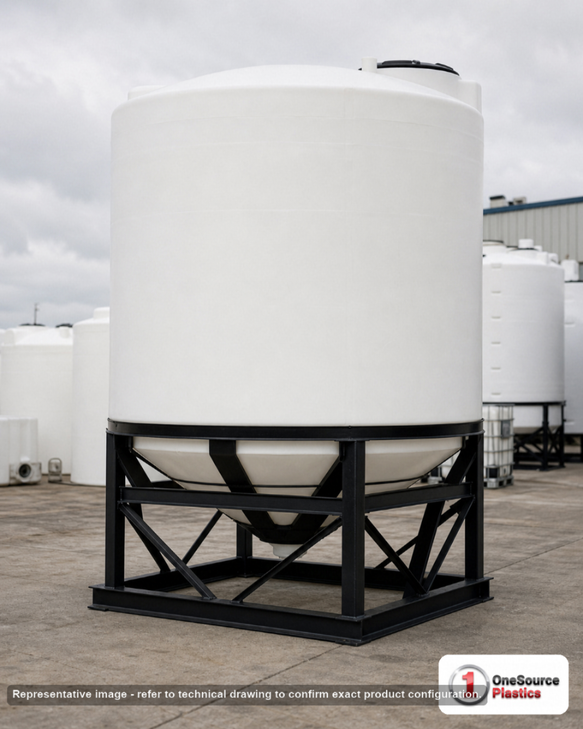
Twenty-five hundred gallons of 30 degree cone, 125 inches tall
The Snyder SII-8350000N45 is a 2500 gallon cone bottom tank in white polyethylene, listed at 95 inches in diameter and 125 inches tall, at 547 pounds empty. The name gives the cone angle as 30 degree and the sheet carries no cone angle field, so the name is the only source for it and this page claims nothing further. Just under eight feet of diameter carrying ten feet five inches of height is a broad, tall vessel, and the cone means it does not stand on its own base. The wall is rated at a specific gravity of 1.9, and the sheet gives 20,850 pounds for 2500 gallons of water at 8.34 pounds per gallon with 39,615 pounds of max contents. The top fitting is an 18 inch threaded vented manway. The service limit is 120 F / 48 C. The sheet publishes no outlet, no stand and no warranty term, and none of them is stated here.
Is this the right 2500 gallon tank? Call 866-418-1777 with the liquid, the site and the ceiling height, or get freight to your ZIP and add it to your cart above.
Chowchilla, California, and what an oversize lane asks of you
Buy this tank knowing where it comes from, because at this size the lane is part of the purchase. The sheet lists one plant, Chowchilla, California, and one shipping state, California, so this vessel starts in the Central Valley and everything east of the Sierra is distance. The freight class reads OVS, an oversize mode rather than a numeric class, under NMFC 156600. Oversize is not a rate, it is a process: the route is planned, the delivery window is agreed, and the unloading equipment has to be standing on your site when the trailer arrives rather than ordered on the day. West Coast buyers get a short haul on a tank that would otherwise be an expensive move; buyers further east should price the lane early, because on an oversize load the freight is a line item worth knowing before the tank is specified rather than after. Price it to your ZIP with the freight cost estimator at the start of the conversation. The second thing the lane decides is the site. A 95 inch circle and 125 inches of height arrive on a trailer lying down and get stood up on your ground, which means crane or reach access to the tank position, a finished and cured foundation, and a stand ready and anchored before delivery. That stand is not on this sheet: no legs, no skirt, no ring and no support are published, so it is a separate item specified with the tank and not after it. The loads it carries are 547 pounds of empty tank, 20,850 pounds of water and 39,615 pounds at the rating the sheet publishes. Do the volume work before the structure is drawn: run your batch size and turnover through the tank sizing calculator and take the freeboard a warming or gassing product needs from the tank sizing guide, because on a cone bottom vessel the last foot of height is the expensive one to add later.
The 95 inch 2500 against three 90 inch ones
| Part | Gallons | Diameter or plan x height | Empty weight |
|---|---|---|---|
| SII-8350000N45 (this tank, widest of the 2500s) | 2500 | 95 x 95 x 125 in | 547 lb |
| 5110000N40 (cross-linked, narrower) | 2500 | 90 x 90 x 125 in | 375 lb |
| 5110000N46 (cross-linked, narrower) | 2500 | 90 x 90 x 125 in | 375 lb |
| 5110000N48 (heavy duty name) | 2500 | 90 x 90 x 125 in | 400 lb |
| 5070000N40 (smaller, shorter) | 2000 | 90 x 90 x 102 in | 325 lb |
| 5100000N40 (larger, taller) | 2600 | 90 x 90 x 139 in | 500 lb |
Four tanks on this sheet hold 2500 gallons at the same 125 inch height, and this one is the odd row: 95 inches across where the other three are 90, and 547 pounds where they are listed at 375, 375 and 400. The sheet gives those figures and explains none of them, so we print them and leave the interpretation alone. What the buyer can act on is the geometry. Five more inches of diameter is five more inches of stand, of bund and of aisle, and it is worth checking against a tight bay before it is ordered; against that, this is the heaviest listing of the four, and a heavier listing in the same volume is the one to ask us about when the duty is hard on the vessel. The last two rows are the size question rather than the variant question. The 2000 gallon 5070000N40 is 90 inches across and 102 inches tall at 325 pounds, which is nearly two feet shorter than this tank and the row to read when the roof, the crane or the lifting height is what limits you. The 2600 gallon 5100000N40 goes the other way at 139 inches tall and 500 pounds on the same 90 inch circle: more product for more height on less floor. Put the three side by side and the pattern across this band is that volume is bought with height, not with width, so the number to take to the site survey is the distance from the finished floor to the lowest obstruction, measured with the stand height already in hand. The buyer's guide to the 30 degree cone bottom tank with a poly stand at this volume is written around exactly that decision, and the 15 degree buyer's guide at the same volume takes the shallower angle if height is what you are short of.
Comparing across brands too? Call 866-418-1777; we carry Norwesco, Snyder, Chem-Tainer, Enduraplas and Bushman and will say which one fits, or price the freight first.
Filling through an 18 inch vented manway
- The opening: an 18 inch threaded vented manway, and it is the only opening this sheet publishes. Eighteen inches at the top of a 125 inch tank means a platform, a fixed ladder and a fall protection plan designed alongside the stand, not improvised after the vessel is standing.
- Filling: bring the fill line to a coupling at working level rather than asking anyone to carry a hose up to the manway, and run it so the delivery driver can see what they are connecting to. A fill that has to be supervised from the top of a ten foot tank is the fill that eventually gets left unattended.
- The vent: the manway is listed as vented, and on a deep column being drawn off the bottom that vent path is what protects the wall. Keep it clear, inspect it on a schedule, and never blank it to stop a smell.
- The discharge: this sheet publishes no outlet size and no bulkhead. The cone ends in a discharge and the sheet does not dimension it, so no number appears here. Give us the line size, the valve type and the product, and we will confirm what this part number carries before anything is ordered.
- Supporting what hangs below: the valve, any reducer and the first run of line are carried on their own steelwork off the stand, never on the cone, with a flexible connector at the first joint so a pump start does not reach the wall.
- Limits and the stand: 120 F / 48 C, a specific gravity rating of 1.9, 20,850 pounds of water and 39,615 pounds of max contents. No stand and no warranty term are published, and the stand is a separate item to specify alongside the tank.
Name the product when you order. Gasket, valve and fitting material on a cone discharge all follow the chemistry, and at this volume the costly part of getting it generic is never the fitting itself.
Slurry, blend and settle duty at this volume
A 30 degree cone at 2500 gallons is a process vessel. It goes into liquid fertiliser and crop input blending at ag retail, mixing and batching in chemical manufacturing, coagulant and polymer make-up at water and wastewater works, mineral and wash plant duty where the water carries light solids, food and beverage holding where the vessel has to drain clean between products, and any operation that changes product in the same tank and cannot carry a heel from one batch into the next. The shallower angle is the compromise that keeps the tank short enough to stand in an existing building, and on a free-flowing product it gives away very little. Where the material packs or bridges rather than pours, say so when you enquire: the honest answer may be a steeper cone and a taller structure, and the buyer's guide one size up is where that argument continues.
Rated chemistries for this tank
The manufacturer lists these liquids for this resin at the concentrations noted, with the fitting and gasket material to specify. Check the concentration and temperature you actually run on the linked page or in the chemical compatibility database before ordering.
- Aluminum Sulfate (50%, PVC, EPDM)
- Ferric Chloride (50%, PVC, EPDM)
- Sodium Hypochlorite (under 16.5%, PVC fittings with Viton gaskets)
- Sulfuric Acid (98%, CPVC fittings with Viton gaskets)
- Phosphoric Acid (85%, PVC, Viton)
- Hydrochloric Acid (37%, PVC, Viton)
- Hydrogen Peroxide (50%, PVC, Viton), and
- DEF at 32.5% (which calls for 316SS fittings and EPDM gaskets).
- Calcium Chloride
- Magnesium Chloride
- Ferric Sulfate
- Ferrous Sulfate
- Sodium Carbonate
- Sodium Thiosulfate
- Potassium Carbonate
- Potassium Hydroxide (saturated)
- Ethylene Glycol
- Propylene Glycol
- Polyaluminum Chloride
- Sodium Bisulfate
- Sodium Bisulfite
- Zinc Orthophosphate
- Urea Solution (50%), and Ozonated Water up to 10 PPM.The more aggressive acids on this list demand upgraded fitting and gasket materials:
- Hydrofluoric Acid (48%, PP/PVC fittings, Viton gaskets)
- Hydrofluosilicic Acid (26%, PP/PVC, Viton), and
- Peracetic Acid (30%, 316SS fittings, Aflas gaskets).Match every fitting and gasket to your specific chemical, and use our
One plant, oversize, 547 pounds
Chowchilla, California is the only plant on this sheet and California the only shipping state, so there is one lane to quote rather than a choice of three. The freight class reads OVS, an oversize mode and not a numeric class, under NMFC 156600, and the shipping weight matches the tank at 547 pounds. Price it to your ZIP with the freight cost estimator; the listed price is before freight. Five hundred and forty-seven pounds is light for a vessel of this size, which is the trap on delivery day: two people cannot control it and the wind can. Keep it on its bearers and out of the wind until the stand is set, levelled and anchored, lift it by the body with slings and never by the manway, and stand it up onto a finished, cured foundation rather than a temporary one. Then fill it with clean water, hold that 20,850 pound load, and read the cone, the manway seal, the stand feet and the slab in that order. Come back the next morning and read the same four things again before a drop of product goes in, because on a tall vessel the thing that moves overnight is almost never the tank. Write the fill date on the manway with a paint marker; it answers the first question anyone asks about a tank.
Freight and documents
Ships from: Chowchilla, CA. LTL freight is quoted to your ZIP with the freight cost estimator or by phone at 866-418-1777. The listed price is before freight.
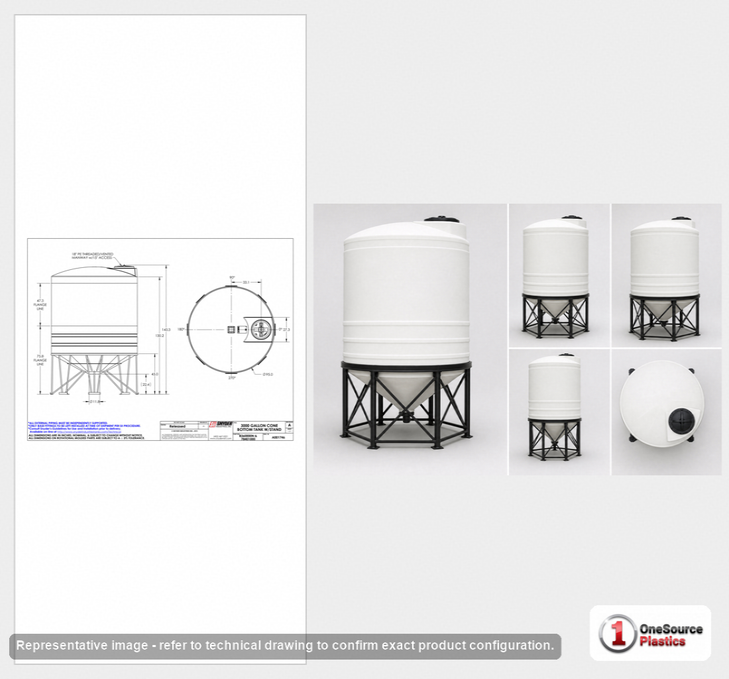
Technical drawing (PDF) for Snyder Industries 8350000N45.
See this tank
Interactive 3D model with live fill. This tank has an interactive 3D model built to its manufacturer dimensions. Rotate it, and set a fill level to see how much liquid it holds at any height. Open the 3D view on the product photo above. Download the 3D model (GLB).
Product video. Watch the Snyder Industries 2500 Gallon 30 Degree HDPE Cone Bottom Tank in White video (68 seconds) with dimensions, fittings and shipping notes.
Ready to order?
Add it to your cart at the top of this page, get LTL freight to your ZIP, request a written quote, or call 866-418-1777. The listed price is before freight.