Three thousand gallons, 95 inches across, rated 1.5
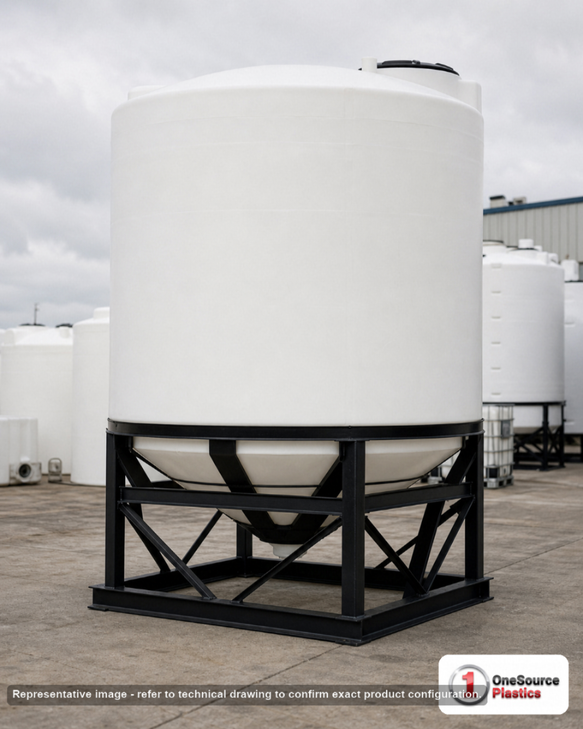
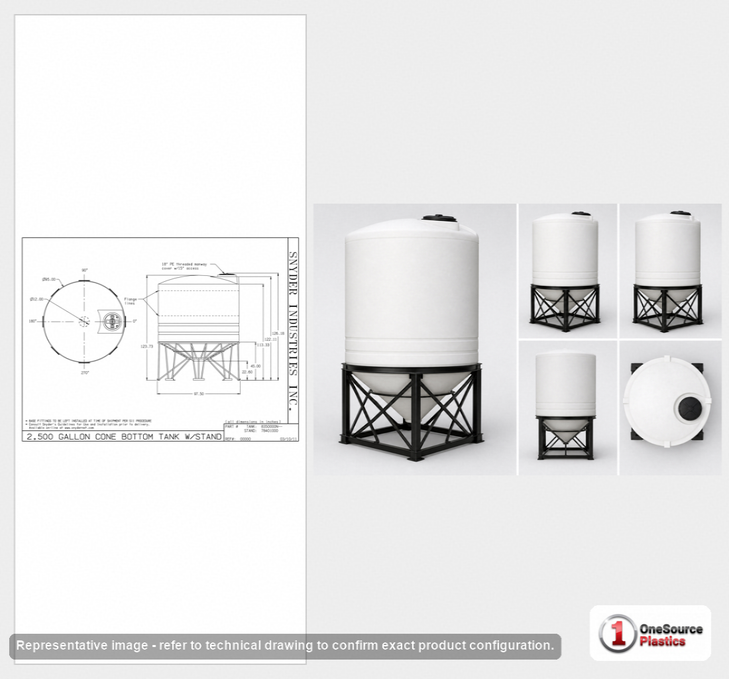
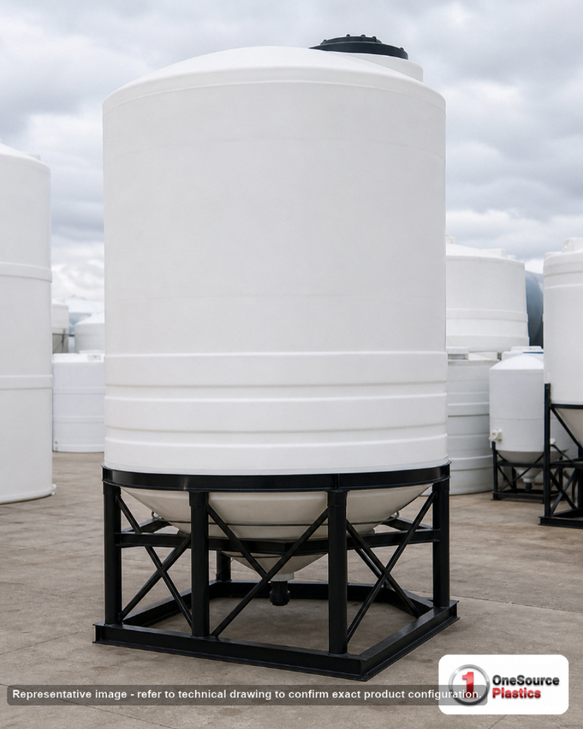
The Snyder SII-8360000N43 is a 3000 gallon cone bottom tank in white polyethylene, listed at 95 inches in diameter and 120 inches tall, at 612 pounds empty. Its name gives the cone angle as 30 degree and the sheet carries no cone angle field, so the name is the only source for it. The wall is rated at a specific gravity of 1.5, which is this tank's own rating and not one borrowed from a sibling, and the sheet gives 25,020 pounds for 3000 gallons of water at 8.34 pounds per gallon with 37,530 pounds of max contents. The top fitting is an 18 inch threaded vented manway. The service limit is 120 F / 48 C. Ten feet of height on a nearly eight foot circle is a broad, relatively short vessel for the volume. The sheet publishes no outlet, no stand and no warranty term, and this page claims none of them.
Ordering for a plant or a bid? Request a written quote with freight to your ZIP for the file; a single 3000 gallon tank goes straight to the cart above.
A California plant and an oversize lane for a shorter tank
Two things decide this purchase and both of them are on the freight line. The sheet lists one plant, Chowchilla, California, and one shipping state, California, and it gives the freight class as OVS, an oversize mode rather than a numeric class, under NMFC 156600. So the lane is a Central Valley lane, and it is an oversize move: a planned route, an agreed delivery window and unloading equipment standing on your site when the trailer arrives. Price it to your ZIP with the freight cost estimator at the start rather than the end of the conversation, because on a project load the freight belongs in the specification. The second thing is that this is the short 3000 gallon tank, and that is what makes an oversize move easier to plan around. At 120 inches the vessel is ten feet tall where the other 3000 gallon listings on this sheet stand at 144 inches, which is two feet less to lift, two feet less to clear on the way in, and two feet less structure to design under the roof. Width is what pays for it, at 95 inches across against their 90. Have the stand ready before delivery, because this sheet publishes no stand, no legs and no ring: a cone bottom tank does not stand on its own base, so the support is a separate item specified with the tank, set, levelled and anchored on a cured foundation before the truck arrives. What that structure carries is 612 pounds of empty tank, 25,020 pounds of water and 37,530 pounds at the rating on this sheet. Do the volume work first: run your batch and turnover through the tank sizing calculator and take the freeboard a warming or gassing product wants from the tank sizing guide, because on a vessel this size the height you did not buy is the height you cannot add later.
The 95 inch 3000 against three 90 inch 3000s
| Part | Gallons | Diameter or plan x height | Empty weight |
|---|---|---|---|
| SII-8360000N43 (this tank, widest and shortest of the 3000s) | 3000 | 95 x 95 x 120 in | 612 lb |
| 5150000N40 (cross-linked, taller and narrower) | 3000 | 90 x 90 x 144 in | 500 lb |
| 5150000N42 (cross-linked heavy duty, heaviest listing) | 3000 | 90 x 90 x 144 in | 670 lb |
| 5150000N46 (cross-linked, taller and narrower) | 3000 | 90 x 90 x 144 in | 500 lb |
| 5100000N40 (smaller volume) | 2600 | 90 x 90 x 139 in | 500 lb |
| 8050000N40 (largest, widest) | 3600 | 102 x 102 x 125 in | 1090 lb |
Four listings hold 3000 gallons and this one is the outlier in the way that matters on a site: 95 inches across and 120 inches tall, where the other three are 90 inches across and 144 inches tall. Two feet of height against five inches of diameter is not a close trade for most buildings. If the roof, the crane, the door or the lifting height is your limit, this is the row to read, and the three taller listings are the rows to read if the floor is what you are short of. Weights are listed at 612 pounds here against 500, 670 and 500 for the others, and the sheet explains none of that, so we print it and leave it alone. The bottom two rows widen the question. The 2600 gallon 5100000N40 is 90 inches across and 139 inches tall at 500 pounds, which is a smaller volume in a taller body, and it is rarely the right answer unless a drawing already names it. The 3600 gallon 8050000N40 is the genuine step up: 102 inches across, 125 inches tall and 1,090 pounds, which is only five inches taller than this tank for six hundred more gallons, on a circle more than half a foot wider in every direction. If you have the floor, that is the row worth pricing. Read the 30 degree cone bottom buyer's guide written around this size before you commit, and the 15 degree buyer's guide at the same volume if a shallower cone would buy you the height you need.
Need the taller or the wider one? Every row links to its page with freight to your ZIP on each; 866-418-1777 will check the ceiling and the pad.
A vented manway on top of a ten foot tank
- The opening: an 18 inch threaded vented manway, the only opening this sheet publishes. Ten feet is still ten feet, so that manway needs a platform, a fixed ladder and a fall protection plan designed alongside the stand rather than bolted on afterwards.
- Filling: run the fill to a coupling at working level so the delivery is made and watched from the ground. A fill line that ends at the top of the tank is a fill line somebody eventually leaves unattended.
- The vent: the manway is listed as vented and that path is the wall's protection while a pump draws the column down. Keep it clear, inspect it on a schedule, and never restrict it to control an odour.
- The discharge: this sheet publishes no outlet size and no bulkhead, so no number appears here. The cone ends in a discharge that the sheet does not dimension. Give us the line size, the valve and the product and we will confirm what this part number carries before it is ordered.
- Carrying the hardware: the valve, any reducer and the first length of pipe are supported on their own steelwork off the stand, never on the cone, with a flexible connector at the first joint so a pump start never loads the wall.
- Ratings: 120 F / 48 C, a specific gravity rating of 1.5 on this sheet, 25,020 pounds of water and 37,530 pounds of max contents. No stand and no warranty term are published; the stand is specified separately.
The rating on this sheet is 1.5, and it is the number that decides whether this part number is the right one for your product. Bring us the density with the enquiry and we will match the tank to it rather than the other way round.
Bulk make-up where the product leaves through the cone
Three thousand gallons over a 30 degree cone is bulk process capacity: liquid fertiliser and crop input blending at an ag retailer or a co-op, mixing and batching in chemical manufacturing, coagulant and polymer make-up at a water or wastewater works, mineral and wash plant duty where the water carries light solids, food and beverage process and holding duty, and any operation that batches a product out completely and starts again. The cone is why all of those work: the vessel drains toward a single low point and keeps draining instead of leaving a ring behind at every changeover, and at this volume a heel left in the bottom is a disposal cost rather than an inconvenience. The shorter, wider shape is the second half of the argument, because it is the version of this volume that fits under an existing roof. Where the product packs rather than pours, say so and we will talk about a steeper cone before you buy this one.
Resin compatibility, line by line
Below are the liquids this resin is rated for, the concentration each rating holds to, and the fitting and gasket to specify. Check the exact concentration and temperature you run against the chemical page or the chemical compatibility database before ordering.
- Acetic Acid at 60% (PP/PVC fittings, EPDM gaskets)
- Aluminum Sulfate at 50% (PVC, EPDM)
- Calcium Chloride at 40% (PVC, EPDM)
- DEF at 32.5% (316SS fittings, EPDM gaskets)
- Ferrous Sulfate at 20% (PVC, EPDM)
- Magnesium Chloride at 30% (PVC, EPDM)
- Sodium Carbonate at 30% (PVC, EPDM)
- Urea Solution at 50% (PP/PVC, EPDM); and Ozonated Water up to 10 PPM (PVC, EPDM). One important build note: every in-spec chemical here runs PVC or PP fi
- Ethylene Glycol
- Ferric Chloride
- Ferric Sulfate
- Hydrochloric Acid
- Hydrofluoric Acid
- Hydrofluosilicic Acid
- Hydrogen Peroxide
- Peracetic Acid
- Phosphoric Acid
- Polyaluminum Chloride
- Potassium Carbonate
- Potassium Hydroxide
- Propylene Glycol
- Sodium Bisulfate
- Sodium Bisulfite
- Sodium Hypochlorite
- Sodium Thiosulfate
- Sulfuric Acid and
- Zinc Orthophosphate. Gasket choice splits on this list too: most run EPDM, but Hydrochloric Acid, Hydrofluoric Acid, Hydrofluosilicic Acid, Hydrogen Peroxide
Chowchilla, oversize, 612 pounds empty
One plant, Chowchilla, California, and California as the shipping state, so there is a single lane to quote. The freight class reads OVS, an oversize mode and not a numeric class, under NMFC 156600, and the shipping weight matches the tank at 612 pounds. Price the lane to your ZIP with the freight cost estimator; the listed price is before freight. Oversize moves are booked, not ordered, so agree the route, the window and the offload before the tank leaves the plant and have the machine on site when it arrives. Six hundred and twelve pounds of empty tank is light enough to be pushed around by weather and heavy enough to hurt somebody, so keep it on its bearers and out of the wind until the stand is anchored, and lift it by the body with slings rather than by the manway. Stand it, restrain it, then fill it with clean water, hold that 25,020 pound load, and read the cone, the manway seal, the stand and the foundation before any product is delivered. Keep the water in it overnight and walk the base again in the morning; a foundation that is going to tell you something tells you then. A strap that is checked once a season is a strap that holds; put it on the same calendar as the gutters.
Freight and documents
Ships from: Chowchilla, CA. LTL freight is quoted to your ZIP with the freight cost estimator or by phone at 866-418-1777. The listed price is before freight.
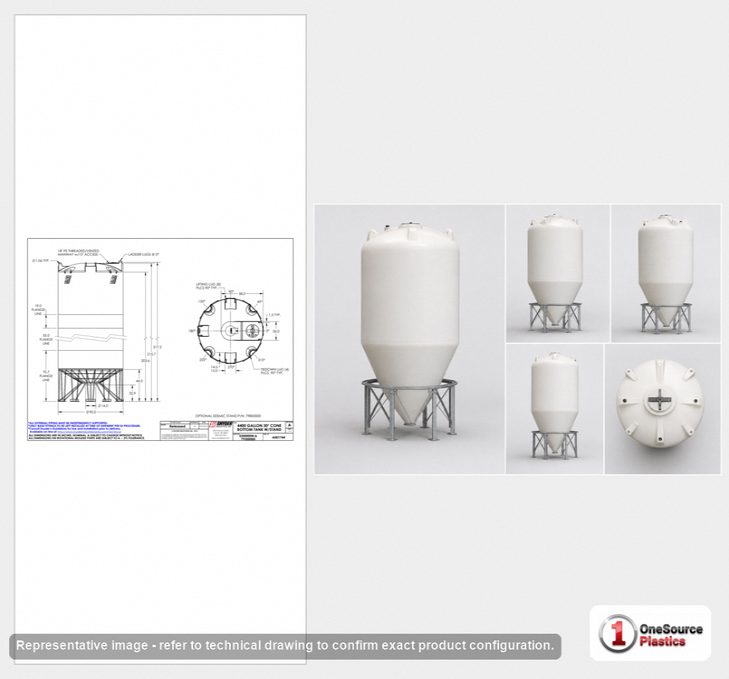
Technical drawing (PDF) for Snyder Industries 8360000N43.
See this tank
Interactive 3D model with live fill. This tank has an interactive 3D model built to its manufacturer dimensions. Rotate it, and set a fill level to see how much liquid it holds at any height. Open the 3D view on the product photo above. Download the 3D model (GLB).
Product video. Watch the Snyder Industries 3000 Gallon 30 Degree Plastic Cone Bottom Tank in White video (60 seconds) with dimensions, fittings and shipping notes.
Ready to order?
Add it to your cart at the top of this page, get LTL freight to your ZIP, request a written quote, or call 866-418-1777. The listed price is before freight.