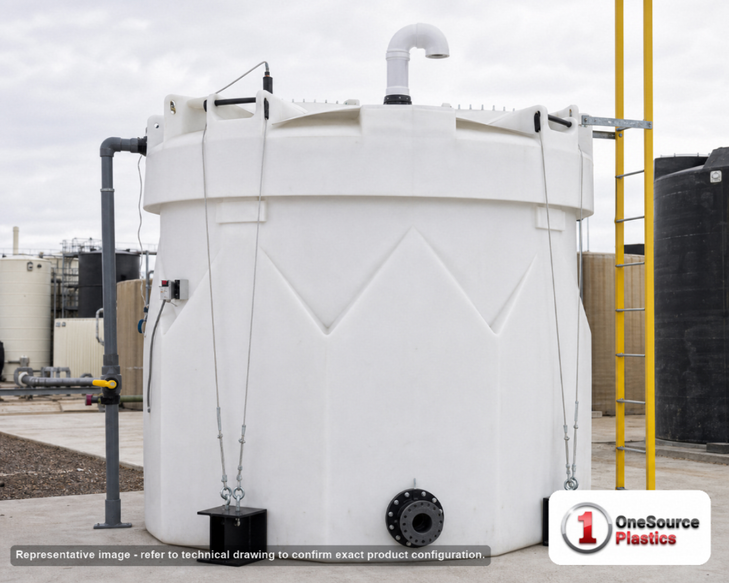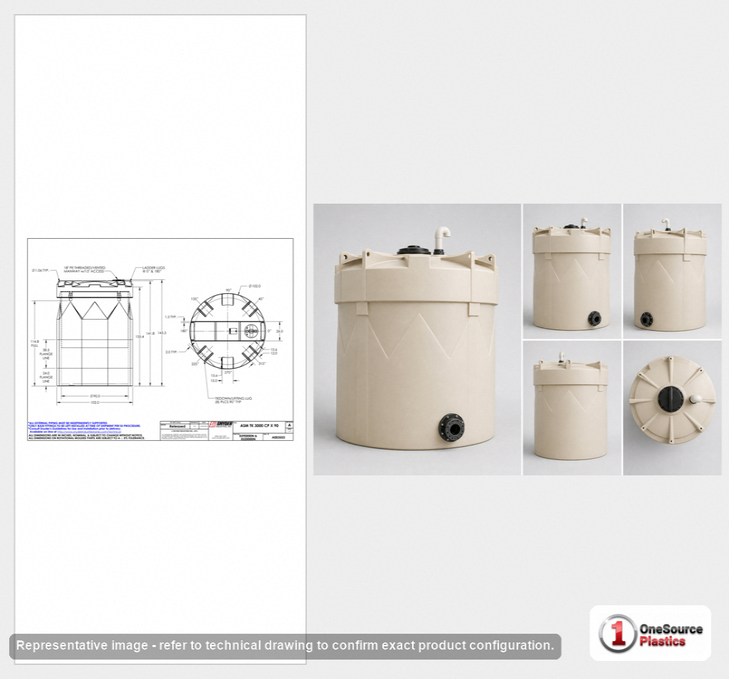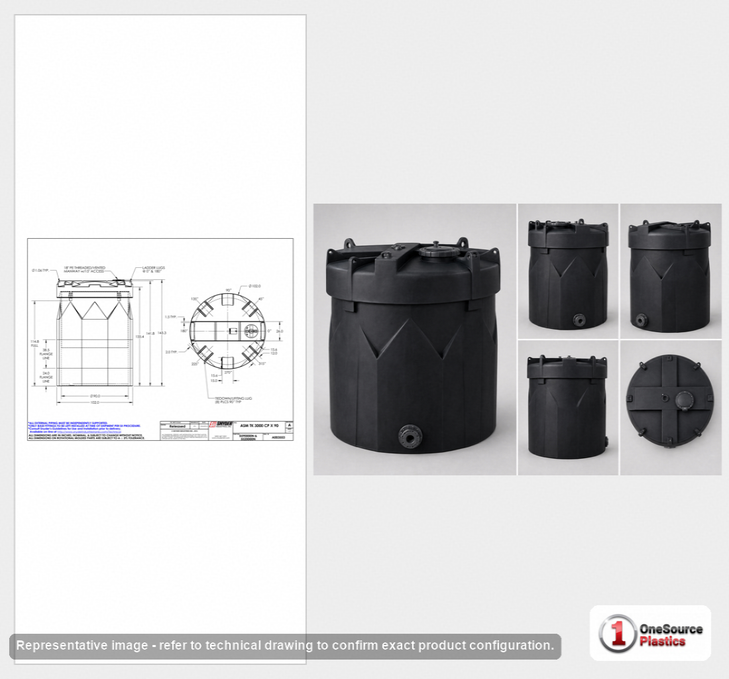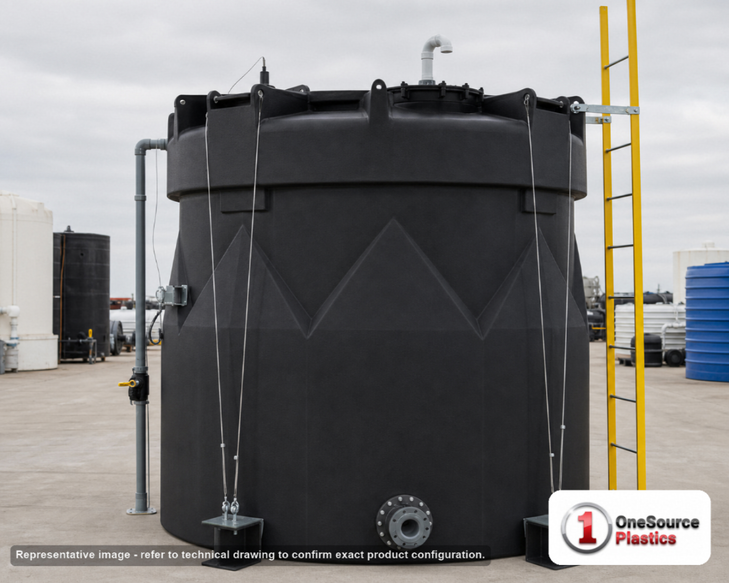
The Snyder Industries 2500 Gallon Captor double-wall tank is built for buyers who cannot afford a spill: a primary containment tank fully enclosed inside an integral secondary shell, molded in crosslinked linear polyethylene (XLPE) and rated to a 1.9 specific gravity. It holds 2,500 gallons, stands 122 inches tall, and sits on a 102 x 102 inch square footprint. The black resin blocks light to limit algae growth in stored water, and the captor design means the secondary containment travels with the tank rather than relying on a separate poured berm.
Will it work for your site?
Plan your pad and your fill logistics around real loaded weight, not the dry shell. Full of water at 8.34 lb per gallon, this tank carries roughly 20,850 lb. At its rated 1.9 specific gravity ceiling it can hold up to 39,615 lb of contents, so a structural slab and verified soil bearing matter here. Confirm your footprint clears the full 102 x 102 inch base, and check overhead clearance above the 122-inch tank height for manway and fill access. The XLPE construction is the high-end Snyder Captor format buyers search for as an ASTM double wall tank, and it gives you the impact resistance crosslinking is known for. Run your fill scenarios through the Tank Sizing Calculator and the Tank Sizing Guide before you commit to a pad design.
Fittings and access
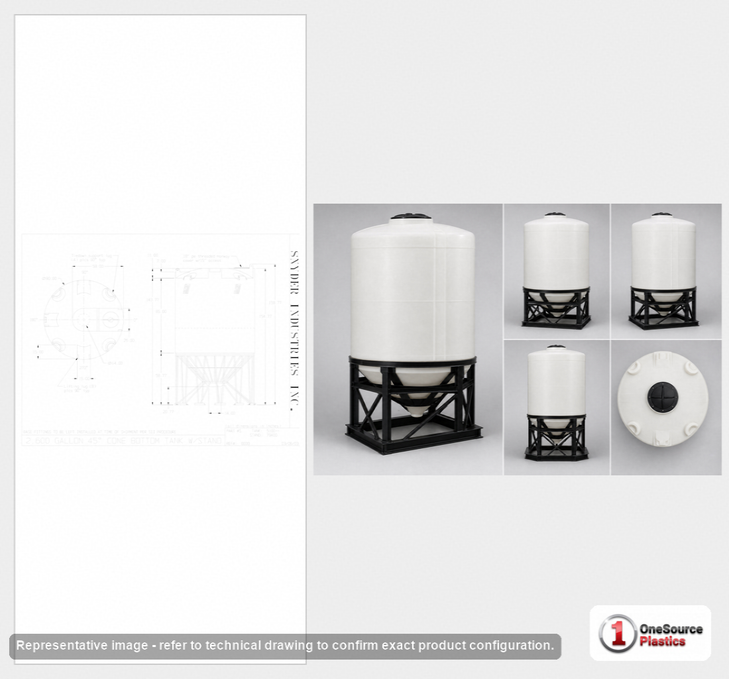
Per the technical drawing on this page, this tank is configured with a flange, an 18-inch PE threaded and vented fitting, and a manway with 15-inch access. The vented fitting is not optional on a sealed double-wall vessel: as you draw the tank down or fill it, the interstitial and primary spaces need to breathe, and the threaded/vented port handles that. The 15-inch manway is also your access point for inspecting the headspace, which matters more than it looks. Verify each fitting size and elevation against the technical drawing before you order pumps, plumbing, or risers, and match your inlet and outlet hardware to the listed connections rather than guessing.
The mistake to avoid
The most common error on a Captor double-wall is treating the 1.9 SG rating as a license to skip the math. The 1.9 figure is the maximum contents density the wall is engineered for; storing water (SG 1.0) is well within that, but it does not change your freeboard or thermal-expansion obligations under ASTM D1998. Read the Captor freeboard sizing guide so you know the real usable volume, and if this is a containment or fire-water reservoir application review the SPCC 40 CFR 112 walkthrough or the NFPA 22 fire-water reservoir design guide. One more often-missed point: failures on double-wall tanks frequently start at the vapor-saturated headspace, not the wetted wall, so do not let a clean liquid-side inspection give you false confidence — use the 15-inch manway to check the vapor space, and the vapor-space wall-thickness guide covers why.
This tank ships LTL freight, typically from Snyder's Lincoln, NE plant — confirm origin when you get your quote, with the carrier rate quoted live to your ZIP. Get your freight number with the Freight Cost Estimator, or call 866-418-1777 and we'll quote the freight and walk through fitting placement with you before the truck rolls.