Three thousand gallons rated to a specific gravity of 1.9
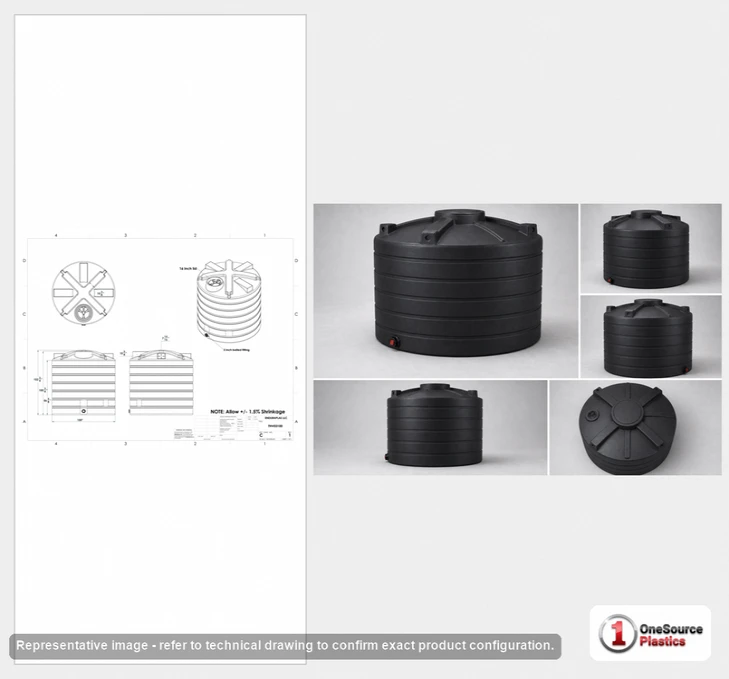
The Snyder 5590000N51 is a 3000 gallon double wall tank, named on its sheet as an ASTM Black Captor Double Wall Tank, moulded in black high density linear polyethylene and listed at 102 inches long by 102 inches wide by 142 inches tall at 1,900 pounds empty. Captor is Snyder's product name and ASTM is a word in that name; nothing further is claimed from either. The sheet gives one capacity, one set of overall dimensions, one weight and one rating for the whole assembly: there is no separate inner tank figure, no separate outer figure, no annulus dimension and no containment percentage on it, so none appears anywhere on this page. The wall is rated at a specific gravity of 1.9, and the sheet gives 25,020 pounds for 3,000 gallons of water at 8.34 pounds per gallon with 47,538 pounds of max contents. The only opening published is an 18 inch threaded vented manway, and the outlet field reads "1 Manway / Lid", which names an opening rather than a pipe size. The service limit is 120 F / 48 C and the warranty is a 3 Year Warranty. Freight is LTL at class 250 with no NMFC number, moulded at Lincoln, Nebraska.
Want a second opinion on the size? Call 866-418-1777 with the daily draw and the delivery interval, or price freight to your ZIP and add it to your cart above.
The duty that buys the 1.9 rating at three thousand gallons
Start with who buys this one, because the rating is the reason. A tank rated at a specific gravity of 1.9 is bought by a plant storing something a good deal heavier than water: 3,000 gallons of water is 25,020 pounds on this sheet, and the same 3,000 gallons at the published rating is 47,538 pounds, near enough twice the load on the same base. That is the duty this part number is for. It lands at municipal water and wastewater works holding a bulk treatment chemical between deliveries, at power stations and large boiler houses, at pulp, paper, metals and mining operations, and at industrial process lines that feed a dosing system continuously. The containment job in all of those looks the same: the vessel stands on a finished floor or a yard slab where a release would have to be recovered from a drain, a sump or the ground, and a built bund is either impossible or expensive. A contained tank answers that as one item with one footprint and nothing to pour. What it asks in return is a base that takes the whole load without argument. Put it on a flat, continuous, level surface carrying the entire 102 inch footprint, never on rails, never packed at one corner, and remember that the 47,538 pound figure is the number the surface has to be designed against rather than the empty weight of 1,900 pounds you see on the delivery. Two sizing questions belong before the order and both have proper answers. The usable volume and the headspace you actually have are not the nameplate figure, which is what the Captor double wall freeboard sizing guide works through on thermal expansion, chemistry and density. Then run your delivery quantity and your turnover through the tank sizing calculator and take the freeboard discipline from the tank sizing guide. The last part of the survey is height. At 142 inches this is a tall vessel, just under twelve feet before anything is added on top, so the roof line, the door and the overhead pipe runs on the route are measurements to take before the truck is booked rather than on the morning it arrives.
One 102 inch shell, four part numbers, two weights
| Part | Gallons | Length x width x height | Empty weight |
|---|---|---|---|
| 5590000N51 (this tank, named ASTM Black Captor) | 3000 | 102 x 102 x 142 in | 1,900 lb |
| 5590000N30 (same shell, same weight) | 3000 | 102 x 102 x 142 in | 1,900 lb |
| 5590000N42 (same shell, same weight) | 3000 | 102 x 102 x 142 in | 1,900 lb |
| 5590000N46 (same shell, lighter) | 3000 | 102 x 102 x 142 in | 1,400 lb |
| 5580000N30 (smaller, shorter) | 2500 | 102 x 102 x 122 in | 1,100 lb |
| 5600000N30 (larger, taller) | 3500 | 102 x 102 x 158 in | 2,500 lb |
Four listings share the identical 102 by 102 by 142 inch shell, and they do not all share a weight: three are 1,900 pounds and one is 1,400. The sheet gives both figures and offers no explanation, so this page prints what it says and invents nothing. What separates the names is a question for the order, not for a table: tell us the product, its strength, its temperature and the duty, and we will confirm which part number is the right one against your chemistry rather than leaving you to read a specification out of a name. This one is the 1,900 pound listing at the 1.9 rating, and that rating is the honest reason to choose it over the lighter row above: the heavier the stored liquid, the fewer of these part numbers remain in the conversation. The two rows that are genuinely different sizes tell you how the range scales, and it scales in one direction only. Every one of these tanks sits on the same 102 inch circle; volume is bought entirely with height. 5580000N30 holds 2,500 gallons at 122 inches and 1,100 pounds. 5600000N30 holds 3,500 gallons at 158 inches and 2,500 pounds. So the floor plan is fixed across the whole range and the ceiling decides which row you can take, which is unusually convenient when a bay is already laid out and you want more volume in the same square. Measure the clear height at the fill point, allow for the manway, the delivery arrangement and whatever access you will build to reach it, and the row picks itself.
Not sure which one? Tell us the liquid, the site and the ceiling height at 866-418-1777, or request a written quote with freight to your ZIP.
Drawing from a tank whose only published opening is on top
- The pump path first: the outlet field on this sheet reads "1 Manway / Lid", which names an opening and not a pipe size, and there is no inlet field, no thread, no flange and no valve anywhere on it. Nothing further is claimed here. With the top opening as the only published route in or out, a common arrangement at this capacity is a suction line and foot strainer dropped through the manway to a pump standing beside the tank. Tell us the product, the flow and the line size and we will confirm what this part number carries before any pipe is bought.
- Prime and suction: a pump beside a vessel just under twelve feet tall is drawing down a long column, so keep the suction short, keep it full, and give it a flooded start where the layout allows rather than asking it to lift on every start.
- Low level: set the strainer clear of the bottom so the last settled inch is not the first thing the pump picks up, and put a low level cut-out on the pump. A dry run is the cheapest failure on this system and the easiest one to design out.
- The fill opening: an 18 inch threaded vented manway on top is the only opening the sheet publishes, which makes it the delivery route, the inspection route and the cleaning route at once. Eighteen inches takes a delivery hose, a drop pipe and a lance, and it is wide enough to get a proper look inside.
- The vent: the manway is listed as vented, and that path is what protects the wall while a delivery pushes air out and while a pump draws the level down. Keep it clear, inspect it whenever the manway is opened, and never blank it.
- The space between the walls: the sheet publishes no monitoring port, no gauge and no alarm, so how that space is watched and recorded is specified separately. It is worth specifying, because the whole value of a second barrier is evidence that it is still empty.
- Limits: 120 F / 48 C, a specific gravity rating of 1.9, and a 3 Year Warranty.
Name the product and its temperature at order time. Every wetted part is chosen against that chemistry, and a second wall does nothing for a fitting that was picked from a default.
Water treatment plants that take a full delivery
Three thousand gallons with containment built in is the size at which a site stops handling totes and starts taking a bulk delivery into a vessel it can stand indoors or on a slab. Municipal water and wastewater treatment, industrial process water, mining and minerals, pulp and paper, power generation and large food and beverage plants all buy this size for the same commercial reason: a bulk price and fewer deliveries, with the containment making the location possible. Where the reason for buying containment is regulatory rather than commercial, the Captor double wall compliance walkthrough goes through the requirements in order instead of asserting that any product satisfies them; this page asserts nothing of the kind. One piece of engineering is worth reading before the vessel is commissioned: the hardest service on a polyethylene wall is at the vapour line rather than under the liquid, which the guide to wall thickness at the vapour saturated headspace explains, along with why an inspection from the liquid side misses it. Set the receiving procedure up on the same day as the tank: where the driver connects, who watches the fill, what the stop level is, and what happens if the vent is obstructed.
Class 250 out of Lincoln, Nebraska at 1,900 pounds
Lincoln, Nebraska is the plant and Nebraska the only ship-from state, which puts the plains and the Midwest on a short lane and makes the coasts a planned move. Freight is LTL at class 250, the sheet gives no NMFC number, and the shipping size is listed at 102 by 102 by 142 inches at 1,900 pounds. Price the lane to your ZIP with the freight cost estimator; the listed price is before freight. This is a dimensional load in both directions, eight and a half feet across and just under twelve feet tall, so the route to the final position needs measuring for width and for height, and the offloading equipment needs the reach and the rating to take the tank under the base rather than by the manway. Set it on the finished, cured, level surface in its final position before a single pipe is connected. Fill it with clean water, hold that 25,020 pound load, and read the manway seal, the base all the way round and the surface under it. Drain it, let it dry, then open the space between the walls, look at it in good light and write the date on the shell. That first look is the baseline every later inspection is compared against, and the tank that never had one is the tank nobody can prove anything about. Chalk the full-water line on the outside after the first fill; it is the level every later reading gets checked against.
Freight and documents
Ships from: Lincoln, NE. LTL freight is quoted to your ZIP with the freight cost estimator or by phone at 866-418-1777. The listed price is before freight.
Technical drawing (PDF) for Snyder Industries 5590000N51.
See this tank
Interactive 3D model with live fill. This tank has an interactive 3D model built to its manufacturer dimensions. Rotate it, and set a fill level to see how much liquid it holds at any height. Open the 3D view on the product photo above. Download the 3D model (GLB).
Ready to order?
Add it to your cart at the top of this page, get LTL freight to your ZIP, request a written quote, or call 866-418-1777. The listed price is before freight.