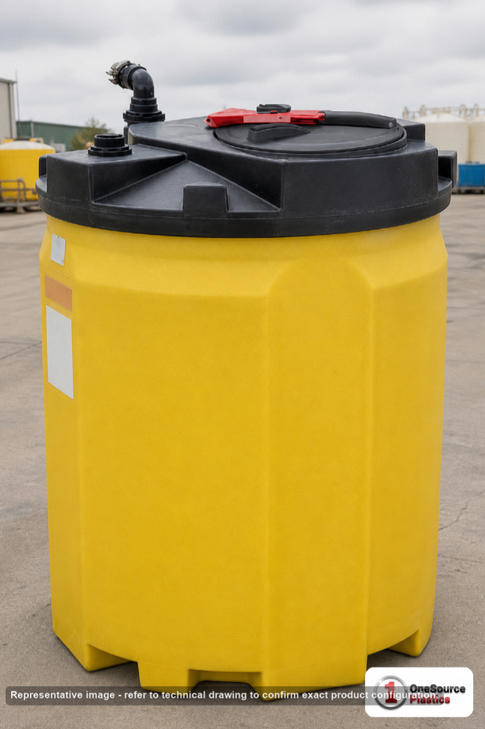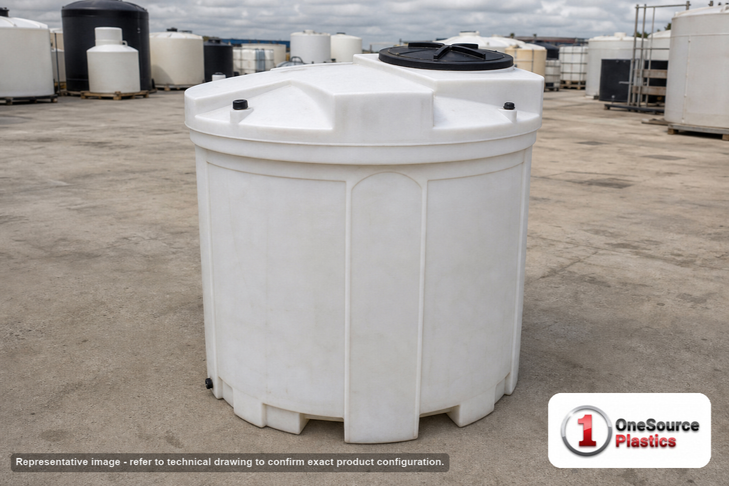
360 gallons of containment on a 53 inch square base, 63 inches tall
The Snyder SII-5760102N52 is a 360 gallon double wall containment tank in white high density linear polyethylene, described on the sheet as an opaque resin tank rated at a specific gravity of 1.9: an inner tank inside an outer containment shell, 53 inches by 53 inches on the base and 63 inches tall, listed at 250 pounds empty and 250 pounds to ship, molded at Marked Tree, Arkansas. The 1.9 rating is where the 5,705 pound maximum contents figure comes from against 3,002 pounds for 360 gallons of water at 8.34 pounds per gallon. Access is an 18 inch threaded vented manway. The service limit is 120 F / 48 C and the sheet gives a 3 year warranty. Freight is class LTL on NMFC 156600. The sheet gives one set of outside dimensions and nothing for the inner tank, so no containment volume is claimed here.
Ready for the pad? Quote freight to your ZIP, add the 360 gallon tank to your cart above, and 866-418-1777 will confirm the truck and the unload.
Opaque resin, and the 275 and the 405 either side of it
The family is where this part number makes sense. Four tanks hold 360 gallons in the same 53 by 53 by 63 inch envelope at the same 250 pounds, and this is the one the sheet describes as opaque resin with the specific gravity rating printed in the title. The other three are 5760102N30, which Snyder names for sulfuric acid service; 5760102N42, a cross-linked tank; and 5760102N48, a cross-linked tank in black. Not one dimension, weight, manway size, service limit or warranty term separates any of the four on this sheet, which means the decision is resin and shell, made against the liquid rather than against a table. An opaque shell is the choice where light on the contents is a problem and the level can be taken through the manway or by instrument; the black tank takes that further, and the others are bought for the duty in their names. Either side of the group sit the two capacities that actually change the installation. The 275 gallon 5740102N30 keeps this exact 63 inch height on a 47 by 47 inch base at 200 pounds, so it fits a narrower spot without changing the headroom you need above it. The 405 gallon 5990702N42 does the opposite: it tucks onto a 48 by 48 inch base, narrower than this tank, and buys its extra volume in height, standing 73 inches tall at 250 pounds. That is the trade worth thinking about before anything is ordered, because a contained tank has to be walked around and looked at, and the specification that decides where it can live is usually the base or the ceiling rather than the gallons. Under it, flat and continuous is the whole requirement: a rotationally molded floor bears on the surface it touches and nothing else, and on a contained tank it is the outer shell standing on that surface, so a slab with a dip under one corner puts 3,002 pounds of water, or up to 5,705 pounds of contents at the rating, onto that corner. Where the rating itself is the question, the difference between specific gravity, density and the numbers a supplier quotes is untangled in the specific gravity versus density guide. Run 360 gallons against your real draw in the tank sizing calculator, and take the working reserve and freeboard from the tank sizing guide.
One 53 inch base, four part numbers, two capacities that bracket it
| Part | Gallons | Length x width x height | Empty weight |
|---|---|---|---|
| SII-5760102N52 (this tank, opaque resin) | 360 | 53 x 53 x 63 in | 250 lb |
| 5760102N30 (same shell, named for sulfuric acid) | 360 | 53 x 53 x 63 in | 250 lb |
| 5760102N42 (same shell, cross-linked) | 360 | 53 x 53 x 63 in | 250 lb |
| 5760102N48 (same shell, cross-linked, black) | 360 | 53 x 53 x 63 in | 250 lb |
| 5740102N30 (narrower base, same height) | 275 | 47 x 47 x 63 in | 200 lb |
| 5990702N42 (narrower base, taller) | 405 | 48 x 48 x 73 in | 250 lb |
The two rows at the bottom of that table are more interesting than the four at the top, because they are the only rows where anything physical changes. Note what the sheet gives: the 405 gallon tank and this 360 gallon tank are both listed at 250 pounds, and the 405 sits on a smaller base, 48 inches square against 53. So the larger tank is not the bigger footprint here; it is the taller one, at 73 inches against 63, and that is the number to check against your canopy, your fill point, your roof line and the reach of whatever lifts it. The 275 gallon tank is the one to look at when the constraint is width: 47 inches square at the same 63 inch height and 200 pounds, which is the lightest tank on the sheet and the easiest to set. Between all six, the outer shell, the single 18 inch manway and the service limit are constant, so nobody is trading away access or temperature by choosing on footprint. What none of these rows tells you is how much the outer shell holds, because no figure for it appears anywhere on this sheet; if a written containment volume is what your permit or your engineer needs, ask us and we will get it from Snyder rather than estimate it. What a contained installation is actually obliged to do at site level, as distinct from what the tank does on its own, is worked through in the Captor double wall compliance walkthrough.
Still deciding between these? Freight to your ZIP often settles it; the wider tanks ship differently. Or call 866-418-1777 and we will walk the table with you.
An 18 inch vented manway on a 63 inch shell
- The vent is the first thing to understand, because the sheet publishes exactly one opening on this tank and that opening is the breathing path: an 18 inch threaded vented manway. Fill 360 gallons in and 360 gallons of air has to leave through it; draw 360 gallons out and the same air has to come back. Obstruct it, cap it against rain, paint over it or let a bird nest in it and the wall takes the difference, pulling inward on a pump draw. Keep it clear and inspect it whenever the manway is opened.
- Headspace comes next. Do not fill to the manway. Leave the liquid the expansion room it needs as it warms and leave the vapour space above the liquid line intact, and take the sizing logic for it from the freeboard sizing guide. On a 63 inch shell that allowance is the difference between 360 gallons of capacity and 360 gallons you can use.
- Access: 18 inches on a tank a little over five feet tall means the manway is reachable from a short step rather than a platform, which is the practical argument for this size of contained tank over a bulk one. It is a hand, a hose, a light and a level probe, and it is the only route into the inner tank.
- Outlet and inlet: the sheet publishes neither, so neither is claimed here. Tell us where the liquid enters, where it leaves, and what pumps or meters it, and the fittings and their positions get confirmed against Snyder's current documentation before anything is drilled or bought.
- Service limit and warranty: 120 F / 48 C, with a 3 year warranty, as the sheet gives them. The limit covers the liquid and the shell standing outdoors in summer sun.
- Rating: a specific gravity of 1.9, with 5,705 pounds given as the maximum contents against 3,002 pounds of water. Those are the two figures to quote and nothing beyond them is asserted.
On a contained tank the rule that saves the most grief is treating the outer shell as a shell rather than as structure. It is not a strap point, not a bracket mount and not something to drill; every valve, line, gauge and sensor is carried on its own stand off the floor or the wall, with a flexible connector in the first joint so pump vibration and thermal movement never load the tank. Keep all four sides of the tank reachable, because a contained tank wedged behind a skid is a contained tank nobody inspects, and the containment space is the most useful instrument you own: look into it with a torch on a written schedule, keep it dry, and treat anything standing in it as information rather than as housekeeping. Level instrumentation belongs through the manway, not through a new hole.
Mid-size chemical storage that has to be contained where it stands
Three hundred and sixty gallons is the size that replaces a tote line-up without becoming a bulk installation. The work it does: a bulk feed for a metering skid at a water or wastewater plant, where a tote runs out mid-shift and a bulk tank is more than the site needs; a chemical supply outside a well house, lift station or booster station, where a release goes into the ground; a cooling water, boiler or process treatment supply at a plant with no bermed chemical area; a plating, finishing, laundry or food plant storing a working volume of an aggressive liquid; a remote or rural site holding a liquid where nobody is going to pour and maintain a berm; a standing reserve on a property that also wants water on hand, a duty whose sizing discipline is set out in the fire-water reservoir design guide. In all of it, the reason for the second wall is where the tank stands rather than what it holds, and the liquid itself is the first thing to settle: check it against our chemical compatibility database and then tell us what it actually is, at what temperature, before the order goes in. Two limits, said once. No containment volume appears on this sheet, so this page will not tell you what proportion of the inner tank the outer shell holds; we will get that in writing from Snyder if you need it on paper. And the service limit is 120 F / 48 C, which takes anything arriving hot off the table. What ends tanks this size early is nearly always the install: a settled slab, hard pipe bolted to the shell, a capped vent, or a fill line left running.
Class LTL out of Marked Tree at 250 pounds
This tank is molded at Marked Tree, Arkansas and it is the only tank on its sheet the freight fields treat as ordinary freight: class LTL on NMFC 156600, shipping at 53 inches square by 63 inches high at 250 pounds. The freight cost estimator prices the lane to your ZIP, and the listed price is before freight. That LTL class is worth a sentence, because it is the difference between a tank that arrives on a normal trailer with a normal appointment and one that needs a permit, an escort and a plan; if you are choosing between this tank and a bulk shell, put the freight difference in the comparison rather than leaving it to the invoice. Tell us at order whether there is a dock, a forklift or neither, because a 53 inch shipment over five feet tall is a pallet shipment and a site with no equipment gets a curbside drop and a problem. Walk the outer shell, the base and the manway seat with the driver before you sign; a shipment this proportion tips more easily in transit than a wide flat one. Then commission it before it carries product: fill the inner tank with clean water, hold it where it will stand, and look into the containment space with a torch before anything else goes in. Book the first containment inspection for thirty days out while the delivery paperwork is still on the desk. Write the outlet fitting size and material on the site plan; the replacement is ordered by those two words.
Freight and documents
Ships from: Marked Tree, AR. LTL freight is quoted to your ZIP with the freight cost estimator or by phone at 866-418-1777. The listed price is before freight.
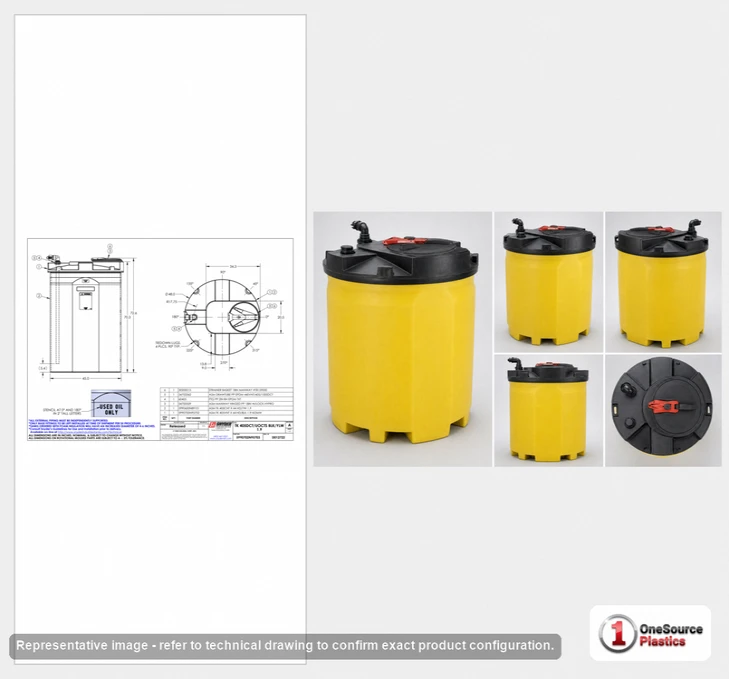
Technical drawing (PDF) for Snyder Industries 5760102N52.
See this tank
Interactive 3D model with live fill. This tank has an interactive 3D model built to its manufacturer dimensions. Rotate it, and set a fill level to see how much liquid it holds at any height. Open the 3D view on the product photo above. Download the 3D model (GLB).
Product video. Watch the Snyder Industries 360 Gallon HDLPE Double Wall Containment Tank Opaque Resin - 1.9 specific gravity video (74 seconds) with dimensions, fittings and shipping notes.
Ready to order?
Add it to your cart at the top of this page, get LTL freight to your ZIP, request a written quote, or call 866-418-1777. The listed price is before freight.