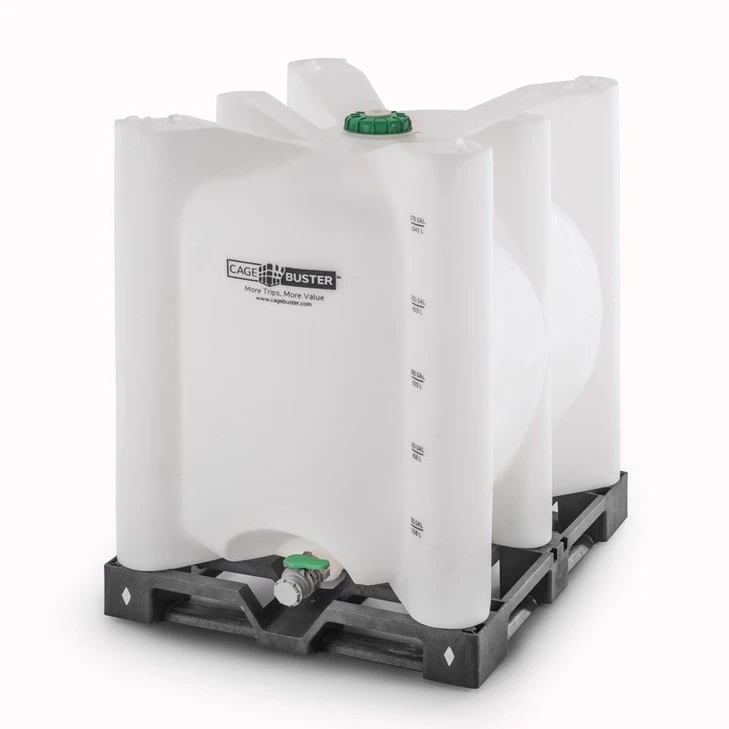
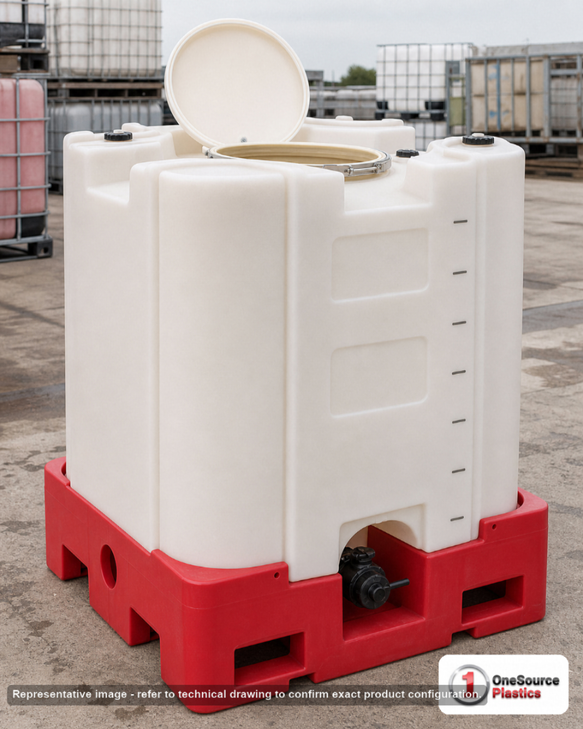
330 gallons rated at a specific gravity of 1.9, with a two inch ball valve fitted
Snyder's SII-6610056B97204 is a 330 gallon stackable IBC tote in high density polyethylene, 45 inches by 45 inches on the base and 63.5 inches tall, listed at 267 pounds empty and 267 pounds to ship, molded at Lincoln, Nebraska. The rating is what sets it apart on its own sheet: a specific gravity of 1.9, which is where the 5,229 pound maximum contents figure comes from against 2,752 pounds for 330 gallons of water at 8.34 pounds per gallon. It arrives fitted, with a 2 inch bung as the inlet and a 2 inch ball valve as the outlet, under a 6 inch threaded vented lid. The service limit is 105 F / 41 C. Freight is class LTL on NMFC 156600-03. The sheet publishes no warranty term, so this page states none; ask us and we will get Snyder's current terms in writing.
Want it on the pad this month? Check freight to your ZIP, add it to your cart above, and 866-418-1777 will confirm the ship date.
The rating is the reason this tote costs more than the one beside it
Three totes on this sheet hold 330 gallons of polyethylene and they are not interchangeable. This one is the tote whose sheet publishes a specific gravity rating of 1.9, and that single line is why it exists as a separate part number. A rating is a statement about how heavy a liquid the wall is designed to carry, and it is the first specification an acid, a brine, a concentrated solution or anything else denser than water has to be checked against. The arithmetic on this sheet makes the point without any help: 330 gallons of water is 2,752 pounds, and the maximum contents figure the sheet gives for this tote is 5,229 pounds. That is the margin you are buying, and it is the reason a buyer moving a dense liquid should stop reading the height and the tare and read the rating line instead. What it costs you is weight and height. At 267 pounds empty this tote is the heavier of that pair on the sheet's own figures, and at 63.5 inches it stands taller than the 52.125 inch Excalibur body, so it needs more headroom at the fill point and more of every freight pound goes to the container. The lower, lighter tote is the better buy for a light liquid in a tight bay, and we will say so. The second reason to take this part number is that it arrives plumbed. A 2 inch bung and a 2 inch ball valve are fitted on the sheet rather than left to the order, which means the tote can be put into service the day it lands, with a known valve, rather than waiting on a fitting nobody confirmed. Under it, flat matters as much as anywhere else: a full tote is 2,752 pounds of water on a 45 inch square footprint, and the floor, rack deck or truck bed takes that through whatever it is actually bearing on. Before you commit to totes at all, price the packaging tier honestly. The choice between drums, totes and a bulk tank is framed in the container versus tank guide and costed against turnover, chemistry and footprint in the drum versus tote versus bulk tank break-even analysis. Then check the volume against your real draw in the tank sizing calculator, and take the reserve you should never dip into and the headspace a warming liquid needs from the tank sizing guide.
Three stackable 330s, three footprints, three weights
| Part | Gallons | Length x width x height | Empty weight |
|---|---|---|---|
| SII-6610056B97204 (this tote, tallest of the stackables) | 330 | 45 x 45 x 63.5 in | 267 lb |
| SII-6610056B97206 (stackable, lower, a shade heavier) | 330 | 46 x 45 x 61 in | 268.4 lb |
| SII-6510101B96002 (Excalibur, lowest and lightest) | 330 | 47 x 47 x 52.125 in | 194 lb |
| 6840000B97202 (Ultratainer, tallest here) | 330 | 46 x 46 x 70 in | 335 lb |
| 6984000B51303 (Supertainer, 304 stainless steel) | 300 | 42 x 48 x 41.25 in | 424 lb |
| 6984300B32224 (Supertainer, carbon steel) | 350 | 42 x 48 x 47.25 in | 469 lb |
The pair worth studying is this tote and the 6984000B51303 beside it, because they answer the same question in two materials. The Supertainer at 300 gallons is 304 stainless steel, on a 42 by 48 inch footprint only 41.25 inches tall, and it weighs 424 pounds empty. It is not polyethylene, it carries no resin and no specific gravity rating on this sheet, and it is the container for a duty where a metal body is the requirement rather than the preference: a cleaning regime, a temperature, a service life, a liquid a polymer wall is simply wrong for. The 350 gallon 6984300B32224 is the carbon steel version of the same idea at 469 pounds. Against them this tote is 267 pounds where they are 424 and 469, it is the one with a published specific gravity rating, and it stands 63.5 inches tall where the stainless body is 41.25, which is the trade: a plastic tote is lighter to move and cheaper to freight and it lives inside a rating. Among the polyethylene totes, the choice is narrow and worth measuring rather than guessing. This one is 45 inches square and 63.5 inches tall at 267 pounds. The 6984000B51303 is not in that comparison at all. The SII-6610056B97206 is a pound and a half heavier and two and a half inches lower on a 46 by 45 inch base, which only decides anything if your rack, door or fill head sits in that gap. The Excalibur is the low, light option at 52.125 inches and 194 pounds. The Ultratainer is the tall one at 70 inches and 335 pounds. Tell us the liquid and the height you have to work under and the part number falls out of it; where the liquid is one your rules require to sit over containment, the leak detection and inspection obligations are set out in the RCRA secondary containment guide, and the difference between a tote in a tray and a genuinely contained tank is spelled out in the Captor Plus containment comparison.
Which wall for your chemical? Call 866-418-1777 with the name and the concentration, or send a quote request and we will pick the row.
Vent first: a threaded vented lid above a two inch bung
- The vent is the first fitting and the one that fails silently. The sheet gives a 6 inch threaded vented lid, and that vent is how the tote breathes: draw 330 gallons out through a valve and the same volume of air has to come back in. Block it, tape it, paint over it or cap it against rain and the body pulls itself inward on the next draw. Check it every time the lid comes off, which on a tote in service is often.
- The inlet: a 2 inch bung, as the sheet spells it. That is a known fitting rather than a bare number, which is the practical advantage of this part number over the Excalibur tote on the same sheet, and it means a fill line can be specified before the tote arrives rather than after.
- The outlet: a 2 inch ball valve, fitted. A quarter-turn valve is the right control for a container people draw from by hand: it is unambiguous open or shut, it is readable across a bay, and it does not creep. Support any pipe or hose off its own stand rather than off the valve body, keep the handle clear of traffic so nobody opens it with a pallet, and fit a cap or plug downstream of it so a knocked handle is not a spill.
- Headspace: leave the liquid room to expand as it warms rather than filling to the lid. Full to the top is the condition in which a warming liquid has nowhere to go, and on a tote the top of the body is also where the vapour sits and where the fittings are.
- Service limit: 105 F / 41 C as the sheet gives it. That is a lower ceiling than the bulk tanks around it and it covers both the liquid and the tote itself, standing on a dock in the sun.
- Rating: a specific gravity of 1.9 on this sheet, with 5,229 pounds given as the maximum contents. Cite those two numbers to your process engineer and nothing else; no margin beyond them is claimed here.
Beyond the fittings, a tote at this rating is usually holding something that punishes carelessness, so the working discipline matters more than the specification. Dedicate the tote to one product and mark it on the body, because a rating tells you what weight the wall carries, not what chemistry it likes, and the compatibility question is one to settle with us before the order rather than after the first fill. Fill it where it will be drawn from: at 2,752 pounds of water, or up to 5,229 pounds of contents at the rating, this is a forklift load and not something to shuffle. Stack it deliberately, square and even, heaviest at the bottom, nothing stacked on a body that is not sitting flat. Keep the valve end away from the aisle. Rinse and inspect on a schedule you write down rather than one you remember, and look at the base and the lower corners each time, because that is where a tote that has been dragged shows it first.
Acid and process chemistry drawn down by valve rather than by pump
The rating and the fitted valve point this tote at a particular kind of work: a dense or aggressive liquid that somebody draws from by hand or feeds to a small pump, in quantities where a drum is a nuisance and a bulk tank is a project. Where they go: water and wastewater treatment plants holding a working supply of a dosing chemical at the point of use; plating, anodising and metal finishing lines drawing measured volumes; pulp, paper, mining and minerals sites keeping a process chemical at a bay; food, beverage and cleaning operations using a concentrate that is heavier than water; distribution and blending operations breaking bulk into totes that then travel; laboratories and pilot plants that need a real volume of a real chemical under a valve they can shut in a quarter turn. In all of it the tote is a container rather than an installation, which is the honest difference from the bulk tanks elsewhere on our site: it is moved, it is returned, it is refilled, and every one of those trips is a handling event. Two limits worth stating without hedging. This is a container, not a contained system; nothing on this sheet gives a secondary containment volume, and if your rules require containment then the tray, the berm or the double wall tank is a separate purchase and a separate conversation. And the service limit on this sheet is 105 F / 41 C, which is the lowest ceiling in this batch and easily reached on an unshaded dock, so plan where it stands as carefully as you plan what goes in it.
Liquids this resin is rated to store
These entries are the manufacturer's ratings for this resin, each with the concentration limit and the fitting and gasket to specify. Your concentration and temperature are confirmed on the chemical page or in the chemical compatibility database before ordering.
- Acetic Acid 60% - PP/PVC fittings, EPDM gaskets
- Aluminum Sulfate 50% - PVC fittings, EPDM gaskets
- Calcium Chloride 40% - PVC fittings, EPDM gaskets
- DEF 32.5% - 316SS fittings, EPDM gaskets
- Ethylene Glycol 100% - PVC fittings, EPDM gaskets
- Ferric Chloride 50% - PVC fittings, EPDM gaskets
- Ferric Sulfate 60% - PVC fittings, EPDM gaskets
- Ferrous Sulfate 20% - PVC fittings, EPDM gaskets
- Hydrochloric Acid 37% - PVC fittings, Viton gaskets
- Hydrofluoric Acid 48% - PP/PVC fittings, Viton gaskets
- Hydrofluosilicic Acid 26% - PP/PVC fittings, Viton gaskets
- Hydrogen Peroxide 50% - PVC fittings, Viton gaskets
- Magnesium Chloride 30% - PVC fittings, EPDM gaskets
- Peracetic Acid 30% - 316SS fittings, Aflas gaskets
- Phosphoric Acid 85% - PVC fittings, Viton gaskets
- Polyaluminum Chloride - concentration not specified, verify - PVC fittings, EPDM gaskets
- Potassium Carbonate 50% - PVC fittings, EPDM gaskets
- Potassium Hydroxide saturated - PVC fittings, EPDM gaskets
- Propylene Glycol - concentration not specified, verify - PP/316SS fittings, EPDM gaskets
- Sodium Bisulfate - concentration not specified, verify - PVC/PP fittings, EPDM gaskets
- Sodium Bisulfite - concentration not specified, verify - PVC/PP fittings, EPDM gaskets
- Sodium Carbonate 30% - PVC fittings, EPDM gaskets
- Sodium Hypochlorite under 16.5% - PVC fittings, Viton gaskets
- Sodium Thiosulfate 40% - PVC fittings, EPDM gaskets
- Sulfuric Acid 98% - CPVC fittings, Viton gaskets
- Urea Solution 50% - PP/PVC fittings, EPDM gaskets
- Zinc Orthophosphate - concentration not specified, verify - PP/316SS fittings, EPDM gaskets
A red tote on a white colour line, 267 pounds to ship
Ask us to confirm the colour in writing before you order if the colour is part of your labelling or segregation scheme, because we will not promise a colour the sheet contradicts. The rest of the freight picture is straightforward. The tote is molded at Lincoln, Nebraska, the sheet gives class LTL on NMFC 156600-03, and it shipments at 45 inches square by 64 inches high at 267 pounds. The freight cost estimator prices the lane to your ZIP, and the listed price is before freight. Say at order whether the address has a dock or a forklift: at 267 pounds and better than five feet tall, this is a pallet shipment and a site with neither gets a curbside drop. Inspect the body, the base, the lid, the vent and the ball valve handle before the driver leaves, and open and close the valve once while the tote is still empty. Keep the pallet. Then water-test it on the floor it will work on, hold it, and check the valve face and the bung seat before a drop of product goes near it. Write the product name, the fill date and the rating on the body in paint marker the day it enters service, and never let a second product into it; a dedicated tote is the only tote whose history anybody can actually vouch for. Walk the base after the first hard rain; a pad that shifts shows it at the edge first.
Freight and documents
Ships from: Lincoln, NE. LTL freight is quoted to your ZIP with the freight cost estimator or by phone at 866-418-1777. The listed price is before freight.
Technical drawing (PDF) for Snyder Industries 6610056B97204.
See this tank
Product video. Watch the Snyder Industries 330 Gallon HDPE Stackable IBC Tote Tank in Red video (64 seconds) with dimensions, fittings and shipping notes.
Ready to order?
Add it to your cart at the top of this page, get LTL freight to your ZIP, request a written quote, or call 866-418-1777. The listed price is before freight.