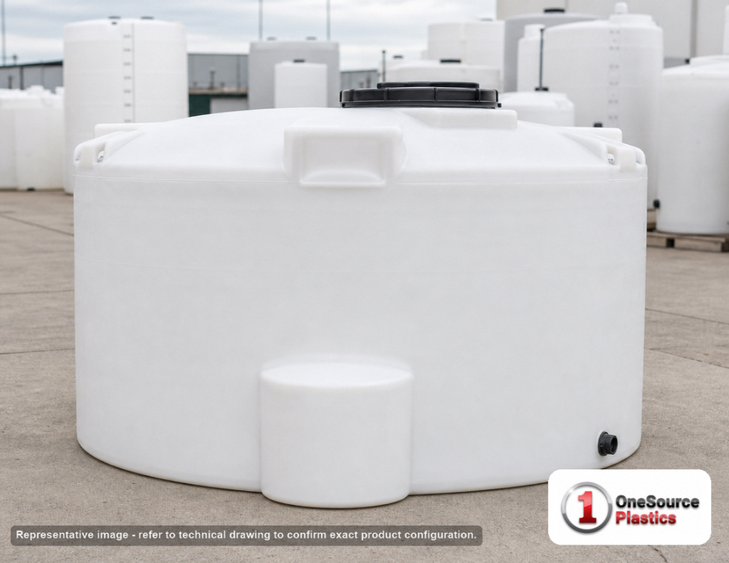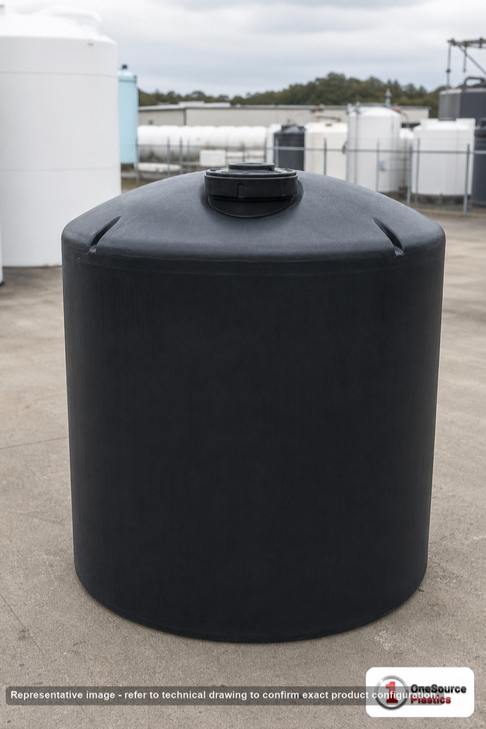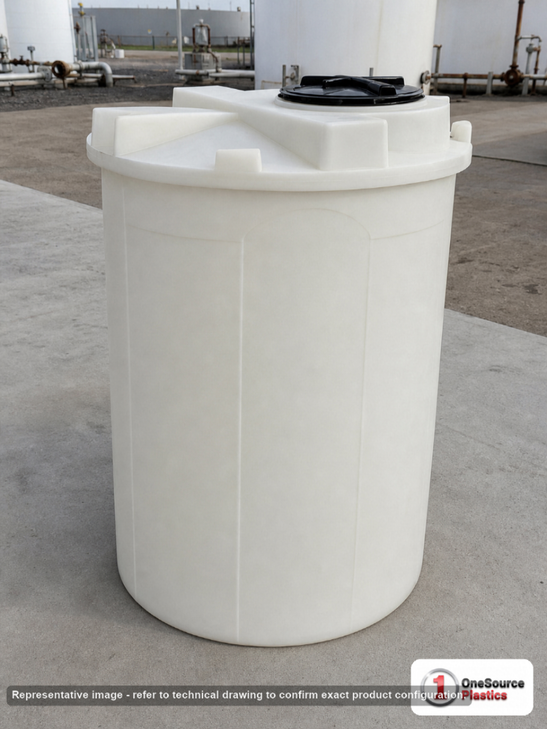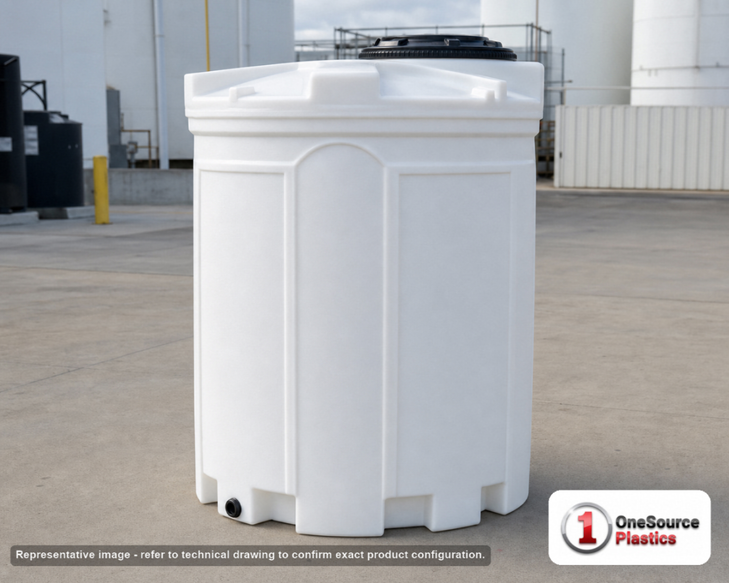
A 500 gallon double wall chemical tank on a 53 inch base
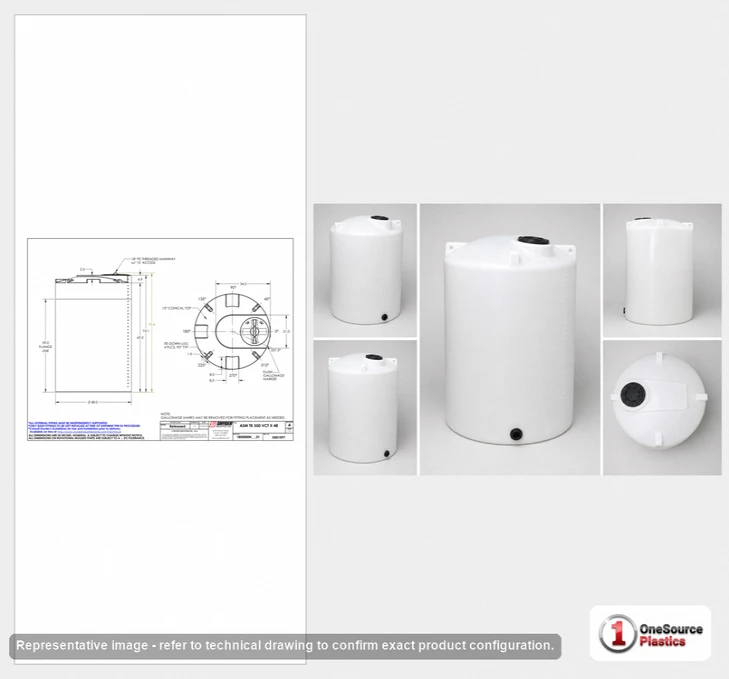
The Snyder 5780102N45 is a double wall chemical storage tank: a 500 gallon white high density linear polyethylene primary rated for a specific gravity of 1.9, or 7,923 pounds of contents against 4,170 for water, standing inside its own secondary containment in a shell 53 inches across and 81 inches tall, weighing 290 pounds. Five hundred gallons is the size a plant buys when a tote a week has become a nuisance and a tanker is still too much; the double wall carries the containment a spill plan asks for inside the tank's own footprint. An 18 inch threaded, vented manway on the primary, a 3 year warranty, and standard LTL freight.
Two ways to buy. Add it to your cart above with freight quoted to your ZIP, or request a written quote for a job that needs paperwork.
Between the tote and the tanker
Two totes fill it with room left for the expansion and the freeboard, and a small delivery truck fills it in one stop, so a plant that dosed from totes moves to bulk pricing without pouring a berm; a double wall tank catches a leak in the interstitial space instead of on the floor, and the SPCC 40 CFR 112 compliance walkthrough covers where that satisfies a spill plan on its own. The list below is the resin's rated chemistry; check the liquid at its concentration in the chemical compatibility database. The 500 gallon vertical tank buyers guide and the 48 by 68 inch 500 gallon guide compare the single wall tanks at this volume, the right comparison only if a spill pallet or a berm is already in place. The tank sizing calculator sizes the tank to feed rate and delivery interval, and the tank sizing guide covers the reserve.
Grades on the 53 x 81 inch double wall, and the sizes beside it
| Part | Gallons | Diameter x height | Empty weight |
|---|---|---|---|
| 5780102N45 (this tank) | 500 | 53 x 81 in | 290 lb |
| 5780102N30 (sulfuric grade) | 500 | 53 x 81 in | 290 lb |
| 5780102N42 (XLPE) | 500 | 53 x 81 in | 290 lb |
| 5780102N48 | 500 | 53 x 81 in | 290 lb |
| 5990702N45 (ASTM certified) | 405 | 48 x 73 in | 250 lb |
| 5040000N30 (squat, sulfuric grade) | 550 | 76 x 65 in | 315 lb |
The N30 is the sulfuric acid grade, the N42 is cross-linked polyethylene for oxidizers, and the N48 is another linear grade, all at the same weight in the same shell. The 5990702N45 is the 405 gallon step down, 8 inches shorter on a base 5 inches narrower, and the 5040000N30 lays 550 gallons down to 65 inches on a 76 inch base in the sulfuric grade.
Torn between two rows? Call 866-418-1777 with the liquid and the ceiling height, or ask for a quote on both and compare the freight.
Access, outlet, interstitial port
- Access: 18 inch threaded, vented manway on the primary, 81 inches up; filled by hose or tote pump through a dip tube, vented outside on anything that fumes.
- Outlet: through both walls at once, the transition supported from the floor rather than the fitting; name the chemical when ordering so the fitting matches it.
- Service limit: 120 F / 48 C.
Watch two levels: the primary, with a sender chosen for the chemical per the level gauge selection guide, and the interstitial space, which is the leak alarm and gets a float switch, a look into the port each shift, and a logged check each week. Liquid in the space means the primary has failed, and the tank is emptied that day. Strap it to a wall; a 53 inch base under 81 inches of dense liquid has a high center of gravity, and full it puts 7,923 pounds on that circle at the rating, which a slab in full contact carries. Mount the dosing pump below the outlet so it primes by gravity.
Receiving a delivery
A small delivery truck's pump still moves liquid faster than a manway vent passes air, so the vent is sized for the unload rate or the fill comes in through a top bulkhead with its own vent line. The fill pipe reaches the floor, so the liquid enters below the surface instead of free-falling and foaming. The first delivery into a new tank is watched from start to finish, with the outlet fitting and the interstitial port checked as the level climbs, and from then on each load is logged by date and strength.
In service
Coagulant, caustic and hypochlorite storage at small water and wastewater plants, acid and inhibitor feed at cooling towers, chemical feed inside occupied buildings, and any 500 gallon vessel of regulated chemical at a site an inspector visits. One chemical to a tank, a label on it, and the manway kept closed.
Liquids this resin is rated to store
These entries are the manufacturer's ratings for this resin, each with the concentration limit and the fitting and gasket to specify. Your concentration and temperature are confirmed on the chemical page or in the chemical compatibility database before ordering.
- Aluminum Sulfate (50%)
- Calcium Chloride (40%)
- Ethylene Glycol (100%)
- Ferric Chloride (50%)
- Ferric Sulfate (60%)
- Ferrous Sulfate (20%)
- Magnesium Chloride (30%)
- Polyaluminum Chloride
- Potassium Carbonate (50%)
- Potassium Hydroxide (saturated)
- Sodium Carbonate (30%), and
- Sodium Thiosulfate (40%).Sodium Bisulfate and Sodium Bisulfite use PVC/PP with EPDM (
- Sodium Bisulfate
- Sodium Bisulfite ).
- Hydrochloric Acid (37%, PVC)
- Phosphoric Acid (85%, PVC)
- Hydrogen Peroxide (50%, PVC)
- Sodium Hypochlorite (under 16.5%, PVC)
- Hydrofluoric Acid (48%, PP/PVC), and
- Hydrofluosilicic Acid (26%, PP/PVC).
- Sulfuric Acid (98%) goes further still, requiring CPVC fittings with Viton.
- Peracetic Acid (30%) uniquely needs 316SS fittings with Aflas gaskets
- Acetic Acid (60%) and
- Urea Solution (50%) run PP/PVC with EPDM.
- DEF (32.5%) wants 316SS with EPDM, while
- Propylene Glycol and
- Zinc Orthophosphate call for PP/316SS with EPDM.Ozonated Water up to 10 PPM is also compatible on PVC with EPDM.Browse the full
Freight and unloading
The 5780102N45 ships palletized as LTL freight (NMFC 156600-03) at a class rate; the freight cost estimator shows the lane to your ZIP; the listed figure is the price before freight. A pallet jack moves 290 pounds. Hold a water test on the primary with the interstitial port watched, then drain and dry ahead of the first chemical. The first fill is the only cheap time to find a problem, so do it in daylight with someone watching the base.
Freight and documents
Ships from: Marked Tree, AR. LTL freight is quoted to your ZIP with the freight cost estimator or by phone at 866-418-1777. The listed price is before freight.
Technical drawing (PDF) for Snyder Industries 5780102N45.
See this tank
Interactive 3D model with live fill. This tank has an interactive 3D model built to its manufacturer dimensions. Rotate it, and set a fill level to see how much liquid it holds at any height. Open the 3D view on the product photo above. Download the 3D model (GLB).
Product video. Watch the Snyder Industries 500 Gallon Plastic Vertical Double Wall Liquid Chemical Storage Tank in White video (69 seconds) with dimensions, fittings and shipping notes.
Ready to order?
Add it to your cart at the top of this page, get LTL freight to your ZIP, request a written quote, or call 866-418-1777. The listed price is before freight.