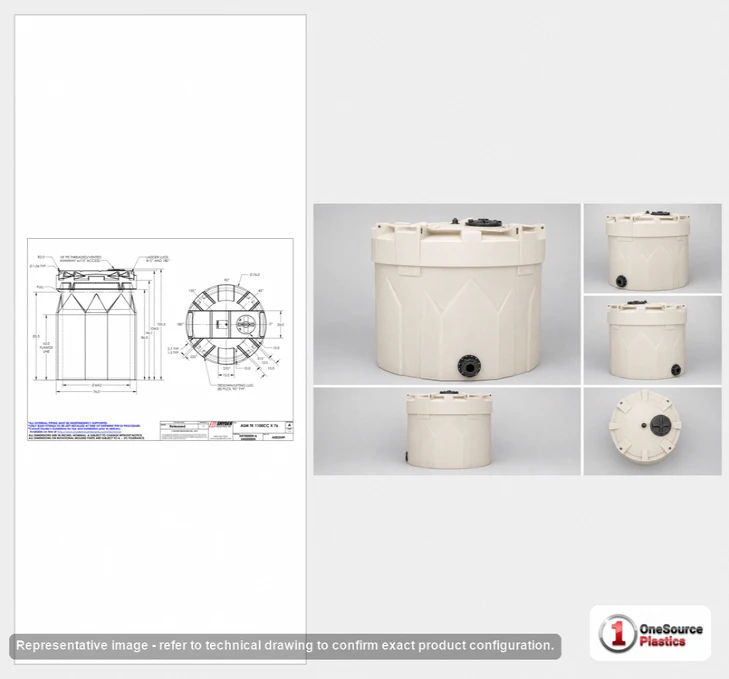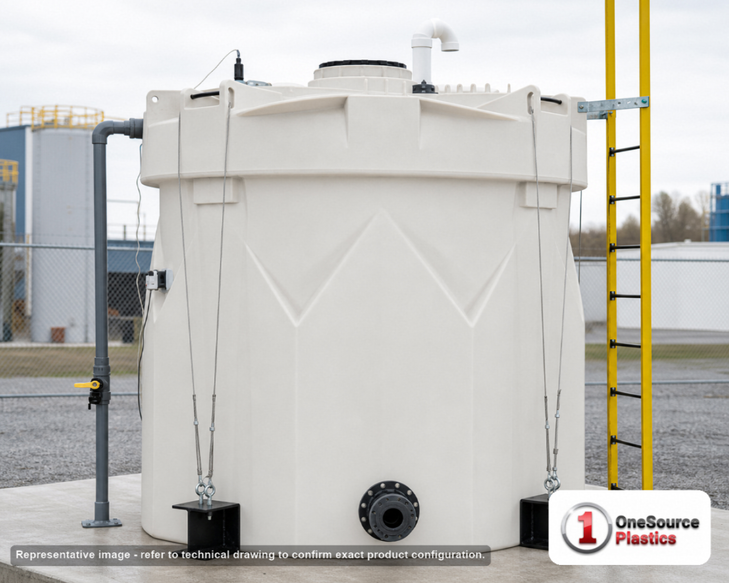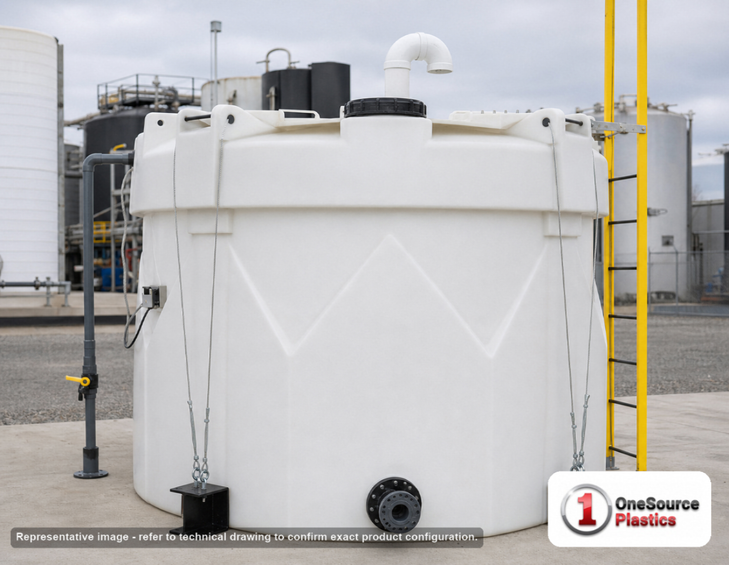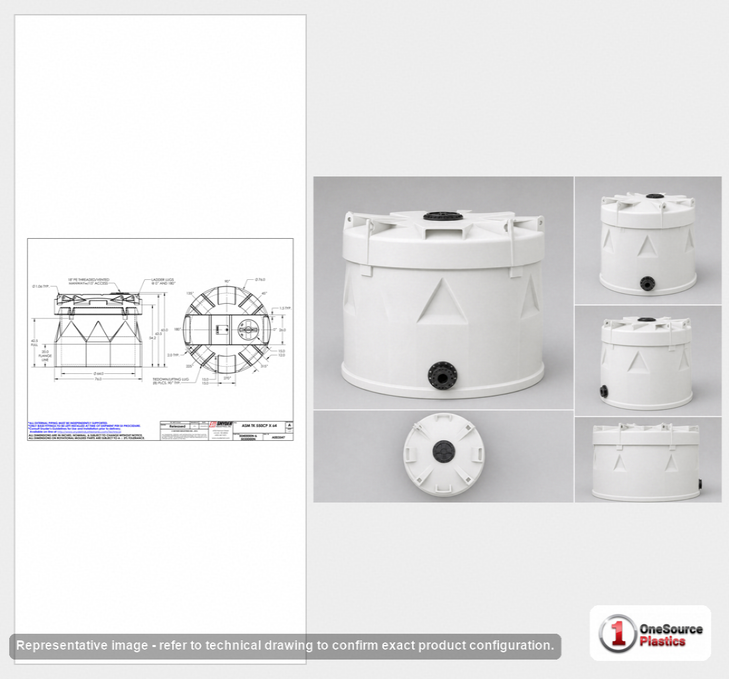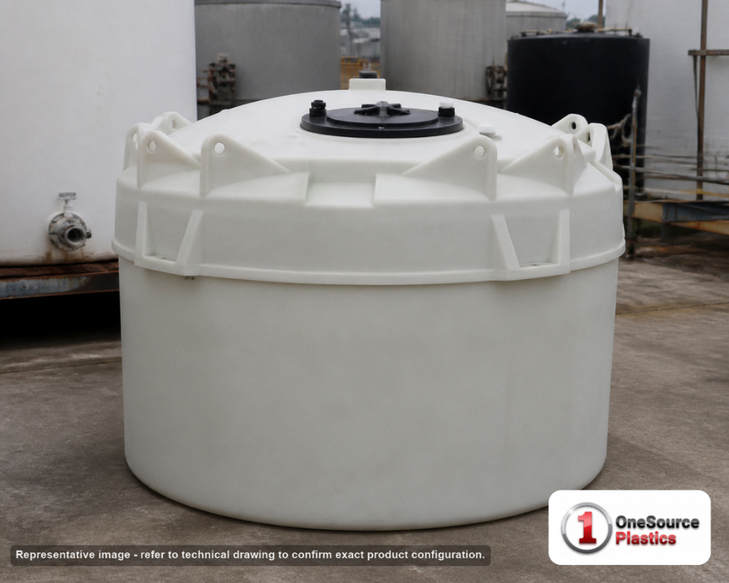
Five hundred and fifty gallons inside a seventy-six inch double wall
This is a 550 gallon double wall storage tank, part number SII-5040000N42, listed at 76 inches long, 76 inches wide and 65 inches tall, at 670 pounds empty and 670 pounds shipping. The material field itself is unusable on this sheet: it holds a comma-separated list of numeric ids rather than a material name, so this page prints the word the listing name carries and does not name a resin beyond that. The wall carries a specific gravity rating of 1.9, and the sheet gives 8,715 pounds of max contents against 4,587 pounds of water at 8.34 pounds per gallon. The opening on top is an 18 inch threaded vented manway and the lid field reads 18 inches. Freight class reads 250 beside an LTL ship mode, the plant field reads Philippi, West Virginia, and the shipping states read Mississippi and West Virginia. The outlet and inlet fields are empty, and the sheet publishes no service limit, no warranty term, no NMFC number and no structural detail. None of those is asserted here.
Price it in one step. Freight to your ZIP shows in seconds; add the 550 gallon tank to your cart above, or call 866-418-1777 if the site has a question in it.
Containment as the duty: what a double wall tank is actually bought for
The duty on this one is not storage, it is containment, and that changes who buys it and why. A single wall tank needs something built around it to catch a release: a bund, a lined pit, a poured kerb, a drain that goes somewhere safe. All of that is civil work, it takes floor area, it fills with rainwater outdoors, and somebody has to maintain it for the life of the tank. A double wall listing puts the containment in the purchase instead of in the concrete, which is why it turns up where floor space is tight, where a slab cannot be cut, where a tank has to go inside an existing building, or where a site would rather buy one item than manage two. The volume tells you the rest of the story. At 550 gallons this is not a bulk holding vessel; it is a working store for something that arrives by tote or by small delivery and is drawn off by a pump or a dosing system. Treatment chemical at a small plant or a package system. Dosing solution at a manufacturing line. A concentrate held near the point of use. A product that has to be kept off the floor drain for reasons that are nothing to do with the tank and everything to do with what is inside it. The number to plan around is the footprint. The record gives 76 inches by 76 inches by 65 inches: six feet four inches square and five feet five inches tall, complete, with the containment already inside that envelope rather than around it. That is the honest comparison against a smaller tank in a bund, and it is usually the argument that wins the purchase. Work the height the same way: 65 inches of tank plus whatever a person needs above the 18 inch manway to open it and run a fill line in, measured to the lowest fixed thing over the spot. The loads are published and they are what the floor or pad has to take: 670 pounds of empty tank, 4,587 pounds of water and 8,715 pounds at the rating, spread over a 76 inch square. Get the base right before anything is ordered, because a contained tank that settles unevenly is a harder problem than a plain one. The concrete pad sizing article works through that properly, the tank sizing calculator settles the volume, and the tank sizing guide carries the freeboard discipline.
The seventy-six inch group, and the two sizes either side of it
| Part | Gallons | Length x width x height | Empty weight |
|---|---|---|---|
| SII-5040000N42 (this tank, white, rated 1.9) | 550 | 76 x 76 x 65 in | 670 lb |
| 5040000N30 (same envelope, listed lighter) | 550 | 76 x 76 x 65 in | 315 lb |
| 5040000N48 (same envelope, black listing) | 550 | 76 x 76 x 65 in | 315 lb |
| 5040000N51 (same envelope, black listing) | 550 | 76 x 76 x 65 in | 315 lb |
| 5780102N42 (less volume, a narrower and taller shape) | 500 | 53 x 53 x 81 in | 290 lb |
| 5990902N30 (more volume, nearly the same height) | 750 | 73 x 73 x 67 in | 390 lb |
Four rows share this 76 by 76 by 65 inch envelope at 550 gallons, and one figure separates this listing from the other three: the sheet gives 670 pounds for this part number and 315 pounds for 5040000N30, 5040000N48 and 5040000N51. The record gives both and does not explain the difference, so this page prints what it says and explains nothing it cannot source. Nothing here describes a wall thickness or a construction difference behind that weight, and nothing here should be read as one. What this page does stand behind is this sheet: 550 gallons, one 76 by 76 by 65 inch envelope, 670 pounds, a specific gravity rating of 1.9 and 8,715 pounds of max contents. If one of the other three listings is what your specification calls for, send the part number and we will confirm what that record carries in writing before an order is placed. The two outer rows are the sizing conversation. 5780102N42 holds 500 gallons in a 53 by 53 by 81 inch shape, which is a much smaller footprint bought with sixteen inches of extra height, and that is the answer where the floor is the constraint and the ceiling is not. 5990902N30 holds 750 gallons at 73 by 73 by 67 inches, which is very nearly this tank's height and a slightly smaller square for more volume. Read those three together before fixing the drawing, because on a contained tank the footprint is the whole argument: the point of buying the containment inside the envelope is that the envelope is all the room it takes. Where the usable volume rather than the nameplate is what matters to you, the double wall freeboard sizing article sets out what thermal expansion and density do to the number you can actually use.
Settled on the 550 gallon tank? Freight to your ZIP and add to cart above; a written quote is one click away for the paperwork.
The drain path on a contained tank, and what this record leaves blank
- The discharge first: the outlet field on this sheet is empty. No outlet dimension, no thread, no bulkhead and no valve is published, so none is claimed here. On a contained tank that question is worth asking before the order rather than after it, because where the line leaves the vessel is part of how the installation is arranged. Send us the line size, the valve type and the product and we will confirm what this part number carries.
- The inlet: also blank on this record. The fill arrangement is not published and is not described here.
- Access on top: an 18 inch threaded vented manway with a lid field of 18 inches, sitting at 65 inches. That is a reachable height from a low platform or a step, which is one of the practical advantages of this shape over a tall column at the same volume.
- The vent: it comes with the manway on this sheet rather than as a separate item. Keep it clear, look at it whenever the tank is opened, and never blank, tape or wrap it. On a tank drawn down by pump the air path is what protects the wall.
- The loads: 670 pounds empty, 4,587 pounds of water at 550 gallons, 8,715 pounds at the rating. Those are the figures the floor, the pad or the plinth has to carry over a 76 inch square.
- Ratings and blanks: a specific gravity rating of 1.9 is the only rating on this record. No service limit, no warranty term, no NMFC number and no structural detail is published, and none is stated.
- Level: a tank in this shape is read from the top or with an instrument, not through the wall. Decide how before it is standing, because retrofitting a gauge on a full vessel is nobody's idea of a good afternoon. The water reuse tank topology article is a useful read where this vessel sits inside a larger storage train.
Everything in that list is a field on the record or a blank on it. Where the sheet is silent we have said so rather than filling the gap with something that sounded right.
Where a contained five hundred and fifty earns its floor space
The sites that buy this one have usually already priced the alternative. A small treatment plant or package system holding a dosing chemical inside a building where a bund would take floor the process needs. A manufacturing line keeping a concentrate near the point of use rather than at a remote bulk store. A workshop, wash bay or laboratory building where a floor drain exists and the whole point is that nothing ever reaches it. A remote or unmanned site where the containment has to work without anybody watching it, and where a pit that fills with rainwater is a maintenance job nobody will do. A rural or off-grid installation where civil work is expensive and an item that arrives complete is worth more than one that needs a contractor. In all of those the purchase is being made for what happens on the worst day rather than for what happens on an ordinary one, which is a perfectly good reason to buy a tank. Two honest notes. The rating on this record is a specific gravity of 1.9 and that is a wall rating: it tells you how dense a liquid the wall is rated to hold and it tells you nothing about how your particular product behaves against polyethylene. Name the liquid, the concentration and the temperature it genuinely sits at through the year when you enquire, and let the chemistry decide the gaskets, the seals and the valve rather than the tank. This record also publishes no service limit at all, so this page states none; if the product is held warm, ask us with the numbers. On the routine side, a contained tank rewards the same discipline as any other and one habit more: keep the top clear and keep the outside of the vessel readable, because the outer surface is the thing an inspection actually reads. Confirm the base is bearing evenly before the first fill and again after it, walk the full square at every inspection, read the manway seal in daylight, and keep a written record of what the tank has held. Where this vessel sits in a fire water or emergency supply role rather than a process one, the fire water reservoir design article covers the sizing and cold-climate questions that a product page cannot.
Six hundred and seventy pounds out of Philippi, West Virginia
The plant field on this record reads Philippi, West Virginia, and the shipping states read Mississippi and West Virginia, which is a wider footprint than a single-plant listing and generally means a shorter lane into the south and the mid-Atlantic. The freight class reads 250, a numeric class rather than a mode, the ship mode reads LTL, and the sheet publishes no NMFC number. It ships at 76 inches by 76 inches by 65 inches at 670 pounds: a compact package by tank standards and a heavy one for its size, which is the opposite of the usual moulded-tank freight problem and generally a friendlier ticket. Price the lane to your own ZIP with the freight cost estimator; the listed price is before freight. At 670 pounds this is a forklift job rather than a hand job, so have the machine, the forks and the operator arranged for the delivery window instead of discovering the weight when the curtain comes back. Have the base ready before the truck arrives: level, clean, and sized for a 76 inch square with room to walk around it, because a tank you cannot get around is a tank you cannot inspect. Set it down square rather than dropping a corner, and check it is bearing evenly before anything goes in. Then prove it with clean water rather than with product: hold the 4,587 pound load, read the manway seal and the full perimeter of the base in daylight, and leave it standing full overnight before the first line is connected. Keep the paperwork with the tank, not in an office drawer, and mark the vessel clearly with what is in it; on a contained tank the label is the first thing an inspector looks for and the last thing anybody remembers to fit. Note the pad height and the outlet height on the site plan while the tape is out; the next pipe run will need both.
Freight and documents
Ships from: Philippi, WV. LTL freight is quoted to your ZIP with the freight cost estimator or by phone at 866-418-1777. The listed price is before freight.
Technical drawing (PDF) for Snyder Industries 5040000N42.
See this tank
Product video. Watch the 550 Gallon Double Wall Storage Tank XLPE 1.9 SG Natural White video (66 seconds) with dimensions, fittings and shipping notes.
Ready to order?
Add it to your cart at the top of this page, get LTL freight to your ZIP, request a written quote, or call 866-418-1777. The listed price is before freight.