60 gallons, 23 pounds, and a width the sheet puts ahead of the length
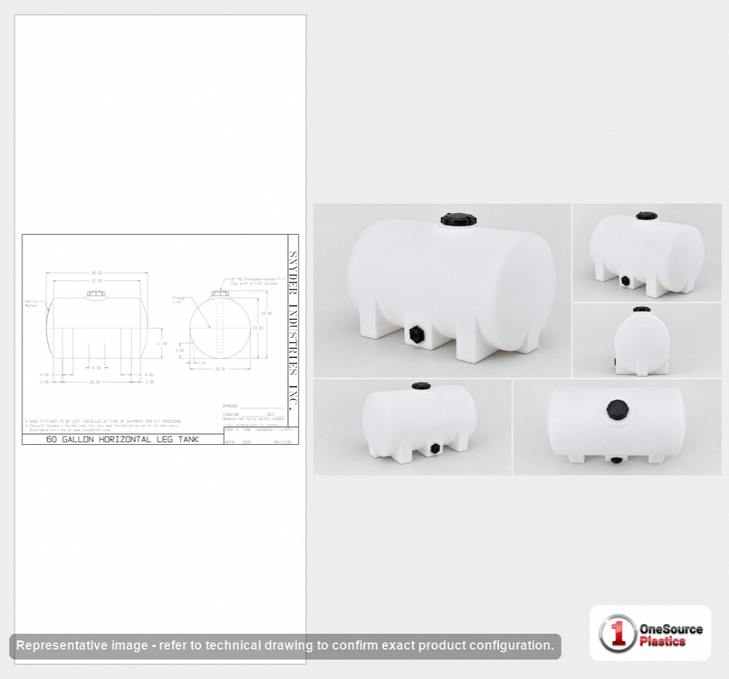
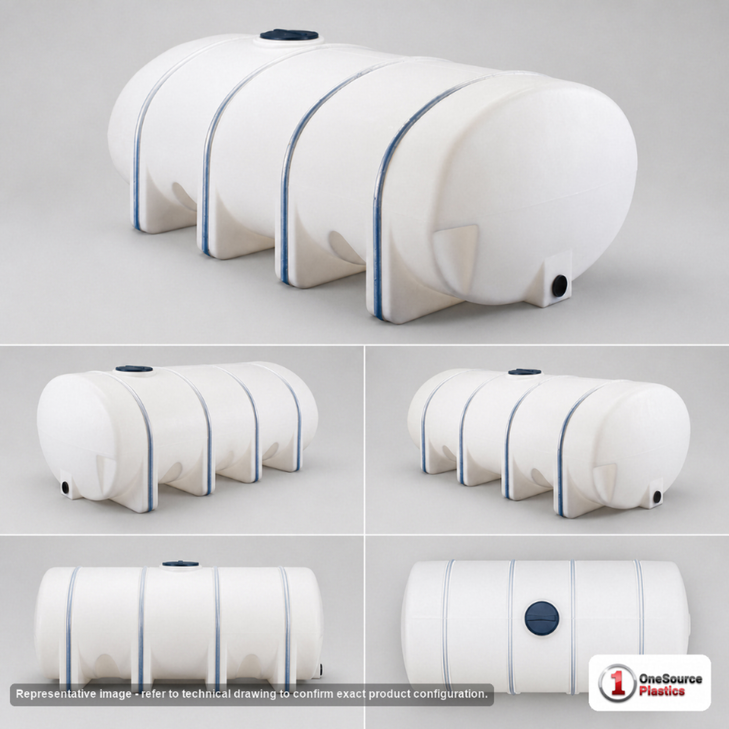
The Snyder SII-1060000C26 is the smallest leg tank here: 60 gallons of white high density linear polyethylene in a body the sheet gives as 39 inches long, 48 inches wide and 26 inches tall, weighing 23 pounds empty and 25 pounds to ship, molded at Chowchilla, California, Lincoln, Nebraska or Philippi, West Virginia. That is the sheet's own order of dimensions and we print it as given: this is a low, wide body whose broadest measurement is the one Snyder lists as width. The legs are moulded in, so it sits flat on a rack, a bed or a bench with no cradle. The wall is rated at a specific gravity of 1.9, which is where the 951 pound maximum contents figure comes from against 500 pounds for 60 gallons of water at 8.34 pounds per gallon. There is a 6 inch threaded vented lid, a service limit of 120 F / 48 C, and a 3 year warranty.
Ordering for a plant or a bid? Request a written quote with freight to your ZIP for the file; a single 60 gallon tank goes straight to the cart above.
Low and wide: the rack, the truck bed and the bench
Twenty-six inches tall is the measurement that puts this tank places the rest of the family cannot go. It sits on a utility-vehicle cargo rack below the line of the roll bar, in a pickup bed under a tonneau or a topper, on a rack over the rear wheels of a compact tractor, on a three-point carrier, on a workbench or a shelf in a shop, on a small trailer alongside other equipment, or on a barn floor in a corner as a standing supply. A tank that has to pass under a lid, a rack or a low doorway is chosen by height first, and 26 inches clears things four feet of tank never will. What it spends to get there is footprint: the sheet gives a 48 inch measurement across the body, four feet of it, which is a lot of deck for 60 gallons, and it means this tank wants a flat, continuous surface the whole way across rather than a pair of rails or a couple of bearers. That is the part people get wrong. The moulded feet bear through their whole flat area onto whatever they are resting on, so a rack made of two tubes, a bed with a rib down the middle, a shelf with a bowed board, or a bench with a lip under one edge carries the load of 500 pounds of water on those points, and a wide, shallow body flexes into the gaps. Put a sheet of plywood or a mat under it on anything ribbed or open, and let it bear across the base. Then strap it down properly even though it is light: 60 gallons of liquid in a wide, shallow body has a long, slow slosh that pushes side to side far harder than the 23 pound empty weight suggests, and the tie-downs go through the legs into structure rather than over the top of the body. What a leg or applicator tank has to satisfy on the road, and how an agricultural exemption differs from general road use, is set out in the applicator and leg tank classification guide, and it is worth knowing before the tank is bolted to a vehicle. Check 60 gallons against the real job in the tank sizing calculator, and take the reserve and the freeboard a warming liquid needs from the tank sizing guide.
Thirty, sixty and sixty-five gallons: the small leg tanks
| Part | Gallons | Length x width x height | Empty weight |
|---|---|---|---|
| SII-1060000C26 (this tank, widest, low) | 60 | 39 x 48 x 26 in | 23 lb |
| SII-1080000C26 (smaller, narrowest, same height) | 30 | 20 x 23 x 26 in | 12 lb |
| SII-1031500C26 (slightly larger, lowest) | 65 | 37 x 32 x 20 in | 38 lb |
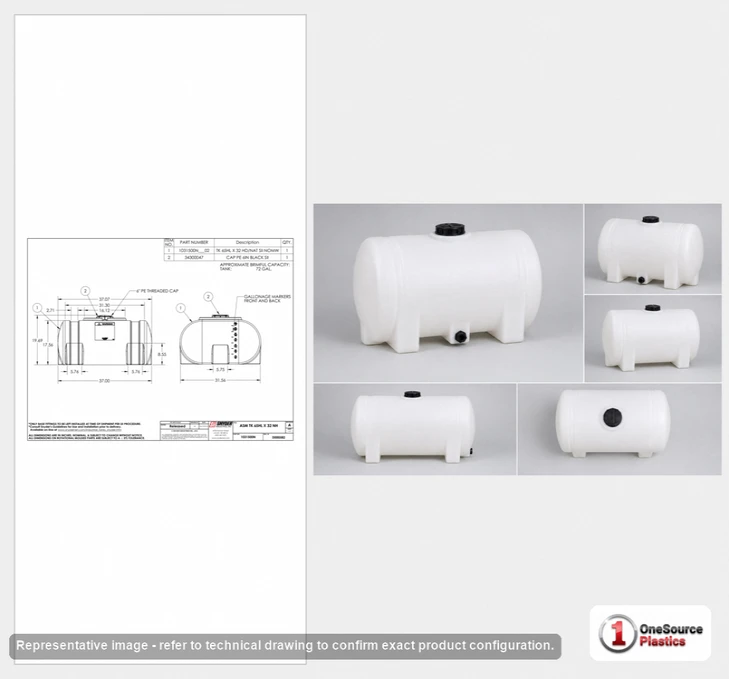
Three small leg tanks, three different reasons to buy. The SII-1080000C26 holds 30 gallons in a body 20 by 23 inches at the same 26 inch height and 12 pounds empty, which is the one to take when the space is a gap rather than a deck: it goes on a quad rack, in a tool box footprint, or beside something else that already owns the bed. The SII-1031500C26 holds 65 gallons, five more than this tank, in a body 37 by 32 inches and only 20 inches tall at 38 pounds, so it is the lowest of the three and the one for a mount with almost no headroom, bought at the price of being the heaviest to handle empty. This tank sits between them and its argument is capacity per inch of height: 60 gallons at 26 inches tall and 23 pounds empty, the lightest tank on this sheet for its volume, on the widest footprint of the three. Take it when the deck or the rack is broad and flat and the height is what is scarce. Take the 65 when the height is scarcer still and the width is not available. Take the 30 when 60 gallons is simply more than the vehicle should be carrying. All three stand on their own moulded feet, which is the point of a leg tank at any size: no stand to buy, no cradle to weld, no saddle to line up.
Need the taller or the wider one? Every row links to its page with freight to your ZIP on each; 866-418-1777 will check the ceiling and the pad.
A small drain, a small lid, and what the sheet does not say about the outlet
- The outlet as the sheet lists it: the sheet gives the outlet as 0.75 and gives no unit for it. This page prints that figure and stops there; it is not presented as a pipe size, because the sheet does not make it one. Tell us what you intend to connect and we will confirm the thread and the fitting against Snyder's current documentation before you buy hose, a valve or an adapter. What the figure does tell you honestly is the scale: this is a small drain and feed port, sized for a hose, a hand wand or a small pump, not for moving 60 gallons anywhere in a hurry.
- Where it sits and how it drains: the outlet is at the low end of the body above the legs, and this is a shallow tank, so the difference between a level mount and one tilted toward the outlet is the difference between draining it and nearly draining it. Shim the far side, or park with the outlet low.
- Valve and first joint: a shut-off at the outlet supported off the rack or the deck rather than off the tank, with a flexible connector before any hard line. On a small tank people skip this because the loads look trivial; the surge from a wide, shallow body on an unpaved track is not.
- No inlet on this sheet, so none is claimed. Filling is through the lid, hose down inside the body.
- Access: a 6 inch threaded vented lid, 26 inches up, which on a tank this low is reachable without a step and easy to look into across a wide, shallow floor. Keep it closed and keep the vent clear; a small tank with a small vent and a pump on the outlet is the easiest of all of these to pull in.
- Service limit: 120 F / 48 C, with a 3 year warranty as the sheet gives it.
Name the liquid at order and the fitting, the gasket and the valve get matched to it rather than guessed. Two things earn their place on a tank this size. First, the strainer: a small port blocks with debris that a large one passes, so a cleanable strainer ahead of any pump is not an accessory here, it is the difference between a working rig and a Saturday morning. Second, the label: a 60 gallon tank on a utility vehicle gets used for whatever is needed that week, and a tank that has held one product and then another without a documented clean-out is a tank nobody can vouch for. Write the product on the body, keep it to that product, and if it must change, rinse it, prove it and re-label it. Where it freezes, drain the outlet, the valve and the hose; a shallow body ices from the surface and survives, a plastic valve full of ice does not.
Spot spraying, water hauling and the jobs a drum cannot do
Sixty gallons on legs is the size that replaces jugs and drums on a vehicle. The work: a spot-spraying rig on a utility vehicle or a quad, with a small pump, a reel and a wand, for fence lines, pastures, trails and rights of way; water hauled to a remote trough, a planting or fencing crew, or a job site in small quantities; wash-down and rinse water on a service truck; a small supply of a shop fluid on a bench, drawn by gravity into pails; dust suppression on a path or a yard; a turf or grounds crew's tank for mixing and refilling backpack sprayers; a fire-cautious property's small standing water supply at a building. The thing that makes it better than a drum for all of those is the shape: a drum is round, tall and must be strapped upright or laid down and chocked, while this body sits flat on its own feet, drains from a fitting at the bottom rather than through a bung, and stays below a rack line at 26 inches. Two limits stated honestly. There is no secondary containment here, so this is not the tank where the rules say the liquid has to be contained. And the 120 F / 48 C service limit on this sheet applies to a small tank sitting loaded in the sun on a dark rack, which is the fastest-heating installation in this whole slice, so shade it or work it down through the day.
Chemical ratings on record for this resin
What the manufacturer lists for this resin, liquid by liquid, with the concentration ceiling and the fitting and gasket material. Your concentration and temperature get checked on the linked page or in the chemical compatibility database before ordering.
- Aluminum Sulfate (50%, PVC, EPDM)
- Calcium Chloride (40%, PVC, EPDM)
- DEF (32.5%, 316SS fittings, EPDM)
- Ethylene Glycol (100%, PVC, EPDM)
- Ferric Chloride (50%, PVC, EPDM)
- Hydrochloric Acid (37%, PVC, Viton)
- Hydrofluoric Acid (48%, PP/PVC, Viton)
- Hydrogen Peroxide (50%, PVC, Viton)
- Phosphoric Acid (85%, PVC, Viton)
- Sodium Hypochlorite (under 16.5%, PVC, Viton)
- Sulfuric Acid (98%, CPVC, Viton)
- Urea Solution (50%, PP/PVC, EPDM), Peracetic Acid (30%, 316SS, Aflas), and Ozonated Water (up to 10 PPM, PVC, EPDM), among others on the full chart. Brow
A parcel class on a tank, from whichever of three plants is nearest
This tank is molded at Chowchilla, California, Lincoln, Nebraska and Philippi, West Virginia, so nearly anywhere in the country has a short lane to one of them. The sheet also gives two weights, 23 pounds empty and 25 pounds to ship, and both are printed. At 23 pounds it is the one tank in this family a person carries alone, and the 48 inch measurement across the body is why it may still travel as a pallet rather than a parcel, so tell us at order whether the address has a dock or whether it is a curbside drop. Check the feet and the outlet before the driver leaves. Then mount it and fill it with clean water before the first working load: run it on the rack or the bed it will live on, drive the track it will see, and look at the tie-downs, the feet and the outlet afterwards, because a light tank on a rough trail moves more than a heavy one does. Then write the date on the lid, because the smallest tank on a farm is the one whose history nobody remembers. A strap that is checked once a season is a strap that holds; put it on the same calendar as the gutters.
Freight and documents
Ships from: Chowchilla, CA; Lincoln, NE; Philippi, WV. LTL freight is quoted to your ZIP with the freight cost estimator or by phone at 866-418-1777. The listed price is before freight.
Technical drawing (PDF) for Snyder Industries 1060000C26.
See this tank
Interactive 3D model with live fill. This tank has an interactive 3D model built to its manufacturer dimensions. Rotate it, and set a fill level to see how much liquid it holds at any height. Open the 3D view on the product photo above. Download the 3D model (GLB).
Product video. Watch the Snyder Industries 60 Gallon Plastic Horizontal Leg Tank video (67 seconds) with dimensions, fittings and shipping notes.
Ready to order?
Add it to your cart at the top of this page, get LTL freight to your ZIP, request a written quote, or call 866-418-1777. The listed price is before freight.