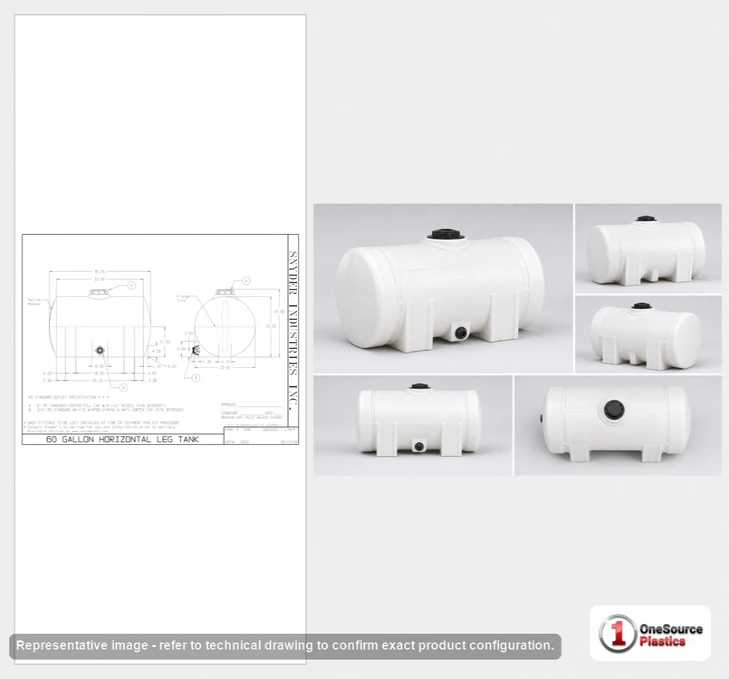
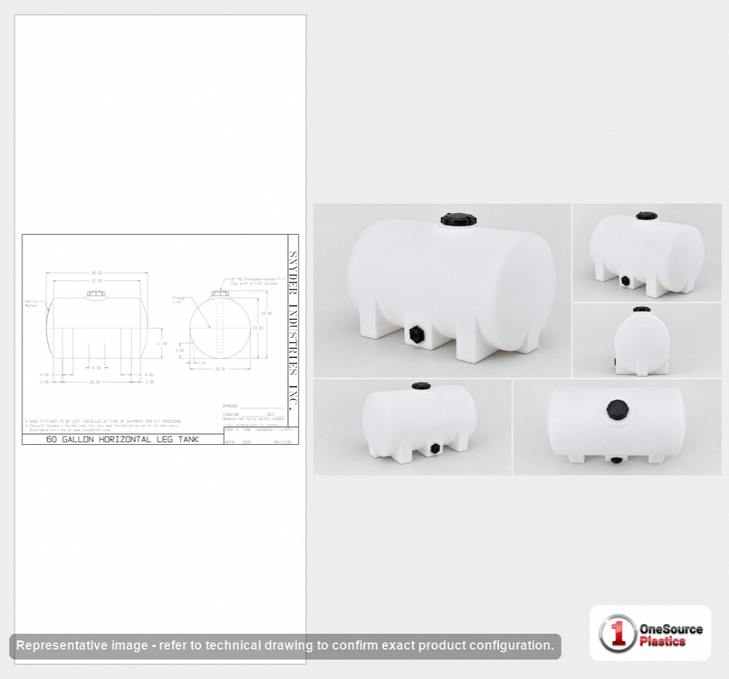
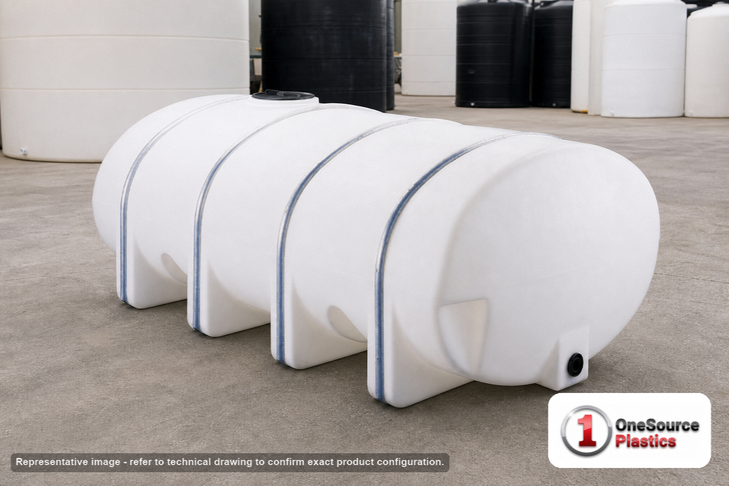
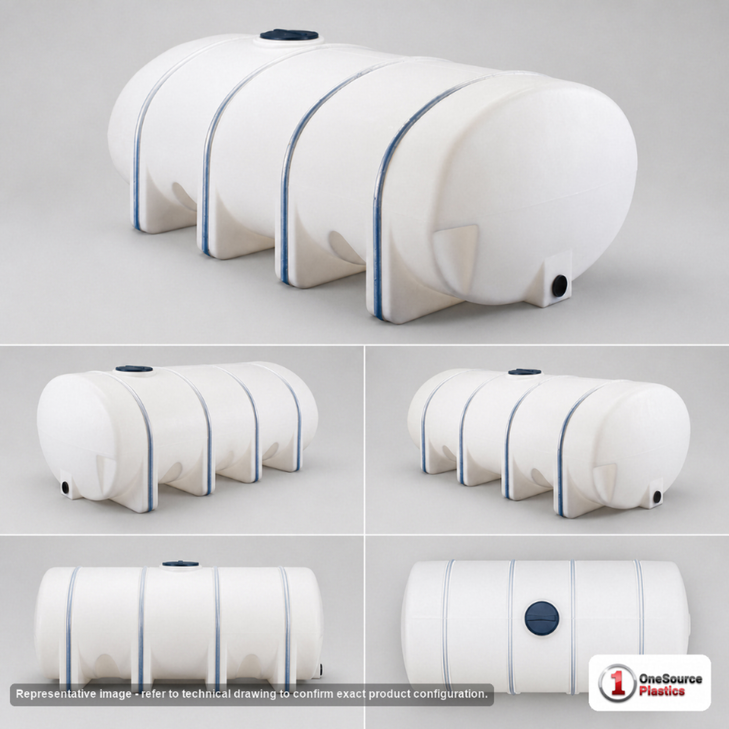
Sixty-five gallons on legs, 37 inches long and only 20 inches tall
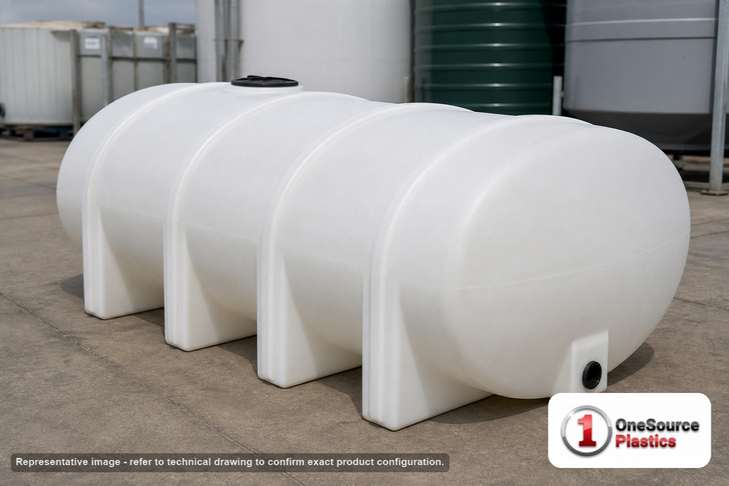
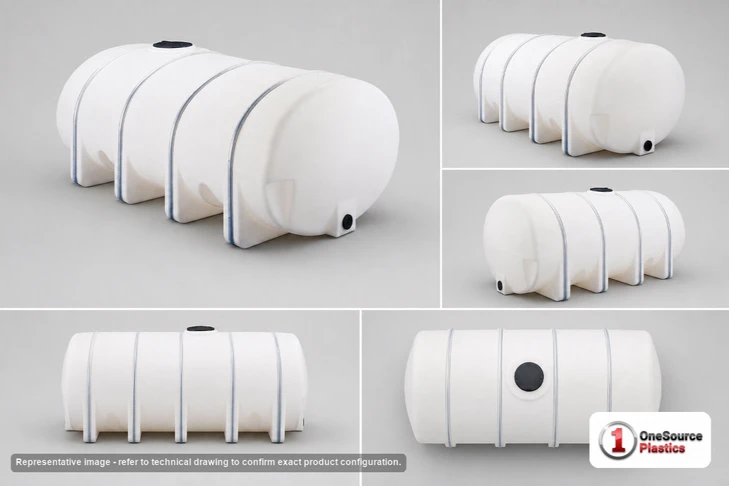
The Snyder SII-1031500C26 is a 65 gallon horizontal leg tank in white high density linear polyethylene, 37 inches long, 32 inches wide and 20 inches tall, listed at 38 pounds empty and the same 38 pounds to ship, molded at Marked Tree, Arkansas. A leg tank carries its own feet: they are part of the moulding, so the tank sits down flat on a deck or a floor and needs no cradle, no saddle and no stand. The sheet rates the wall at a specific gravity of 1.9, which is where the 1,030 pound figure for maximum contents comes from, against the 542 pounds that 65 gallons of water weighs at 8.34 pounds per gallon. Fittings are a 0.75 inch outlet and a 6 inch threaded vented lid. The service limit is 120 F / 48 C, and the sheet gives a 3 year warranty.
Want it on your site? Get LTL freight to your ZIP, add it to your cart above, or call 866-418-1777 and a tank specialist will confirm the fit.
What a 20 inch tank clears: under a rack, in a bed, beside a wheel well
Start with the 20 inches, because on this tank the height is the whole argument. Twenty inches is low enough to slide under a headache rack on a pickup, low enough to sit in a bed and stay below the line of the sides where it does not block a mirror or a back window, low enough to live under a workbench or a shelf in a shop, and low enough that one person can look into the 6 inch lid without standing on anything. At 37 inches long and 32 inches wide it is close to square in plan, so it goes crossways behind a cab or lengthways beside a wheel well without wasting the rest of the bed. The molded feet are what make either of those work: they give the body a flat bearing surface, they hold the outlet corner clear of the deck, and they let the tank be bolted or strapped down through its own structure rather than cinched over its middle. What the shape costs is depth of liquid. A 20 inch body gives you very little height above the outlet, so gravity draw is slow by nature and the last gallons want the deck tilted toward the fitting. Under the tank, flat and continuous is not a nicety. A rotationally molded floor bears on the whole surface it is resting on and nothing else, so a bed rib, a raised toolbox lip, a warped board or a rusted-through floor becomes the bearing point for 542 pounds of water, or up to 1,030 pounds of contents at the rating, instead of the feet carrying it evenly. Lay a mat or a sheet of plywood under it on a ribbed bed. Then plan for the liquid moving, because a wide, shallow body sloshes with a long slow wave that pushes side to side harder than people expect: restrain it fore, aft and across, through the feet rather than over the crown. How leg and applicator tanks are classified when they travel, and what an agricultural exemption does and does not cover, is worked through in the applicator and leg tank classification guide, with the portable utility case set out in the loaf-style portable utility tank guide; both are worth reading before the tank is mounted rather than after. Check 65 gallons against your real draw and the interval between refills in the tank sizing calculator, and take the working reserve and the freeboard a warming liquid needs from the tank sizing guide.
Three small leg tanks, and why the 65 is not the 60
| Part | Gallons | Length x width x height | Empty weight |
|---|---|---|---|
| SII-1031500C26 (this tank, the lowest) | 65 | 37 x 32 x 20 in | 38 lb |
| SII-1060000C26 (wider, taller, lighter on the sheet) | 60 | 39 x 48 x 26 in | 23 lb |
| SII-1003600C26 (larger, taller) | 125 | 44 x 32 x 35 in | 55 lb |
The interesting comparison on this sheet is the 60 gallon SII-1060000C26, because it holds five fewer gallons in a body that is 39 inches long, 48 inches wide and 26 inches tall and is listed at 23 pounds against this tank's 38 pounds. So the smaller capacity is the wider and the taller of the two, and it is the lighter figure by a wide margin; the sheet gives both and we print what it says. What that leaves you is a real choice rather than a step up a ladder. Take this tank when the width is the constraint: 32 inches across fits between wheel wells and down a walkway where 48 inches does not, and 20 inches of height is the lowest in the group. Take the 60 when the deck is broad and flat and you would rather carry less weight in the empty tank. Above both, the 125 gallon SII-1003600C26 keeps this tank's 32 inch width and nearly doubles the volume at 44 inches long and 35 inches tall, which is the honest answer as soon as you find yourself refilling a 65 more than twice in a working day, and it is the same width to mount. Between the three, the tank does not change in kind, only in rectangle and in the size of the lid it carries. Pick the space first, the volume second, and tell us the liquid so the fitting and gasket get matched to it rather than guessed at the counter.
Picked the 65 gallon tank? Add it to your cart above; freight is quoted to your ZIP before you pay anything.
The outlet is three quarters of an inch, and that decides everything downstream
- Outlet: a 0.75 inch outlet, as the sheet lists it, and it is the smallest fitting in this family. Be clear-eyed about what that means: it is sized for a garden hose, a wand, a small spot-spray pump or filling a jug or a backpack sprayer, and it is not a transfer port. Emptying 65 gallons through it is a matter of minutes rather than seconds, and putting a large pump on it starves the pump rather than speeding the job.
- Where it sits: on a leg tank the outlet is at the low end of the body, above the feet, so the tank drains to the fitting when the deck is level and drains to a corner when it is not. With only 20 inches of body there is very little head, so tilt the deck toward the outlet if you want the last of it out.
- Valve and first joint: put a shut-off at the outlet, carry it on its own support off the deck rather than off the tank wall, and break the first joint with a flexible connector so brake loads, deck flex and thermal movement do not land on the fitting. On a mobile tank that connector is not optional.
- No inlet on this sheet, so none is claimed here. Filling is through the 6 inch threaded vented lid, with the hose down inside the body rather than splashing across the surface.
- Access: a 6 inch threaded vented lid. That is enough for a fill hose, a light and a look, and it is a small opening to lose in transit. Keep the vent clear, because a tank that cannot breathe while a pump draws from it will pull its own wall in, and a shallow body has less wall to give.
- Service limit: 120 F / 48 C as the sheet gives it, with a 3 year warranty.
Name the liquid when you order and we will match the outlet fitting, the gasket and the valve material to it against Snyder's current documentation instead of guessing; compatibility is the question that decides whether a tank lasts a season or a decade. Where the liquid is a blended fertilizer solution, the thing that will bite you is not the tank but the blend settling into layers in a body that is wide and shallow rather than tall, and the physics of that, plus the field checks that catch it before a spreader runs off spec, is worked through in the fertilizer blend stratification guide. Where site rules say the liquid has to be held inside something else, a single-wall leg tank is not that product, and the Captor double wall containment walkthrough sets out what a contained installation actually has to do. In winter, drain the outlet, the valve and the hose and leave the body alone; a plastic valve full of ice is scrap and a tank with a crust on the surface is still a tank.
Spot spraying, tree watering and shop transfer at jug-replacement scale
Sixty-five gallons is the size that replaces a stack of jugs rather than a bulk tank. The work it does: a spot-spray outfit on a utility vehicle or a small trailer with a 12 volt pump, a reel and a wand; watering new trees, beds or plugs on a grounds or landscape crew; a small nurse supply that tops up a backpack or a hand sprayer in the field; wash-down and equipment rinse water on a service truck; a shop fluid kept low under a bench and drawn by gravity into pails; de-icing brine on a small walk-behind or utility rig; water hauled to a remote pump, a hive yard or a fence crew. In all of those the tank rides on something that moves and gets filled by a hose, which is why the mounting discipline above matters far more than the wall thickness does. Two honest limits are worth stating. This is a single-wall tank with no containment of any kind, so it is the wrong buy where the liquid must be held inside a second barrier. And the sheet's service limit of 120 F / 48 C is a real number on a dark deck in July, so a loaded tank that sits in the sun all day should be shaded, filled cool, or drawn down before the afternoon. Beyond that, what ends small leg tanks early is almost never the liquid; it is a strap over the body instead of through the feet, a rigid pipe bolted to a 0.75 inch fitting, or the tank dragged across a deck on its feet as though they were skids.
Rated chemistries for this tank
The manufacturer lists these liquids for this resin at the concentrations noted, with the fitting and gasket material to specify. Check the concentration and temperature you actually run on the linked page or in the chemical compatibility database before ordering.
- DEF (32.5%) - 316SS fittings, EPDM gaskets
- Acetic Acid (60%) - PP/PVC fittings, EPDM gaskets
- Aluminum Sulfate (50%) - PVC fittings, EPDM gaskets
- Calcium Chloride (40%) - PVC fittings, EPDM gaskets
- Ferric Chloride (50%) - PVC fittings, EPDM gaskets
- Ferric Sulfate (60%) - PVC fittings, EPDM gaskets
- Ferrous Sulfate (20%) - PVC fittings, EPDM gaskets
- Hydrochloric Acid (37%) - PVC fittings, Viton gaskets
- Hydrofluoric Acid (48%) - PP/PVC fittings, Viton gaskets
- Hydrofluosilicic Acid (26%) - PP/PVC fittings, Viton gaskets
- Hydrogen Peroxide (50%) - PVC fittings, Viton gaskets
- Magnesium Chloride (30%) - PVC fittings, EPDM gaskets
- Peracetic Acid (30%) - 316SS fittings, Aflas gaskets
- Phosphoric Acid (85%) - PVC fittings, Viton gaskets
- Polyaluminum Chloride - PVC fittings, EPDM gaskets
- Potassium Carbonate (50%) - PVC fittings, EPDM gaskets
- Potassium Hydroxide (saturated) - PVC fittings, EPDM gaskets
- Sodium Bisulfate - PVC/PP fittings, EPDM gaskets
- Sodium Bisulfite - PVC/PP fittings, EPDM gaskets
- Sodium Carbonate (30%) - PVC fittings, EPDM gaskets
- Sodium Hypochlorite (
- Sodium Thiosulfate (40%) - PVC fittings, EPDM gaskets
- Sulfuric Acid (98%) - CPVC fittings, Viton gaskets
- Urea Solution (50%) - PP/PVC fittings, EPDM gaskets
- Ethylene Glycol (100%) - PVC fittings, EPDM gaskets
- Propylene Glycol - PP/316SS fittings, EPDM gaskets
- Zinc Orthophosphate - PP/316SS fittings, EPDM gaskets
Marked Tree at 38 pounds, where the sheet gives two freight answers
This tank is molded at Marked Tree, Arkansas. The freight cost estimator prices the lane to your ZIP, and the listed price is before freight. At 38 pounds and 37 inches long it sits right on the boundary where a parcel rate and a pallet rate can both apply, so tell us at order whether the delivery address has a dock, a forklift or neither, because a shipment this size at a door with no dock is a curbside drop and two sets of hands. Check the feet, the outlet and the lid seal before the driver leaves. Have the mount ready before the tank lands: the anchor points, the straps and the mat or plywood if the deck is ribbed. Then water-test it where it will live, fill it with clean water, let it stand, drive it gently if it is mobile, and look underneath afterwards, because a tank that shifts with water in it will shift with anything. Write the outlet size on the vehicle's maintenance sheet the day the tank goes on; three quarters of an inch is the one number you will want in a hurry and the one nobody remembers. Keep the delivery paperwork with the tank; the serial number on the shell is what a warranty claim starts from.
Freight and documents
Ships from: Marked Tree, AR. LTL freight is quoted to your ZIP with the freight cost estimator or by phone at 866-418-1777. The listed price is before freight.
Technical drawing (PDF) for Snyder Industries 1031500C26.
See this tank
Product video. Watch the Snyder Industries 65 Gallon Plastic Horizontal Leg Tank in White video (71 seconds) with dimensions, fittings and shipping notes.
Ready to order?
Add it to your cart at the top of this page, get LTL freight to your ZIP, request a written quote, or call 866-418-1777. The listed price is before freight.