60 gallons, 23 pounds, and a freight class that reads UPS
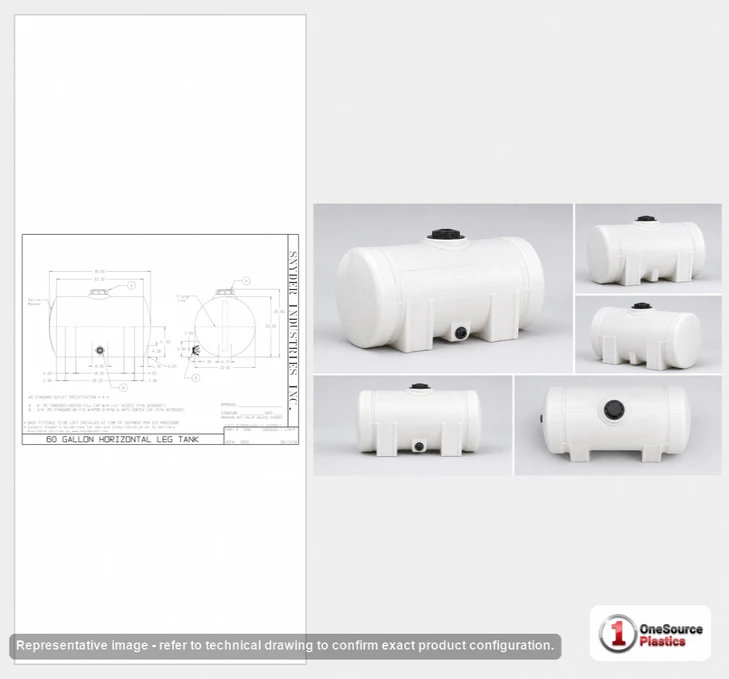
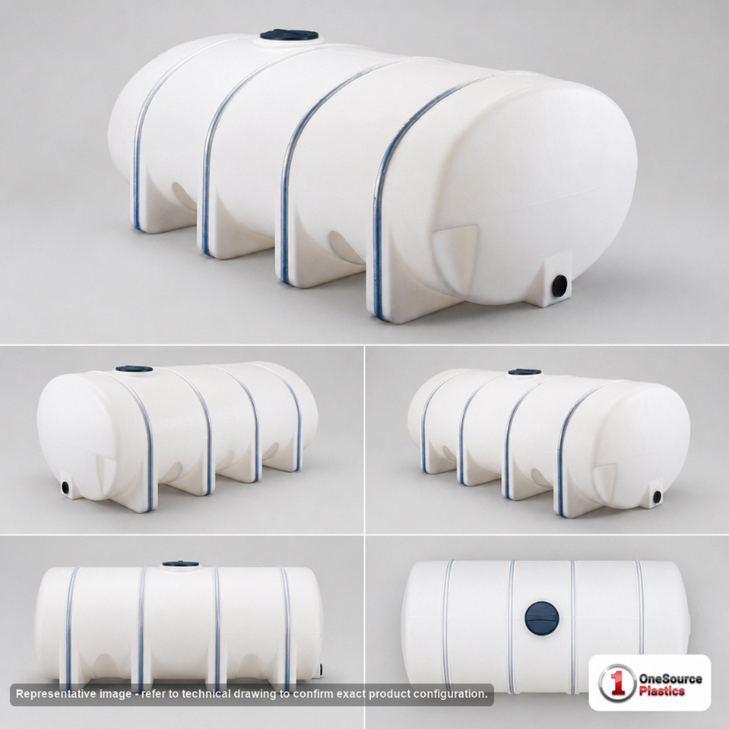
The Snyder SII-1060000N45 is the small one: a 60 gallon white polyethylene horizontal leg tank 39 inches long, 23 inches wide and 26 inches tall, listed at 23 pounds empty with a ship weight of 25 pounds. It is the only tank in this group whose freight class field reads UPS rather than LTL, under NMFC 156600, and it is the only one whose ship weight is listed above its empty weight. Both figures are printed as the sheet gives them. The wall is rated at a specific gravity of 1.9, so 60 gallons of water at 8.34 pounds per gallon is 500 pounds and max contents is 951 pounds. Fittings are listed as a 0.75 inch outlet and a 6 inch lid, and the service limit is 120 F / 48 C. The sheet publishes no warranty term and no leg or road rating.
Need it before the next delivery? Call 866-418-1777 for the ship date, or get freight to your ZIP and add it to your cart above now.
The spot tank a crew throws on a pickup bed
This is a tool, not an installation. The buyer is a crew that needs a little liquid where the job is: a spray crew with a spot-treatment tank behind the cab, a fence or line crew carrying water for a mixer and a wash-up, a groundskeeper with a hand-wand tank on a utility vehicle, a mechanic with a coolant or wash tank on a service truck, a smallholder moving stock water to a paddock, a contractor keeping 60 gallons of clean water on site for dust and hands. At 39 inches long and 23 inches wide it fits behind the cab of a half ton, across the bed of a utility vehicle, on a quad trailer or on a pallet in the corner of a shop, and at 23 pounds one person carries it empty. That last number is the reason people buy this size and it is also the reason they get hurt with it: 60 gallons of water is 500 pounds and the sheet's own rating gives 951 pounds of max contents, so the tank that one person lifts empty cannot be lifted, slid or nudged by anyone once it is full. Fill it where it is going to sit. The legs bear along their full length on a flat, continuous surface, so a bed floor, a board or a pallet, not across a pair of rails with a gap in the middle and not wedged on top of a toolbox lid. Strap it at both ends and against a bulkhead, because a small tank slides where a big one only leans. Check whether 60 gallons is really the number in the tank sizing calculator, since a spot tank that runs dry halfway through a job costs more than the next size up, and take the freeboard from the tank sizing guide. Where the load is a blended product rather than water, the fertilizer-blend tank stratification article is worth a read even at this size, because a small shallow body layers as readily as a big one and there is less liquid to average it out.
30, 60 and 65 gallons in three shapes
| Part | Gallons | Length x width x height | Empty weight |
|---|---|---|---|
| SII-1060000N45 (this tank) | 60 | 39 x 23 x 26 in | 23 lb |
| SII-1080000N45 (smaller, half the length) | 30 | 20 x 23 x 26 in | 12 lb |
| SII-1031500N45 (larger, wide and low) | 65 | 44 x 32 x 20 in | 38 lb |
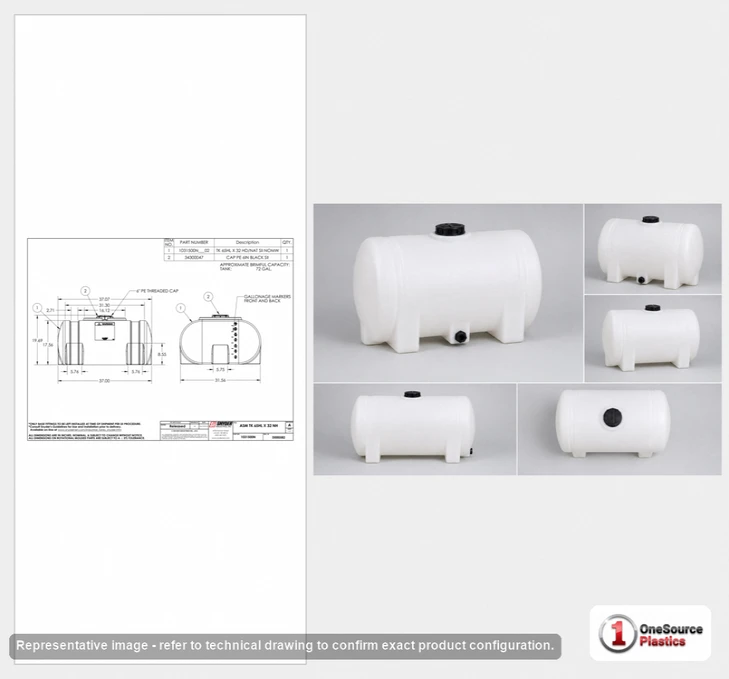
Three small tanks, three different reasons. SII-1080000N45 is this tank's own cross-section cut short: the same 23 inch width and 26 inch height in a 20 inch length at 12 pounds, holding 30 gallons, which is the one for a quad trailer, a narrow bed slot or a tank that has to be carried full-handed by one person a short way. SII-1031500N45 goes the other direction and changes shape while it does it: 65 gallons in a 44 by 32 inch plan only 20 inches tall and listed at 38 pounds, which is the flattest of the three and the one to buy when the tank has to live under a tonneau, a lid or a low rack. This tank is the middle and, for most crews, the right one: 60 gallons in a 23 inch width that still leaves bed space beside it, at a height that keeps the 6 inch lid clear of a rack, and at 23 pounds. Three plants are listed for it, so it usually ships a short lane, and its freight class field reads UPS where the bigger leg tanks read LTL.
Need a different size? Every tank in the table is in stock programs; ask for a quote on the one that fits, or call 866-418-1777.
Three quarters of an inch out of the low end
- The pump and drain path: the sheet lists a 0.75 inch outlet, which is a hose and a small pump rather than a transfer line, and that is the right size for the duty. Mount a small twelve volt or engine-driven pump below the outlet with the shortest possible hose falling into the suction, and it will prime and stay primed on a 26 inch body. Anything mounted above the outlet on a tank this shallow will lose prime before the tank is empty.
- Prime and protection: a self priming pump or a foot valve, a small cleanable strainer, and a habit rather than a switch: on a 60 gallon tank the operator is the low level cut-out, so run the pump where the level can be seen. Never dry-run a diaphragm pump to find the bottom of the tank.
- Gravity draw: at 26 inches tall the outlet still sits above a bucket, a knapsack or a wash tray, so a shutoff at the fitting and a short hose makes this a gravity dispenser without the pump, which is most of what a spot tank does all day.
- Filling: a 6 inch lid on top, easily reached. Fill it through the lid with the hose end inside the rim, keep the vent path clear, and close it before the vehicle moves, because at this size a loose lid empties a good part of the load on the first corner.
- Service limit: 120 F / 48 C, and that is the only limit published on this sheet.
Small tanks take more abuse than large ones because they get moved. Put a flexible connector or a short length of hose at the first joint off the outlet rather than a rigid elbow, keep the valve where a boot cannot catch it, and if the pump is mounted on the same board as the tank, mount it so the whole assembly comes off as one piece. Name the liquid when you order and the outlet fitting and gasket are matched to it. Rinse and drain through the outlet at the end of a job, not at the start of the next one.
Spot spraying, wash-up water and service trucks
Sixty gallons rides out for spot treatment and hand-wand spraying, wash and rinse water on service and utility trucks, water for a small mixer on a fencing or concrete crew, stock water carried to a paddock, greenhouse and nursery hand watering, and clean water for hands and tools on a job site. The road question on a farm vehicle does not get smaller with the tank, so read what the exemption covers and what it does not in the 49 CFR 173.5 agricultural exemption article, and where the choice is still between a leg tank, a loaf and an applicator body for a small vehicle, the applicator and leg tank guide puts the shapes against the duties.
Resin compatibility, line by line
Below are the liquids this resin is rated for, the concentration each rating holds to, and the fitting and gasket to specify. Check the exact concentration and temperature you run against the chemical page or the chemical compatibility database before ordering.
- DEF at 32.5%
- Peracetic Acid
- Propylene Glycol and
- Zinc Orthophosphate call for 316 stainless
- Sulfuric Acid at 98% needs CPVC; and the Viton-gasket group includes hydrochloric, hydrofluoric, hydrofluosilicic, hydrogen peroxide, phosphoric acid.
- Acetic Acid (60%, PP/PVC fittings, EPDM gasket)
- Aluminum Sulfate (50%, PVC, EPDM)
- Calcium Chloride (40%, PVC, EPDM)
- Ethylene Glycol (100%, PVC, EPDM)
- Ferric Chloride (50%, PVC, EPDM)
- Ferric Sulfate (60%, PVC, EPDM)
- Ferrous Sulfate (20%, PVC, EPDM)
- Hydrochloric Acid (37%, PVC, Viton)
- Hydrofluoric Acid (48%, PP/PVC, Viton)
- Hydrofluosilicic Acid (26%, PP/PVC, Viton)
- Hydrogen Peroxide (50%, PVC, Viton)
- Magnesium Chloride (30%, PVC, EPDM)
- Phosphoric Acid (85%, PVC, Viton)
- Polyaluminum Chloride (PVC, EPDM)
- Potassium Carbonate (50%, PVC, EPDM)
- Potassium Hydroxide (saturated, PVC, EPDM)
- Sodium Bisulfate (PVC/PP, EPDM)
- Sodium Bisulfite (PVC/PP, EPDM)
- Sodium Carbonate (30%, PVC, EPDM)
- Sodium Hypochlorite (
- Sodium Thiosulfate (40%, PVC, EPDM)
- Urea Solution (50%, PP/PVC, EPDM)
Parcel class, three plants, 25 pounds on the scale
Three plants are listed for this part, Chowchilla, California, Lincoln, Nebraska and Philippi, West Virginia, which is the widest plant coverage in this batch and usually the shortest lane. The freight class field reads UPS under NMFC 156600, and the sheet gives an empty weight of 23 pounds with a ship weight of 25 pounds, shipping at 39 by 23 by 26 inches; both weights are printed as the sheet lists them. The freight cost estimator prices the delivery to your ZIP, and the listed price is before freight. It arrives as a package one person can carry, which is the whole point of this size, so check it for scuffs and a sound lid before it goes in the truck. Fill it with clean water on the ground first, watch the 0.75 inch fitting and the 6 inch lid seal for a few minutes, tip it out, and then load it. Write the date on the tank and keep it in daylight when it is not working, because the small tanks are the ones that disappear behind a shed and come back full of something nobody can name. Keep the first delivery's paperwork with the tank; strength and date on day one is the baseline for every batch after.
Freight and documents
Ships from: Chowchilla, CA; Lincoln, NE; Philippi, WV. LTL freight is quoted to your ZIP with the freight cost estimator or by phone at 866-418-1777. The listed price is before freight.
Technical drawing (PDF) for Snyder Industries 1060000N45.
See this tank
Interactive 3D model with live fill. This tank has an interactive 3D model built to its manufacturer dimensions. Rotate it, and set a fill level to see how much liquid it holds at any height. Open the 3D view on the product photo above. Download the 3D model (GLB).
Product video. Watch the Snyder Industries 60 Gallon Plastic Horizontal Leg Tank video (65 seconds) with dimensions, fittings and shipping notes.
Ready to order?
Add it to your cart at the top of this page, get LTL freight to your ZIP, request a written quote, or call 866-418-1777. The listed price is before freight.