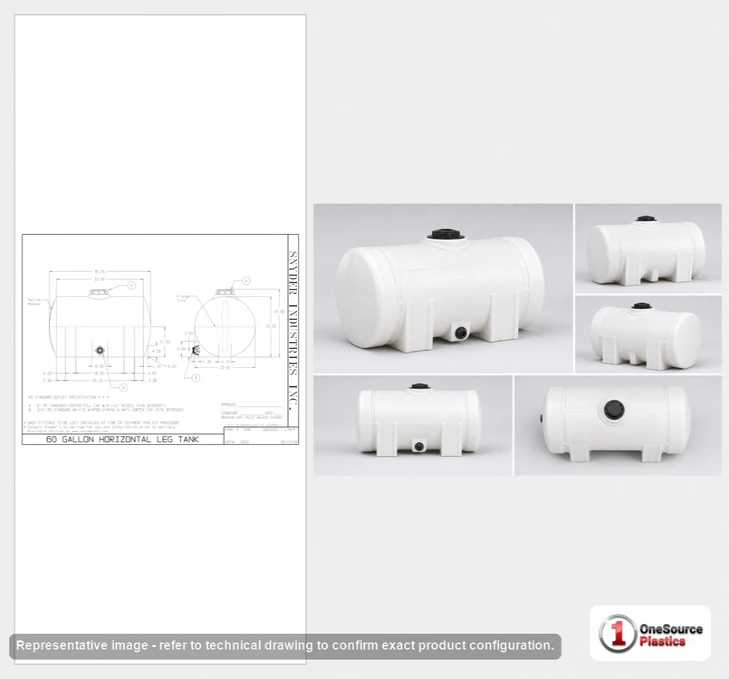
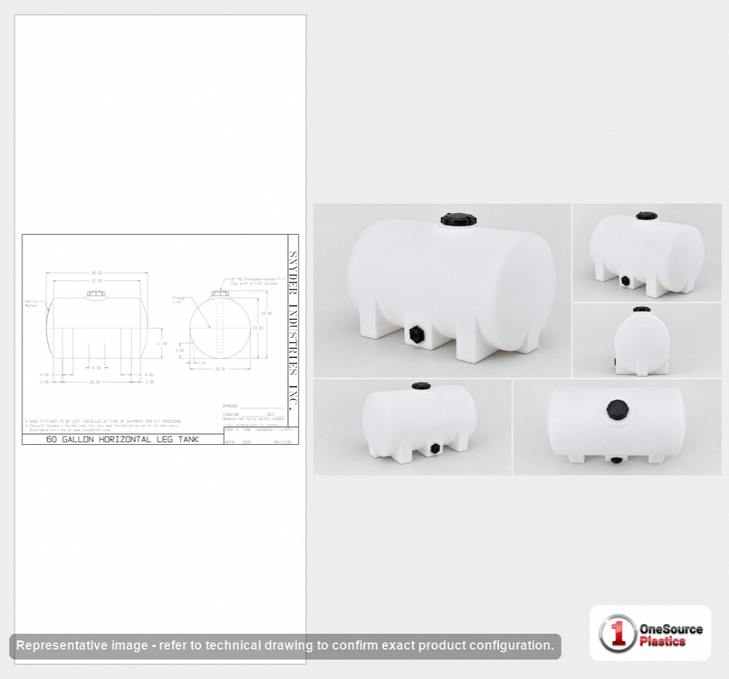
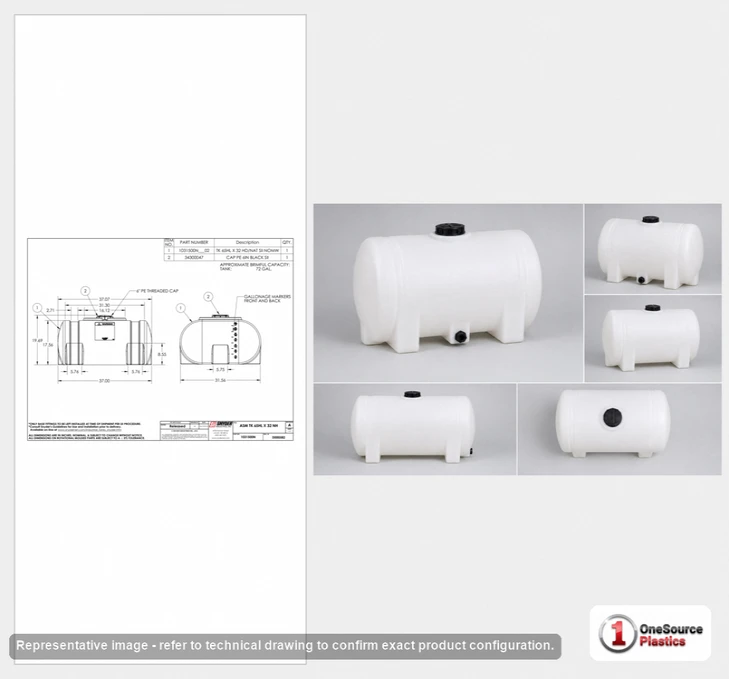
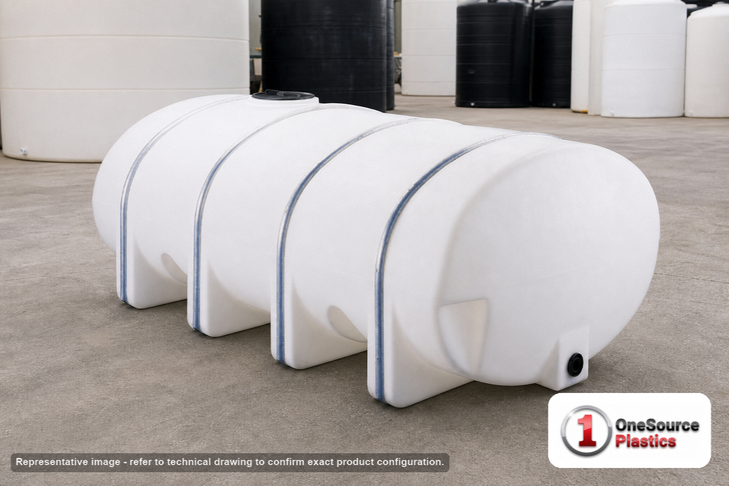
Sixty-five gallons in a 20 inch tall shell, 38 pounds empty
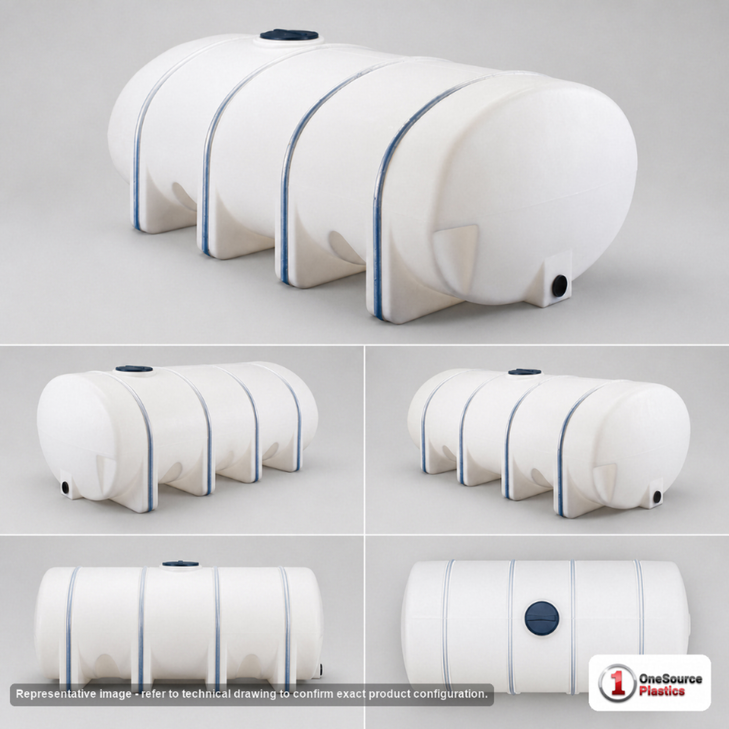
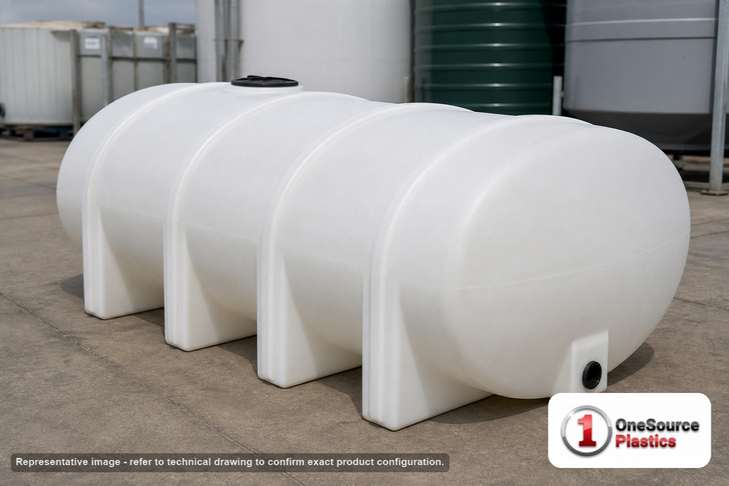
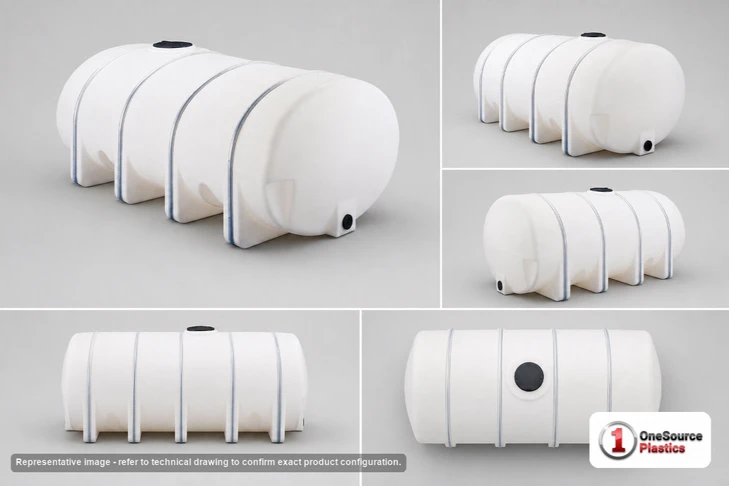
The Snyder SII-1031500N45 is a 65 gallon horizontal leg tank in white polyethylene, 44 inches long, 32 inches wide and 20 inches tall, weighing 38 pounds empty. Twenty inches is the number that sells it. That is low enough to ride in a pickup bed under a closed tailgate, low enough to sit on a shelf or a bench without the fill point going over somebody's head, and low enough that a full one can be reached into rather than climbed. The sheet rates the wall at a specific gravity of 1.9, which gives 542 pounds for 65 gallons of water at 8.34 pounds per gallon and 1,030 pounds of maximum contents. Fittings as listed: a 0.75 inch outlet and a 6 inch lid. This sheet publishes no maximum operating temperature and no warranty term, so this page states neither.
Two ways to buy. Add it to your cart above with freight quoted to your ZIP, or request a written quote for a job that needs paperwork.
The bed floor, the shelf and the skid a 20 inch tank fits
Start with the surface. A horizontal leg tank bears along the full length of its legs, so what it needs under it is flat, continuous and level: a bed floor, a plywood-topped skid, a steel deck, a shelf built as a single plane, a poured pad. What it must not have is a gap under the middle, one leg hanging past an edge, one leg propped up with a block to level the shell, or a bolt driven through a leg to hold it down. At 32 inches wide it will sit between the wheel wells of a full size pickup bed, and 44 inches of length leaves room for a pump, a hose reel and a toolbox beside it. On a bench or a mezzanine, 20 inches of height is what lets the tank live under a shelf rather than instead of one. Strap over the body at both ends, against a bulkhead or a headboard where there is one, and remember what the straps are actually holding: 542 pounds of water, and 1,030 pounds at the rating on this sheet, all of it moving whenever the vehicle turns or stops. Because the shell is wide and low, the liquid inside has a lot of surface and very little depth, so it sloshes early and settles slowly. Fill it and drive it once before you trust the mounting. The other half of the decision is whether 65 gallons is the right number at all. Run your real draw, your refill interval and the distance to the refill point through the tank sizing calculator before you order, and take the freeboard a warming liquid needs from the tank sizing guide. A tank that gets refilled twice a shift is the wrong tank no matter how well it fits the bed, and a tank that never empties is money sitting on the deck.
Where the 65 sits between the 60 and the 125
| Part | Gallons | Length x width x height | Empty weight |
|---|---|---|---|
| SII-1031500N45 (this tank, lowest profile) | 65 | 44 x 32 x 20 in | 38 lb |
| SII-1060000N45 (smaller, narrowest, lightest) | 60 | 39 x 23 x 26 in | 23 lb |
| SII-1003600N45 (larger, same footprint, taller) | 125 | 44 x 32 x 35 in | 55 lb |
These three tanks divide on shape, not on volume, and the reason to buy this one is the 20 inch height. Against SII-1060000N45 the trade is plain: that tank holds 60 gallons in a 39 by 23 inch plan at 26 inches tall and 23 pounds, so it is narrower, shorter and lighter, the one to take when the space is a gap between two fixed things and the tank has to be carried by one person. This tank gives you five more gallons, a wider and longer footprint, and six inches less height, which is the whole argument when the limit is a lid, a tonneau, a shelf or a headroom line. Against SII-1003600N45 the footprint is identical at 44 by 32 inches and the difference is vertical: that tank is 35 inches tall for 125 gallons at 55 pounds, so it nearly doubles the volume on exactly the same floor area by going up. If the rack or the bed is already built to 44 by 32 inches and the ceiling allows it, the 125 is the better value per square inch of deck. If the ceiling is the constraint, this 65 is the only one of the three that fits it, and no amount of arguing changes that. The honest summary: buy SII-1060000N45 for the narrow slot, this one for the low slot, and SII-1003600N45 when the height is free.
Torn between two rows? Call 866-418-1777 with the liquid and the ceiling height, or ask for a quote on both and compare the freight.
A 0.75 inch outlet, and the valve that belongs on it
- The outlet: the sheet lists 0.75 inches, at the low end of the shell. That is a drain and a small transfer port, not a dump port. Put a full-flow shutoff valve directly at the fitting, carry the valve on its own bracket off the deck or the bench rather than hanging it on the tank, and break the first joint with a flexible connector so road shock and pump start never land on the tank wall.
- Gravity from 20 inches: the whole standing height of this tank is 20 inches, so gravity gives you very little head. It will fill a bucket, a backpack sprayer or a mix jug from a shelf; it will not push a hose across a yard. Where the liquid has to move, a pump does it.
- The pump path: mount the pump below the outlet, run the hose falling toward it and keep the run short, so the pump stays flooded to the last of the load. A self priming pump or a foot valve is the right answer on a shell this shallow, because the surface drops out from under a suction line quickly when 65 gallons is spread across a 44 by 32 inch floor. Add a run-dry stop and a strainer that can be cleaned without breaking the line.
- Filling and access: a 6 inch lid, which is a hose fill rather than a bucket fill, and a narrow window for washing out. Plan the fill line and the cleaning routine around the opening the sheet gives. Put the hose end below the rim when filling so the liquid does not fall in and foam.
- Venting: keep the lid's vent path clear at all times. A sealed lid with a pump drawing on the outlet is how a polyethylene wall gets pulled inward, and it happens faster on a thin, wide shell than on a tall one.
- Limits: this sheet publishes no maximum operating temperature and no warranty term, and no inlet fitting is listed either. We print what the sheet gives and nothing more.
Tell us the liquid when you order. The outlet fitting, the gasket and the bolting are matched to the chemistry rather than left generic, and on a 0.75 inch port there is no room for a second guess. Where a regulated product is going to live on a vehicle or in a shop, the Snyder Captor SPCC walkthrough works through what a second wall does and what it costs in usable volume, which is the conversation worth having before the first delivery rather than after the first spill.
Small transfers, spot work and yard water
Sixty-five gallons on a low shell goes out for spot spraying and fence line work on farms and ranches, nurse and rinse water behind a sprayer, wash water on an equipment yard, dust control on a small job site, and transfer or decant duty in a shop under a drum. It is also a common carrier for diesel exhaust fluid on a service truck, where the low fill height and the small lid matter more than the gallons. Check the liquid against the wall before you buy, not after: our chemical compatibility database carries the polyethylene position chemical by chemical, including sodium hypochlorite, sulfuric acid, hydrochloric acid and diesel exhaust fluid, and the fitting and gasket answer changes with all four. Where the load is a blended fertilizer that has to go out on spec, read the fertilizer blend stratification article first, because a wide, shallow body layers differently from an upright one and the spreader is where that shows up. For the wider family of applicator and leg tanks, the applicator and leg tank guide compares the shapes against the duty, and before a loaded tank goes on the road behind a farm vehicle the 49 CFR 173.5 agricultural exemption article sets out the scope honestly instead of promising it covers your trip.
Marked Tree to your door on the sheet's UPS class
This tank is molded at Marked Tree, Arkansas. The sheet gives the freight class as UPS, which is a mode rather than a numeric class, and the NMFC code as 156600; it shipments at 44 by 32 by 20 inches at 38 pounds. Price the lane to your ZIP with the freight cost estimator, and note that the listed price is before freight. Thirty-eight pounds is a one-person lift for anyone who lifts for a living and a two-person lift for everyone else, and it should be lifted by the body, never by the lid and never by the outlet fitting. Get it onto the bed, the bench or the skid it will live on before anything is plumbed to it, then fill it with clean water on level ground, look along the legs for full contact and at the 0.75 inch outlet and the 6 inch lid for weeping, and drain it before the working liquid goes in. Keep the carton until that first fill is done. Mark the tank with the liquid it holds on the day it goes into service; a small white tank with no label is the one that gets the wrong product poured into it. The first fill is the only cheap time to find a problem, so do it in daylight with someone watching the base.
Freight and documents
Ships from: Marked Tree, AR. LTL freight is quoted to your ZIP with the freight cost estimator or by phone at 866-418-1777. The listed price is before freight.
Technical drawing (PDF) for Snyder Industries 1031500N45.
See this tank
Interactive 3D model with live fill. This tank has an interactive 3D model built to its manufacturer dimensions. Rotate it, and set a fill level to see how much liquid it holds at any height. Open the 3D view on the product photo above. Download the 3D model (GLB).
Product video. Watch the Snyder Industries 65 Gallon Plastic Horizontal Leg Tank video (65 seconds) with dimensions, fittings and shipping notes.
Ready to order?
Add it to your cart at the top of this page, get LTL freight to your ZIP, request a written quote, or call 866-418-1777. The listed price is before freight.