The 1.9 rated 4,500: the same 102 by 142 shell, 1,300 pounds of wall
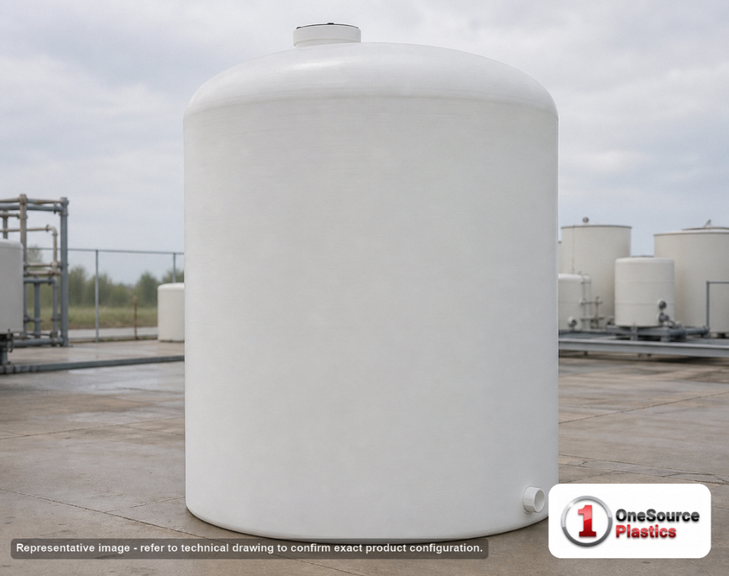
Same silhouette, heavier wall. The Snyder SII-7420000N45 holds 4,500 gallons in a white polyethylene shell 102 inches across and 142 inches tall, and the sheet lists it at 1,300 pounds empty. It is rated at a specific gravity of 1.9 and gives the maximum contents as 71,307 pounds, where the same 4,500 gallons of water would weigh 37,530 pounds at 8.34 pounds per gallon. ASTM appears among the designations in its certifications field and in its own product name. The only fitting the sheet names is an 18 inch threaded vented manway: no outlet size and no inlet are published, so the connections are specified at order. Freight is class 400 as an oversize load, with two plants named, Chowchilla, California and Lincoln, Nebraska. This sheet gives no temperature limit and no warranty term, so this page asserts neither; ask us and we will get Snyder's current terms in writing.
Have the liquid and the ZIP? That is all 866-418-1777 needs to confirm the fit; or price freight to your ZIP and add it to your cart above.
A 102 inch pad under 71,307 pounds, with no service limit published
Everything about siting this tank follows from one number: 71,307 pounds of contents standing on a circle 102 inches across, eight feet six inches, carried into the ground through a rotationally molded floor that bears on the whole surface it touches and on nothing it does not. That is the highest load per square foot in this family, and it makes the slab a piece of engineering rather than a piece of groundwork: designed for the weight, level, continuous, in full contact, and carried out past the wall instead of stopped at it, to the framework in the concrete pad sizing guide. Where the liquid is regulated, the containment is designed with the pad and sized to the tank rather than to the budget. Above ground the shell stands 142 inches, eleven feet ten inches, and at 1,300 pounds empty it is a sail until it is full, so cables or bands go to structure or to anchors set with the pad before the first fill and get retensioned after the first summer in the sun. The second thing the site has to answer is what this sheet does not say. There is no maximum operating temperature on it and no warranty term, so nothing on this page asserts either, and a service that runs warm, whether that is a hot fill, a process return or a dark yard in July, is a question to settle with us in writing before the order rather than an assumption to discover afterwards. Third, size the working volume rather than the nominal one. A wall rated 1.9 exists for liquids well heavier than water, so the arithmetic that matters is the density, the headspace the liquid needs as it warms and therefore the usable fraction of 4,500 gallons, which is what the tank sizing calculator and the tank sizing guide are built to work out.
The heavy wall in this shell, against the lighter grades around it
| Part | Gallons | Diameter x height | Empty weight |
|---|---|---|---|
| SII-7420000N45 (this tank, white, rated 1.9) | 4,500 | 102 x 142 in | 1,300 lb |
| the lighter white wall in this same shell | 4,500 | 102 x 142 in | 900 lb |
| 7000400N29 (wide and low, rated 1.35 in its name) | 4,500 | 143 x 91 in | 900 lb |
| 7000400N32 (black, wide and low) | 4,500 | 143 x 91 in | 900 lb |
| 7000400N33 (black, wide and low) | 4,500 | 143 x 91 in | 900 lb |
| 5210000N40 (smaller, narrowest, tallest) | 4,400 | 90 x 182 in | 1,100 lb |
| 7000500N40 (larger, wide, cross-link) | 4,600 | 120 x 116 in | 1,450 lb |
Weight is the argument on this page. Every other 4,500 gallon tank in the group is listed at 900 lb and this one is listed at 1,300 lb in an identical 102 by 142 inch shell, and that difference is the product: a wall rated 1.9 on its own sheet, for a liquid dense enough that the lighter grades are not the right vessel. Nothing else about the silhouette changes, which is what makes the comparison easy. The lighter tank in this same shell publishes a service limit and a warranty term on its own sheet where this one publishes neither, so the two are a genuine trade rather than a simple upgrade, and this page asserts none of that tank's figures. The three 7000400 grades take the same volume onto a 143 inch base only 91 in tall, which is the buy when height is capped and floor is free; two are black walls for a light-sensitive liquid and one carries a 1.35 rating in its own name. At the far end of the slim argument, 5210000N40 puts 4,400 gallons on a 90 inch base at 182 in and 1,100 lb, fifteen feet of tank on the tightest footprint here, and 7000500N40 holds 4,600 gallons in cross-linked polyethylene at 120 by 116 in and 1,450 lb. Read across the group by what the liquid weighs, not by what the tank looks like.
Found the 4500 gallon tank in the table? Freight to your ZIP is one click; add it to your cart above, or call 866-418-1777 to check the grade.
The manway is the only fitting this sheet names
- Outlet: none published. This sheet gives no outlet size, no material and no fitting style, so this page prints none and infers nothing from the tanks beside it. Tell us the liquid, its density, the flow you need and how the tank is being plumbed, and we will confirm the outlet and the gasket against Snyder's current specification in writing before the order.
- Inlet: none published either, which makes the fill point a design decision. On a shell eleven feet ten inches tall, that means a fill connection at working level or a drop pipe taken down inside the tank, rather than a hose lifted to the crown.
- What the base connection will have to take: 142 inches of liquid at a rating of 1.9 puts nearly twice the pressure at the base that the same height of water would, so every valve, gasket, union and length of pipe is rated for the liquid and not for the tank, and the first valve stands on its own support off the pad rather than hanging from the wall.
- Pump: set below the base connection on its own foundation with a short falling suction run. Size it for the density and the viscosity of the real liquid, fit a strainer that can be cleaned without breaking the line, and give it a run-dry cut-out that stops it with liquid still standing over the fitting.
- Access: an 18 inch threaded vented manway on the crown, the one fitting the sheet does name. Fixed access with a rail, the vent clear at all times, and nothing drawing on the tank against a closed vent. Log the date every time the lid is opened, because on a dense-liquid tank the inside is the part nobody sees.
The advantage of a sheet that publishes only the manway is that nothing is inherited by accident: the outlet, the fill, the vent path and the level instrument all get placed where the operator needs them rather than where a previous order happened to put them. Use that. Decide the monitoring at the same time as the fittings, put the level reading at ground level where somebody will actually look at it, and write the specified fitting sizes onto the site drawing the week the tank is ordered, because in five years the drawing will be the only record of what was agreed.
Heavy solutions, brines and the duty that buys the extra wall
Nobody buys 1,300 pounds of wall for water. This tank is for the liquids that are genuinely heavy: concentrated solutions and brines, dense chemical and additive storage at a plant, liquid fertiliser and crop inputs at a dealer, heavy process liquors, and slurries and wastewater streams that carry solids. On all of them the wall at the vapour-saturated headspace is where trouble starts rather than the wall in contact with the liquid, liquid-side inspection routinely misses it, and the sizing logic behind it is worked through in the HDPE wall thickness and ASTM D1998 sizing article. Read it before the tank is commissioned rather than after the first inspection. Where a vessel of this size is instead holding water against a fire risk on a remote site, the honest account of what makes stored gallons into a usable reserve, draw rate, connection, freeze protection, is in the fire-water reservoir design guide.
Class 400 out of California or Nebraska, 1,300 pounds empty
This sheet names Chowchilla, California and Lincoln, Nebraska, and which plant an order ships from is confirmed at the time of the order rather than assumed here; on an oversize load the lane usually matters more than the class does. Freight is class 400 as the sheet lists it, crated at 102 inches by 102 inches by 142 inches. Plan the lift before the freight: 1,300 pounds of empty tank is a machine job, with slings under the body and never a hook through the manway, and eight feet six inches of width makes it a permitted load that needs a route, a gate and somewhere for the truck to stand. The freight cost estimator prices the lane to your ZIP, and the listed price is before freight. Stand it on the cured slab, band or cable it before the machine leaves, then fill it with clean water and hold it while you read the base, the pad edge and the manway seat, since plain water is the only cheap test a tank destined for a heavy liquid will ever get. Keep the delivery paperwork and the agreed fitting schedule in the same file, because on this sheet the fittings are the part that was negotiated rather than printed. Check the strap tension a week after the first fill; a tank settles a little, and the strap that was tight is loose.
Freight and documents
Ships from: Chowchilla, CA; Lincoln, NE. LTL freight is quoted to your ZIP with the freight cost estimator or by phone at 866-418-1777. The listed price is before freight.
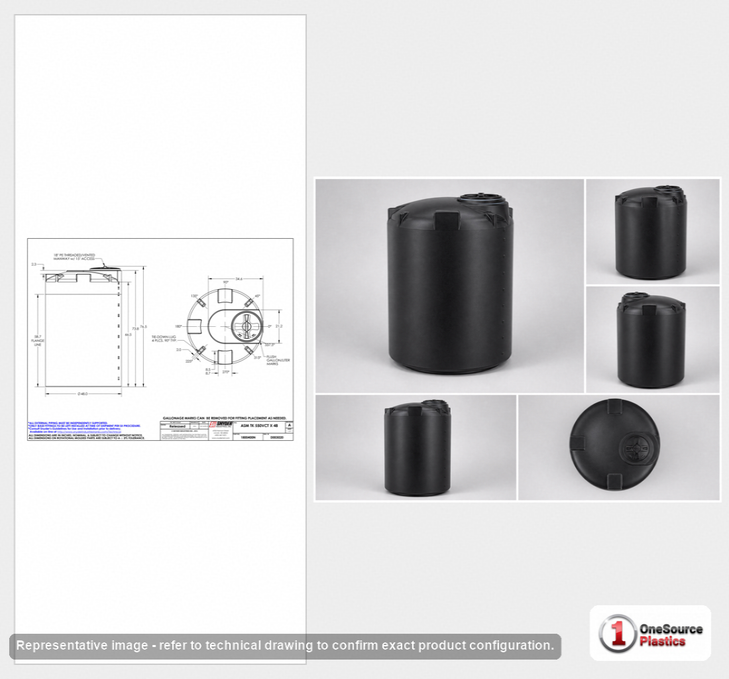
Technical drawing (PDF) for Snyder Industries SII-7420000N45.
See this tank
Interactive 3D model with live fill. This tank has an interactive 3D model built to its manufacturer dimensions. Rotate it, and set a fill level to see how much liquid it holds at any height. Open the 3D view on the product photo above. Download the 3D model (GLB).
Ready to order?
Add it to your cart at the top of this page, get LTL freight to your ZIP, request a written quote, or call 866-418-1777. The listed price is before freight.