


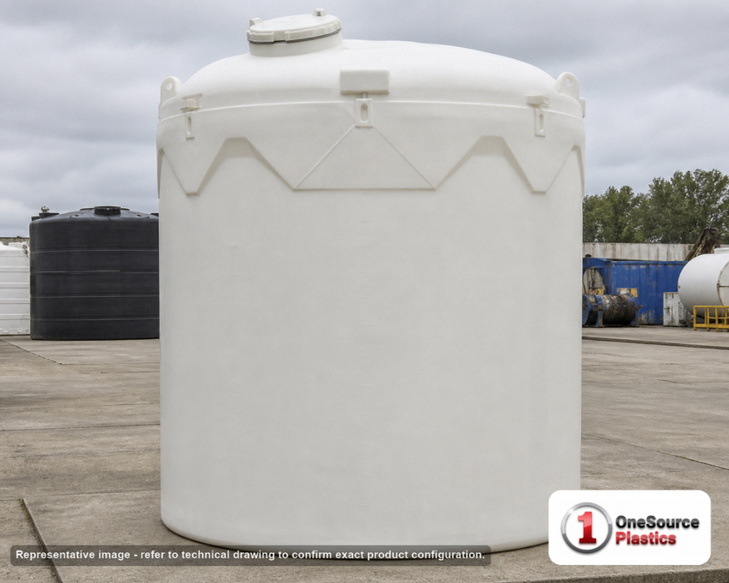
Fifty five hundred gallons in a double wall shell, 120 inches across
The Snyder SII-5660000N52 is a 5500 gallon double wall tank in high density linear polyethylene, listed 120 inches across and 172 inches tall at 3,800 pounds empty. Its name ends with the words sodium hypo and opaque; those are Snyder's own words for the part and this page repeats them without adding a concentration, a temperature or any other claim the sheet does not publish. The colour field reads white while the name says opaque, and both are printed as given. The sheet rates the wall at a specific gravity of 1.9 and gives 45,870 pounds for 5500 gallons of water at 8.34 pounds per gallon with 87,153 pounds of max contents. The only opening published is an 18 inch threaded vented manway, with the lid size field reading 18 inches; there is no outlet and no inlet on this sheet, and none is claimed. There is also no maximum operating temperature and no warranty term, so this page states neither. The sheet carries one capacity, one envelope and one weight for this part, and this page prints those and no others. Freight is class 300 with an oversize ship mode, from one plant.
Want it on the pad this month? Check freight to your ZIP, add it to your cart above, and 866-418-1777 will confirm the ship date.
One plant in Nebraska and an oversize lane for a ten foot circle
The freight on this vessel is not an afterthought to the purchase, it is part of the purchase, and it starts with the fact that the sheet lists exactly one plant: Lincoln, Nebraska, with Nebraska named as the shipping state. One moulding point means there is no nearest option to choose between, so the lane runs from the plains to wherever you are, and it runs as an oversize movement rather than as ordinary freight. Ten feet across and better than fourteen feet tall is wider than a trailer deck is meant to carry and taller than most things that travel on one. That makes the route a scheduled item: the road, the permits, the delivery window, the place the truck can actually stop, and the machine that lifts it off, all agreed before the tank leaves the plant rather than discovered on the morning it arrives. A site that has not worked out how a fourteen foot vessel comes off a trailer is a site that pays for a second visit, and on a load this size a refused delivery is charged in both directions. Plan the last hundred yards as carefully as the thousand miles. What is waiting at the end of that lane matters just as much. Empty this tank is 3,800 pounds; the sheet gives 45,870 pounds full of water and 87,153 pounds at the rating, and all of that stands on a circle 120 inches across. A rotationally moulded floor bears on the whole surface it touches and on nothing else, which means a low corner, a hollow under the middle or a soft patch at one edge does not get shared out, it becomes the new bearing point. Engineer the slab or the compacted base rather than pouring one to suit the drawing: the framework for that, and where its boundary lies, is set out in the concrete pad sizing guide for above-ground polyethylene tanks. Pour it level, in full contact and wider than the tank, and give the overflow somewhere to go that is not the edge of the base. The last planning question is the one people leave until the tank is standing, which is how much of the volume is actually usable once the product warms, the vessel is double walled and a working freeboard has been kept. That is arithmetic rather than a rule of thumb, and the double wall freeboard sizing guide works it through properly. Cross-check the volume against your real turnover in the tank sizing calculator and take the working reserve from the tank sizing guide before the base is poured, because on a vessel this size the expensive mistake is the one you correct with concrete.
Four fifty five hundreds at two weights, a taller five thousand and a wider sixty five hundred
| Part | Gallons | Plan x height | Empty weight |
|---|---|---|---|
| SII-5660000N52 (this tank, high density linear, rated one point nine) | 5500 | 120 x 120 x 172 in | 3,800 lb |
| 5660000N42 (crosslinked, same envelope, same weight) | 5500 | 120 x 120 x 172 in | 3,800 lb |
| 5660000N40 (crosslinked, same envelope, lighter listing) | 5500 | 120 x 120 x 172 in | 3,200 lb |
| 5660000N46 (crosslinked, black, lighter listing) | 5500 | 120 x 120 x 172 in | 3,200 lb |
| 5630000N40 (narrower and much taller) | 5000 | 102 x 102 x 216 in | 3,600 lb |
| 5670000N30 (same plan, taller, heaviest) | 6500 | 120 x 120 x 199 in | 5,300 lb |
Four listings on this sheet hold 5500 gallons inside the identical 120 by 172 inch envelope, at two different weights: 3,800 pounds for this tank and 5660000N42, and 3,200 pounds for 5660000N40 and 5660000N46. The sheet gives those weights and explains nothing about them, so we print what it says and offer no theory. What this page can say about its own listing is the part that is published: this shell is high density linear polyethylene, the colour field reads white against a name ending in opaque, and the wall is rated at a specific gravity of 1.9. If your product is heavier than water, start from the rating and let it narrow the part number before anything else does. The last two rows are the genuine alternatives rather than variants. 5630000N40 holds 5000 gallons on a 102 inch plan standing 216 inches, which trades eighteen inches of base for nearly four more feet of height: the buy when floor is the constraint and the building is tall. 5670000N30 holds 6500 gallons on this tank's own 120 inch plan at 199 inches and 5,300 pounds, which is the step up in volume without a step up in footprint, and which asks for the extra height and the extra weight instead. Footprint against height is the only question in this family that is genuinely yours to answer; the rating and the envelope answer the rest.
Which wall for your chemical? Call 866-418-1777 with the name and the concentration, or send a quote request and we will pick the row.
An eighteen inch vented manway, and no outlet on the sheet
- The opening: an 18 inch threaded vented manway on top, with the lid size field reading 18 inches. That is the only opening this sheet publishes, and at 172 inches of height it is a platform, a fixed ladder and a fall protection arrangement rather than a step. Plan how a person reaches it at the same time as you plan the base, not afterwards.
- The vent: the manway is listed as vented, and on a vessel this tall the vent path is what protects the wall while a pump is drawing the column down. Keep it clear, inspect it on a schedule, and never restrict it to control an odour; there are better ways to do that and none of them involve the vent.
- The fill: with the manway as the only published opening, how the product goes in is confirmed rather than assumed. Tell us how deliveries arrive and at what rate and we will confirm what this part number carries before it is ordered.
- The outlet: this sheet publishes no outlet and no inlet, so no size, no position, no thread and no valve is stated here. We will not print a fitting the maker does not list.
- Level: no sight gauge, no float and no graduation appears on the sheet. On a vessel where the contents are measured against a delivery schedule, knowing what is left is worth more than knowing what went in, and the arrangement is specified rather than assumed.
- Limits: the specific gravity rating is 1.9. This sheet publishes no maximum operating temperature and no warranty term at all, so this page states neither; ask us and we will get Snyder's current figures in writing.
Name the product, its strength and the temperature it truly sits at when you enquire. The name on this tank tells you what Snyder built it around and it tells you nothing about your own duty, and the difference between those two is where a wrong gasket comes from.
Bulk chemical storage where the ground underneath is the real question
A double wall vessel at this volume is bought where a release would be somebody's very bad week: municipal water and wastewater treatment plants dosing from bulk, industrial cooling and process water treatment, pulp and paper and textile bleaching operations, food and beverage sanitation systems, pool and recreational water plant, and any site holding a reactive product indoors, over a drain, near a watercourse or on ground that would have to be recovered. What those duties share is that the containment question comes before the storage question. A single wall tank on a bare slab makes the ground the last line of defence; a contained arrangement moves that line inside the installation. What this page will not do is describe the construction of that arrangement, put a percentage on it or cite a rule at you, because none of that is on this sheet. Two operational habits go with a vessel this size whatever it holds. Record the date and the strength of every delivery on a log kept at the tank rather than in somebody's memory, because every reading afterwards is measured against the first one. And walk the base, not just the tank, on a schedule, since on a concentrated load the thing that moves is almost never the shell.
Oversize out of Lincoln at thirty eight hundred pounds
This tank is moulded at Lincoln, Nebraska, and Nebraska is the only shipping state on the sheet. The freight class reads 300 with an oversize ship mode, and the sheet's ship dimensions read 172 inches long by 120 inches wide by 120 inches high against a tank listed 120 inches across and 172 inches tall; both are printed as the sheet gives them and this page does not reconcile them. Price the lane to your ZIP with the freight cost estimator; the listed price is before freight. An oversize move is booked rather than ordered: route, permits, window, unloading equipment and the person responsible for each all agreed before the tank leaves the plant. Have the base poured, cured and level, and the lifting machine standing on site, before the trailer is anywhere near you. Take it off with slings under the body, never a hook through the manway, and set it straight onto the finished base rather than parking it on the dirt beside the base, because 3,800 pounds is easy to move now and impossible to move later. Then accept it properly: fill it with clean water, hold the 45,870 pound load, and read the manway seal, the base, the edge of the pad and the ground in that order, with the water still in it the following morning. That first fill is the cheapest hour this installation will ever get, and it is the only one that tests the ground rather than the paperwork. Walk the base after the first hard rain; a pad that shifts shows it at the edge first.
Freight and documents
Ships from: Lincoln, NE. LTL freight is quoted to your ZIP with the freight cost estimator or by phone at 866-418-1777. The listed price is before freight.
Technical drawing (PDF) for Snyder Industries SII-5660000N52.
See this tank
Interactive 3D model with live fill. This tank has an interactive 3D model built to its manufacturer dimensions. Rotate it, and set a fill level to see how much liquid it holds at any height. Open the 3D view on the product photo above. Download the 3D model (GLB).
Ready to order?
Add it to your cart at the top of this page, get LTL freight to your ZIP, request a written quote, or call 866-418-1777. The listed price is before freight.


