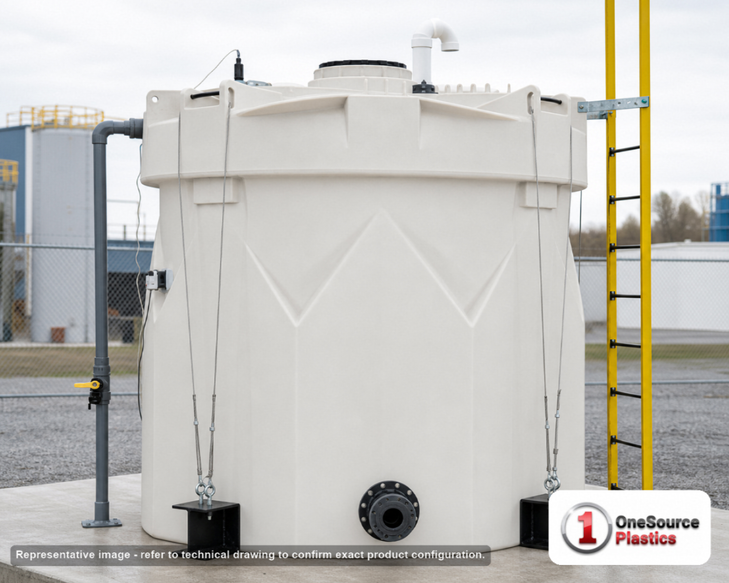
5500 gallons on a 120 inch base, 172 inches tall, 3,000 pounds empty
The Snyder SII-5660000N30 is a 5500 gallon double wall liquid chemical storage tank in white high density linear polyethylene, which Snyder names for sulfuric acid service: an inner tank inside an outer containment shell, 120 inches by 120 inches on the base and 172 inches tall, listed at 3,000 pounds empty and 3,000 pounds to ship, molded at Lincoln, Nebraska. The sheet rates it at a specific gravity of 1.9, which is where the 87,153 pound maximum contents figure comes from against 45,870 pounds for 5500 gallons of water at 8.34 pounds per gallon. Access is an 18 inch threaded vented manway. The service limit is 120 F / 48 C and the sheet gives a 3 year warranty. Freight is class OVS on NMFC 156600. Nothing beyond the name is asserted here about the liquid: no concentration, no strength, no temperature past the sheet's own limit.
Ready for the pad? Quote freight to your ZIP, add the 5500 gallon tank to your cart above, and 866-418-1777 will confirm the truck and the unload.
The lightest 5500 on its own sheet
Look at the family first and one figure jumps out. Four part numbers hold 5500 gallons in the same 120 by 120 by 172 inch shell, and this one is listed at 3,000 pounds empty against 3,200 pounds for 5660000N40, 3,800 pounds for 5660000N42 and 3,200 pounds for 5660000N46. The sheet gives all four weights, gives no wall figure for any of them, and offers no explanation, so this page prints what it says and stops. Do not read that as a wall comparison, and do not let anyone else read it that way either; what it is, honestly, is four part numbers at one capacity in one envelope where the difference the sheet publishes is a name, a resin, a colour and a number on the weight line. This tank is the one Snyder names for sulfuric acid service, and that name is the reason to choose it for that duty rather than anything on the weight line. The second reason to look at this part number is the shell itself, and it is the more practical one. Ten feet of diameter at 172 inches of height is the low, wide way to hold 5500 gallons. Every 5000 gallon tank on this sheet is 102 inches across and 216 inches tall, which is a taller, narrower shell holding less, so if your site has a canopy, a mezzanine, a roof line, a crane hook height or a fill arm at a fixed elevation, this is the tank that fits under it. What you pay for that is ground: a ten foot circle plus walking room all the way round, which is a lot of pad. And the pad is the installation. A rotationally molded floor bears on every part of the surface it touches and nothing else, and here it is the outer containment shell doing the standing, carrying 45,870 pounds of water, or up to 87,153 pounds of contents at the rating, across a 120 inch base. Flat, level, continuous, cured, and poured wider than the tank. Run 5500 gallons against your delivery quantity and your real consumption in the tank sizing calculator before you commit, and take the working reserve and the freeboard a warming liquid needs from the tank sizing guide. What a contained installation has to satisfy at site level, as opposed to what the tank provides on its own, is worked through in the Captor double wall compliance walkthrough, and it is a better read before the concrete than after the inspection.
Ten feet of diameter, and the 5000 and the 6500 that are not
| Part | Gallons | Length x width x height | Empty weight |
|---|---|---|---|
| SII-5660000N30 (this tank, named for sulfuric acid) | 5500 | 120 x 120 x 172 in | 3000 lb |
| 5660000N40 (same shell, cross-linked) | 5500 | 120 x 120 x 172 in | 3200 lb |
| 5660000N42 (same shell, cross-linked, heaviest here) | 5500 | 120 x 120 x 172 in | 3800 lb |
| 5660000N46 (same shell, cross-linked, black) | 5500 | 120 x 120 x 172 in | 3200 lb |
| 5630000N40 (narrower base, much taller, smaller) | 5000 | 102 x 102 x 216 in | 3600 lb |
| 5670000N30 (same base, taller, larger, named for sulfuric acid) | 6500 | 120 x 120 x 199 in | 5300 lb |
Read the bottom two rows as the two directions out of this tank. Downward in capacity, the 5000 gallon 5630000N40 is the wrong shape for a low bay: it holds 500 gallons less than this tank and stands 216 inches tall on a 102 inch base at 3,600 pounds, so it is narrower, taller and heavier on the sheet than the tank you are reading about. That combination is worth pausing on, because a buyer working down a price list by capacity would never notice it. Upward, the 6500 gallon 5670000N30 keeps this exact 120 inch base and adds height, 199 inches against 172, at 5,300 pounds, and Snyder names it for the same service this one is named for. That is the clean upgrade path: the pad you pour for this tank takes that tank too, the walking room is the same, the base detail is the same, and the only thing that changes is the height and what it takes to reach the manway. If there is any prospect of the duty growing, pour for the larger circle now and buy the tank you need today, because concrete is the part of this installation you cannot change later. Inside the 5500 gallon group, the choice is the duty name and the resin, and it is made against the liquid with us rather than from the table. None of these rows publishes a containment volume, an annulus dimension or an inner tank dimension, so nothing here tells you how much the outer shell holds; if that number has to appear on a permit or a drawing, ask and we will get it from Snyder in writing.
Still deciding between these? Freight to your ZIP often settles it; the wider tanks ship differently. Or call 866-418-1777 and we will walk the table with you.
Vent, gauge and alarm: what belongs on top of a 172 inch shell
- The vent first. The sheet publishes one opening on this tank, an 18 inch threaded vented manway, and that vent is the whole breathing system. A tanker unloading 5500 gallons has to push that volume of air out through it, and a transfer pump drawing the tank down pulls the same volume back in. A blocked vent on a shell this size is not a nuisance, it is a deformation; keep it clear, name it on the inspection sheet, and never cap it against weather.
- Headspace and freeboard. Vapour sits above the liquid line, a warming liquid needs room, and a tank filled to the manway has neither. Leave the freeboard deliberately rather than by habit, and take the sizing logic from the freeboard sizing guide, which is what separates 5500 gallons of capacity from 5500 gallons you can actually use.
- Level measurement. On a shell 172 inches tall nobody is reading a level by eye, so the gauge is part of the purchase rather than an afterthought, and it belongs through the manway rather than through a new penetration. The trade-offs between radar, ultrasonic, hydrostatic and magnetostrictive measurement in chemical service are worked through in the level gauge selection guide, and the wrong choice here shows up as a tank that is trusted when it should not be.
- High level alarm and cutoff. Almost every serious release at this scale happens during a delivery, with a hose connected and somebody watching a truck instead of a tank. The layered approach to that, alarms, automatic cutoff and valve discipline, is set out in the spillover redundancy guide, and on a contained tank it is what keeps the containment space empty.
- Access: 18 inches of manway 172 inches up is a platform, a ladder and a fall protection plan, planned into the installation rather than improvised. It is the only route into the inner tank.
- Outlet and inlet: the sheet publishes neither, so neither is claimed here. Sizes and positions are confirmed with us at order against Snyder's current documentation.
- Service limit, warranty and rating: 120 F / 48 C, a 3 year warranty, and a specific gravity rating of 1.9 with 87,153 pounds given as the maximum contents against 45,870 pounds of water. Nothing beyond those figures is claimed.
The rule that protects a tank this size is that nothing structural touches the shell. Pipework, valves, gauges, alarm floats, ladders and sunshades stand on their own steel with a flexible connector at the first joint, and the containment space stays a containment space: no conduit through it, no penetrations, no rainwater collecting in it, no using it as a convenient trough. Keep the full circumference walkable, because a ten foot tank that has been built in on two sides is a tank whose containment nobody has actually looked at since the day it was commissioned. Then use that space as your instrument: a torch, a written schedule, a dry floor, and a standing instruction that anything found in there gets reported rather than mopped.
Loadout and day storage on a plant pad
Fifty-five hundred gallons is bulk, which means a tanker, a schedule and a procedure. The duties this tank is bought for: bulk chemical storage feeding a dosing or treatment system at a municipal water or wastewater plant; a process supply at a mining, minerals or metals site; pulp, paper and board mills; plating, anodising and finishing plants; fertilizer and chemical blending or distribution terminals, where the same pad holds several tanks and each one has to answer for itself; power station and industrial water treatment; oilfield and industrial service yards holding a working volume outdoors. The low, wide shell is the reason a plant picks this one: it puts 5500 gallons under a roof line, a canopy or a crane hook that a 216 inch tank would not clear, and it puts the manway within reach of a shorter platform. Two honest limits. The sheet publishes no containment volume, no annulus figure and no inner tank dimension, so this page does not state what proportion of the inner tank the outer shell holds; we will get that from Snyder in writing if it has to go on a drawing. And the service limit is 120 F / 48 C, for the liquid and for the shell, which rules the tank out for anything arriving hotter. Everything else that shortens a tank like this is preventable and is all on the installation side: an uncured or settling pad, hard pipe bolted to the shell, a vent nobody checked, a level gauge nobody trusted, or a delivery with no high level alarm behind it.
Compatibility list
Liquids the maker rates this resin for, with concentration limits and the wetted fitting and gasket to specify. Confirm your own concentration and temperature on the chemical page or in the chemical compatibility database before ordering.
- Sulfuric Acid at 98% with CPVC fittings and Viton gaskets
- Hydrochloric Acid at 37% with PVC fittings and Viton gaskets
- Hydrofluoric Acid at 48% with PP/PVC fittings and Viton gaskets
- Hydrofluosilicic Acid at 26% with PP/PVC fittings and Viton gaskets
- Phosphoric Acid at 85% with PVC fittings and Viton gaskets
- Acetic Acid at 60% with PP/PVC fittings and EPDM gaskets
- Peracetic Acid at 30% with 316SS fittings and Aflas gaskets
- Hydrogen Peroxide at 50% with PVC fittings and Viton gaskets
- Sodium Hypochlorite at
- Ferric Chloride at 50% with PVC fittings and EPDM gaskets
- Ferric Sulfate at 60%
- Ferrous Sulfate at 20%, and
- Aluminum Sulfate at 50%, all with PVC fittings and EPDM gaskets
- Calcium Chloride at 40% and
- Magnesium Chloride at 30% with PVC fittings and EPDM gaskets
- Sodium Carbonate at 30%
- Potassium Carbonate at 50%, and
- Potassium Hydroxide saturated, with PVC fittings and EPDM gaskets
- Sodium Thiosulfate at 40%
- Sodium Bisulfate and
- Sodium Bisulfite with PVC/PP fittings and EPDM gaskets
- Polyaluminum Chloride and
- Zinc Orthophosphate with PVC or PP/316SS fittings and EPDM gaskets
- DEF at 32.5% and
- Urea Solution at 50% with 316SS or PP/PVC fittings and EPDM gaskets
- Ethylene Glycol at 100% and
- Propylene Glycol with PVC or PP/316SS fittings and EPDM gaskets
Lincoln, Nebraska, and a shipment 172 inches long
This tank is molded at Lincoln, Nebraska and the sheet gives class OVS on NMFC 156600, shipping at 120 inches by 120 inches by 172 inches at 3,000 pounds. Ten feet wide is what makes it an oversize load; at 3,000 pounds it is the lightest of the big shells in this batch, which means the weight is rarely the constraint and the width almost always is. The freight cost estimator prices the lane to your ZIP, and the listed price is before freight. Before the truck is booked, walk the route with us: gate width, overhead lines, tree limbs, the turn into the yard, the surface the truck will stand on, and the swing room for whatever lifts a ten foot shell off a trailer and stands it on a pad. Have the pad poured, cured and surveyed flat first; a tank of this diameter set on green concrete or on a pad with a low corner is a settlement problem that shows up months later as a shell nobody wants to explain. Inspect the whole outside of the shell, the base ring and the manway while the tank is still horizontal on the trailer, because that is the last easy look anybody gets at the underside. Then commission it in place: water in the inner tank, a hold, a walk of the pad and the containment space, and a check for settlement before product is ordered. A ten foot circle of concrete poured once, level, with room to walk around it, is the cheapest insurance on the whole installation. Write the outlet fitting size and material on the site plan; the replacement is ordered by those two words.
Freight and documents
Ships from: Lincoln, NE. LTL freight is quoted to your ZIP with the freight cost estimator or by phone at 866-418-1777. The listed price is before freight.
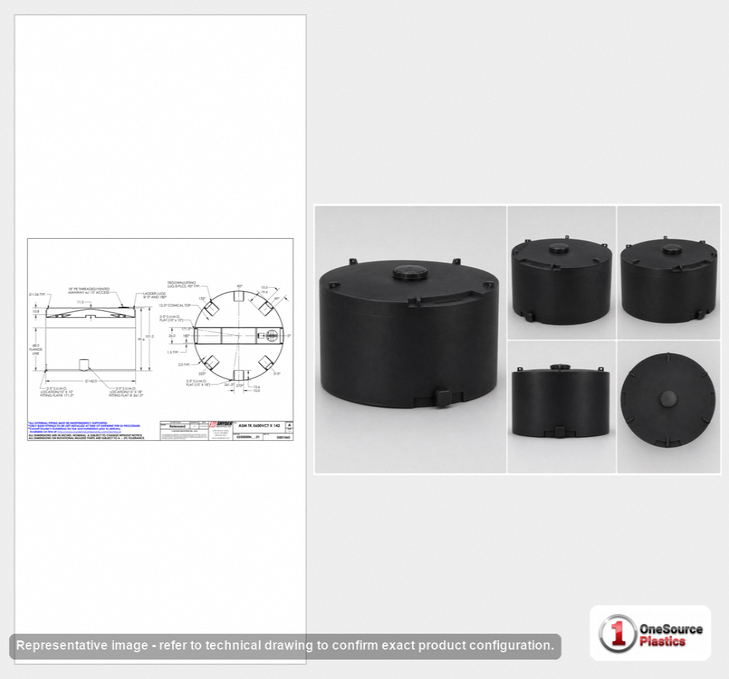
Technical drawing (PDF) for Snyder Industries 5660000N30.
See this tank
Interactive 3D model with live fill. This tank has an interactive 3D model built to its manufacturer dimensions. Rotate it, and set a fill level to see how much liquid it holds at any height. Open the 3D view on the product photo above. Download the 3D model (GLB).
Product video. Watch the Snyder Industries 5500 Gallon HDLPE Double Wall Liquid Chemical Storage Tank for Sulfuric Acid video (73 seconds) with dimensions, fittings and shipping notes.
Ready to order?
Add it to your cart at the top of this page, get LTL freight to your ZIP, request a written quote, or call 866-418-1777. The listed price is before freight.