1,900 gallons, the 1.5 wall, ten feet tall
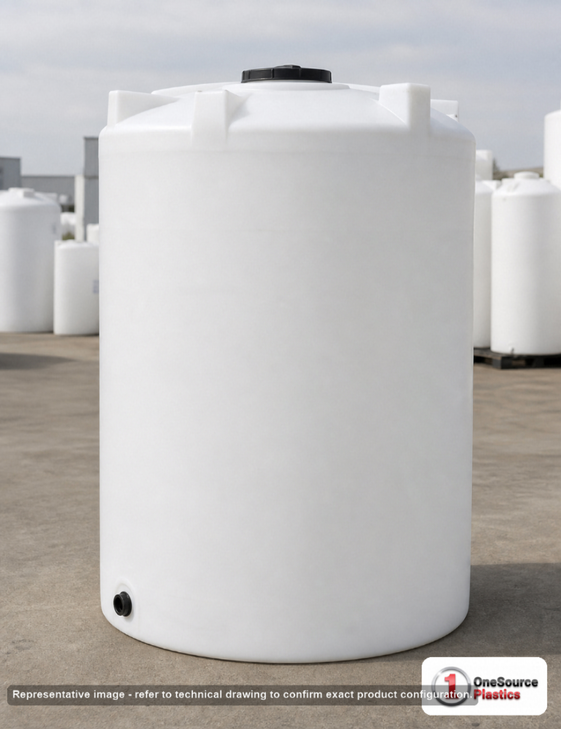
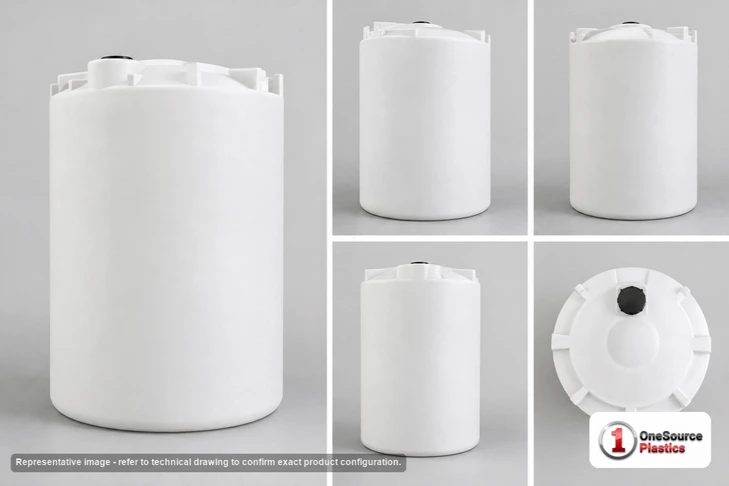
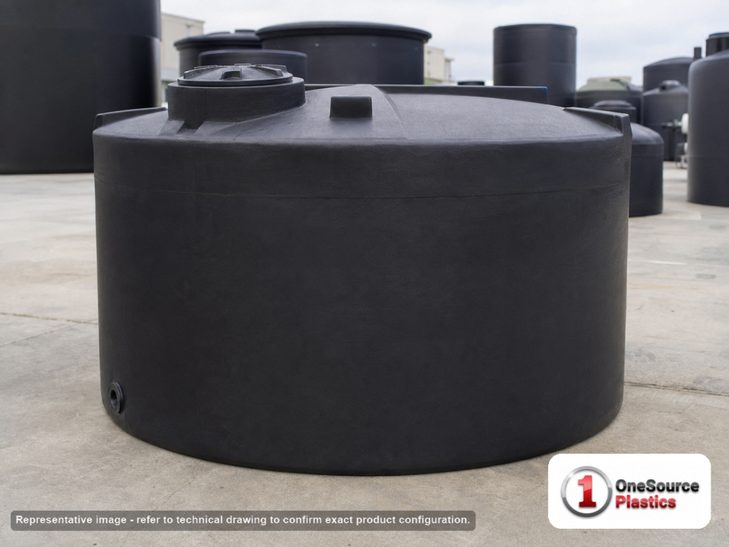
The Snyder 1780200N49 is the working wall in the six foot family: 1,900 gallons of black polyethylene, 72 inches across the base, 119 inches tall, 445 pounds empty, out of Chowchilla, California. The sheet rates it for a specific gravity of 1.5, which is 23,769 pounds of contents against 15,846 pounds for the same tank full of water at 8.34 pounds per gallon, and that covers hypochlorite, brine, polymer, process water and most of what a plant doses day to day. An 18 inch threaded, vented manway on the top head, a service limit of 120 F / 48 C, a 3 year warranty, two flange lines, and freight at class 300. The outlet field on the sheet reads 1 Manway / Lid, with no bottom fitting size given.
Ordering for a plant or a bid? Request a written quote with freight to your ZIP for the file; a single 1900 gallon tank goes straight to the cart above.
The duty: the everyday dosing tank on a crowded pad
Most tanks this size are not bought for an unusual liquid. They are bought because a plant needs one more vessel on a pad that already has three, holding something ordinary, feeding a pump that runs every day. That is this tank: a municipal water or wastewater plant, a bottler, a laundry, a car wash, a food plant, a campus utility room. The delivery is routine, a hose off a route truck or a transfer out of a tote, and the failure modes are routine too, which is the point of designing for them up front: an overfill because nobody could see the level from the fill point, and a dry pump because nobody fitted a float. At 119 inches, just under ten feet, the tank needs a platform or a fixed ladder for the manway and clearance above it for a fill line and a vent, so measure the height to the purlins and add that work rather than measuring the tank. On the ground, full at the rating there are 23,769 pounds on a 72 inch circle with the whole molded floor bearing, so the slab gets engineered to the concrete pad sizing guide, poured level and in full contact, inside a berm sized to the tank where the liquid is regulated. Ten feet of empty tank at 445 pounds leans in wind, so band it to structure or to slab anchors before the first fill. Check 1,900 gallons against your dose rate and delivery interval in the tank sizing calculator, with the reserve and the freeboard from the tank sizing guide.
The lighter wall among the 1780200s
| Part | Gallons | Diameter x height | Empty weight |
|---|---|---|---|
| 1780200N49 (this tank, black, rated 1.5) | 1,900 | 72 x 119 in | 445 lb |
| 1780200N46 (cross-linked, black) | 1,900 | 72 x 119 in | 445 lb |
| 1780200N40 (cross-linked, natural) | 1,900 | 72 x 119 in | 445 lb |
| 1780200N42 (cross-linked, heavier) | 1,900 | 72 x 119 in | 520 lb |
| SII-32118 (white, low and wide) | 1,600 | 86 x 71 in | 264 lb |
| 5050000C26 (white, wider and shorter) | 2,000 | 90 x 88 in | 340 lb |
The reason to take this one over the rest of the shell is that it is the plain answer to a plain duty. At the 1.5 rating and 445 pounds it costs less wall than the heavy version of this black shell, which is cited on its own page, and less than the cross-linked grades, which solve a chemistry problem rather than a density one. Choose a cross-linked tank when the liquid attacks polyethylene; choose this one when the liquid is simply a bit heavier than water. The N46 is the black cross-linked tank and the N40 the natural one, both at 445 pounds, and the N42 is given at 520 pounds in the same shell, each rated as its own sheet says. If the room has a header beam instead of a floor problem, the SII-32118 lays 1,600 gallons down to 71 inches on an 86 inch base; if a bit more volume buys another day between deliveries, the 5050000C26 holds 2,000 gallons on a 90 inch base at 88 inches in white, where the level reads through the wall.
Need the taller or the wider one? Every row links to its page with freight to your ZIP on each; 866-418-1777 will check the ceiling and the pad.
Keeping the pump flooded to the last inches
- Pump: at 119 inches this tank gives a genuinely useful column of liquid, so mount the dosing or transfer pump below the outlet and let gravity keep it flooded rather than asking it to prime on suction. Fit a low level float wired to stop the pump with liquid still over the port, calibrate the dose against the level rather than the run hours, and on a duty that runs every day, put a pressure gauge downstream so a failing impeller shows as a number instead of a complaint.
- Outlet: the sheet lists the outlet as 1 Manway / Lid. No bottom fitting diameter, material, thread or gasket is named, so tell us the liquid and the pipe size at order and the draw-off is specified then. Nothing is guessed.
- Access: 18 inch threaded, vented manway on the top head at 119 inches, reached from a platform or a fixed ladder; fill down a dip tube to the floor, run the vent outdoors on anything that fumes, and size the vent to the delivery pump so a fast fill does not push the lid.
- Service limit: 120 F / 48 C.
A tank in daily service wears at its connections, so use a flexible connector between the tank and hard pipe, carry the first valve on its own support off the pad, and keep a spare gasket on the shelf for whatever fitting was specified. Put the level sender where the operator reads it from the fill point, keep the manway closed between deliveries, and name the one liquid on the wall so the next shift does not guess. Once a month, take the lid off and put a light on the band of wall above the liquid line, and write down what you see; a daily duty leaves a record on that band long before it leaves one anywhere else.
Dosing, washdown and stored process water
Hypochlorite and polymer at a treatment plant, brine at a softener, a wash chemical at a food plant or a laundry, recovered washdown water, a 1,900 gallon buffer ahead of a skid. Where a second wall is required around the tank, the Captor double wall freeboard guide works out what containment costs in usable gallons at this size, which is the number that gets missed when the berm is drawn late. Where storage sits between the stages of a reuse train, the industrial water reuse tank topology article places a vessel this size in the sequence. Water is comfortably inside the 1.5 rating, though a fire reserve is a system with its own sizing and freeze rules, covered in the fire-water reservoir design guide.
A 445 pound tank on the deck
The 1780200N49 is molded at Chowchilla, California and moves as freight at class 300 as the sheet lists it. At 119 inches long and 72 inches across it rides inside a trailer, and 445 pounds is a forklift load with the forks under the pallet, straps under the body, never a hook in the manway. The freight cost estimator prices the lane to your ZIP, and the listed price is before freight. Water test before product: fill to the manway, hold it a shift, read the base, the pad edge and the fitting specified at order, then drain and dry. Then photograph the tank on its pad, full, on day one, because that photograph is the baseline every later inspection gets compared against and nobody ever takes it later. A strap that is checked once a season is a strap that holds; put it on the same calendar as the gutters.
Freight and documents
Ships from: Chowchilla, CA. LTL freight is quoted to your ZIP with the freight cost estimator or by phone at 866-418-1777. The listed price is before freight.
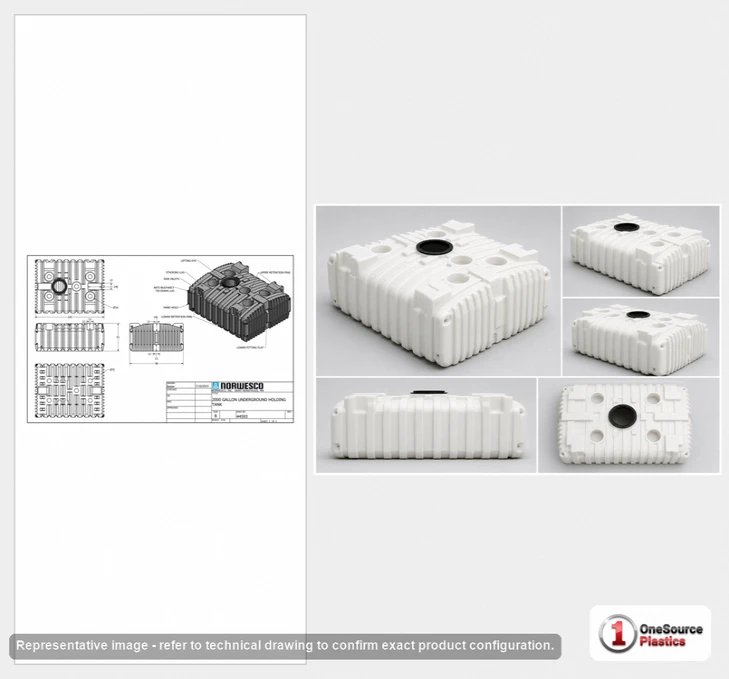
Technical drawing (PDF) for Snyder Industries 1780200N49.
See this tank
Interactive 3D model with live fill. This tank has an interactive 3D model built to its manufacturer dimensions. Rotate it, and set a fill level to see how much liquid it holds at any height. Open the 3D view on the product photo above. Download the 3D model (GLB).
Ready to order?
Add it to your cart at the top of this page, get LTL freight to your ZIP, request a written quote, or call 866-418-1777. The listed price is before freight.