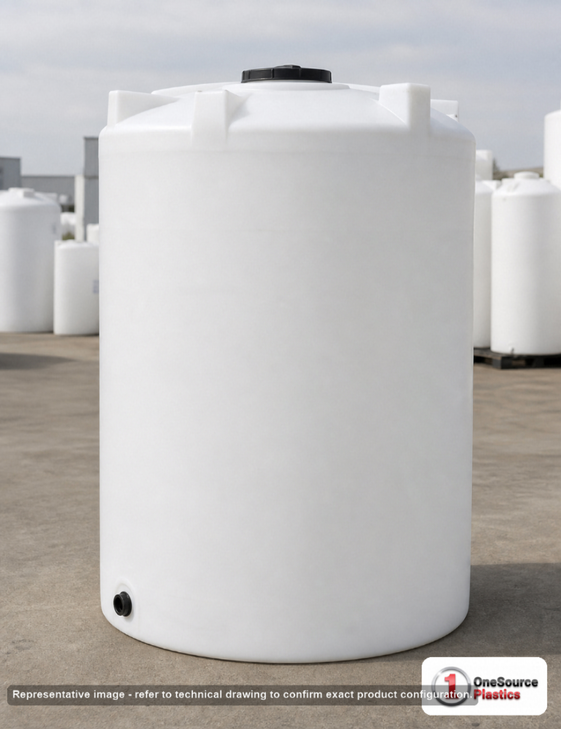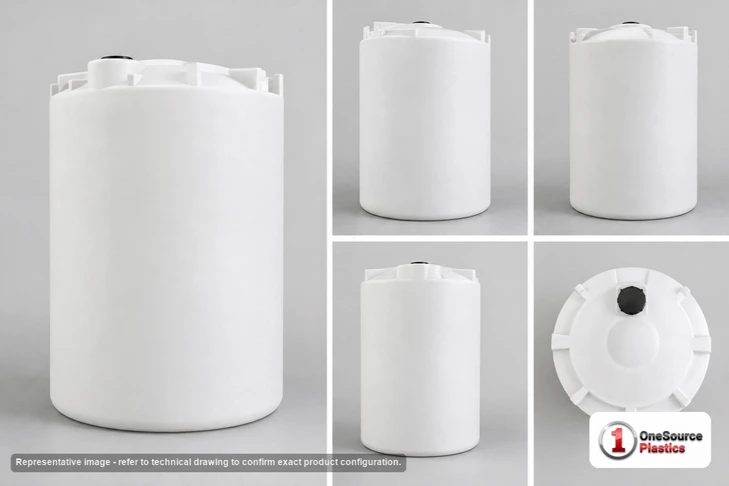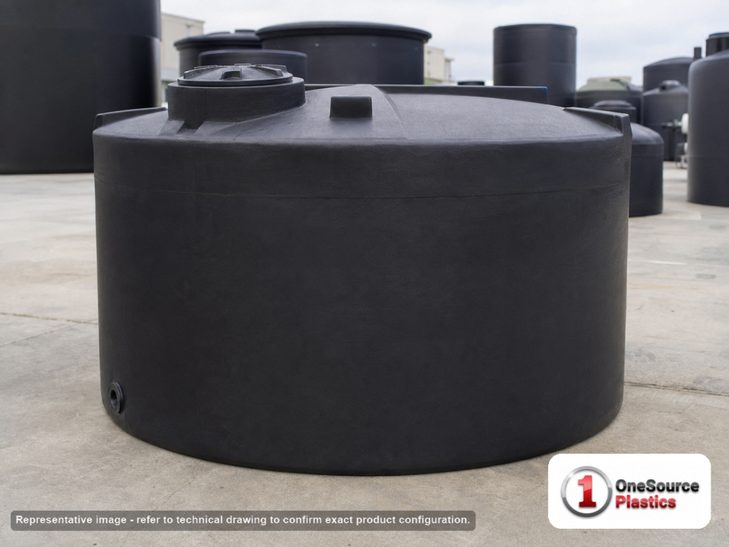
1,900 gallons in the slim shell at the 1.5 rating
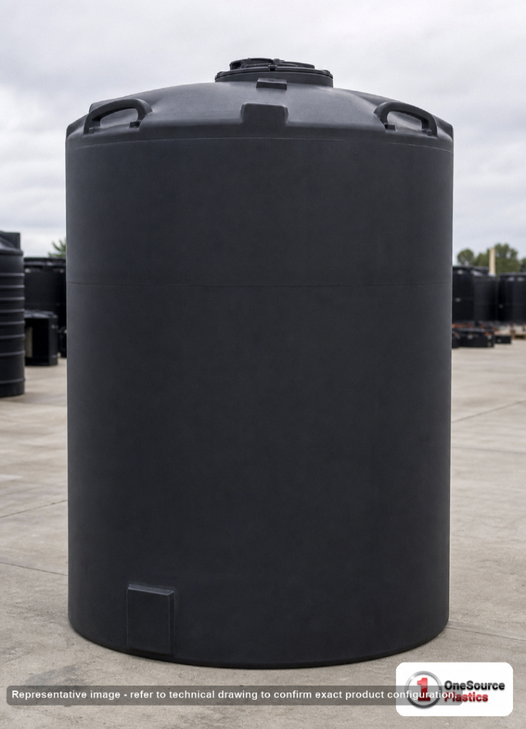
Same narrow molding, less wall, and for most duties that is the right buy. The Snyder 8300000N49 holds 1,900 gallons of black polyethylene at 64 inches across the base and 147 inches tall, 460 pounds empty, molded at Philippi, West Virginia. The sheet rates it for a specific gravity of 1.5, which is 23,769 pounds of contents against 15,846 pounds for the same tank full of water at 8.34 pounds per gallon: margin for brine, hypochlorite, process water and most dosing chemistry, and no more wall than those load. An 18 inch threaded, vented manway on the top head, a service limit of 120 F / 48 C, a 3 year warranty, two flange lines, and freight at class 300. The sheet lists the outlet as 16.
Price it in one step. Freight to your ZIP shows in seconds; add the 1900 gallon tank to your cart above, or call 866-418-1777 if the site has a question in it.
The duty: process water where the floor is already full
The plants that buy this tank are out of room, not out of money. A reuse skid needs a break tank between stages. A wash line needs 1,900 gallons of recovered water where a pallet rack stands. A treatment building put in twenty years ago has height over the walkway and nothing on the floor. A 64 inch circle fits those slots and a wider tank does not, and the liquid is ordinary enough that the 1.5 rating is all the wall the job calls for. The delivery is usually not a tanker at all: it is a pipe from upstream, a hose off a smaller vessel, or a hauled load into a fill point somebody has to reach in a tight aisle, so the fill point, the vent and the level readout get located before the tank is set rather than after. Under it, full at the rating there are 23,769 pounds on a 64 inch circle with the whole molded floor in contact, which is a concentrated load, so the slab is engineered to the concrete pad sizing guide rather than poured by rule of thumb, level and in full contact, inside a berm sized to the tank where the liquid is regulated. Above it, 147 inches of empty tank on a narrow base wants banding to structure in the top third and anchors set in the slab, tightened before the first fill and checked after the first windy week. Take 1,900 gallons and your draw to the tank sizing calculator, and the reserve and the freeboard to the tank sizing guide.
The 64 inch shell against the 72 inch shell
| Part | Gallons | Diameter x height | Empty weight |
|---|---|---|---|
| 8300000N49 (this tank, black, slim, rated 1.5) | 1,900 | 64 x 147 in | 460 lb |
| 1780200N40 (cross-linked, 72 inch base) | 1,900 | 72 x 119 in | 445 lb |
| 1780200N46 (cross-linked, black, 72 inch base) | 1,900 | 72 x 119 in | 445 lb |
| 1780200N42 (cross-linked, 72 inch base) | 1,900 | 72 x 119 in | 520 lb |
| SII-32118 (white, low and wide) | 1,600 | 86 x 71 in | 264 lb |
| 5050000C26 (white, 90 inch base) | 2,000 | 90 x 88 in | 340 lb |
The shell is the decision on this page. The sheet gives this tank as 64 by 147 inches and gives every 1780200 tank holding the same 1,900 gallons as 72 by 119, so the question is only whether you can spare the floor or the headroom, and this is the answer when you can spare the headroom. The heavy wall version of this same 64 inch molding is the buy when the liquid is genuinely dense; it carries its own rating on its own page and is not named here, because it is not on this sheet. The cross-linked 1780200 tanks are the wider, shorter shape, each rated as its own sheet says, and the sheet gives the N42 at 520 pounds where the N40 and N46 in that shell are 445, which we print as given. The SII-32118 is the low option at 1,600 gallons and 71 inches on an 86 inch base for a room with a header beam, and the 5050000C26 is the white 2,000 on a 90 inch base for a bit more volume and a level you can read through the wall.
Settled on the 1900 gallon tank? Freight to your ZIP and add to cart above; a written quote is one click away for the paperwork.
Suction head is the advantage, and the sheet gives no outlet size
- Pump: this is the shape to buy when a pump is in the picture. With 147 inches of liquid above the base, a transfer pump set below the outlet runs flooded to the last few inches and never has to prime itself, which on recovered or process water full of solids is the difference between a pump that lasts and one that cavitates. Fit a low level float so it stops before it pulls air, and keep the suction line short and straight rather than routing it around the aisle.
- Outlet: the sheet lists the outlet as 16. That is the field as published; it is not a pipe size and we do not print it as one. Give us the liquid and the pipe you are tying into at order and the base fitting, gasket and bolting are specified then.
- Access: 18 inch threaded, vented manway on the top head at 147 inches, which means fixed access and a rail rather than a leaned ladder; a dip tube to the floor for the fill, and the vent run outdoors and sized to whatever is doing the filling.
- Service limit: 120 F / 48 C.
Twelve feet of head is useful and it is also a load on everything at the base, so the connector between the tank and hard pipe is flexible, the first valve rides on its own support off the pad, and nothing rigid bolts to a polyethylene wall where thermal movement and pump vibration can walk back into the fitting. Stock a spare gasket for whatever gets specified. On recovered water, put a sample point and a drain in the run rather than opening the manway to look, keep the lid closed against debris, name the one liquid on the wall, and put a light on the band of wall above the liquid line every time it does come off, because on a tank in a busy room that band is where scale and film show first.
Reuse trains in a crowded plant room
Break tanks and equalization between treatment stages, recovered washdown water, condensate aggregation, a cooling side stream, a 1,900 gallon buffer ahead of a dosing skid. Where storage sits between the stages of a reuse train, the industrial water reuse tank topology article is the piece to read first, because the sequence decides the number of tanks before the size of any one of them. Water sits well inside the 1.5 rating, though a fire reserve is a system with its own sizing and freeze rules rather than a tank you buy, which the fire-water reservoir design guide sets out.
The 460 pound lift from Philippi
The 8300000N49 is molded at Philippi, West Virginia and moves as freight at class 300 as the sheet lists it. At 147 inches long on the deck and 64 inches across it rides inside a trailer rather than as a permitted load, which is a real saving on a tank this tall, and at 460 pounds it is a forklift or small crane lift with straps under the body and never a hook in the manway. The freight cost estimator prices the lane to your ZIP, and the listed price is before freight. Land it on the anchors poured with the pad and tighten the bands the same day. Water test before product: fill to the manway, hold it a shift, read the base, the pad edge and the fitting specified at order, then drain and dry. Measure the doorway and the aisle turn before delivery day, not on it, because a tank that fits the slot still has to get to the slot. Note the pad height and the outlet height on the site plan while the tape is out; the next pipe run will need both.
Freight and documents
Ships from: Philippi, WV. LTL freight is quoted to your ZIP with the freight cost estimator or by phone at 866-418-1777. The listed price is before freight.
Technical drawing (PDF) for Snyder Industries 8300000N49.
See this tank
Interactive 3D model with live fill. This tank has an interactive 3D model built to its manufacturer dimensions. Rotate it, and set a fill level to see how much liquid it holds at any height. Open the 3D view on the product photo above. Download the 3D model (GLB).
Ready to order?
Add it to your cart at the top of this page, get LTL freight to your ZIP, request a written quote, or call 866-418-1777. The listed price is before freight.