The Lincoln 2000: one shell, and a wider crate on this sheet
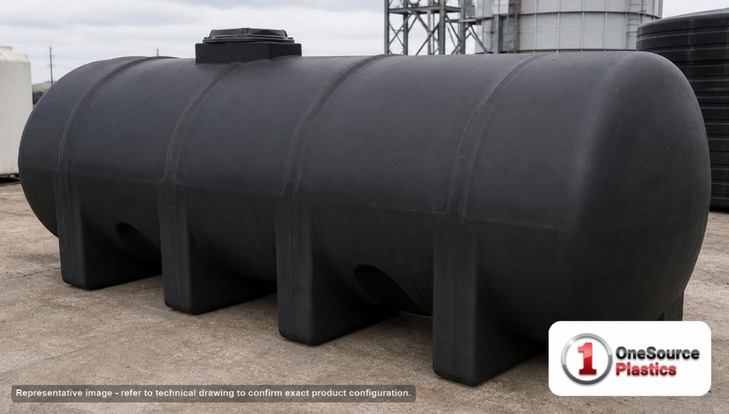
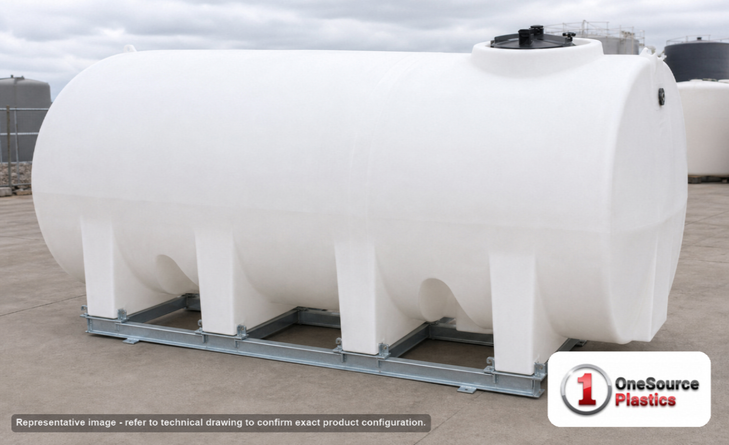
Snyder's SII-7510000N45 holds 2000 gallons in a white polyethylene horizontal leg tank that the sheet names with securing hoops, 160 inches long, 62 inches wide and 70 inches tall, listed at 580 pounds empty and 580 pounds to ship, molded at Lincoln, Nebraska. Its feet are molded into the body, so it stands on a deck or a floor with nothing fabricated underneath it. The sheet rates the wall at a specific gravity of 1.9, which is where the 31,692 pound figure for maximum contents comes from against 16,680 pounds for 2000 gallons of water at 8.34 pounds per gallon. It lists a 2 inch outlet and an 18 inch lid, and a service limit of 120 F / 48 C. Freight is class OVS under NMFC 156600, and the crate on this sheet is given as 160 inches by 70 inches by 70 inches, which is wider than the tank's own published width; both figures are printed here as the sheet gives them. No warranty term appears on this sheet, so none is stated; ask us and we will get Snyder's current terms in writing.
Know your ZIP and your ceiling height? Freight to your ZIP takes seconds, and 866-418-1777 will confirm the height; then add it to your cart above.
Duty first: a co-op yard, a nurse trailer and a plant wash line
Three kinds of buyer keep coming back for this size. The first is a co-op or terminal yard that needs a tank to stand still: filled from a bulk delivery, drawn down through a week by a loading pump, sitting on a slab beside a scale or a loading bay where the width of the pad is fixed and the length is not. The second is an applicator or a grower running a nurse trailer, where 2000 gallons is the number that keeps a sprayer in the field for a whole day and the tank has to ride thirteen feet of deck without moving. The third is a plant: wash water, rinse water, process water or brine held on a floor and fed to a line at line rate, with the tank chosen because a horizontal body fits under a roof that a vertical of the same volume would not. Those three duties want the same two things from the installation, and neither of them is on the spec sheet. The first is continuous flat bearing along the whole body, because a rotationally molded tank carries through every part of the surface it is resting on and nothing else: 16,680 pounds of water, or up to 31,692 pounds of contents at the sheet's rating, will find a proud crossmember, a cracked board or a low spot in a slab and stand on it. Mat or plywood on a ribbed deck, a flat pour on concrete, full contact either way. The second is restraint in three directions, because the surge in a body thirteen feet four inches long is the biggest load the mount ever takes and it is worst at part-full: anchor fore, aft and across, through the structure of the tank, with hardware you inspect at the start of every season. Check the height too, at five feet ten inches loaded, before a trailer with a headache bar or a shed with a roller door turns into a problem. The sheet names this part number with securing hoops and publishes no hoop dimension, count or rating, so this page describes no hoop function and no mounting method that leans on one; ask us if your mount depends on it and we will get the detail from Snyder in writing. How leg and applicator tanks are classified once they travel is set out in the applicator and leg tank classification guide, and the portable utility tank case in the loaf-style portable utility tank guide. Size the volume against the duty in the tank sizing calculator, with the reserve and the freeboard from the tank sizing guide.
Five 2000 gallon part numbers, and what actually separates them
| Part | Gallons | Length x width x height | Empty weight |
|---|---|---|---|
| SII-7510000N45 (this tank, long shell, wider crate) | 2000 | 160 x 62 x 70 in | 580 lb |
| SII-1002300N45 (wide shell, lower) | 2000 | 142 x 84 x 55 in | 700 lb |
| SII-1002300C37 (wide shell, second part family) | 2000 | 142 x 84 x 55 in | 700 lb |
| SII-1002300N51 (wide shell, named Black) | 2000 | 142 x 84 x 55 in | 700 lb |
| SII-1460000C26 (smaller, narrowest) | 1685 | 159 x 48 x 62 in | 480 lb |
| SII-8470000C26 (larger, widest) | 2600 | 155 x 82 x 70 in | 1014 lb |
Read this table as two groups and one outlier. The first group is this tank and the SII-7510000C26, which the sheets publish as the same tank in every dimension, the same 580 pounds, the same 2 inch outlet, the same 18 inch lid, the same plant and the same class; the only figure that differs between them is the crate, given as 70 inches wide here and 62 inches wide there. Both are printed as the sheets give them and neither sheet explains it, so if the crate width is load-bearing for your dock, your door or your unloading plan, name it when you order and we will confirm the crate before the tank ships rather than after. The second group is the three SII-1002300 part numbers, all 2000 gallons at 142 by 84 by 55 inches and 700 pounds, one of them named Black. They hold the same volume fifteen inches lower on a base nearly two feet wider, which is the trade to take when the clearance above your deck is the binding constraint and the width is free. The outlier is where the volume steps: the SII-1460000C26 at 1685 gallons is the narrowest body here, 48 inches across and 480 pounds, for a deck that cannot take five feet of width, and the SII-8470000C26 at 2600 gallons is the same 70 inch height as this tank on an 82 inch base at 1014 pounds. If a 2000 is being emptied and refilled more than once a day, that one tank replaces the second trip.
Need two of them? Request a written quote for the pair with freight to your ZIP, or call 866-418-1777 and we will price the truck once.
Priming a pump off a 2 inch port at the low end of the shell
- The pump: everything about this tank's fittings comes back to keeping a 2 inch suction flooded. Put the pump low, below the outlet and forward of it, bolted to the deck or the pad and never to the tank, with a short run falling all the way into the suction port and as few elbows as the layout allows. Full, the 70 inch shell gives a decent column behind the fitting; near empty it gives almost none, which is where a badly placed pump starts cavitating and an operator starts blaming the pump.
- Prime and protection: a self-priming pump if it cannot sit below the fitting, a cleanable strainer ahead of it, a check valve where the line lifts, and a low level cut-out that stops the pump with liquid still over the outlet. On a yard tank make that automatic rather than procedural, because the person filling a truck is not watching a level.
- Outlet: a 2 inch outlet, as the sheet lists it, at the low end of the body. It is a feed and metering port on 2000 gallons: good for a loading pump, a boom, a hose line or a valve into a basin, slow for gravity-emptying a full load. Where discharge speed is the duty, tell us and we will point you at the larger ports in this family instead of overselling this one.
- The valve and the first joint: a shutoff at the outlet carried on its own support off the deck or the pad, and a flexible connector before any hard pipe. Rigid line bolted from the fitting to a pump bracket puts every brake load, every bit of deck flex and every degree of thermal movement into the tank fitting, and on a tank thirteen feet long that is the failure that actually happens.
- No inlet on this sheet, so none is claimed: filling is through the 18 inch lid at 70 inches, from a hose run down inside the body. At that height the access is a step or a platform question, not an afterthought. Keep the lid closed in transit and the vent path clear at all times.
- Service limit: 120 F / 48 C, as the sheet gives it. The sheet publishes no warranty term, so this page claims none.
Tell us the liquid when you order and the outlet fitting, the gasket and the valve material get matched to it against Snyder's current documentation instead of guessed at across a counter. For blended fertilizer solutions the failure mode is the blend rather than the tank, because a wide shallow body gives layers room to form and a separated load will put a spreader off spec before anybody sees it; the fertilizer blend stratification guide covers the physics and the checks. Where the liquid has to be contained, a single-wall leg tank does not do it and this sheet publishes no containment figure; the Captor double wall containment walkthrough explains what a contained installation has to satisfy. Where it freezes, drain the valve, the outlet and the hose, and leave the body to ice from the top down.
Nurse duty, brine, right-of-way spraying and plant water
The jobs this tank is bought for are the ones measured in days rather than minutes. Nurse duty on a trailer behind a sprayer, drawn down across a field and topped up from a tender. Right-of-way, pasture, turf and orchard spraying where the rig is filled from the tank and the tank is filled from a delivery. Brine storage and hauling for road and lot de-icing, going out at dawn and coming back part-full. Water hauled in quantity to livestock, a remote building, a planting crew or a site with no well. Dust control and compaction water on construction and utility jobs. Wash, rinse and process water on a plant floor, fed to a line through a pump. Carrier solution and fluid feed to a planter across a season. In every one of those the tank stands on its own feet on something flat and gets let down slowly through a 2 inch port, which is the shape and the fitting working together rather than against each other. Two honest limits. There is no secondary containment on this tank, so it is the wrong buy anywhere containment is required. And the 120 F / 48 C limit on this sheet applies to the liquid and to the tank in the sun, so a loaded tank on a dark deck through a summer afternoon wants shade, a cool fill, or to be drawn down before the heat. Beyond that, the mount and the pipework decide how long it lasts, not the liquid.
Compatibility list
Liquids the maker rates this resin for, with concentration limits and the wetted fitting and gasket to specify. Confirm your own concentration and temperature on the chemical page or in the chemical compatibility database before ordering.
- acetic acid ), aluminum sulfate at 50% (PVC, EPDM
- aluminum sulfate ), calcium chloride at 40% (PVC, EPDM
- calcium chloride ), DEF at 32.5% (316SS fittings, EPDM
- DEF ), ethylene glycol at 100% (PVC, EPDM
- ethylene glycol ), ferric chloride at 50% (PVC, EPDM
- ferric chloride ), ferric sulfate at 60% (PVC, EPDM
- ferric sulfate ), ferrous sulfate at 20% (PVC, EPDM
- ferrous sulfate ), magnesium chloride at 30% (PVC, EPDM
- magnesium chloride ), phosphoric acid at 85% (PVC, Viton
- phosphoric acid ), polyaluminum chloride (PVC, EPDM
- polyaluminum chloride ), potassium carbonate at 50% (PVC, EPDM
- potassium carbonate ), potassium hydroxide saturated (PVC, EPDM
- potassium hydroxide ), propylene glycol (PP/316SS, EPDM
- propylene glycol ), sodium bisulfate (PVC/PP, EPDM
- sodium bisulfate ), sodium bisulfite (PVC/PP, EPDM
- sodium bisulfite ), sodium carbonate at 30% (PVC, EPDM
- sodium carbonate ), sodium thiosulfate at 40% (PVC, EPDM
- sodium thiosulfate ), urea solution at 50% (PP/PVC, EPDM
- urea solution ), zinc orthophosphate (PP/316SS, EPDM
- zinc orthophosphate ), and ozonated water up to 10 PPM (PVC, EPDM). The aggressive oxidizers and strong acids demand Viton or Aflas gaskets and acid-rated fitt
- hydrochloric acid ), hydrofluoric acid at 48% (PP/PVC, Viton
- hydrofluoric acid ), hydrofluosilicic acid at 26% (PP/PVC, Viton
- hydrofluosilicic acid ), hydrogen peroxide at 50% (PVC, Viton
- hydrogen peroxide ), peracetic acid at 30% (316SS fittings, Aflas gaskets
- peracetic acid ), sodium hypochlorite below 16.5% (PVC, Viton
- sodium hypochlorite ), and sulfuric acid at 98% (CPVC fittings, Viton gaskets
- sulfuric acid ). See the full
Two crate widths on one sheet, and how this one ships
This tank is molded at Lincoln, Nebraska, and the sheet lists it at class OVS under NMFC 156600 at 580 pounds. The crate line on this sheet reads 160 inches by 70 inches by 70 inches, which is wider than the 62 inch width the same sheet publishes for the tank, and its twin part number carries a 62 inch crate instead; both are printed here exactly as given and neither is explained, so plan your unloading against the wider figure and ask us to confirm the crate before the truck is booked. It moves as an oversize load rather than as ordinary freight, which makes the route part of the purchase: thirteen feet four inches long and close to six feet in both other directions needs a place to stop, a machine to take it off, and an approach with no low line and no tight turn. The freight cost estimator prices the lane to your ZIP, and the listed price is before freight. Slings under the body or forks under the crate, never a hook through the lid. Set it straight onto the finished mount rather than beside it, because 580 pounds of empty tank is easy to move today and impossible to move with liquid in it. Then fill it once with clean water, hold it, and read the feet, the deck or pad, the outlet and the lid seal through the hold. Photograph the crate and the tag the day it arrives, because on a shell that exists under two crate lines, a photograph settles in a minute what a phone call takes a week to settle. Photograph the outlet fitting from below before the pipe goes on; a slow weep is easier to compare against than to describe.
Freight and documents
Ships from: Lincoln, NE. LTL freight is quoted to your ZIP with the freight cost estimator or by phone at 866-418-1777. The listed price is before freight.
Technical drawing (PDF) for Snyder Industries 7510000N45.
See this tank
Interactive 3D model with live fill. This tank has an interactive 3D model built to its manufacturer dimensions. Rotate it, and set a fill level to see how much liquid it holds at any height. Open the 3D view on the product photo above. Download the 3D model (GLB).
Ready to order?
Add it to your cart at the top of this page, get LTL freight to your ZIP, request a written quote, or call 866-418-1777. The listed price is before freight.