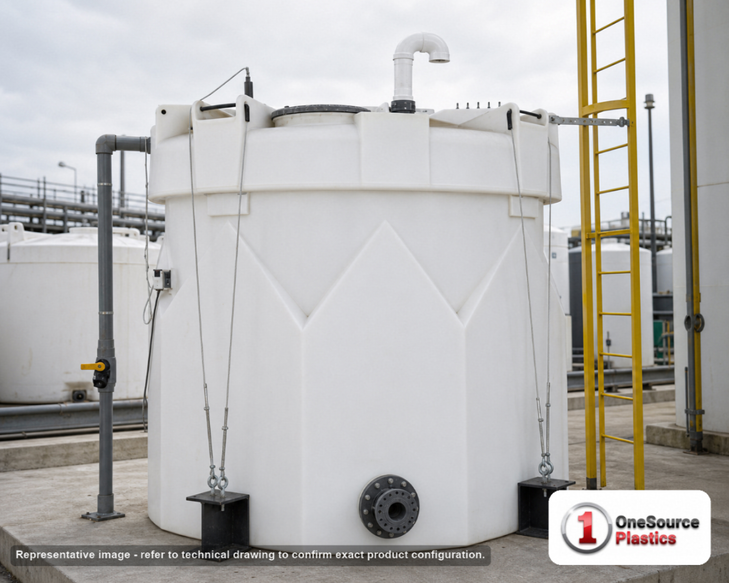
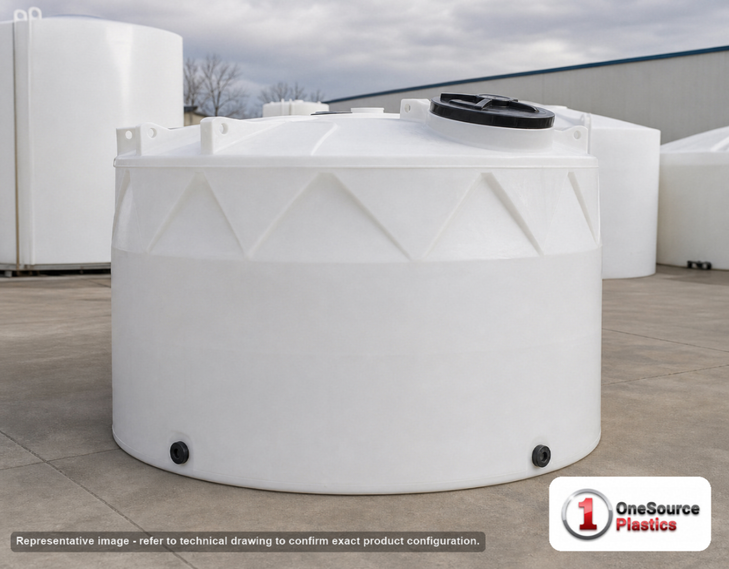
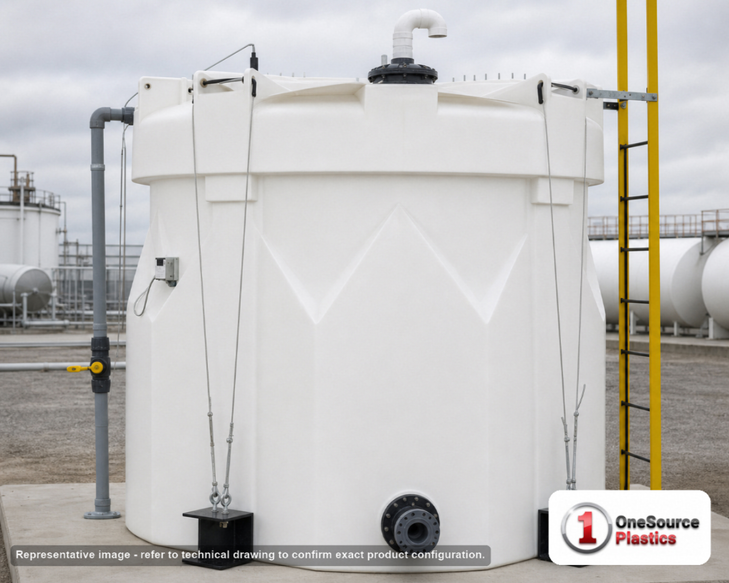
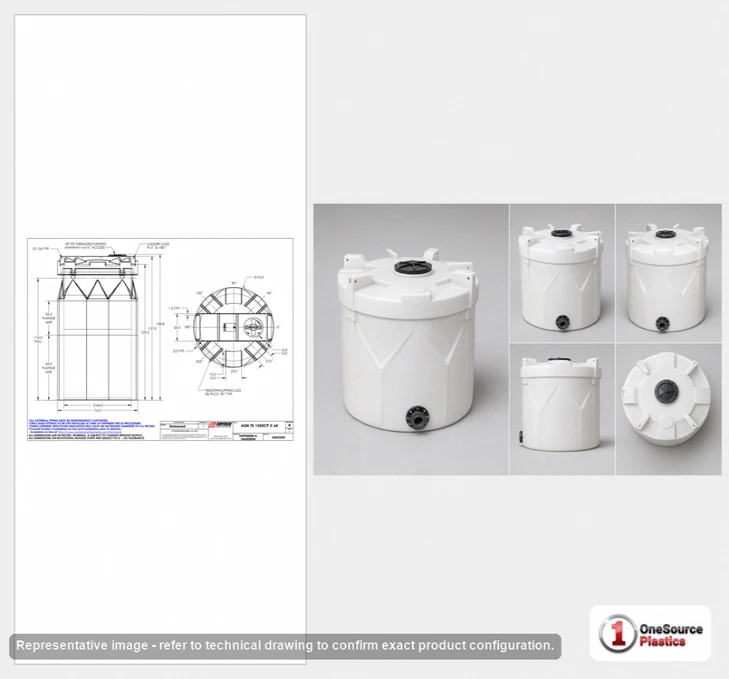
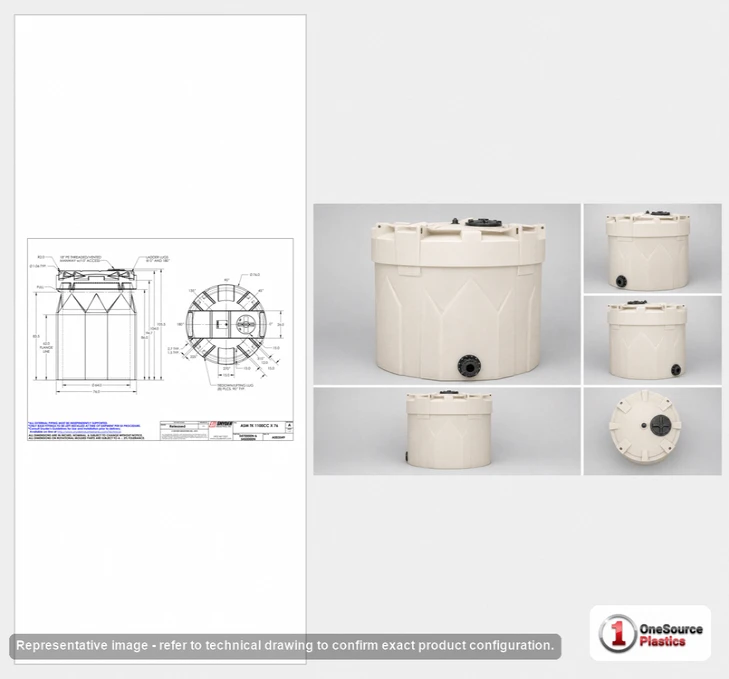
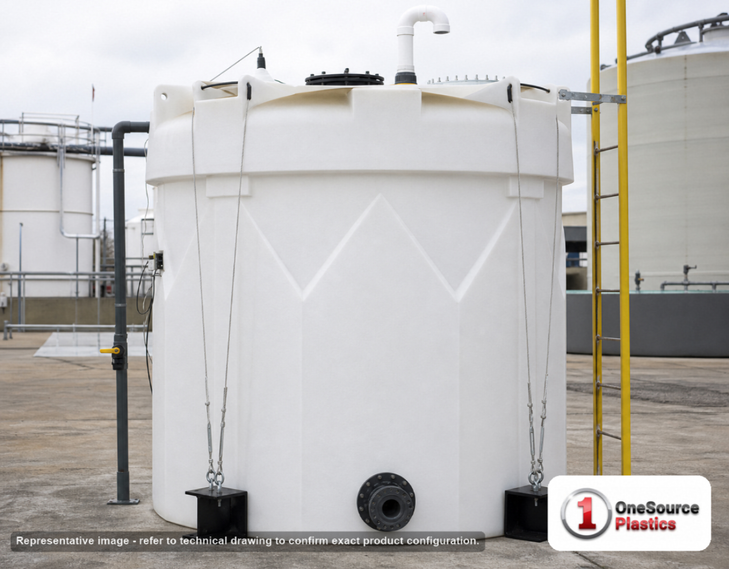
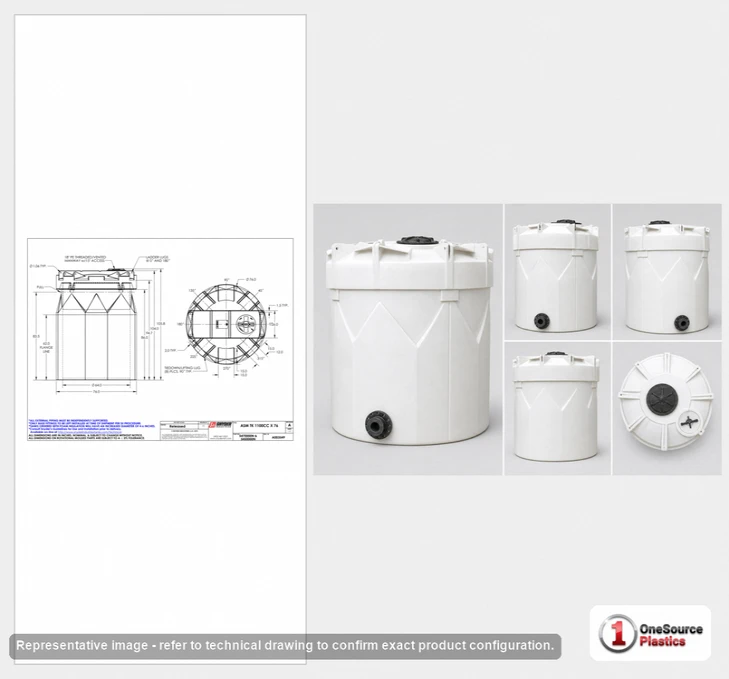
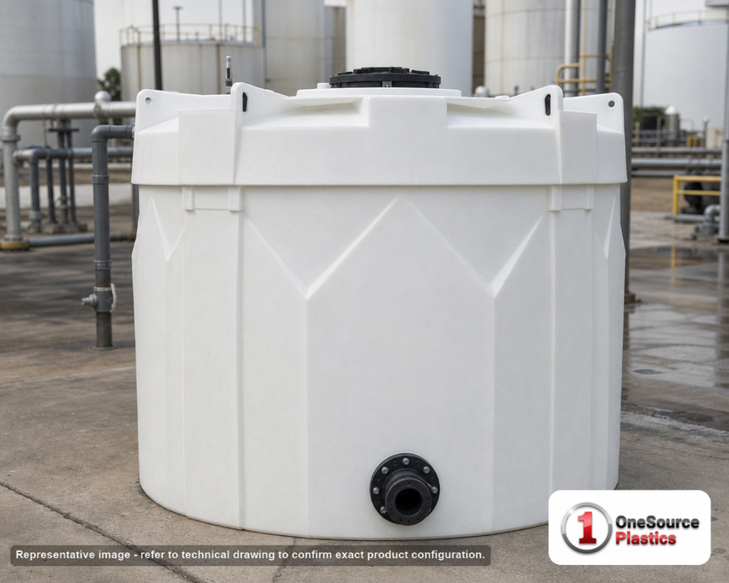
2,000 gallons, double wall, cross-linked polyethylene
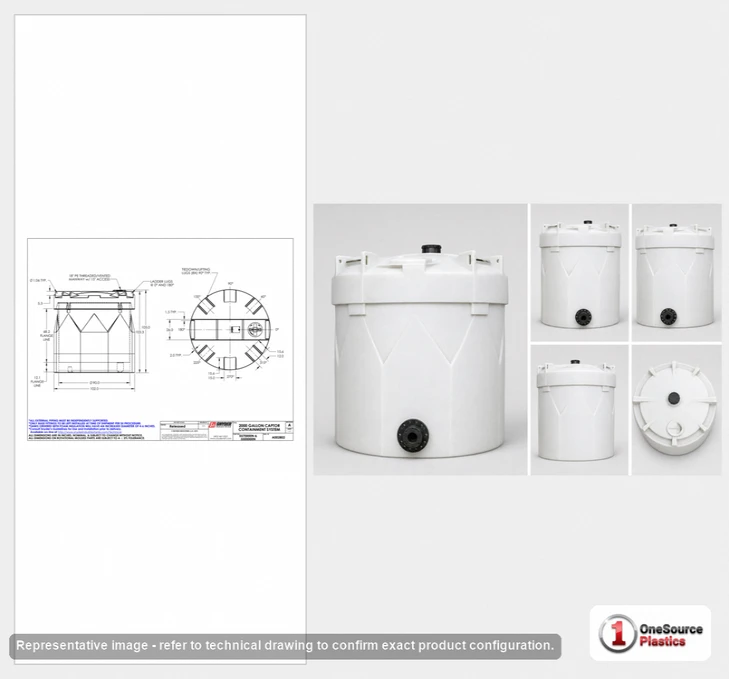
The Snyder 5570000N42 is the cross-linked polyethylene version of Snyder's 2,000 gallon double wall tank: a 102 inch by 103 inch shell, 1,180 pounds, with a primary rated for a specific gravity of 1.9, or 31,692 pounds of contents against 16,680 for water, standing inside its own secondary containment. Cross-linked resin is the wall for the chemicals that finish a linear tank, hypochlorite and the other oxidizers, sulfuric acid at strength, and anything stored warm; the double wall is the containment a spill plan asks for, and the low, wide shape keeps the manway within a short step. The primary carries an 18 inch threaded, vented manway; the warranty is 3 years.
Want it on the pad this month? Check freight to your ZIP, add it to your cart above, and 866-418-1777 will confirm the ship date.
Cross-linking plus containment at plant scale
Linear polyethylene softens with heat and creeps under sustained load; cross-linked polyethylene is molded with a catalyst that ties the polymer chains into one network, so it holds its shape under a dense liquid, resists the stress cracking oxidizers cause, and tolerates heat. The trade is that it cannot be plastic-welded, so fittings are bulkhead or bolted and any added port is decided before the tank is filled. The double wall keeps its containment inside the outer shell, so the 102 inch footprint is all the room it needs and the tank can stand inside an occupied building where a spill must never reach a floor drain; the SPCC 40 CFR 112 compliance walkthrough covers where a double wall tank satisfies a spill plan on its own. The chemistry list below is what the resin is rated for; check the liquid at its concentration in the chemical compatibility database. The tank sizing calculator turns feed rate and delivery interval into a volume, and the tank sizing guide covers the reserve; hypochlorite in particular is sized for short turnover.
Grades on the 102 x 103 inch double wall
| Part | Gallons | Diameter x height | Empty weight |
|---|---|---|---|
| 5570000N42 (this tank, XLPE) | 2,000 | 102 x 103 in | 1,180 lb |
| 5570000N45 (HDLPE) | 2,000 | 102 x 103 in | 1,180 lb |
| 5570000N48 | 2,000 | 102 x 103 in | 900 lb |
| 5490000N48 (tall) | 1,550 | 76 x 136 in | 780 lb |
| 5580000N30 (sulfuric grade) | 2,500 | 102 x 122 in | 1,100 lb |
The N45 is the linear-resin twin at the same weight, for milder chemicals and a lower price; the N48 is a lighter general grade at 900 pounds. The 5490000N48 is the tall 1,550 gallon double wall on a 76 inch base, 33 inches higher on a pad 26 inches narrower, and the 5580000N30 is the 2,500 gallon sulfuric-grade step up at 122 inches on this same base.
Need a different size? Every tank in the table is in stock programs; call 866-418-1777 for the one that fits.
Connections and the interstitial check
- Access: 18 inch threaded, vented manway on the primary, a short step up; vent outside on hypochlorite, acid and caustic, fill through a dip tube, and size the vent for a tanker's unload rate.
- Outlet: through both walls together, with the transition supported off the floor; specify the fitting for the chemical when ordering, and decide any added port before the tank is filled, because XLPE cannot be welded.
- Service limit: 120 F / 48 C.
Watch two levels: the primary, with a sender chosen for the chemical, since hypochlorite is hard on wetted parts, and the interstitial space, the leak alarm, with a float or conductivity switch, a glance into the port every shift, and a written check weekly. If the space is ever wet, the primary is leaking and the tank comes out of service the same day. Full, the tank loads a 102 inch circle to 31,692 pounds at the rating, a slab in full contact under the whole floor.
Filling from a tanker
Unloading a tanker pushes air out faster than a stock manway vent can pass it; size the vent for that rate, or fill through a dedicated top bulkhead vented separately. The fill pipe reaches the floor, so the liquid enters below the surface instead of free-falling and foaming. The first fill of a new tank is watched end to end: slab edge, outlet fitting and interstitial port, checked as the level comes up; after that, a dated log of each delivery and its strength is what turns a guess about turnover into a schedule, and for hypochlorite the schedule is short.
Where you will find one
Hypochlorite and acid bulk storage at water systems that cannot build a berm, oxidizer storage inside occupied buildings, and any regulated chemical at plant scale at a site an inspector visits. One chemical per tank, labeled for both inspectors at once, manway closed against vapor loss, and the tank shaded.
Shipping the tank
At 102 inches across the 5570000N42 is oversize freight (NMFC 156600) on a flatbed at a lane rate; the freight cost estimator prices it for your ZIP, and the listed price is before freight. A forklift with long forks sets 1,180 pounds on the slab. Water-test the primary, confirm the interstice stays dry through the hold, then drain and dry before the first chemical delivery. Walk the base after the first hard rain; a pad that shifts shows it at the edge first.
Liquids this resin is rated to store
These entries are the manufacturer's ratings for this resin, each with the concentration limit and the fitting and gasket to specify. Your concentration and temperature are confirmed on the chemical page or in the chemical compatibility database before ordering.
- acetic acid ), Aluminum Sulfate at 50% (PVC, EPDM
- aluminum sulfate ), Calcium Chloride at 40% (PVC, EPDM
- calcium chloride ), DEF at 32.5% (316SS fittings, EPDM gasket
- DEF ), Ethylene Glycol at 100% (PVC, EPDM
- ethylene glycol ), Ferric Chloride at 50% (PVC, EPDM
- ferric chloride ), Ferric Sulfate at 60% (PVC, EPDM
- ferric sulfate ), Ferrous Sulfate at 20% (PVC, EPDM
- ferrous sulfate ), Hydrofluosilicic Acid at 26% (PP/PVC fittings, Viton gasket
- hydrofluosilicic acid ), Magnesium Chloride at 30% (PVC, EPDM
- magnesium chloride ), Polyaluminum Chloride (PVC, EPDM
- polyaluminum chloride ), Potassium Carbonate at 50% (PVC, EPDM
- potassium carbonate ), Potassium Hydroxide saturated (PVC, EPDM
- potassium hydroxide ), Propylene Glycol (PP/316SS fittings, EPDM
- propylene glycol ), Sodium Carbonate at 30% (PVC, EPDM
- sodium carbonate ), Sodium Thiosulfate at 40% (PVC, EPDM
- sodium thiosulfate ), Urea Solution at 50% (PP/PVC, EPDM
- urea solution ), and Ozonated Water up to 10 PPM (PVC fittings, EPDM gasket). For DEF and urea or ozonated service, the gasket and fitting metallurgy not
Freight and documents
Ships from: Lincoln, NE. LTL freight is quoted to your ZIP with the freight cost estimator or by phone at 866-418-1777. The listed price is before freight.
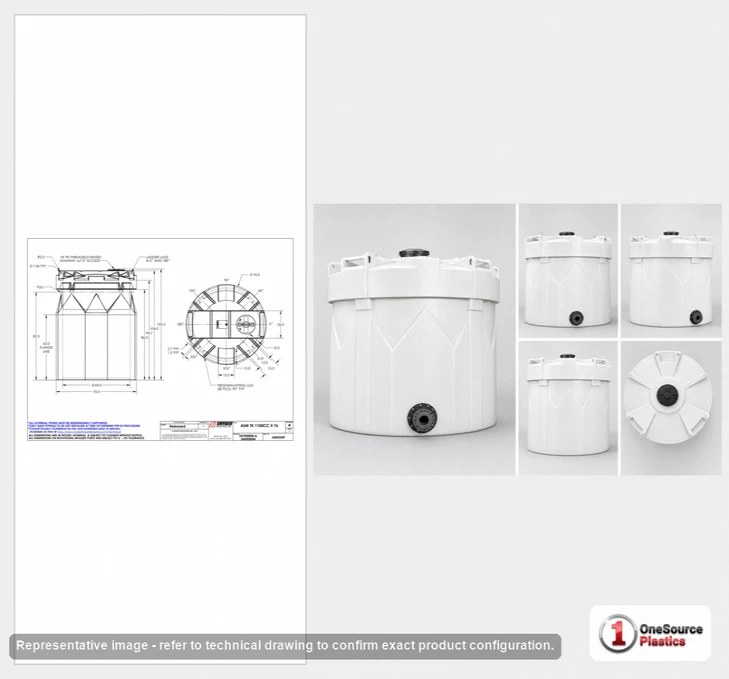
Technical drawing (PDF) for Snyder Industries 5570000N42.
See this tank
Product video. Watch the Snyder Industries 2000 Gallon XLPE Vertical Double Wall Liquid Chemical Storage Tank in White video (71 seconds) with dimensions, fittings and shipping notes.
Ready to order?
Add it to your cart at the top of this page, get LTL freight to your ZIP, or call 866-418-1777. The listed price is before freight.