225 gallons on legs, 52 inches long, 85 pounds empty
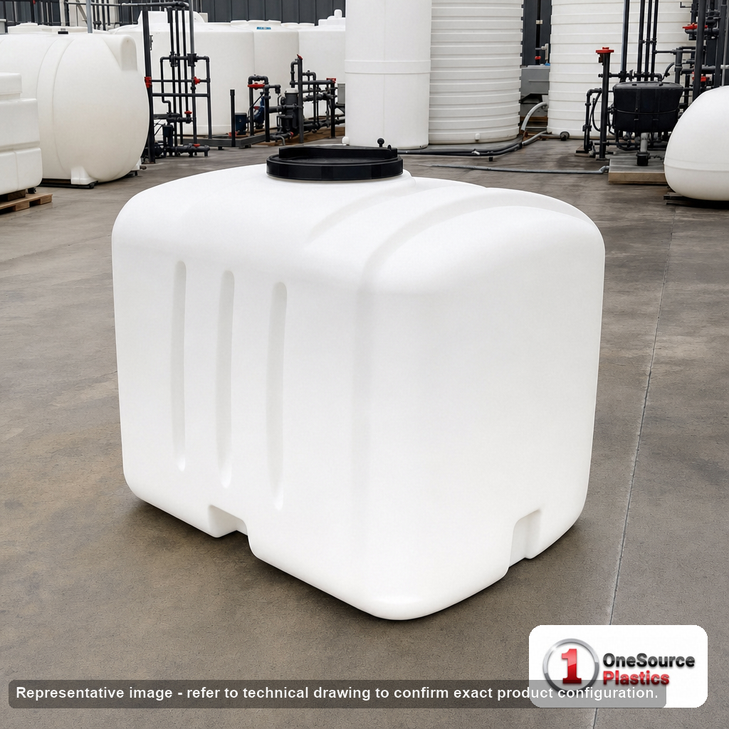
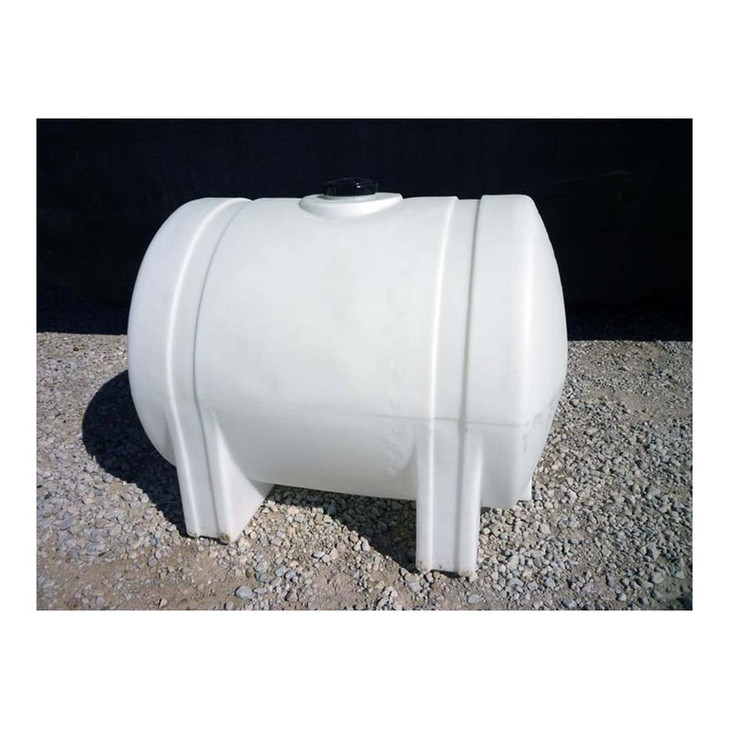
The Snyder SII-1003900N45 is a 225 gallon horizontal leg tank in white high density linear polyethylene, listed at 52 inches long, 38 inches wide and 42 inches tall, and 85 pounds empty. It is a deck tank: a shallow body carried on moulded legs that has to bear along their full length on a flat surface, filled through a lid and drained from the low end. The wall is rated at a specific gravity of 1.9, which gives 1,876 pounds for 225 gallons of water at 8.34 pounds per gallon and 3,565 pounds of max contents. The only fitting the sheet publishes is a 6 inch lid; the outlet and inlet fields are empty, so this page names no outlet size and no plumbing detail. The service limit is 120 F / 48 C. Freight is given as LTL under NMFC 156600-03, out of Marked Tree, Arkansas. There is no warranty term, no leg load rating and no over-the-road rating on the sheet, and none is claimed here.
Replacing a tank that failed? Call 866-418-1777 with what it held and how long it lasted; or check freight to your ZIP and put the 225 gallon tank in your cart above.
The 225 and the 230 are not the same tank
The family is the reason to read this page carefully, because the sheet lists a tank that looks like this one and is not. SII-1280000N45 holds 230 gallons on the same 52 by 38 inch plan, stands 43 inches tall against this tank's 42, and is listed at 68 pounds against this tank's 85. Same length, same width, near enough the same volume, and a substantial difference in listed weight. If the tank is going on a deck where the footprint is the constraint, the two are interchangeable and the choice is whichever is in stock and whichever your fleet already carries spares for. If the tank is being lifted on and off by hand, or if it is going on a light trailer where empty weight comes off the payload, the lighter body is the one to ask about. If a heavier moulding is what you want under a load that gets handled roughly, this is the one on the sheet at 85 pounds. Below both sits SII-1003600N45 at 125 gallons in a 44 by 32 by 35 inch envelope and 55 pounds, which is the tank for a short bed, a compact trailer or a job where 225 gallons is more water than the route needs. What all three share is what a leg tank asks for: continuous bearing under the full length of the legs on a solid deck, a plywood-topped skid or a poured pad, with no gap under the middle, no leg over an edge and nothing driven through a leg. Strap over the body at both ends and take the load against a headboard, because 1,876 pounds of water moves every time the vehicle does. Size the volume against your real draw and refill trip in the tank sizing calculator before the order, and take the freeboard a warm liquid needs from the tank sizing guide.
125, 225 and 230 gallons in the leg tank family
| Part | Gallons | Length x width x height | Empty weight |
|---|---|---|---|
| SII-1003900N45 (this tank) | 225 | 52 x 38 x 42 in | 85 lb |
| SII-1280000N45 (same plan, taller, lighter listing) | 230 | 52 x 38 x 43 in | 68 lb |
| SII-1003600N45 (smaller, shorter, narrower) | 125 | 44 x 32 x 35 in | 55 lb |
Three tanks, two footprints. The 125 gallon body is the only one that changes the plan: at 44 by 32 inches it takes eight inches less length and six inches less width than the other two, and at 35 inches tall it sits seven inches lower than this tank, which matters on a trailer where the tank has to clear a rail or a mirror line. It is also the lightest at 55 pounds, which is the one you can set on a deck alone. The 225 and the 230 share 52 by 38 inches and differ by an inch of height and the weight line discussed above. Buy on the deck first, the weight second and the gallons last, because the gallons in this family are decided for you once the footprint is fixed. One thing the sheet does not do is separate these tanks by wall material or by rating: all three are given at the same service limit, and this one at a specific gravity of 1.9. Where the load is a fertilizer blend that has to leave the tank the way it went in, or where somebody is deciding between a leg tank, a loaf tank and an upright for the same vehicle, the applicator and leg tank guide compares the shapes against the duty rather than against the price list.
Want the certified one or the plain one? Call 866-418-1777 and say what the inspector asks for; or request a quote on the row you need.
A 6 inch lid to breathe through, and no outlet on the sheet
- The air path, first: 6 inches is the only opening the sheet publishes, and on a tank being pumped down it is doing double duty as the fill point and as the way air gets back in. A shallow horizontal body with a tight lid and a pump drawing hard will pull its wall inward, and it does it faster in the sun. Keep the vent path in the lid clear, look at it every time the tank is opened, and close the lid before the vehicle moves.
- What 6 inches means for filling and cleaning: it is a hose-fill opening, not a bucket opening, and it is a narrow window to get a hand or a wash wand through. Plan the fill line and the rinse routine around the opening the sheet gives rather than the one you would like. Keep the hose end below the rim while filling.
- Outlet and suction: the sheet publishes none. No outlet, no inlet and no bulkhead appears on it, so no size is stated here, and the discharge is specified with the order or by whoever mounts the tank. Wherever it lands, the pump goes below the outlet with a short falling run into the suction; the whole standing height is 42 inches and every inch of lift is taken out of the prime.
- Draining a shallow body: a horizontal leg tank drains to the low end rather than to a centre sump, so park the deck with a fall toward the outlet end when the last of a load has to come out, and flush and drain in that same position before changing liquids.
- Ratings: a specific gravity of 1.9 on the wall, 1,876 pounds of water, 3,565 pounds of max contents, and a service limit of 120 F / 48 C. That is the whole published list.
The joint to get right is the first one off the tank: a flexible connector, a valve carried on its own bracket off the deck, and nothing rigid clamped between the tank and the vehicle. A tank that moves is a tank whose fitting takes the movement. Tell us the liquid when you order so the fitting, gasket and bolting are matched to it. Where a regulated product is stored or carried and somebody has raised containment, the Captor double-wall SPCC 40 CFR 112 walkthrough works through what a second wall actually buys and what it costs in usable volume.
Applicator decks, nurse loads and blend hauling
Two hundred and twenty-five gallons on a 52 inch deck length does nurse and applicator duty on farms, spray and rinse supply for contractors, hydrant and main flushing at small utilities, dust control and compaction water on job sites, and transfer or decant service in a shop under a tote. The regulatory question on a farm vehicle is what the load is and who is moving it, and the 49 CFR 173.5 agricultural exemption article sets out the scope honestly rather than promising it covers your trip. Ask it before the tank is loaded for the road, not after. Whatever the tank carries, dedicate it to one product where you can, label it, and rinse it on a schedule the operator can state without looking it up.
Listed chemical service for this shell
The maker's list for this resin: each liquid, the concentration it is rated to, and the fitting and gasket that go on the order. Verify your own service on the linked page or in the chemical compatibility database before ordering.
- Acetic Acid at 60% - PP/PVC fittings, EPDM gaskets
- Aluminum Sulfate at 50% - PVC fittings, EPDM gaskets
- Calcium Chloride at 40% - PVC fittings, EPDM gaskets
- DEF at 32.5% - 316SS fittings, EPDM gaskets
- Ethylene Glycol at 100% - PVC fittings, EPDM gaskets
- Ferric Chloride at 50% - PVC fittings, EPDM gaskets
- Ferric Sulfate at 60% - PVC fittings, EPDM gaskets
- Ferrous Sulfate at 20% - PVC fittings, EPDM gaskets
- Hydrochloric Acid at 37% - PVC fittings, Viton gaskets
- Hydrofluoric Acid at 48% - PP/PVC fittings, Viton gaskets
- Hydrofluosilicic Acid at 26% - PP/PVC fittings, Viton gaskets
- Hydrogen Peroxide at 50% - PVC fittings, Viton gaskets
- Magnesium Chloride at 30% - PVC fittings, EPDM gaskets
- Peracetic Acid at 30% - 316SS fittings, Aflas gaskets
- Phosphoric Acid at 85% - PVC fittings, Viton gaskets
- Polyaluminum Chloride - PVC fittings, EPDM gaskets
- Potassium Carbonate at 50% - PVC fittings, EPDM gaskets
- Potassium Hydroxide saturated - PVC fittings, EPDM gaskets
- Propylene Glycol - PP/316SS fittings, EPDM gaskets
- Sodium Bisulfate - PVC/PP fittings, EPDM gaskets
- Sodium Bisulfite - PVC/PP fittings, EPDM gaskets
- Sodium Carbonate at 30% - PVC fittings, EPDM gaskets
- Sodium Hypochlorite at under 16.5% - PVC fittings, Viton gaskets
- Sodium Thiosulfate at 40% - PVC fittings, EPDM gaskets
- Sulfuric Acid at 98% - CPVC fittings, Viton gaskets
- Urea Solution at 50% - PP/PVC fittings, EPDM gaskets
- Zinc Orthophosphate - PP/316SS fittings, EPDM gaskets
An Arkansas lane, 85 pounds, and the first water fill
This tank is molded at Marked Tree, Arkansas, which is the short lane into the Mid-South and the lower Mississippi valley and a long one to the west coast; it is worth pricing before you compare it with anything else. The sheet gives the freight class as LTL, a mode rather than a numeric class, under NMFC 156600-03, and it shipments at 52 by 38 by 42 inches, so it rides on a pallet rather than as a parcel. Quote the lane to your ZIP with the freight cost estimator; the listed price is before freight. Eighty-five pounds is a two-person lift or a forklift under the legs, never a drag by the lid. Set it on the deck or skid it will live on before anything is plumbed, then fill it with clean water on level ground and watch the legs for full contact and the lid for weeping through a complete load. Drain it, then put the working liquid in. Photograph the tank strapped down on its finished mounting on day one, because that photograph is what settles the argument after the first hard stop. Keep one spare gasket for the outlet fitting on the shelf; it is the part that fails on a holiday.
Freight and documents
Ships from: Marked Tree, AR. LTL freight is quoted to your ZIP with the freight cost estimator or by phone at 866-418-1777. The listed price is before freight.
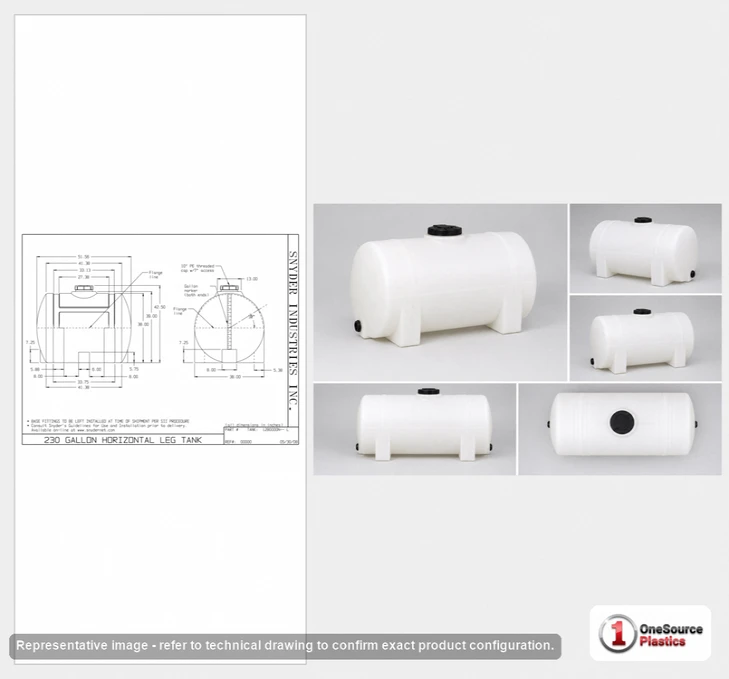
Technical drawing (PDF) for Snyder Industries 1003900N45.
See this tank
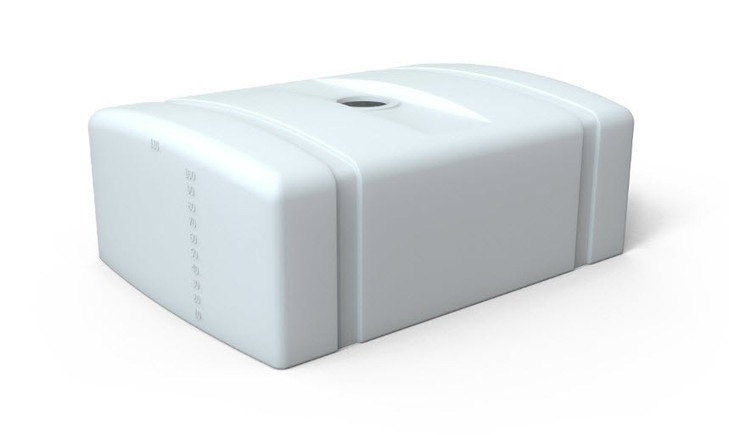
Interactive 3D model with live fill. This tank has an interactive 3D model built to its manufacturer dimensions. Rotate it, and set a fill level to see how much liquid it holds at any height. Open the 3D view on the product photo above. Download the 3D model (GLB).
Product video. Watch the Snyder Industries 225 Gallon Plastic Horizontal Leg Tank in White video (73 seconds) with dimensions, fittings and shipping notes.
Ready to order?
Add it to your cart at the top of this page, get LTL freight to your ZIP, request a written quote, or call 866-418-1777. The listed price is before freight.