Twenty-five cubic feet of dry material on a 48 inch square
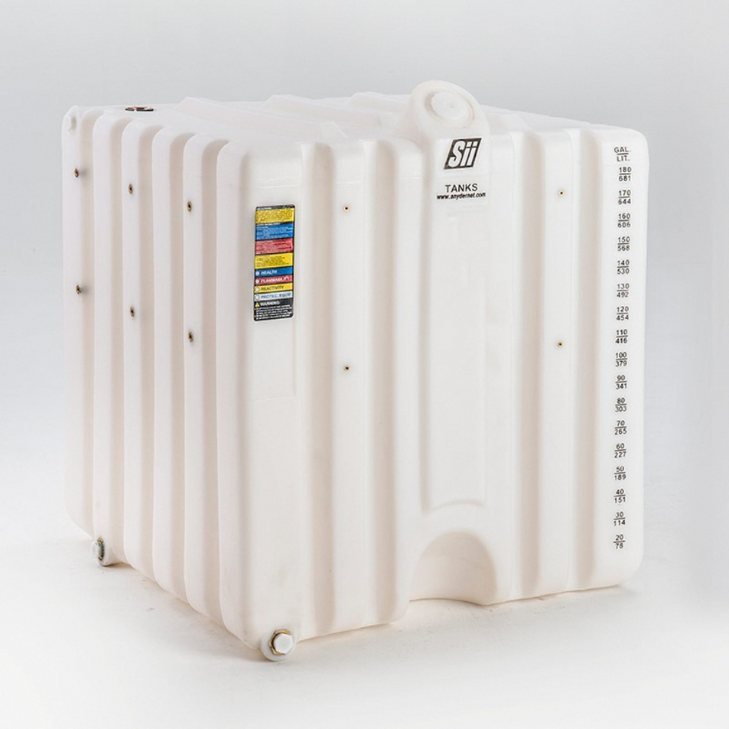
The Snyder SII-6370424N95402 is a Flowmaster dry hopper bin tank, rated by its own sheet at 25 cubic feet and listed under a product application of dry hopper bin tanks. It is white polyethylene, 48 inches long, 48 inches wide and 57 inches tall, at 330 pounds empty. A dry hopper bin is a container for dry material that discharges through a sloped bottom under its own weight, and that is how this page treats it throughout. The same sheet also carries a 190 gallon capacity figure, a specific gravity of 1.9, 1,585 pounds against 190 gallons of water at 8.34 pounds per gallon and 3,011 pounds of max contents; we print those exactly as the sheet gives them and assert no liquid duty, no liquid capacity and no specific gravity service for this bin. The outlet is listed as 2 inches and the lid as 12 inches. The service limit is 120 F / 48 C, and the sheet publishes no warranty term, no cone angle and no discharge height.
Want it on the pad this month? Check freight to your ZIP, add it to your cart above, and 866-418-1777 will confirm the ship date.
A 48 inch square base, a cone, and whatever you put under it
Buy this bin for the clearance underneath it, not for the volume inside it. The base plan is 48 inches square, which is the standard pallet footprint almost every plant already stores, moves and racks to, and the height is 57 inches, which clears a standard doorway and most low roller doors. Between the base and the discharge is the sloped section that makes it a hopper, and the whole purpose of that slope is that the material leaves without a shovel, an auger or a person inside the vessel. The number the sheet does not give is the height from the floor to the discharge, and that is the one number that decides whether a drum, a sack, a bag filler, a weigh hopper, a screw feeder or a mixer inlet fits underneath. Measure what has to go under it and tell us before the order rather than after the truck. The bin wants a flat, continuous, level bearing surface under the full 48 inch square, whether that is a slab, a deck or a purpose-built steel frame, and if it is going on a frame then the frame is what sets your discharge height and the frame is what has to be engineered for the load. Empty it is 330 pounds. What the loaded weight is depends entirely on the bulk density of what you put in it, which is a number we do not have and will not invent, so weigh the material or get the density from the supplier before you build anything under this bin. On a poured pad rather than a structural slab the concrete pad sizing guide for above-ground polyethylene tanks is where the loading question gets answered properly. For general sizing across our range the tank sizing calculator and the tank sizing guide are the tools we point people at, with the caveat that both are written around liquid volume and this is a bin sold in cubic feet.
Twenty-five cubic feet against the viscous bin and the feed stations
| Part | Rated as | Length x width x height | Empty weight |
|---|---|---|---|
| SII-6370424N95402 (this bin, dry) | 25 cu ft | 48 x 48 x 57 in | 330 lb |
| SII-6370425N95402 (viscous hopper bin) | 190 gal | 45 x 48 x 55 in | 330 lb |
| SII-5710103CF42 (chemical feed station) | 150 gal | 56 x 43 x 62 in | 138 lb |
| SII-5720103CF42 (chemical feed station) | 200 gal | 76 x 62 x 57 in | 198 lb |
The second row is the one people confuse this bin with, and the distinction is the reason to read the table. SII-6370425N95402 is the viscous hopper bin: rated in gallons, built for product that flows slowly but does flow, on a 45 by 48 inch plan at 55 inches tall. This bin is the dry one, rated in cubic feet, for material that is poured, augered or tipped in and falls out of the bottom. Both are listed at 330 pounds empty and they are two inches apart in plan and in height, so they will look interchangeable on a drawing and they are not. Order by the material, and if the material is a slurry, a paste or anything you would describe as wet, the viscous bin is the one to be reading about. The two feed stations in the last rows are a different family again and they are liquid vessels: 150 gallons at 138 pounds on a 56 by 43 inch plan, and 200 gallons at 198 pounds spread across 76 by 62 inches. They appear beside these bins because they land in the same volume band, and they are both much lighter and, in the 200 gallon case, much wider. Nothing in this page claims a dry duty for them or a liquid duty for this bin. Buy the vessel that matches the state of what you are storing, and where a supplier has given you a figure in one unit and your drawing is in another, send both to us and we will quote against the sheet rather than a conversion.
Which wall for your chemical? Call 866-418-1777 with the name and the concentration, or send a quote request and we will pick the row.
The 2 inch cone outlet and the 12 inch fill lid
- The discharge: the sheet lists a 2 inch outlet at the bottom of the sloped section. On dry material the outlet size and the material's own behaviour decide everything about flow, so the slide gate, the butterfly valve or the adapter that goes on it should be chosen against the material's particle size and flow character, not against the pipe you happen to have.
- Bridging and rat-holing: any dry material can arch over an opening or channel straight through the middle and leave the walls loaded. That is a material property rather than a fault in the bin, and it is designed around with the discharge arrangement and the fill habit. Tell us what the material is and how it behaves and we can point the discharge specification the right way.
- What goes under it: the receiving container, gate or feeder is supported on its own frame and never on the bin. Nothing bolted to a polyethylene wall carries hardware.
- Filling: a 12 inch lid on top at 57 inches. Twelve inches takes a bag chute, a fill spout, a lance or an arm, and it is the opening you will use for every inspection and every clean-out, so keep the space above it clear.
- Emptying completely: the slope takes most of it and no bin discharges itself entirely. Build in a way to look inside and a way to clean out before the first material goes in, especially where the plant runs more than one product through the same bin.
- Limits: 120 F / 48 C is the service limit and the only limit this sheet publishes. There is no warranty term, no cone angle and no bulk density rating on it, so this page states none.
Do not treat this as a liquid vessel because its sheet carries a gallon number. The sheet lists 190 gallons and a specific gravity of 1.9 alongside the 25 cubic feet rating, and we print those because they are what the sheet says, not because they describe a duty this bin is sold for. If your job is liquid, ask us for a liquid vessel and we will quote one.
Dry material held above the point that uses it
A dry hopper bin is bought where a bag, a sack or a drum has become the bottleneck: resin pellets and regrind at a moulding plant, powdered chemical at a treatment works, granular additive or pigment on a compounding line, blended feed or seed on a farm or at a mill, salt, lime and grit at a municipal yard, abrasive media in a blast shop, and powder that is decanted into small containers for issue. In all of those the reason to lift the material off the floor and put it over the process is the same: gravity is free and handling is not. What this bin gives you is a pallet-sized plan, a sloped bottom and an opening big enough to fill through properly, at a weight a forklift handles all day. What it does not give you is a flow guarantee for your particular material, and anyone who offers you one without asking what the material is has not understood the question.
Shipped 48 by 48 by 57 out of Nebraska
This bin is moulded at Lincoln, Nebraska, and the sheet lists Nebraska as the state it ships from. The freight class is given as LTL under NMFC 156600-03, and the shipping size is 48 inches long by 48 inches wide by 57 inches high, which is a plain pallet footprint at a height that goes through a standard dock door standing up. Price the lane to your ZIP with the freight cost estimator; the listed price is before freight. Three hundred and thirty pounds empty means forks or a pallet jack at both ends, so book the machine for the delivery window rather than the afternoon. Take it from under the base and never by the lid or the discharge. Set it on its final position or its frame, get the gate and the receiving container fitted underneath, and then run a harmless material through it before the real one: a bin that has never been emptied is a bin whose flow you are still guessing at, and the cheapest time to find that out is before it is full of something expensive. Walk the base after the first hard rain; a pad that shifts shows it at the edge first.
Freight and documents
Ships from: Lincoln, NE. LTL freight is quoted to your ZIP with the freight cost estimator or by phone at 866-418-1777. The listed price is before freight.
Technical drawing (PDF) for Snyder Industries 6370424N95402.
See this tank
Product video. Watch the Snyder Industries 25 Cubic Feet Plastic Flowmaster Dry Hopper Bin Tank video (72 seconds) with dimensions, fittings and shipping notes.
Ready to order?
Add it to your cart at the top of this page, get LTL freight to your ZIP, request a written quote, or call 866-418-1777. The listed price is before freight.