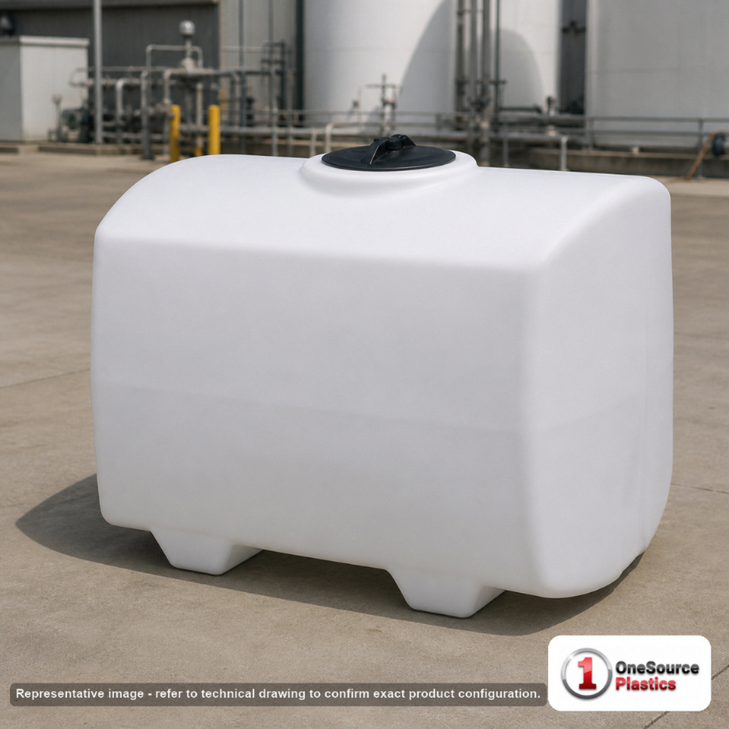
A cross-linked 150, 62 inches tall and 138 pounds
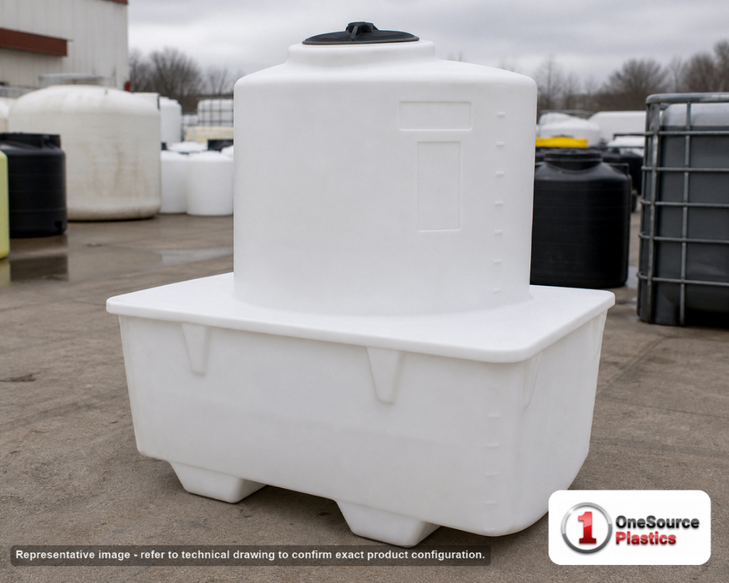
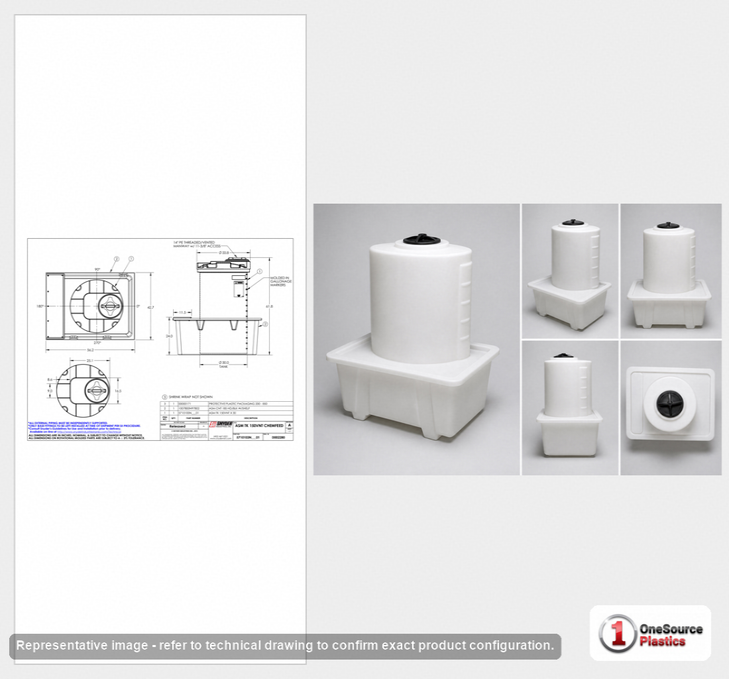
Cross-linked polyethylene is the whole reason this part number exists. The Snyder SII-5710103CF42 is a 150 gallon chemical feed station tank, white, 56 inches long by 43 inches wide by 62 inches tall, 138 pounds empty, standing on the floor rather than on a stand, and the sheet names its material as cross-linked polyethylene where its otherwise identical stablemate is linear. Cross-linked is the wall to specify when the chemistry or the handling is hard on a tank; on the same shell at the same listed height and weight, that is the only thing you are choosing between. As a feed station it does what the family does: holds a day tank charge for a metering pump, sits where the pump can draw from it, and is filled from a drum, a tote or a delivery hose. The sheet rates the wall at a specific gravity of 1.9, giving 1,251 pounds for 150 gallons of water at 8.34 pounds per gallon and 2,377 pounds of maximum contents. The lid is 14 inches, the service limit is 120 F / 48 C, and no warranty term is published.
Two ways to buy. Add it to your cart above with freight quoted to your ZIP, or request a written quote for a job that needs paperwork.
Same plant, same shipment, different wall
Start with what does not change. This station is molded at Marked Tree, Arkansas and shipments at 56 by 43 by 62 inches at 138 pounds, exactly as its linear-walled stablemate does, so the freight lane, the door clearance, the unloading and the floor plan are the same conversation for both. One pallet, ordinary LTL, no crane and no permit: that is what makes a 150 gallon station a purchase rather than a project, and it is why plants buy one instead of dosing out of drums or building a bulk installation outside. What does change is the wall, and it changes for one reason. Where the chemical is aggressive, where the station is charged, drained and recharged constantly, where the room runs warm, or where the tank is going to be knocked about by the traffic in a working plant room, a cross-linked wall is what gets specified. The sub-code on this part's freight listing also differs from its stablemate's on an identical shipment; the sheet gives both and we print what it says rather than explaining it. The site work is the same discipline either way, and it is worth stating plainly because a good wall on a bad floor still fails. Fifty-six by 43 inches goes down on a level, continuous, finished surface that carries the whole base: a chemical room floor, a coated slab, a poured pad, or the deck of a bund sized for the largest vessel in it. Not on two rails with a hollow under the middle, not on a pallet as a permanent home, not part on a kerb. At 62 inches the lid is roughly chest height, so the tank is charged from the floor without a platform, which is the standing advantage of the floor-mounted version and the thing you give up by buying the stand. What you give up in return is the flooded suction: with the tank on the floor, the metering pump either sits in a pit, sits beside the tank and lifts, or you buy the version on the stand. Settle that before the room is laid out. Then settle the charge itself against your dosing rate and delivery interval in the tank sizing calculator, with the reserve and freeboard discipline from the tank sizing guide.
Cross-linked or linear at 150 gallons
| Part | Wall | Height | Empty weight |
|---|---|---|---|
| SII-5710103CF42 (this tank, on the floor) | Cross-linked | 62 in | 138 lb |
| SII-5710103CF45 (on the floor) | Linear | 62 in | 138 lb |
| SII-5710104CFWS42 (with stand) | Cross-linked | 78 in | 174 lb |
| SII-5710104CFWS45 (with stand) | Linear | 78 in | 174 lb |
| SII-5700103CF42 (smaller, on the floor) | Cross-linked | 51 in | 130 lb |
Read this table in pairs. The first pair is the wall decision at 62 inches and 138 pounds: this tank in cross-linked polyethylene, SII-5710103CF45 in the linear wall the sheet names for that part, identical in every published dimension and weight. The second pair is the same wall decision at 78 inches and 174 pounds, on the stand. So there are two questions and not four options, and they are independent of each other. Do I need the pump under the tank on a flooded suction? Then take a 78 inch version. Is the chemistry or the handling hard on a tank? Then take a cross-linked wall, which is what this part number is. The reason to buy this one specifically is the combination: the harder wall at the lower height, for a plant that wants the tougher tank but has a ceiling, a duct or a hand-charging routine that rules out the stand. SII-5700103CF42 is the same cross-linked wall at a smaller charge, 120 gallons at 51 inches and 130 pounds, and it is only worth taking when eleven inches of height genuinely decides the installation, because it costs thirty gallons of working charge for almost no floor area and almost no weight. One sibling on the sheet is not a feed station at all: SII-6370424N95402 is a dry hopper bin tank rated at 25 cubic feet, 190 gallons, 48 by 48 by 57 inches and 330 pounds, made for dry material discharged through a hopper. It is listed beside these because the volume is similar; nothing about liquid duty is claimed for it here.
Torn between two rows? Call 866-418-1777 with the liquid and the ceiling height, or ask for a quote on both and compare the freight.
Charging the tank: the lid, the coupling and the vent path
- The opening: a 14 inch lid at 62 inches off the floor. That is the working height that makes this version easy to live with. A drum pump wand, a delivery coupling and a hand sampler all reach from the floor, and no open container has to go above shoulder height.
- Charging it properly: run the delivery into a fixed coupling rather than over the rim, keep the hose end below the surface where the chemical foams or gives off vapour, and charge to a marked level rather than to the sound of it. Fourteen inches is a good filling opening and a tight cleaning one, so plan the wash-out around it.
- The vent path: clear at all times, particularly while a pump is drawing. A cross-linked wall is a harder wall, not an immune one, and a closed lid over a drawing pump will pull on any polyethylene tank.
- The discharge: this sheet publishes no outlet fitting. No pipe size, no valve and no bulkhead assembly is named on this page for that reason. Give us the chemical and the pump and we will get the discharge arrangement confirmed by the maker in writing before the station ships.
- Everything after the discharge: isolation valve at the tank, flexible connector at the first joint, cleanable strainer before the pump, and all pipe weight carried on its own supports rather than on the tank.
- Pump protection: a low level float or probe that stops the pump while liquid is still above the fitting.
- Limits: 120 F / 48 C is the only service limit this sheet publishes, and it states no warranty term.
Two things are worth doing on the day the station is commissioned rather than in the second year. Put the level reading where the operator actually stands and choose it for the chemistry, using the level gauge selection guide. And mark the tank once, correctly, with the tank label and signage guide, which reconciles the standards a fire inspector and a workplace inspector will each hold you to. Both jobs take an afternoon and both are miserable to retrofit around live pipework.
Harder chemistries and longer service
A cross-linked station goes where the duty is demanding: acid and caustic dosing at water and wastewater plants, metal finishing and plating lines, pickling and cleaning chemistry, pulp and paper additives, mining reagents, and any day tank that is charged and drained hard enough that the tank is handled as much as the chemical is. The wall is the reason to buy it, and the sampling discipline is the reason it keeps working correctly: what the process gets is the charge in the tank, and what you believe about the charge is whatever the last sample said. The chemical sampling protocol article covers stratification, sediment and the container mistakes that produce a wrong result nobody questions. Same point, same depth, same cadence, logged.
Rated chemistries for this tank
The manufacturer lists these liquids for this resin at the concentrations noted, with the fitting and gasket material to specify. Check the concentration and temperature you actually run on the linked page or in the chemical compatibility database before ordering.
- PP/PVC fittings, EPDM gaskets ), Aluminum Sulfate at 50% (
- PVC, EPDM ), Calcium Chloride at 40% (
- PVC, EPDM ), DEF at 32.5% (
- 316SS, EPDM ), Ethylene Glycol at 100% (
- PVC, EPDM ), Ferric Chloride at 50% (
- PVC, EPDM ), Ferric Sulfate at 60% (
- PVC, EPDM ), Ferrous Sulfate at 20% (
- PVC, EPDM ), Hydrofluosilicic Acid at 26% (
- PP/PVC, Viton gaskets ), Magnesium Chloride at 30% (
- PVC, EPDM ), Polyaluminum Chloride (
- PVC, EPDM ), Potassium Carbonate at 50% (
- PVC, EPDM ), Saturated Potassium Hydroxide (
- PVC, EPDM ), Propylene Glycol (
- PP/316SS, EPDM ), Sodium Carbonate at 30% (
- PVC, EPDM ), Sodium Thiosulfate at 40% (
- PVC, EPDM ), and Urea Solution at 50% (
- PP/PVC, EPDM ). Ozonated Water is rated up to 10 PPM with PVC fittings and EPDM gaskets - note that 10 PPM is a trace-oxidant limit, not a 10% solutio
Freight priced on a 56 by 43 by 62 inch shipment
Molded at Marked Tree, Arkansas. The sheet gives the freight class as LTL, a mode and not a numeric class, under NMFC 156600-01, and the shipment as 56 by 43 by 62 inches at 138 pounds. Price it to your ZIP with the freight cost estimator; the listed price is before freight. This is the lower of the two shipment heights in the 150 group, which usually means no argument with a door header, but measure the aisle and the turn anyway, because a pallet jack needs more room to turn than a tank needs to stand. Forklift under the base or two people under the body, never the lid. Set it on its final, level floor or bund deck before anything is plumbed to it, water-fill it once and read the base and the lid seal, then drain it dry before the chemical is delivered. Keep the first-fill date and the chemical name on the tank where the delivery driver will see them; a station that is not labelled is a station that will eventually take the wrong load. The first fill is the only cheap time to find a problem, so do it in daylight with someone watching the base.
Freight and documents
Ships from: Marked Tree, AR. LTL freight is quoted to your ZIP with the freight cost estimator or by phone at 866-418-1777. The listed price is before freight.
Technical drawing (PDF) for Snyder Industries 5710103CF-42.
See this tank
Product video. Watch the Snyder Industries 150 Gallon XLPE Chemical Feed Station Tank video (67 seconds) with dimensions, fittings and shipping notes.
Ready to order?
Add it to your cart at the top of this page, get LTL freight to your ZIP, request a written quote, or call 866-418-1777. The listed price is before freight.