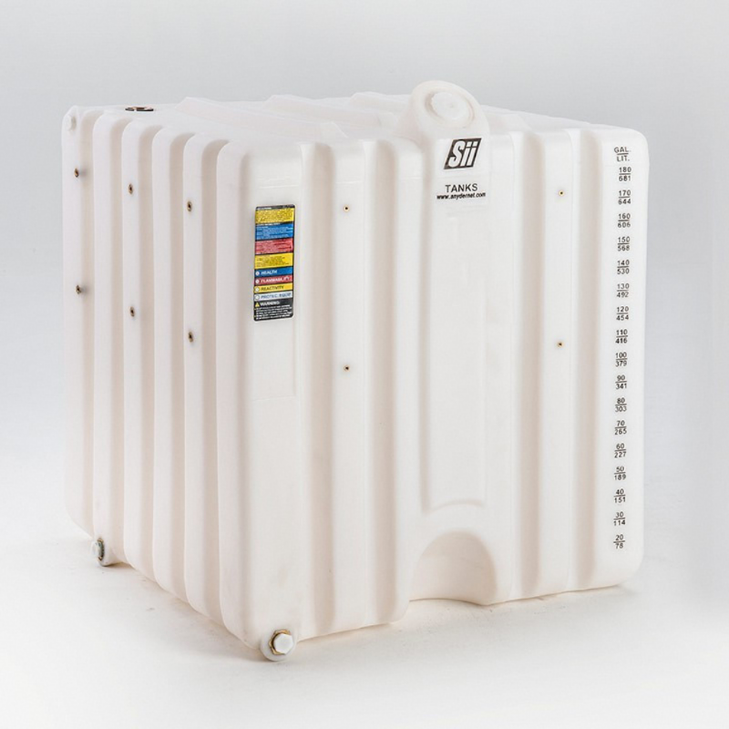
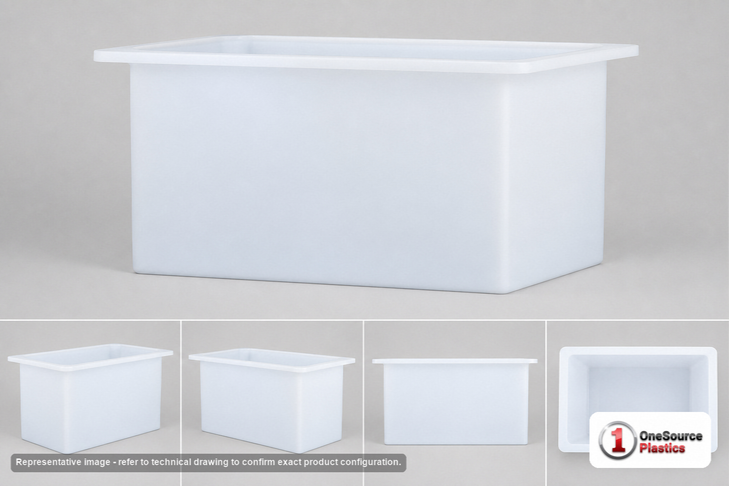
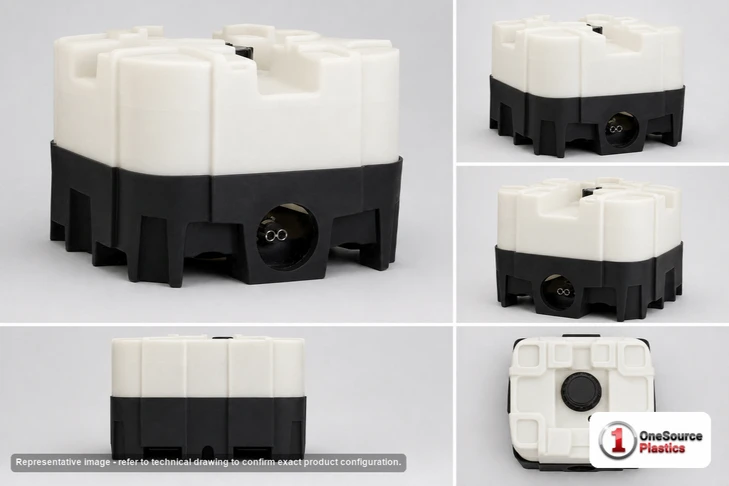
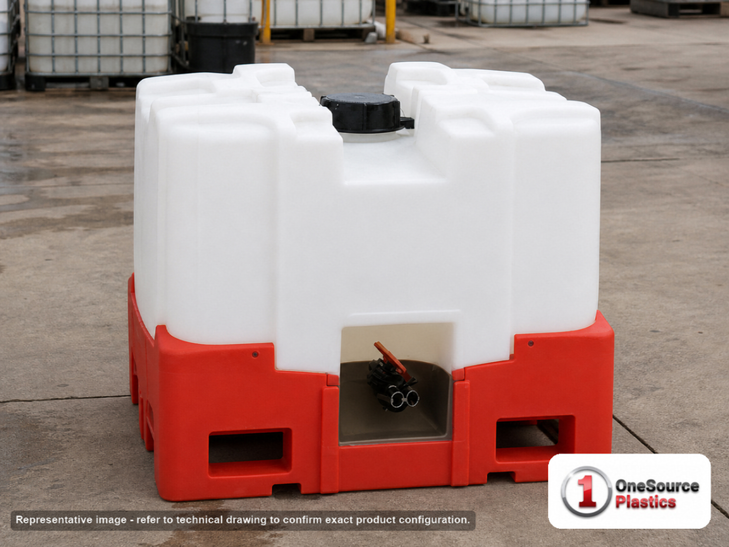
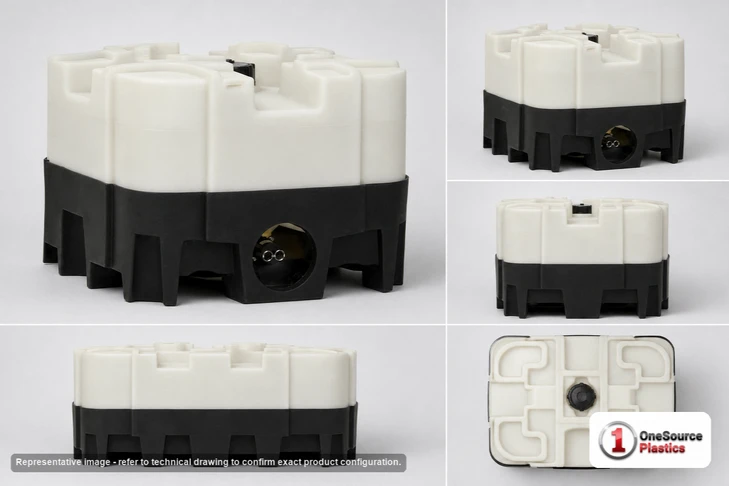
A 220 gallon stackable tote, 45.75 inches square and 46.25 inches tall
The Snyder SII-6630023B97203 is a 220 gallon stackable IBC tote tank in high density polyethylene, 45.75 inches long, 45.75 inches wide and 46.25 inches tall, listed at 188 pounds empty and 188 pounds to ship, molded at Lincoln, Nebraska. Its name says black and its colour field says white; the sheet gives both, and we print what it says rather than choosing. It arrives fitted: a 2 inch polypropylene female NPT bulkhead inlet, a 2 inch ball valve for the outlet and a 6 inch threaded vented lid. The sheet rates it at a specific gravity of 1.9, which is where the 3,486 pound maximum contents figure comes from, against 1,835 pounds for 220 gallons of water at 8.34 pounds per gallon. The service limit is 105 F / 41 C, the lowest in this group. Freight is class LTL. The sheet names it stackable and publishes no stacking load rating and no warranty term, so this page asserts neither; ask us and we will get Snyder's current terms in writing.
Buying on a purchase order? Request a written quote and we will return it with freight to your ZIP; card buyers add the 220 gallon tank to the cart above.
Why a tote ships differently from a tank, out of Lincoln, Nebraska
A tote is bought for the way it moves, and that starts at the plant. This one is molded at Lincoln, Nebraska and the sheet gives its class as LTL at 45.75 by 45.75 by 46.25 inches and 188 pounds. Read those numbers as a shipping unit rather than a tank: a footprint a shade under four feet square and a height a shade under four feet, which is pallet-scale in every direction. That is what separates a tote from everything else in this catalogue. It goes on a standard trailer with other freight instead of taking a permitted load to itself, it comes off with any forklift or pallet jack on the site, it fits through a roller door and down a plant aisle, and it goes back out the same way when the product changes or the vessel is done. A bulk tank arrives once and stays; a tote is a unit of handling that keeps moving for its whole life, and everything about the shape follows from that. Two consequences are worth planning for. The first is the floor, not the pad: a tote lives on a warehouse or plant floor, so the question is not slab design but whether the floor is level where it stands, whether it is somewhere a pallet jack can reach, and whether a full one at 1,835 pounds of water, or up to 3,486 pounds of contents at the rating, is sitting somewhere the building's floor loading allows. The second is traffic. The commonest damage to a tote is a pallet corner, a forklift tine or a dropped pipe, all of it at the valve, so the outlet faces away from the aisle and there is a kerb, a rack upright or a bollard between the tote and the traffic. The sheet names this one stackable and publishes no stacking load rating, so we state none: ask us and we will get Snyder's current stacking terms in writing before anything is put on top of anything. Whether a tote is the right tier for your volume at all, against a drum or a bulk tank, is worked through in the container against tank buying guide, and the arithmetic of turnover, handling and total cost that decides it is set out in the drum against tote against bulk tank break-even analysis. Check 220 gallons against your real draw in the tank sizing calculator, and take the reserve and the headspace a warming liquid needs from the tank sizing guide.
Five totes on one sheet, from 180 to 245 gallons
| Part | Gallons | Length x width x height | Empty weight |
|---|---|---|---|
| SII-6630023B97203 (this tote, the lightest and lowest of the 220s) | 220 | 45.75 x 45.75 x 46.25 in | 188 lb |
| SII-6630023B97202 (same volume, taller, heavier) | 220 | 45 x 45 x 48 in | 243.1 lb |
| SII-6630041B97202 (same volume, taller) | 220 | 45 x 45 x 48.5 in | 211 lb |
| SII-6820000B97202 (same volume, tallest and heaviest) | 220 | 46 x 46 x 54 in | 295.9 lb |
| 6984100B51301 (smaller, rectangular, low) | 180 | 42 x 48 x 29.25 in | 351 lb |
| 6984000B32217 (larger, rectangular, low) | 245 | 42 x 48 x 35.25 in | 389 lb |
Four part numbers here hold 220 gallons and none of them are the same unit. This one is the lowest and the lightest on the sheet at 46.25 inches and 188 pounds, which is the pair of figures to buy it for: a lower tote is easier to fill from a hose, easier to look into, less top-heavy on a pallet jack across a rough floor, and it goes under a low door or a conveyor that a 54 inch tote will not clear. The SII-6630023B97202 and the SII-6630041B97202 put the same volume in a 45 inch square at 48 and 48.5 inches tall, listed at 243.1 and 211 pounds, and the SII-6820000B97202 goes to 46 inches square and 54 inches tall at 295.9 pounds. The sheet gives all of those figures and explains none of the weight differences, so they are printed as given. The last two rows are a different animal entirely: the 180 gallon 6984100B51301 and the 245 gallon 6984000B32217 are 42 by 48 inch rectangles only 29.25 and 35.25 inches tall, listed at 351 and 389 pounds, which is a much lower unit on a standard pallet rectangle and a much heavier empty weight. Those are the ones to look at when the height is capped hard or the footprint has to match a pallet position exactly, and the weight is somebody else's problem. Between all six, pick on height and footprint first, because the volume barely moves and the shapes do.
Ready to choose a row? Add the 220 gallon tank to your cart above with freight quoted to your ZIP, or 866-418-1777 will confirm it against the site first.
The 6 inch threaded vented lid on top, and the 2 inch ball valve below
- Filling through the top: a 6 inch threaded vented lid. That is the opening you will use every week, so it sets the routine. It takes a fill hose, a light and a hand for a wipe-out, and the vent is what lets the tote breathe while it is filled and drawn. Keep the vent path clear; a tote pumped out through a blocked vent will pull its own wall in, and a 45.75 inch square body flexes visibly when it does.
- Filling through the wall: a 2 inch polypropylene female NPT bulkhead inlet, as the sheet lists it, which is where a pumped or piped fill lands so the product is not falling into the lid from height. Take the fill down inside the body rather than splashing it across the surface.
- Drawing it off: a 2 inch ball valve, as the sheet lists it. A ball valve is a quarter-turn on, quarter-turn off fitting, which means it is fast, it is easy to read at a glance, and it is very easy to leave open by accident; so the discipline on a tote is that the valve is closed, capped and checked before the unit is moved, every time. Support anything heavy that hangs off it on its own bracket rather than on the valve body.
- Moving it full: at 1,835 pounds of water, or up to 3,486 pounds of contents at the rating, this is a machine job, and a part-full tote sloshes with a long slow wave across nearly four feet of width. Drive it slowly, turn it slowly, and never lift or drag it by the valve or the lid.
- Service limit: 105 F / 41 C, the lowest limit in this group and a number worth knowing. That covers the liquid and the tote standing in the sun on a loading dock, which on a summer afternoon is not a theoretical figure. No warranty term is published on this sheet.
- Stackable, with no figure: the sheet names the tote stackable and gives no stacking load rating, so nothing about stacking is asserted here. Ask us before anything goes on top.
Tell us the liquid at order and the valve, the gasket and the bulkhead fitting get matched to it against Snyder's current documentation instead of guessed at the counter, and label the tote for the one product it holds and keep it to that product, because a tote is easy to rinse and hard to prove clean. Where site rules require the liquid to sit inside a barrier, a tote does not provide one: what containment has to do for a waste or hazardous liquid, the leak detection options and the inspection cadence that goes with them, is set out in the secondary containment and leak detection guide, and the case for a contained tank instead of a container plus a structure is compared in the Captor containment comparison. In freezing weather, drain the valve and the hose and leave the body alone.
Process fluid turnover where a drum is too small and a tank is too much
Two hundred and twenty gallons is the tier that replaces four drums without committing a site to a tank. The work it does: a process fluid, cleaner, coolant, additive or concentrate held at a production line and drawn by pump or by valve; a chemical delivered in a tote and used from the tote, with no decanting and no drum handling; a batching or blending supply at a food, beverage, cosmetics or specialty chemical plant; waste and spent-solution collection waiting on a collection cycle; a mobile supply that goes out on a truck to a job, a site or a second building and comes back; a seasonal liquid stored and handled a few times a year, where a tank would stand empty for nine months. The reason to buy a tote instead of drums is handling: one valve instead of four bungs, one unit for a forklift to move, one label to keep right, and a far smaller floor area per gallon. The reason to buy a tote instead of a tank is that it leaves. When a product changes, a line moves or a contract ends, a tote goes out on the same trailer it came in on, and that optionality is worth real money on a site whose product mix changes. Two honest limits. There is no secondary containment on a tote, so where a barrier is required it has to come from the floor, the bund or a contained tank instead. And the 105 F / 41 C service limit is the lowest figure in this group, so a tote that stands in the sun on a dock or takes a warm charge off a process needs shade, a cooler charge, or a different vessel.
Service list by chemical
One line per liquid the maker rates for this resin, with the concentration it is rated to and the fitting and gasket to order. Take your own concentration and temperature to the linked page or the chemical compatibility database before ordering.
- Acetic Acid (60%) - PP/PVC fittings, EPDM gaskets
- Aluminum Sulfate (50%) - PVC fittings, EPDM gaskets
- Calcium Chloride (40%) - PVC fittings, EPDM gaskets
- DEF (32.5%) - 316SS fittings, EPDM gaskets
- Ethylene Glycol (100%) - PVC fittings, EPDM gaskets
- Ferric Chloride (50%) - PVC fittings, EPDM gaskets
- Ferric Sulfate (60%) - PVC fittings, EPDM gaskets
- Ferrous Sulfate (20%) - PVC fittings, EPDM gaskets
- Hydrochloric Acid (37%) - PVC fittings, Viton gaskets
- Hydrofluoric Acid (48%) - PP/PVC fittings, Viton gaskets
- Hydrofluosilicic Acid (26%) - PP/PVC fittings, Viton gaskets
- Hydrogen Peroxide (50%) - PVC fittings, Viton gaskets
- Magnesium Chloride (30%) - PVC fittings, EPDM gaskets
- Peracetic Acid (30%) - 316SS fittings, Aflas gaskets
- Phosphoric Acid (85%) - PVC fittings, Viton gaskets
- Polyaluminum Chloride - PVC fittings, EPDM gaskets
- Potassium Carbonate (50%) - PVC fittings, EPDM gaskets
- Potassium Hydroxide (saturated) - PVC fittings, EPDM gaskets
- Propylene Glycol - PP/316SS fittings, EPDM gaskets
- Sodium Bisulfate - PVC/PP fittings, EPDM gaskets
- Sodium Bisulfite - PVC/PP fittings, EPDM gaskets
- Sodium Carbonate (30%) - PVC fittings, EPDM gaskets
- Sodium Hypochlorite (under 16.5%) - PVC fittings, Viton gaskets
- Sodium Thiosulfate (40%) - PVC fittings, EPDM gaskets
- Sulfuric Acid (98%) - CPVC fittings, Viton gaskets
- Urea Solution (50%) - PP/PVC fittings, EPDM gaskets
- Zinc Orthophosphate - PP/316SS fittings, EPDM gaskets
Class LTL on 188 pounds, and the forklift that moves it
The sheet gives class LTL at 45.75 by 45.75 by 46.25 inches and 188 pounds, molded at Lincoln, Nebraska. The freight cost estimator prices the lane to your ZIP, and the listed price is before freight. This is the easiest delivery in the slice and it still has one question in it: a dock and a forklift make it routine, and their absence makes it a curbside drop with an empty tote to walk somewhere, so say at order which you have. One hundred and eighty-eight pounds empty is liftable by a crew and should not be, because everything about the unit is designed for a machine to pick it up; use one. Look at the ball valve, the bulkhead inlet and the lid before the driver leaves, since those three are the parts that get knocked in transit and the parts that matter. Then fill it with clean water where it will be used, let it stand a few hours, and check the valve, the inlet and the underside before you trust it with a product. Write the product name and the date of first fill on the tote in paint marker the day it goes into service, because the first question anybody asks about a tote in a plant aisle is what is in it and how long it has been there. Leave room to walk all the way around it; the side of the tank nobody can see is the side that leaks.
Freight and documents
Ships from: Lincoln, NE. LTL freight is quoted to your ZIP with the freight cost estimator or by phone at 866-418-1777. The listed price is before freight.
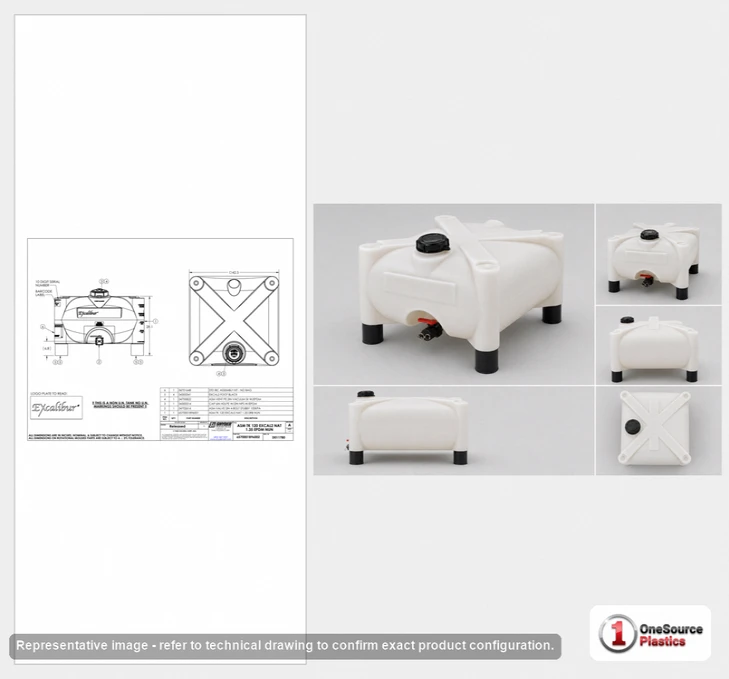
Technical drawing (PDF) for Snyder Industries 6630023B97203.
See this tank
Product video. Watch the Snyder Industries 220 Gallon HDPE Stackable IBC Tote Tank in Black video (67 seconds) with dimensions, fittings and shipping notes.
Ready to order?
Add it to your cart at the top of this page, get LTL freight to your ZIP, request a written quote, or call 866-418-1777. The listed price is before freight.